
Current RBI Policy Rates in India: Repo Rate, SDF, MSF, CRR & SLR Explained
Current RBI policy rates and reserve ratios in India, including repo rate, SDF, MSF, Bank Rate, reverse repo, CRR and SLR, with simple explanations and the latest MPC decision.
Quick Answer
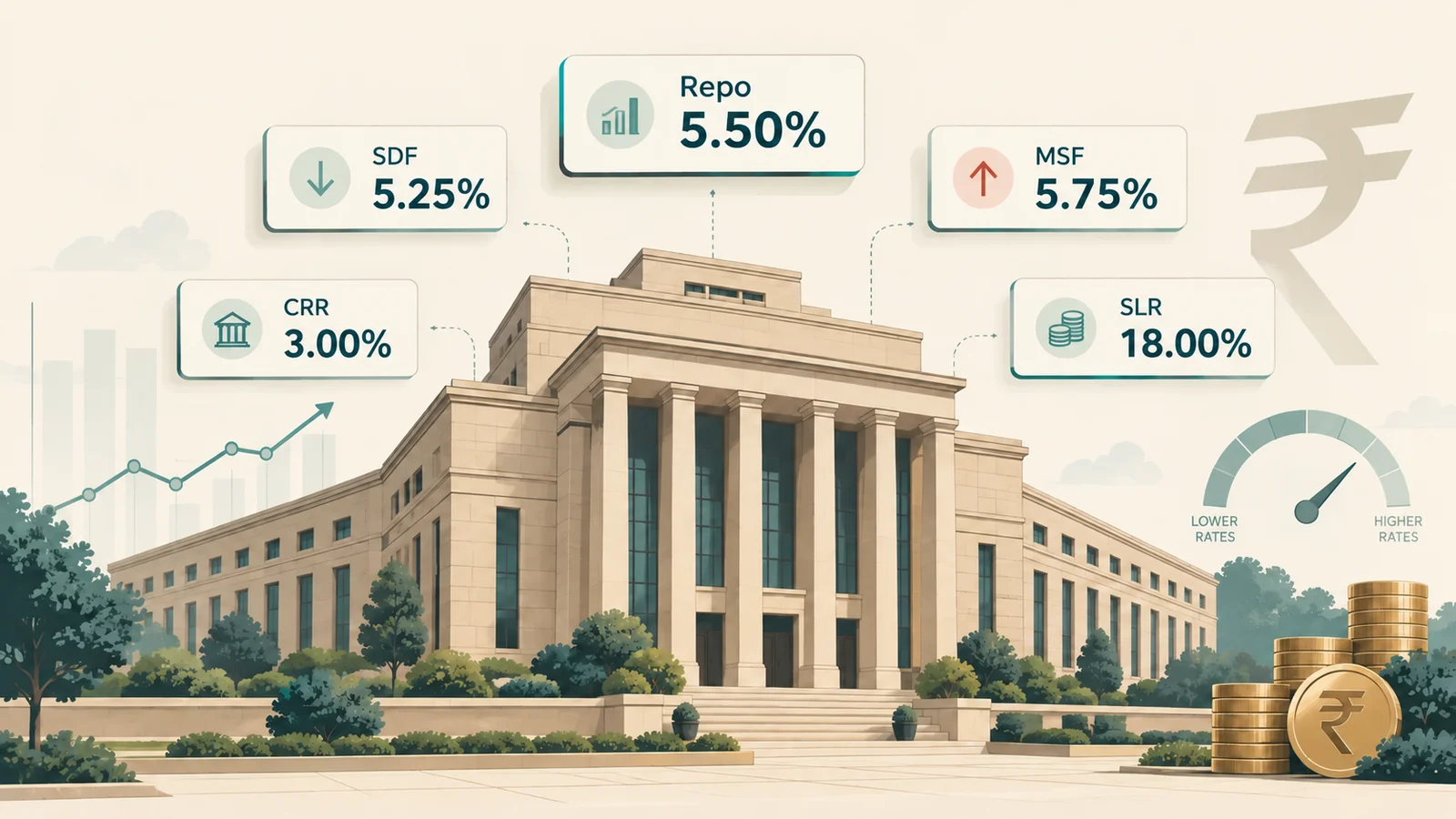
As of 8 October 2026, the RBI's key rates and reserve ratios are:
| Measure | Current level | What it does |
|---|---|---|
| Policy Repo Rate | 5.50% | Main policy rate; RBI lends liquidity against eligible collateral |
| Standing Deposit Facility (SDF) | 5.25% | Floor of the current LAF corridor; RBI absorbs overnight liquidity without collateral |
| Marginal Standing Facility (MSF) | 5.75% | Ceiling of the corridor; banks can borrow overnight in exceptional liquidity need |
| Bank Rate | 5.75% | Reference/penal rate linked to RBI's broader monetary framework |
| Fixed Reverse Repo Rate | 3.35% | Legacy/discretionary liquidity-absorption rate; no longer the corridor floor |
| Cash Reserve Ratio (CRR) | 3.00% | Share of applicable bank liabilities kept as cash reserves with RBI |
| Statutory Liquidity Ratio (SLR) | 18.00% | Share of applicable liabilities maintained in prescribed liquid assets |
CRR and SLR are reserve ratios, not interest rates.
The latest MPC decision, announced on 7 October 2026, raised the repo rate by 25 basis points to 5.50% and adopted calibrated tightening. The rate decision was unanimous; two members preferred retaining a neutral stance.
The next scheduled MPC meeting is 2–4 December 2026.
The Policy Corridor
RBI's current Liquidity Adjustment Facility corridor is:
SDF 5.25% → Repo 5.50% → MSF 5.75%
That means:
- SDF is 25 basis points below the repo rate
- MSF is 25 basis points above the repo rate
- the repo rate sits in the middle
The objective is to keep short-term money-market rates reasonably aligned with the policy repo rate.
1. Repo Rate — 5.50%
The repo rate is the most important RBI policy rate for most consumers and businesses.
It is the rate at which RBI provides liquidity under the Liquidity Adjustment Facility against eligible collateral.
Why it matters
A change in the repo rate can influence:
- floating-rate home loans
- personal and business lending rates
- bank MCLR/external-benchmark pricing
- fixed-deposit rates
- bond yields
- overall borrowing and spending conditions
Simple interpretation
Repo cut: generally makes monetary conditions easier.
Repo hike: generally makes monetary conditions tighter.
The effect is not instant or identical across every bank and loan.
2. Standing Deposit Facility — 5.25%
The Standing Deposit Facility (SDF) allows RBI to absorb overnight liquidity from eligible participants without providing collateral.
It is currently the floor of the LAF corridor.
RBI introduced the SDF in April 2022 and replaced the fixed reverse repo as the standing floor of the corridor.
Why it matters
If banks have excess short-term liquidity, the SDF gives them a standing facility for placing it with RBI.
3. Marginal Standing Facility — 5.75%
The MSF is the upper end of the policy corridor.
It gives scheduled commercial banks access to overnight RBI funds against eligible securities when they face short-term liquidity stress.
Why it matters
It acts as a safety valve for the banking system.
Because the MSF rate is above the repo rate, routine borrowing through normal liquidity channels is generally cheaper.
4. Bank Rate — 5.75%
The Bank Rate is currently 5.75%, the same as the MSF rate.
Under the RBI Act, it is the standard rate at which RBI is prepared to buy or rediscount eligible bills of exchange or commercial paper.
In modern practice it also serves as an important reference for certain penal and regulatory interest rates.
5. Fixed Reverse Repo Rate — 3.35%
RBI still lists the Fixed Reverse Repo Rate (FRRR) at 3.35%.
However, this number is often misunderstood.
Before 2022, the fixed reverse repo was the standing floor of the liquidity corridor. Since the introduction of the SDF, SDF—not the fixed reverse repo—is the current corridor floor.
RBI can still conduct fixed-rate reverse repo operations at its discretion for specified purposes.
So for understanding today's monetary-policy corridor, focus on:
SDF → Repo → MSF
not:
Reverse Repo → Repo → MSF
6. CRR — 3.00%
The Cash Reserve Ratio is the share of applicable bank liabilities that banks must maintain as cash reserves with RBI.
It is currently 3.00%.
If RBI raises CRR
Banks must keep more money with RBI, reducing the amount available for lending.
If RBI cuts CRR
More liquidity can remain available within the banking system.
CRR is therefore a liquidity tool, but it is not an interest rate.
7. SLR — 18.00%
The Statutory Liquidity Ratio is currently 18.00%.
Banks must maintain the prescribed share of their relevant liabilities in specified liquid assets.
SLR is another prudential/liquidity requirement rather than a policy interest rate.
Latest RBI MPC Decision
At its meeting held 5–7 October 2026, the Monetary Policy Committee:
- raised the repo rate by 25 basis points to 5.50%
- raised the SDF to 5.25%
- raised MSF and Bank Rate to 5.75%
- adopted calibrated tightening, with two members preferring a neutral stance
- voted unanimously for the repo-rate decision
RBI's current-rate page was checked on 8 October 2026.
What Does “Calibrated Tightening” Stance Mean?
Calibrated tightening signals that near-term rate cuts are not envisaged; the next decision may be a hike or a pause, depending on conditions.
The MPC continues to assess incoming data on:
- inflation
- economic growth
- food and fuel prices
- global commodity prices
- financial conditions
- external risks
The stance does not guarantee a rate increase at every meeting.
How RBI Policy Rates Affect You
Home and floating-rate borrowers
A repo-rate change can eventually affect loans linked to external benchmarks or bank lending benchmarks.
But your actual loan rate also includes the bank's spread and loan-specific terms.
Fixed-deposit customers
Repo cuts can create downward pressure on new FD rates, while tighter policy can support higher deposit rates.
Banks still set deposit rates based on their own funding and liquidity needs.
Savings-account customers
Savings rates can move much less than repo rates and are independently set by banks within RBI rules.
Markets
Repo expectations influence:
- government bond yields
- money-market rates
- bank funding costs
- equity-sector expectations
- currency-market sentiment
RBI's Inflation Objective
India's monetary-policy framework targets CPI inflation of 4%, with a tolerance band of ±2 percentage points.
The MPC determines the policy repo rate required to achieve the inflation objective while keeping growth considerations in view.
Next RBI MPC Meeting
The RBI's published 2026–27 MPC calendar schedules the next meeting for:
2, 3 and 4 December 2026
The subsequent scheduled meetings are:
- 3–5 February 2027
These figures should be reviewed again after the December decision, or sooner if RBI announces a change.
How to Read Future RBI Decisions
When an MPC decision is announced, check these five things:
- Repo rate: changed or unchanged?
- Policy stance: neutral, accommodative, withdrawal-oriented, or other wording?
- Vote: unanimous or split?
- Inflation outlook: raised or lowered?
- Growth outlook: raised or lowered?
The repo rate is the headline, but the stance and outlook often matter just as much for what may happen next.
Primary Sources
- RBI current rates, checked 8 October 2026: https://www.rbi.org.in/
- RBI monetary-policy operating framework and instruments: https://systemhealth.rbi.org.in/Scripts/FS_Overview2752.aspx.html
- RBI — introduction of Standing Deposit Facility: https://systemhealth.rbi.org.in/Scripts/BS_PressReleaseDisplay.aspx_prid%3D53536.html
- RBI monetary-policy glossary / liquidity framework: https://rbi.org.in/scripts/PublicationsView.aspx?Id=18086
- RBI October 2026 MPC decision, 7 October 2026
- RBI 2026–27 MPC meeting schedule, Press Release 2025-2026/2306, dated 23 March 2026