
Car Accessories That Are Actually Useful in India
Car Accessories That Are Actually Useful in India. Most cars do not need dozens of accessories. The useful ones fall into four groups:
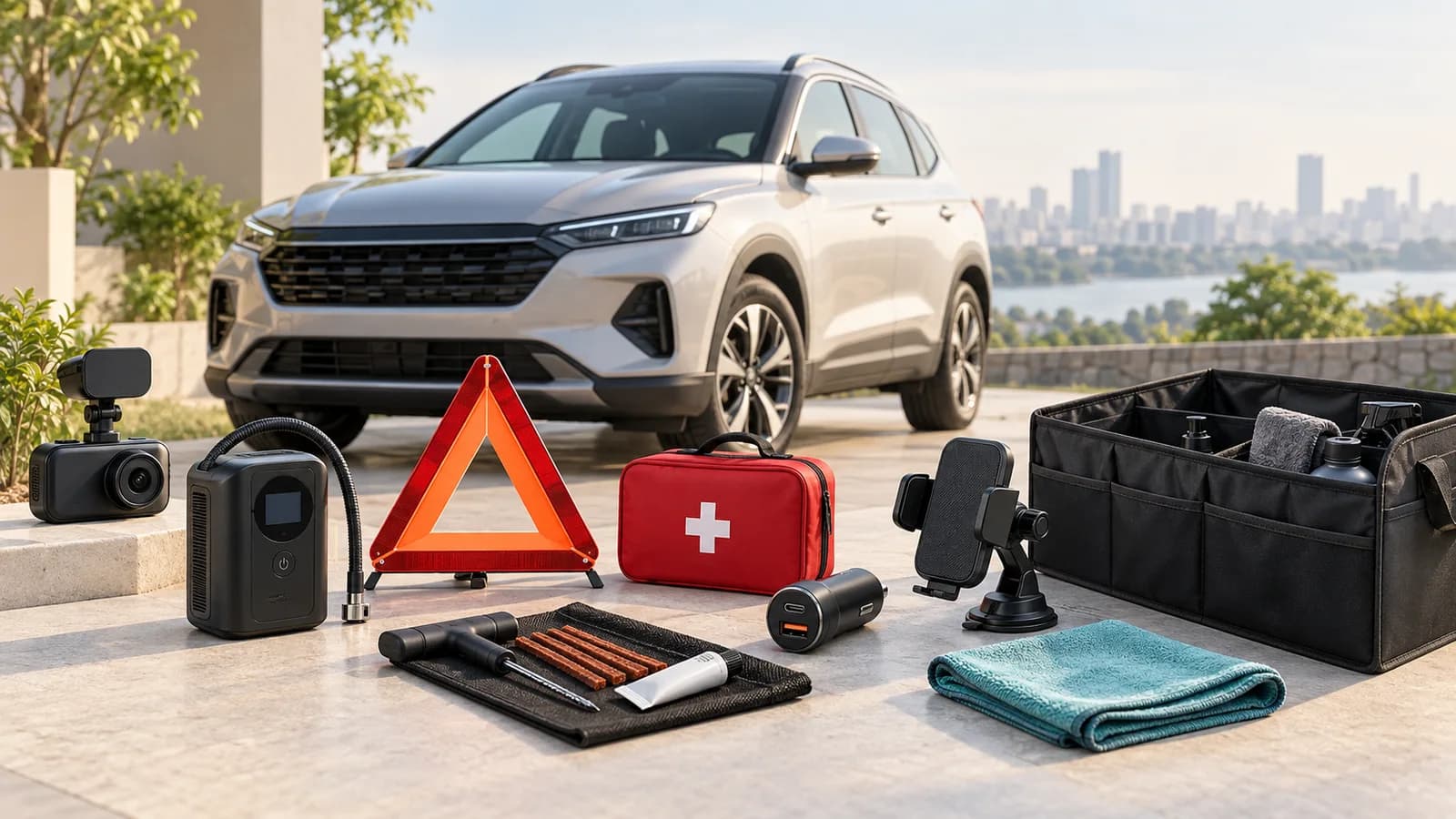
Quick Answer
Most cars do not need dozens of accessories. The useful ones fall into four groups:
- Safety and emergencies
- Tyre care
- Navigation and charging
- Keeping the cabin usable
For most owners, the best starting set is:
- dashcam
- tyre inflator with pressure gauge
- warning triangle
- first-aid kit
- fast USB-C car charger
- secure phone mount
- puncture-repair kit for tubeless tyres
- boot organiser
- microfibre cloth and glass cleaner
Buy accessories that solve a real problem. Skip anything that obstructs visibility, interferes with airbags, encourages phone use while driving, or adds purely cosmetic clutter.
1. Dashcam
Priority: Highly recommended
Best for: accident evidence, insurance disputes, parking incidents and documenting unusual road events.
A dashcam is one of the few accessories that can become genuinely valuable after a collision or dispute.
Look for:
- at least 2K front recording
- reliable low-light performance
- G-sensor/event recording
- supercapacitor rather than a conventional internal battery where possible
- loop recording
- app access or easy file retrieval
- high-endurance microSD support
- optional rear camera if your budget allows
Current example: Qubo Dashcam Car Pro 2K
Qubo currently lists the Dashcam Car Pro 2K at about ₹4,290. It records at 2K, includes a collision-detection G-sensor and uses a built-in supercapacitor.
A front-and-rear 2K + 1080p version is listed around ₹6,490.
Buy front-only if: you mainly want basic incident evidence.
Buy front + rear if: you frequently drive in dense traffic or park on public roads.
2. Tyre Inflator With Pressure Gauge
Priority: Must-have for frequent highway travel
Best for: topping up a slowly leaking tyre, correcting pressure before a trip and avoiding unnecessary roadside stops.
Correct tyre pressure matters for safety, tyre life and fuel efficiency. Bridgestone India recommends checking car tyre pressure about once every two weeks and before long trips, using the vehicle manufacturer's recommended cold-tyre pressure.
A portable inflator is most useful for top-ups, not as a substitute for repairing a puncture or damaged tyre.
Current example: Portronics Vayu Swift
Portronics currently lists the Vayu Swift at about ₹1,599. It is a 12V corded inflator rated up to 150 PSI with a 3-metre power cord and LED light.
A battery-powered alternative such as Xiaomi's Portable Electric Air Compressor 1S is more convenient away from a 12V socket, but availability can vary.
View Portronics car accessories
3. Warning Triangle
Priority: Essential
Best for: breakdowns and roadside emergencies.
Before buying one, check your car's boot: many cars already include a warning triangle with the factory toolkit.
India's Central Motor Vehicles Rules require four-wheelers to carry a prescribed reflective warning triangle, and the Motor Vehicles (Driving) Regulations state that on highways and major roads a reflective warning triangle should be placed 50 metres behind a broken-down vehicle.
Do not buy a decorative or tiny unreflective triangle. Use the original equipment supplied with the car or one conforming to applicable automotive standards.
Read MoRTH driving regulations
4. First-Aid Kit
Priority: Recommended
Best for: minor cuts, burns and basic assistance until professional help arrives.
A compact kit can contain:
- sterile gauze
- adhesive bandages
- antiseptic wipes
- medical tape
- disposable gloves
- small scissors
- basic burn dressing
Check expiry dates at least once a year.
A car first-aid kit should support basic first response; it is not a substitute for medical treatment.
5. Fast USB-C Car Charger
Priority: Highly useful if the car lacks adequate USB-C charging
Best for: navigation-heavy drives and charging multiple phones.
Modern phones can discharge surprisingly quickly when running navigation, mobile data, Bluetooth and a bright display.
Choose a charger with:
- USB-C Power Delivery
- enough wattage for your phone
- a reputable brand
- over-current/over-voltage protection
- a snug fit in the 12V socket
Current example: Portronics Car Power 6
Portronics currently lists the Car Power 6 at about ₹525. It provides a 33W USB-C PD port plus an 18W USB-A port, for up to 51W combined output.
Skip it if: your car already provides fast USB-C charging at the wattage your phone needs.
6. Secure Phone Mount
Priority: Useful for navigation
Best for: keeping navigation visible without holding the phone.
A good mount should:
- remain stable on rough roads
- hold the phone securely
- allow one-handed mounting/removal
- avoid blocking the windscreen, airbag zone or important controls
- position the display where it requires minimal eye movement
Current example: Portronics Clamp M4 Prime
The Clamp M4 Prime is currently listed around ₹449. It uses a suction mount, supports 360-degree rotation and is designed for dashboard/windscreen installation.
Important: a mount does not make interacting with a phone while driving safe or legal. India's driving regulations prohibit use of a hand-held mobile phone or communication device while driving. Set your route before moving and use voice guidance where practical.
View Portronics Clamp M4 Prime
7. Tubeless-Tyre Puncture Repair Kit
Priority: Situational but useful
Best for: remote travel and temporary roadside repair of simple tread punctures.
A basic plug kit can help with a small puncture in the tread area when used correctly.
It is not appropriate for:
- sidewall damage
- large cuts
- bent wheels
- damaged tyre beads
- tyres that have been driven flat for too long
Treat an external plug as an emergency measure and have the tyre inspected professionally.
Pair the kit with a tyre inflator.
8. Boot Organiser
Priority: Useful
Best for: keeping emergency equipment, cleaning supplies and charging cables from rolling around the boot.
A simple collapsible organiser is more useful than many decorative accessories because it keeps:
- inflator
- first-aid kit
- cleaning cloths
- spare cables
- puncture kit
- small tools
easy to find during an emergency.
Choose one with a non-slip or hook-and-loop base and dividers.
9. Microfibre Cloth + Automotive Glass Cleaner
Priority: Useful and inexpensive
Best for: clear windscreen and mirrors.
Keep at least one clean microfibre cloth specifically for the inside of the windscreen.
Fingerprints, dashboard haze and dust can create glare at night or in low-angle sunlight.
Avoid household cleaners containing ingredients that may damage tint, coatings or interior materials. Use an automotive-safe product.
10. Windshield Sunshade — When Parked
Priority: Situational
Best for: cars regularly parked outdoors.
A reflective or insulated windshield sunshade can reduce direct solar load on the dashboard and steering wheel while the car is parked.
Use it only when parked and remove it completely before driving.
Useful Only for Some Drivers
Portable jump starter
Worth considering if:
- your car has an ageing 12V battery
- you travel to remote areas
- you frequently leave a car parked for long periods
Buy the correct specification for your vehicle and follow the manufacturer's polarity and connection instructions carefully.
Portable vacuum
Useful if you regularly carry children, pets or food. Otherwise, occasional professional cleaning may be more economical than carrying another device.
TPMS retrofit
Useful on older cars that do not already have tyre-pressure monitoring. If your vehicle already has factory TPMS, an aftermarket unit usually adds little value.
Accessories I Would Usually Skip
Seat-belt alarm stopper clips
Do not use them. They defeat a safety reminder.
Oversized dashboard ornaments
They can obstruct visibility and can become dangerous projectiles in a crash.
Steering-wheel covers with a loose fit
A cover that moves independently of the steering wheel can compromise control.
Decorative pedal covers
Avoid poorly fitted add-ons that may interfere with pedal operation.
Fake exhaust tips, unnecessary ambient-light kits and cosmetic chrome packs
Buy them only if you genuinely like the appearance. They provide little practical value.
Very dark aftermarket window film
Do not assume a product sold online is road-legal. Check current Indian rules before altering glazing or visibility.
A Sensible Starter Kit
If you have just bought a car, start with:
- Confirm that the factory spare/repair system, jack, tools and warning triangle are present.
- Add a first-aid kit.
- Add a tyre inflator.
- Add a dashcam.
- Add a USB-C charger only if the car's built-in ports are inadequate.
- Add a phone mount if you use phone navigation.
- Add a boot organiser to store the above.
Everything else can wait until you discover a real need.
How These Picks Were Chosen
This guide prioritises:
- safety
- roadside usefulness
- everyday convenience
- compatibility with modern phones
- low clutter
- value for money
Current product examples are included only to illustrate what useful specifications look like. They are not the only products worth buying.
No hands-on testing is claimed.
Primary Sources
- Ministry of Road Transport & Highways — Central Motor Vehicles Rules, Chapter VI: https://morth.nic.in/sites/default/files/CMVR-chapter6.pdf
- Ministry of Road Transport & Highways — Motor Vehicles (Driving) Regulations 2017: https://morth.nic.in/sites/default/files/Motor-Vehicle-Driving-Regulation-2017.pdf
- Bridgestone India — tyre-pressure guidance: https://www.bridgestone.co.in/stories/tyre-care-and-maintenance/how-often-should-i-check-my-car-tyre-pressure
- Michelin India — tyre-pressure guidance: https://www.michelin.in/auto/advice/tyre-pressure/what-tyre-pressure
- Qubo India — Dashcam Car Pro 2K: https://www.quboworld.com/products/dashcam-pro-2k
- Qubo India — Dashcam Pro 2K Front + Rear: https://www.quboworld.com/products/dashcam-pro-2k-front-rear
- Portronics — car accessories: https://www.portronics.com/collections/car-accessories
- Portronics — Car Power 6: https://www.portronics.com/products/car-power-6
- Portronics — Clamp M4 Prime: https://www.portronics.com/products/clamp-m4-prime
- Xiaomi India — Portable Electric Air Compressor 1S: https://www.mi.com/in/product/air-compressor-1s/