
Best Cricket Equipment for Children by Age Group
A practical parent’s guide to choosing the right cricket equipment for children by age and size, including bat sizes, pads, gloves, helmets, shoes and realistic starter budgets.
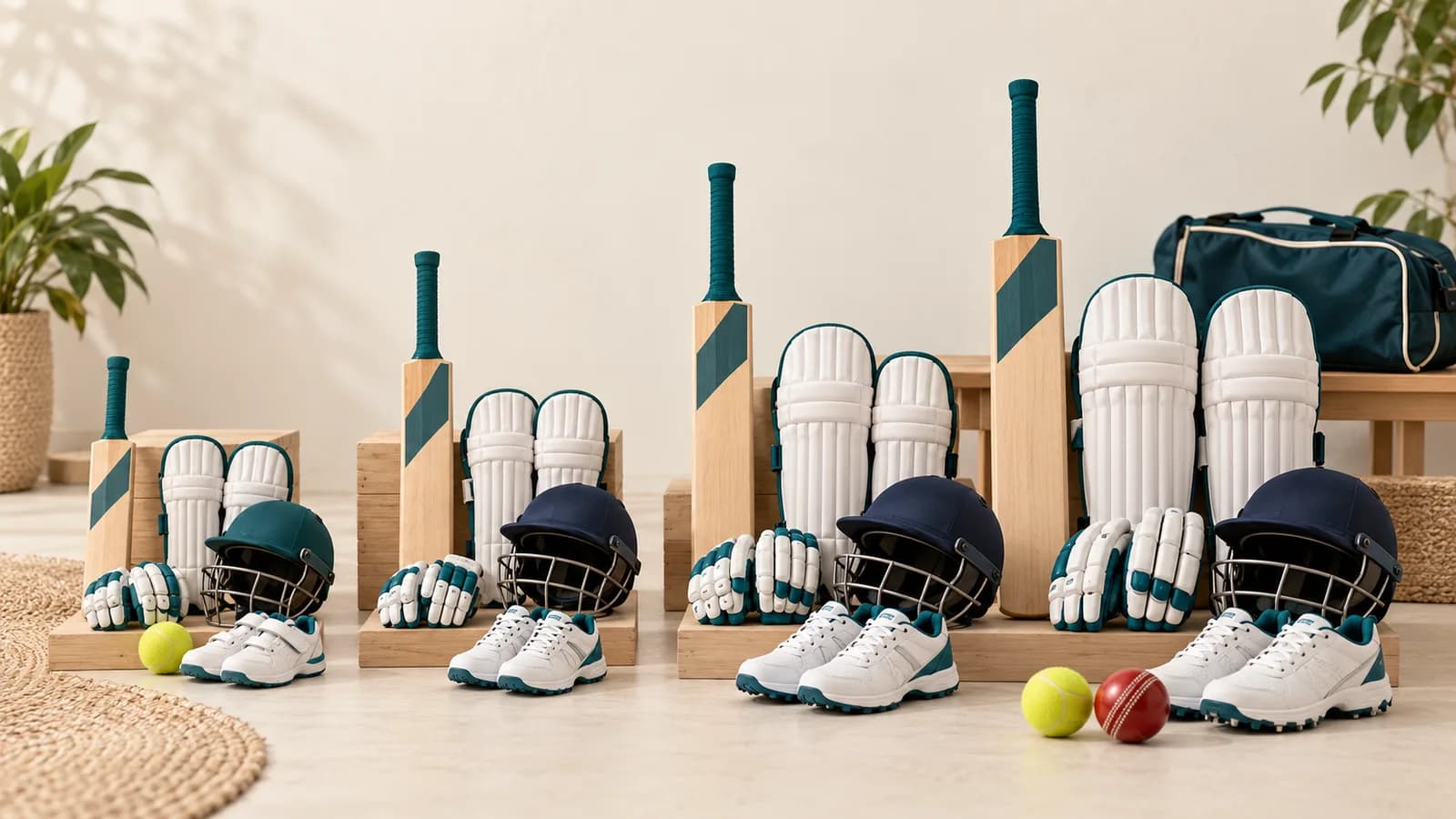
Quick Answer
The best cricket equipment for children depends more on height, ball type and training level than on age alone.
The most common mistake parents make is buying gear “to grow into.” Oversized bats, pads and gloves usually make children less comfortable and can slow skill development.
As a practical starting point:
| Age group | Typical bat size | Best equipment approach |
|---|---|---|
| 4–6 years | Size 1–2 | Soft-ball starter kit; keep it light and fun |
| 7–9 years | Size 2–3 | Junior beginner kit; soft ball or entry-level hard-ball practice |
| 10–12 years | Size 4–5 | Proper junior kit with helmet, pads and gloves |
| 13–15 years | Size 6 / Harrow | More serious junior match kit, better protection |
| 15+ years | Harrow / Short Handle | Youth-to-adult transition kit based on height |
Bat size should be chosen mainly by height. Gray-Nicolls’ junior guide maps up to 4'2" to Size 1, 4'2"–4'5" to Size 2, 4'5"–4'8" to Size 3, 4'8"–4'11" to Size 4, 4'11"–5'1" to Size 5, 5'1"–5'4" to Size 6, 5'4"–5'7" to Harrow, and 5'7"+ to full size. Pads should be measured from the top of the instep to the middle of the kneecap, and gloves from the base of the palm to the tip of the middle finger.
Best Cricket Equipment by Age Group
1) Age 4–6 Years — Best First Cricket Kit
Typical bat size: Size 1 or Size 2
Best for: backyard cricket, school introduction, basic coaching with soft balls.
At this age, equipment should focus on confidence, control and safety, not on copying a full adult kit.
Recommended equipment
- lightweight junior bat
- soft tennis ball or soft training ball
- a few plastic or lightweight stumps
- basic sports shoes
- optional small duffle bag
- helmet only if the child is facing harder balls or formal coaching requires it
What to prioritise
- very light pickup
- short practice sessions
- fun over premium materials
- simple, comfortable clothing
Best buying approach
A soft-ball starter set is usually the best value at this stage.
Practical starter budget in India
₹1,500–₹4,000
Avoid
- heavy bats
- adult gloves or pads
- expensive English willow bats
- hard-ball gear unless the child is already in structured coaching
2) Age 7–9 Years — Best Beginner Junior Kit
Typical bat size: Size 2 or Size 3
Best for: school cricket, beginner academy sessions, transition from play to practice.
This is the age where many children start more regular coaching. Equipment can still be simple, but sizing becomes more important.
Recommended equipment
- junior cricket bat (usually Kashmir willow is enough)
- junior batting gloves
- junior batting pads
- junior helmet if facing a hard ball
- abdominal guard
- practice balls (soft or training balls, depending on academy)
- rubber-soled cricket shoes or training shoes
Best buying approach
If the child is still playing soft-ball cricket, avoid a full premium hard-ball kit.
If the child has started leather-ball cricket, helmet, pads and gloves become essential.
Practical starter budget in India
- Soft-ball / light practice setup: ₹2,500–₹5,000
- Basic hard-ball junior setup: ₹5,000–₹10,000
Parent note
At this age, fit matters more than brand. The child should be able to lift the bat comfortably with one hand and play straight without struggling.
3) Age 10–12 Years — Best Proper Junior Cricket Kit
Typical bat size: Size 4 or Size 5
Best for: regular coaching, inter-school cricket, beginner match play.
This is the stage where many children need a proper cricket kit, especially if they are playing with a hard ball.
Recommended equipment
- size 4 or size 5 junior bat
- junior batting pads
- junior batting gloves
- helmet with proper face protection
- abdominal guard
- thigh guard for hard-ball net sessions or matches
- cricket shoes appropriate to the surface
- kit bag
Best buying approach
Most children at this stage do not need an expensive English willow bat. A good Kashmir willow or entry English willow bat is usually enough.
Practical starter budget in India
- Entry match kit: ₹8,000–₹15,000
- Better all-round kit: ₹15,000–₹25,000
Key advice
- Do not oversize the pads “for next year.”
- The helmet should sit securely and not wobble.
- The child should be able to close the gloves comfortably around the handle.
4) Age 13–15 Years — Best Serious Junior Match Kit
Typical bat size: Size 6 or Harrow
Best for: academy cricket, regular leather-ball use, school/club matches.
At this stage, players often develop clearer preferences: lighter pickup, more protection, or specific shoe needs.
Recommended equipment
- size 6 or Harrow bat
- better-quality junior or youth pads
- better-quality batting gloves
- properly fitted helmet
- abdominal guard
- thigh guard
- arm guard or chest guard if required
- spiked or hybrid cricket shoes for turf cricket
- large kit bag
Best buying approach
This is a reasonable stage to consider a good English willow bat if the child plays frequently and has the technique to benefit from it. But the bat should still suit the player’s size and strength.
Practical starter budget in India
- Solid junior match kit: ₹15,000–₹30,000
- More serious competitive kit: ₹30,000–₹50,000+
Key advice
Serious players often need better shoes and a better helmet before they need a premium bat.
5) Age 15+ — Best Youth Transition Kit
Typical bat size: Harrow or Short Handle
Best for: older teenagers moving into senior school, club or academy cricket.
At this stage, some players stay on Harrow, while others move into Short Handle full-size bats, depending mainly on height, strength and control.
Recommended equipment
- Harrow or SH bat depending on height and pickup
- youth or adult-size gloves
- youth or adult-size pads
- properly fitted senior helmet
- abdominal guard
- thigh/arm/chest protection as needed
- cricket spikes or good turf shoes
- large kit bag
Best buying approach
Buy based on the actual player, not just age. A shorter, slimmer teenager may still be better served by Harrow or smaller protection sizes.
Practical starter budget in India
- Good youth match kit: ₹20,000–₹40,000
- Advanced competitive kit: ₹40,000+
What Children Actually Need
Essential for soft-ball beginners
- bat
- ball
- stumps
- comfortable shoes
Essential for hard-ball beginners
- bat
- helmet
- gloves
- pads
- abdominal guard
- appropriate shoes
Often useful later, not necessarily on day one
- thigh guard
- arm guard
- chest guard
- specialist wicketkeeping gear
- expensive spikes
- premium English willow bat
How to Choose the Right Bat Size
The best junior bat is usually chosen by height, not just age.
A simple guide based on the Gray-Nicolls junior size chart:
| Bat size | Approx. height | Typical age guide |
|---|---|---|
| Size 1 | Up to 4'2" | 4–5 years |
| Size 2 | 4'2"–4'5" | 6–7 years |
| Size 3 | 4'5"–4'8" | 8–9 years |
| Size 4 | 4'8"–4'11" | 9–10 years |
| Size 5 | 4'11"–5'1" | 10–11 years |
| Size 6 | 5'1"–5'4" | 11–13 years |
| Harrow | 5'4"–5'7" | 12–14 years |
| SH | 5'7"+ | 15+ years |
How to Measure Gloves and Pads
Gray-Nicolls advises:
- Gloves: measure from the base of the palm to the tip of the middle finger.
- Pads: measure from the top of the instep (where the shoe tongue sits) to the middle of the kneecap.
These measurements matter more than the label alone.
Hard-Ball Safety Advice for Parents
If your child is facing a hard cricket ball, a helmet is not optional. Gloves, pads and an abdominal guard should also be treated as core equipment.
Do not compromise on:
- helmet fit
- face protection
- comfort and movement
- proper shoe grip
A cheaper bat is acceptable. Poor protection is not.
Shoes: What to Buy
For very young children or soft-ball cricket
Normal sports shoes are usually enough.
For junior hard-ball cricket on matting or hard practice surfaces
Rubber-soled cricket shoes or training shoes are usually fine.
For older children playing on turf
Consider cricket spikes or hybrid cricket shoes, especially from the 13–15 age group onward.
Wicketkeeping Equipment by Age
Children who keep wicket will eventually need:
- wicketkeeping gloves
- wicketkeeping pads
- inners
- often a separate keeping bag setup
But for beginners, only buy specialist wicketkeeping gear if the child is actually keeping regularly.
Common Buying Mistakes
- Buying a bat that is too heavy
- Buying pads and gloves “for future growth”
- Spending too much on the bat and too little on the helmet
- Buying hard-ball kit for a child who only plays soft-ball cricket
- Ignoring comfort and movement
- Buying full wicketkeeping gear too early
- Assuming age matters more than height and fit
Which Kit Should Most Parents Buy?
Best for most children aged 4–6
A soft-ball starter set
Best for most children aged 7–9
A basic junior kit, and add a helmet/pads/gloves only if hard-ball coaching begins
Best for most children aged 10–12
A proper junior hard-ball kit with helmet, pads, gloves and abdominal guard
Best for most children aged 13–15
A serious junior match kit with better protection and better shoes
Best for older teenagers
A fit-based youth transition kit, not automatically full adult gear
How These Recommendations Were Built
This guide is based on official junior sizing advice from Gray-Nicolls and practical buying principles used by coaches, parents and equipment retailers: buy according to the child’s height, playing level and ball type rather than assuming that the most expensive gear is best.
No claim is made that every product category suits every academy’s rules. Always confirm specific gear rules with the coach or school.
Primary Sources
- Gray-Nicolls junior bat size guide: https://help.gray-nicolls.co.uk/hc/en-gb/articles/360012725079--What-size-bat-do-I-need-Junior
- Gray-Nicolls size guides: https://www.gray-nicolls.co.uk/pages/size-guides