
Best AI and Machine Learning Courses for Beginners and Developers
Best AI and Machine Learning Courses for Beginners and Developers. The right AI or machine-learning course depends on how technical you want to get.
Quick Answer
The right AI or machine-learning course depends on how technical you want to get.
- Best non-technical AI introduction: AI For Everyone
- Best beginner machine-learning course: Machine Learning Specialization
- Best free compact ML course: Google Machine Learning Crash Course
- Best free broader AI course with Python projects: CS50's Introduction to Artificial Intelligence with Python
- Best structured deep-learning specialization: Deep Learning Specialization
- Best free project-first deep-learning course: fast.ai Practical Deep Learning for Coders
- Best career-oriented AI engineering certificate: IBM AI Engineering Professional Certificate
If you are new to coding, start with AI For Everyone for concepts or learn basic Python before moving into technical ML. If you already know Python, Andrew Ng's Machine Learning Specialization is the most balanced starting point.
Quick Picks
AI For Everyone — best non-technical AI introduction
Best for: Students, managers and beginners who want to understand what AI and machine learning can and cannot do before learning to build models.
Andrew Ng's current Coursera course is a 4-module, roughly 7-hour introduction with no prior experience required. It covers AI terminology, machine learning, deep learning, project workflows, organisational use cases and responsible AI.
Why choose it
- No coding required
- Fast overview of the AI landscape
- Good preparation before a technical course
- Covers practical limits and responsible use
Trade-off It will not teach you to train or deploy machine-learning models.
Official link: https://www.coursera.org/learn/ai-for-everyone
Machine Learning Specialization — best beginner machine-learning course
Best for: Beginners who want a structured path from core ML concepts to practical model building.
The DeepLearning.AI / Stanford Online Machine Learning Specialization is a 3-course series taught by Andrew Ng and collaborators. Coursera currently lists it as beginner level at around 2 months at 10 hours per week.
It covers:
- linear and logistic regression
- classification
- neural networks
- decision trees and ensembles
- clustering
- anomaly detection
- recommender systems
- reinforcement learning
- model evaluation and ML best practices
Hands-on work uses tools including NumPy, scikit-learn and TensorFlow.
Why choose it
- Strong conceptual foundation
- Beginner-friendly progression
- Mix of theory and implementation
- Covers supervised and unsupervised learning
- Good bridge into deep learning
Trade-off It is broader than deep. You will still need projects and more specialised courses for production ML or advanced neural networks.
Official link: https://www.coursera.org/specializations/machine-learning-introduction
Google Machine Learning Crash Course — best free compact ML course
Best for: Learners who want a concise, practical, self-paced introduction from Google.
Google's Machine Learning Crash Course uses animated videos, interactive visualisations and hands-on exercises. The refreshed curriculum currently includes:
- linear regression
- logistic regression
- classification
- numerical and categorical data
- generalisation and overfitting
- neural networks
- embeddings
- large language models
- production ML systems
- AutoML
- ML fairness
Why choose it
- Free
- Compact and modular
- Strong interactive explanations
- Includes modern topics such as LLMs and production ML
- Easy to revisit topic-by-topic
Trade-off It is a crash course, not a complete career curriculum or portfolio program.
Official link: https://developers.google.com/machine-learning/crash-course
CS50's Introduction to Artificial Intelligence with Python — best free broader AI course
Best for: Python programmers who want to study AI beyond only supervised machine learning.
Harvard's CS50 AI is free through OpenCourseWare and contains seven weeks covering:
- search
- knowledge representation
- uncertainty
- optimisation
- machine learning
- neural networks
- language and large language models
Projects include logic, probability, reinforcement learning, classification and language tasks.
Prerequisite: CS50x or roughly one year of Python experience.
Why choose it
- Free OpenCourseWare
- Broader AI foundations than most ML-only courses
- Strong hands-on projects
- Covers classical AI as well as modern ML
- Free CS50 certificate available after meeting project-score requirements
Trade-off It is not aimed at programming beginners.
Official link: https://cs50.harvard.edu/ai/
Deep Learning Specialization — best structured deep-learning pathway
Best for: Learners who already understand basic machine learning and want a systematic deep-learning curriculum.
DeepLearning.AI's current 5-course specialization is listed as intermediate and takes roughly 3 months at 10 hours per week.
It covers:
- deep neural networks
- optimisation
- ML strategy
- convolutional neural networks
- sequence models
- TensorFlow-based implementation
- computer vision and NLP applications
Why choose it
- Strong deep-learning foundations
- Clear mathematical and architectural progression
- Widely used stepping stone after introductory ML
- Covers CNNs and sequence models
Trade-off It is better after you already understand Python and basic ML.
Official link: https://www.coursera.org/specializations/deep-learning
fast.ai Practical Deep Learning for Coders — best free project-first deep-learning course
Best for: Programmers who prefer to build useful models first and learn theory in context.
fast.ai's free Practical Deep Learning course takes a top-down approach. Part 1 contains 9 lessons of roughly 90 minutes each and covers areas such as:
- computer vision
- NLP
- tabular models
- collaborative filtering
- random forests
- deployment
- PyTorch
- fastai
- Hugging Face
The course says you do not need university-level mathematics, but you should already know how to code, preferably in Python.
Why choose it
- Free
- Practical from the first lessons
- Strong project/deployment orientation
- Uses modern PyTorch tooling
- Teaches theory through working examples
Trade-off Its top-down style may feel less systematic if you prefer mathematical theory before implementation.
Official link: https://course.fast.ai/
IBM AI Engineering Professional Certificate — best career-oriented AI engineering certificate
Best for: Learners with some technical background who want a broad applied AI-engineering pathway.
IBM's current Coursera program is a 13-course, intermediate-level Professional Certificate, listed at about 4 months at 10 hours per week.
It covers:
- supervised and unsupervised ML
- scikit-learn
- Spark / PySpark
- TensorFlow
- Keras
- PyTorch
- computer vision
- NLP
- large language models
- prompt engineering
- vector databases
- RAG
- LangChain
- generative-AI application projects
Why choose it
- Broad engineering stack
- Multiple deep-learning frameworks
- Includes GenAI, LLM and RAG skills
- Hands-on labs and projects
- Shareable IBM certificate
Trade-off The breadth is substantial, so beginners should build Python and ML foundations first.
Official link: https://www.coursera.org/professional-certificates/ai-engineer
Which Course Should You Choose?
| Your goal | Start with |
|---|---|
| Understand AI without coding | AI For Everyone |
| Learn machine learning from the beginning | Machine Learning Specialization |
| Get a free compact ML refresher | Google ML Crash Course |
| Learn broader AI algorithms with Python | CS50 AI |
| Specialise in deep learning | Deep Learning Specialization |
| Build deep-learning projects quickly | fast.ai |
| Prepare for applied AI-engineering work | IBM AI Engineering |
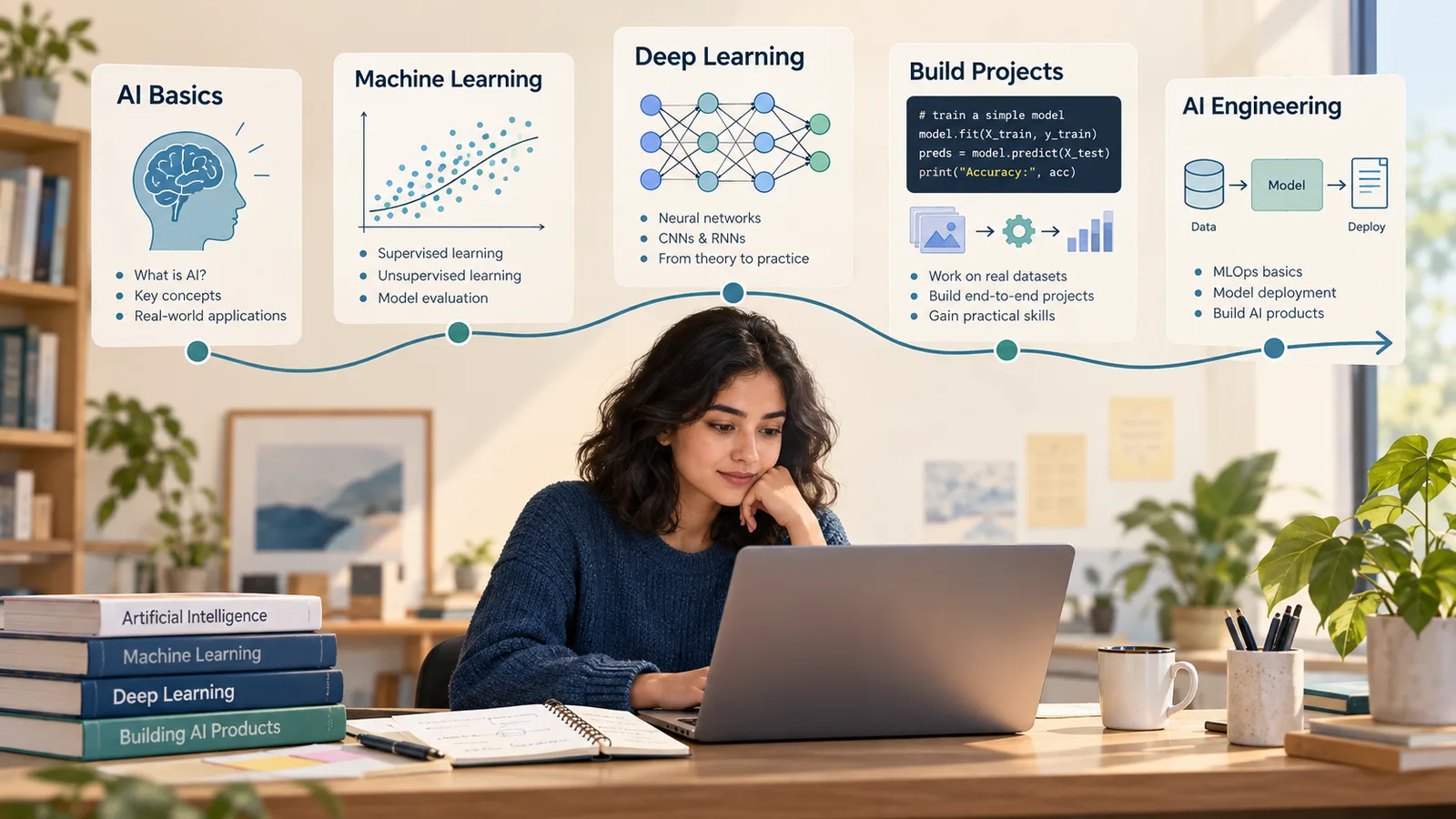
A Practical Learning Order
For a technical beginner:
- Learn Python basics first.
- Complete the Machine Learning Specialization or Google ML Crash Course.
- Build 2–3 small ML projects.
- Move to CS50 AI if you want broader AI foundations.
- Choose Deep Learning Specialization or fast.ai for neural networks.
- Use a career-oriented program such as IBM AI Engineering if you want deployment, PyTorch/TensorFlow, LLMs and RAG in one path.
Do not collect several overlapping certificates without building projects.
How These Picks Were Chosen
Selections are based on current official course information, curriculum depth, prerequisites, hands-on work, free-access options, provider credibility and usefulness for different AI/ML learning goals.
The list intentionally mixes free courses and paid certificate programs because the best learning resource is not always the most expensive one.
Primary Sources
- AI For Everyone: https://www.coursera.org/learn/ai-for-everyone
- Machine Learning Specialization: https://www.coursera.org/specializations/machine-learning-introduction
- Google Machine Learning Crash Course: https://developers.google.com/machine-learning/crash-course
- CS50 AI: https://cs50.harvard.edu/ai/
- CS50 AI certificate: https://cs50.harvard.edu/ai/certificate/
- Deep Learning Specialization: https://www.coursera.org/specializations/deep-learning
- fast.ai Practical Deep Learning: https://course.fast.ai/
- IBM AI Engineering Professional Certificate: https://www.coursera.org/professional-certificates/ai-engineer
At a glance
AI For Everyone
Best for: Understanding AI concepts, capabilities, project workflows and responsible use without coding
- No coding required
- Short and accessible
- Explains realistic AI capabilities and limits
- Useful preparation before technical study
- Does not teach model implementation
Machine Learning Specialization
Best for: Building a strong foundation in practical machine learning
- Strong fundamentals
- Beginner-friendly
- Hands-on implementation
- Covers supervised and unsupervised ML
- Good path into deep learning
- Additional projects are needed for job readiness
Machine Learning Crash Course
Best for: A free, concise and interactive introduction or ML refresher
- Free
- Interactive visualizations
- Hands-on exercises
- Modern LLM and production topics
- Modular structure
- Not a full career or portfolio program
CS50's Introduction to Artificial Intelligence with Python
Best for: Python programmers who want broader AI algorithms and hands-on projects
- Free OpenCourseWare
- Strong project work
- Broader AI coverage than ML-only courses
- Classical and modern AI topics
- Free completion certificate option
- Not suitable for programming beginners
Deep Learning Specialization
Best for: Structured progression into modern neural networks and deep learning
- Structured deep-learning curriculum
- Strong fundamentals
- CNN and sequence-model coverage
- Good follow-on from introductory ML
- Better suited after basic ML and Python
Practical Deep Learning for Coders
Best for: Programmers who want project-first deep learning with modern tooling
- Free
- Project-first approach
- Practical deployment
- Modern PyTorch ecosystem
- Theory taught through examples
- Top-down approach may feel less systematic for theory-first learners
IBM AI Engineering Professional Certificate
Best for: Career-oriented learners seeking a broad applied AI engineering stack
- Broad engineering stack
- Hands-on labs and projects
- Multiple ML/deep-learning frameworks
- Includes LLMs and RAG
- Shareable IBM credential
- Too broad for learners without Python and ML foundations