
ATM Withdrawal Failed but Account Debited? How to Trace and Recover Your Money
Trace a failed ATM cash withdrawal in India, collect transaction evidence, claim delayed reversal compensation and escalate unresolved complaints under RBI rules.
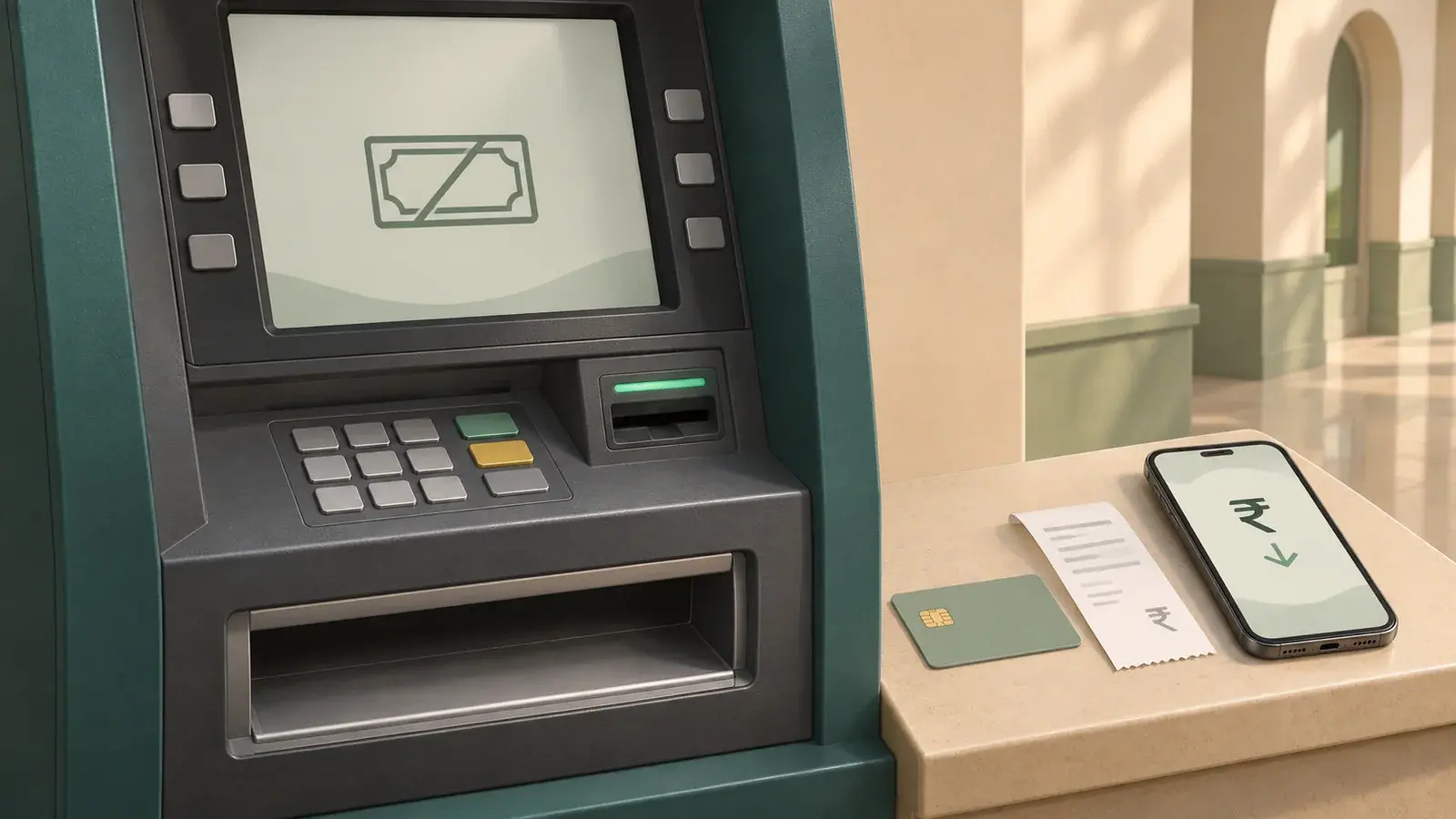
Quick Answer
If an ATM debits your bank account but dispenses no cash, report the failed withdrawal to your card-issuing bank immediately. For qualifying domestic ATM failures, RBI requires the money to be returned within five calendar days after the transaction date (T+5). A delay beyond that limit attracts ₹100 per day in compensation, payable automatically.
You do not need to wait five days before complaining, even when the ATM belongs to another bank or a white-label operator.
1. Record the details before leaving the ATM
Make sure the transaction session has ended, retrieve your card and check your account through your bank's official app or SMS alert. Avoid repeating the withdrawal until you understand the first debit.
Save the following details:
| Evidence | What to record |
|---|---|
| Transaction | Date, approximate time and amount debited |
| ATM | Terminal ID, operator name and exact location |
| Reference | Transaction number or retrieval reference number (RRN), if available |
| Proof | ATM receipt, debit SMS and relevant account statement entry |
| Cash outcome | No cash received, or the exact amount received if only partially dispensed |
A missing receipt does not prevent you from raising a complaint. Ask your bank to identify the transaction using the account, amount and time.
Use verified support numbers from your bank's app or website. Never share your PIN, OTP or CVV, or approve a payment request to receive a refund.
2. Register a failed ATM transaction complaint
Contact the bank that issued your debit card through its official app, customer-care number, complaint portal or branch. For another bank's ATM, your own bank can coordinate the investigation with the ATM operator through the relevant network.
Request a written acknowledgement or service-request number. Select the complaint category for cash not dispensed rather than unauthorised withdrawal if you personally initiated the transaction.
Sample written complaint
Subject: Failed ATM withdrawal — account debited, cash not received
On [date] at [time], I attempted to withdraw ₹[amount] from ATM [ID/location] using my card ending [last four digits]. My account was debited, but no cash was received. The transaction reference is [reference, if available]. Please trace the transaction, reverse the debit, credit any applicable RBI delay compensation and provide a written resolution. Relevant transaction records are attached. Please acknowledge this complaint with a reference number.
3. Track the RBI reversal deadline
The RBI failed-transaction circular of 20 September 2019 and its ATM/White Label ATM FAQs establish the following rules for eligible domestic failures:
| Requirement | Time or amount |
|---|---|
| T | Original transaction date |
| Reversal deadline | T+5 calendar days |
| Compensation | ₹100 per day beyond T+5 |
| Separate compensation claim | Not required |
Weekends and bank holidays count. The reversal clock starts on the transaction date, not the complaint date. The five-day period is an outer limit, not a mandatory waiting period.
Illustrative example: ₹5,000 debited on 10 November, with no cash dispensed. The reversal is due by 15 November. If the account is re-credited on 18 November, the delay is three days and compensation is ₹300, in addition to the ₹5,000 refund.
Check your actual statement for both credits. A technical failure should not consume a free ATM transaction or attract a transaction charge under the RBI ATM FAQs.
4. What if the bank says cash was dispensed?
A debit entry alone does not establish that you received the notes. Ask for a reasoned written response explaining how the disputed transaction was verified.
Request that the bank examine:
- The ATM electronic journal (EJ), including dispense status and error records.
- Transaction messages, reversal records and any network dispute reference.
- ATM cash reconciliation and any relevant excess cash or rejected/retracted notes.
- Available CCTV footage for the relevant period; request prompt preservation.
These are investigation records, not documents that customers are automatically entitled to receive in full. Ask for relevant findings and permissible extracts. If only part of the requested cash was received, report the exact shortfall and request investigation; do not claim that no cash was received.
For the technical background, see how an ATM knows your balance and dispenses cash.
5. Escalate if the refund or compensation is missing
After T+5, follow up with the issuing bank and escalate through its published grievance hierarchy, quoting your original complaint number.
Under the Reserve Bank – Integrated Ombudsman Scheme, 2026 FAQs, you can approach the RBI Ombudsman if you are dissatisfied with the bank's response, or if no response arrives within 30 days of receipt of your complaint (or a longer applicable RBI, NPCI or card-network period, if specified).
File within 90 days from the expiry of that applicable period or the bank's last communication, whichever is later, subject to the Scheme's admissibility conditions. Use the free RBI Complaint Management System. Attach your original complaint, acknowledgement, bank replies, transaction evidence and compensation calculation.
6. Was the withdrawal actually unauthorised?
If you did not initiate the transaction, block the card and report the unauthorised debit immediately. Suspected financial cyber fraud should also be reported via 1930 and the National Cyber Crime Reporting Portal. Different customer-liability rules may apply; do not wait for the ordinary ATM reversal deadline.
If you need to escalate, use the bank complaint file checklist to organise your evidence.