How Does an ATM Know Your Balance—and Dispense Exactly the Right Cash?
Learn how an ATM asks your bank for authorization, receives balance or approval information, selects notes from cash cassettes and checks the cash before dispensing it.
You insert your debit card into an ATM and ask for ₹5,000.
A few seconds later, exactly ₹5,000 comes out.
Or you tap:
Balance Enquiry
and the machine displays a number that reflects the money available in your bank account.
This can make the ATM look much smarter than it really is.
The machine does not normally keep a live copy of your bank account inside the cabinet.
It does not periodically download your balance.
And it does not decide on its own whether you have enough money.
Instead, the ATM acts as a secure terminal.
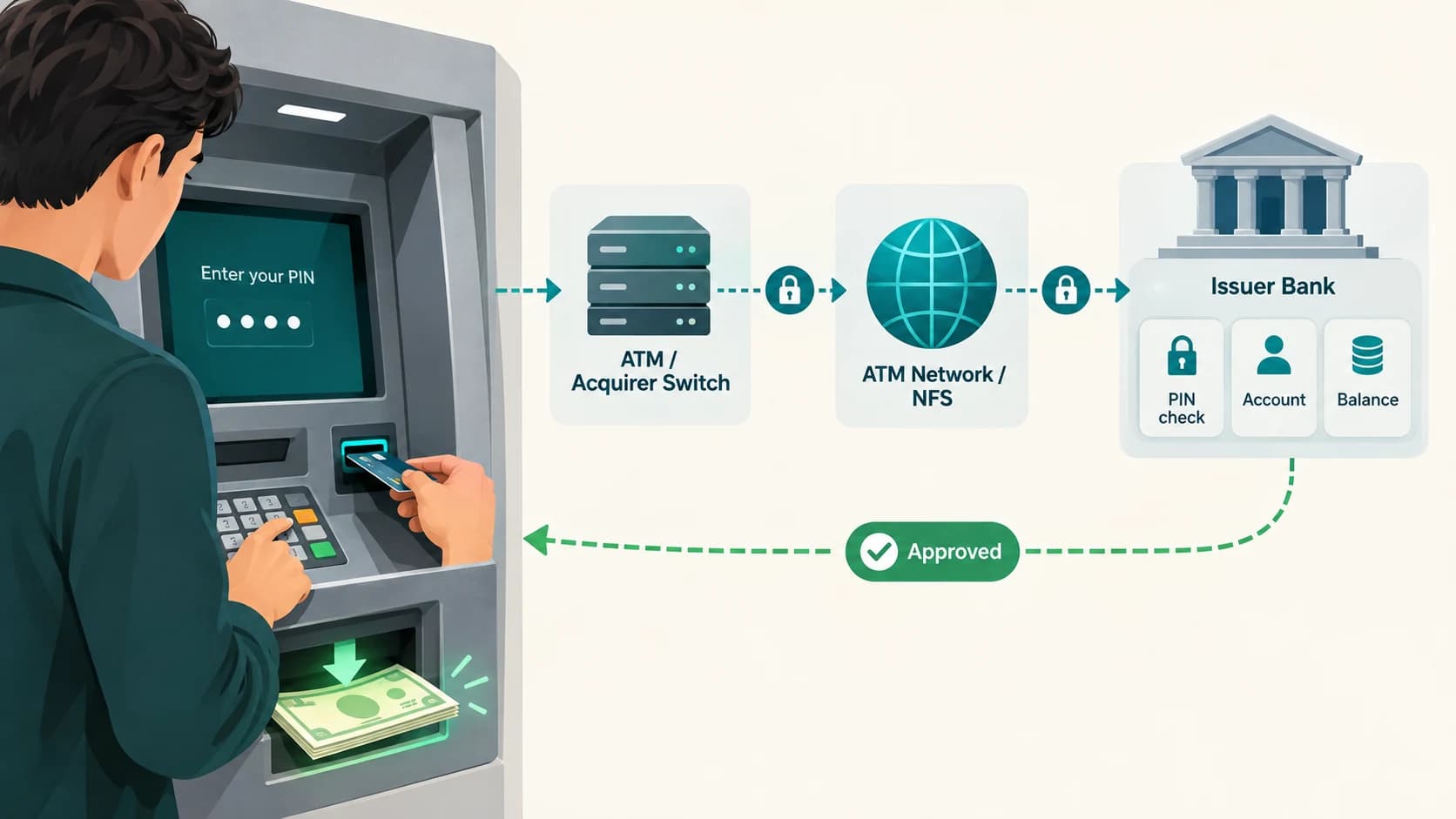
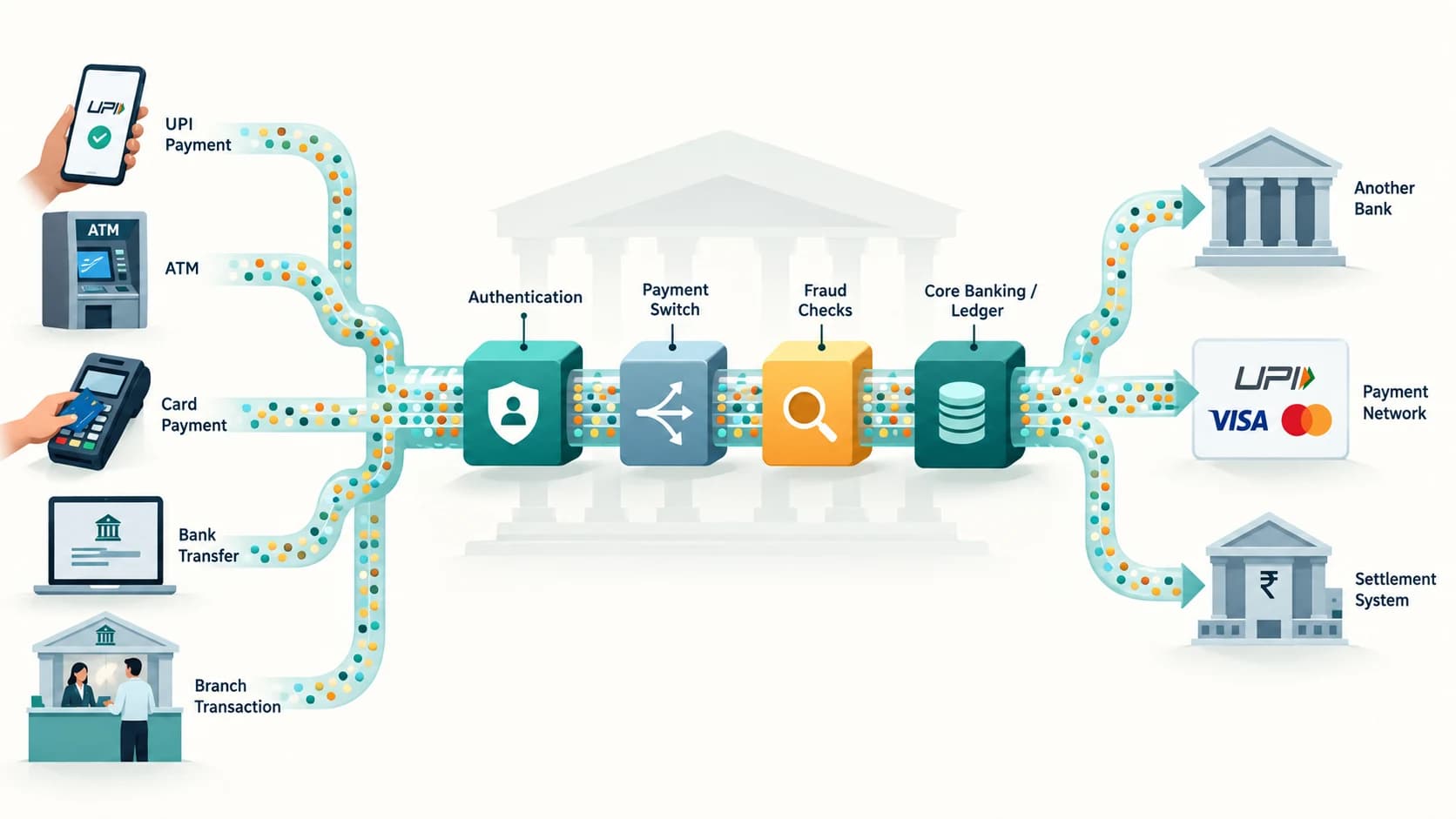
It reads your card, captures the transaction request and sends a message through banking systems to the institution that issued your card.
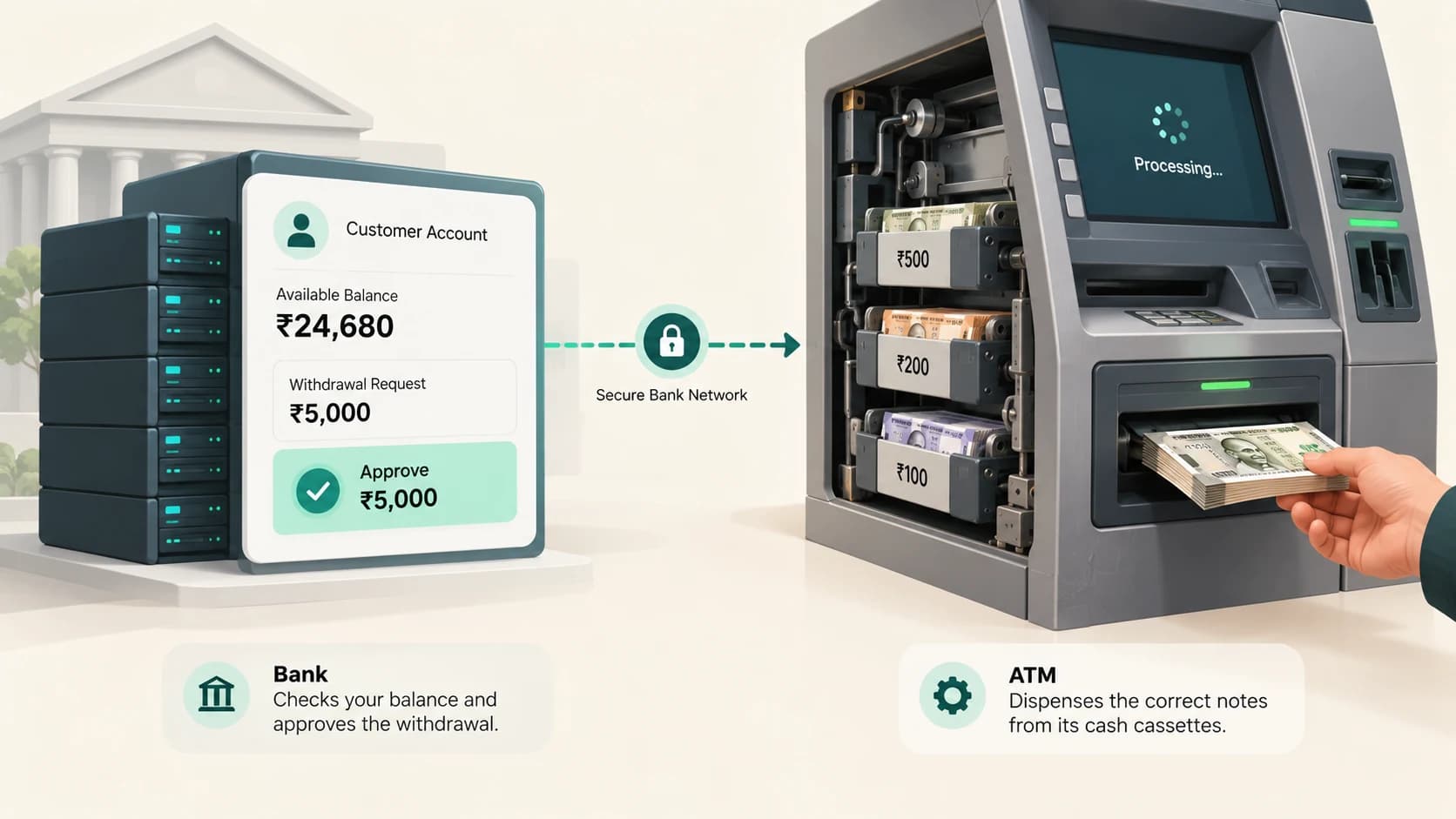
Your bank is the system that knows the account.
The ATM is the system that controls the physical cash.
That creates an elegant division of work:
Bank: “Yes, this customer may withdraw ₹5,000.”
ATM: “I have the correct notes. I will now dispense ₹5,000.”
Understanding that distinction explains almost everything that happens after you press Enter.
The ATM Does Not Store Your Live Account Balance
Suppose your bank account contains ₹32,400.
The ATM does not need to have ₹32,400 stored anywhere in its own database.
If it did, every ATM would constantly need to synchronize with millions of customer accounts.
That would be slow, difficult and risky.
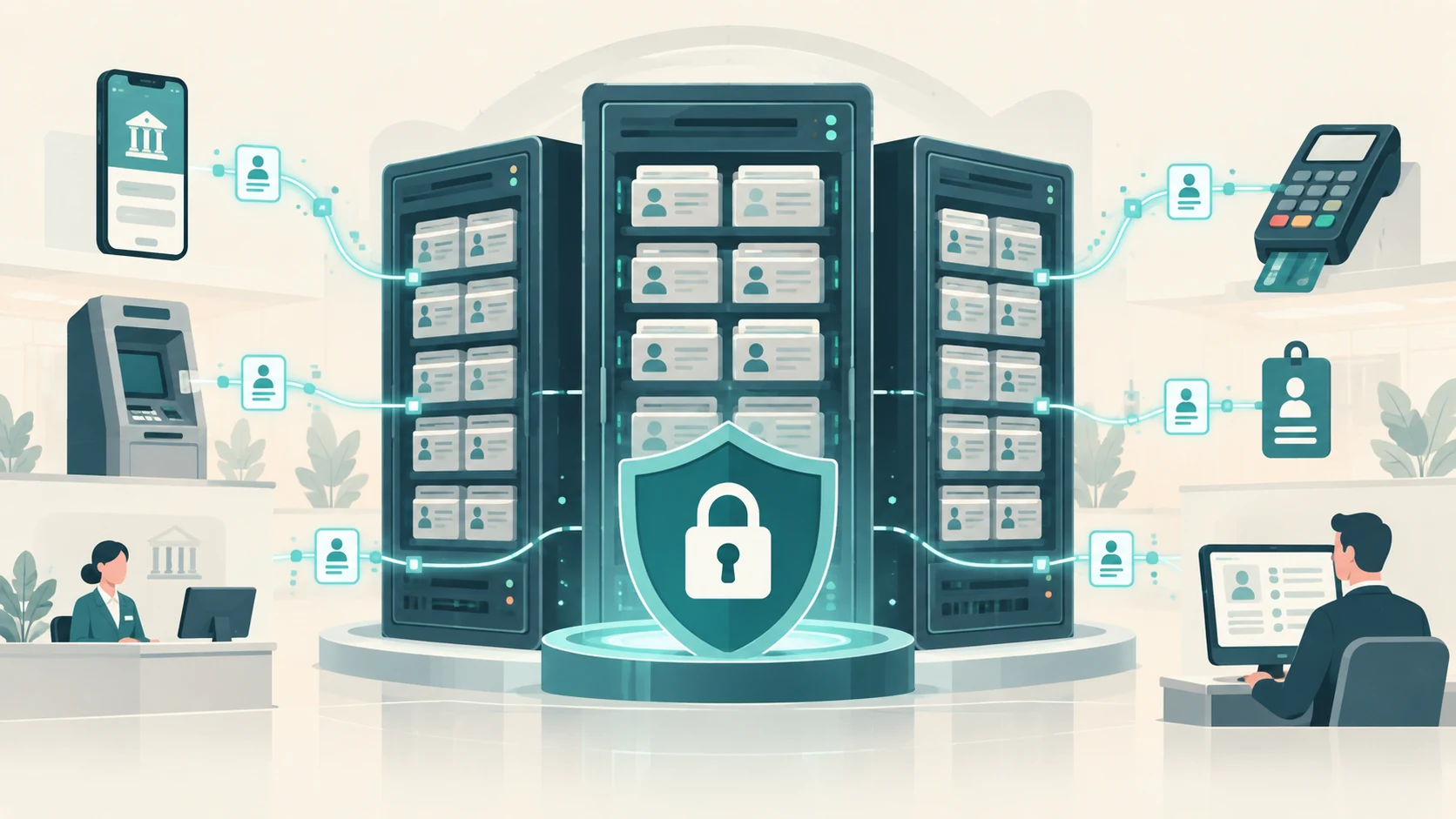
Instead, the account balance lives in your bank's banking systems.
When you request a balance enquiry, the ATM sends a message asking the card issuer for the relevant account information.
When you request a withdrawal, the ATM sends a different message asking, in effect:
Can this customer withdraw ₹5,000 from this account now?
The issuer evaluates the request and returns a response.
So the ATM knows only what it needs for the transaction.
A Balance Enquiry and a Cash Withdrawal Are Different Requests
This is an important distinction.
Balance enquiry
The customer explicitly asks:
What balance can you show me for this account?
The bank returns the permitted balance information, which the ATM displays.
Cash withdrawal
The ATM does not necessarily need the complete account balance.
It needs to know whether the requested withdrawal is allowed.
The issuer can check:
- available funds,
- card status,
- PIN,
- withdrawal limits,
- account restrictions,
- fraud controls.
The result may simply be:
Approved
or
Declined.
So if you have ₹32,400 and request ₹5,000, the ATM does not need to receive:
“This person has exactly ₹32,400.”
It can receive the authorization needed to continue.
That is both simpler and more private.
What Does the Card Contribute?
The debit card helps identify the banking relationship and provides security information.
With a modern EMV chip card, the chip can participate in cryptographic checks and generate transaction-specific security data.
EMVCo explains that EMV chip technology validates card authenticity and creates a unique security code for a transaction, helping make simple counterfeit-card reuse much more difficult.
The card therefore helps answer:
Which issuer should receive this request, and is this a genuine supported card interaction?
The live account balance still comes from the issuer's systems.
What Does the PIN Contribute?
The PIN helps prove that the person using the card is authorized to use it.
But the PIN should not travel through the network as ordinary readable text.
RBI's digital-payment security directions require sensitive PIN and cryptographic-key operations to be handled through secure controls, including Hardware Security Modules, or HSMs.
At a high level:
You enter PIN
↓
secure ATM PIN-entry equipment protects it cryptographically
↓
protected PIN data is included in the authorization flow
↓
issuer-side secure systems verify it
The ATM is therefore not simply asking the bank:
“Is 1234 correct?”
in plain text.
Step 1: The ATM Builds the Transaction
Imagine you select:
Withdrawal
Savings
₹5,000
The ATM now creates a structured transaction message.
Conceptually, it can contain information such as:
- card-related identifier,
- transaction type,
- amount,
- ATM identifier,
- date and time,
- encrypted/protected PIN information,
- EMV security data,
- routing fields.
Financial-card systems commonly use message structures based on the ISO 8583 family.
ISO 8583:2023 defines a common interface for exchanging card-originated financial messages between acquirers and issuers.
The standard does not mean every bank's internal system is identical.
It provides a structured way for financial systems to communicate.
Step 2: The Request Reaches Your Bank
If you are using your own bank's ATM, the message may remain largely within that bank's infrastructure.
If you are using another bank's ATM, the transaction may travel through a shared network such as NPCI's National Financial Switch (NFS).
NPCI describes NFS as India's leading shared ATM network.
The basic off-us route can look like:
ATM
↓
ATM owner's acquiring switch
↓
NFS / relevant card network
↓
your card issuer
Your bank then performs the authorization checks.
What Does the Bank Check Before Saying Yes?
The exact logic differs between banks, but a withdrawal authorization can involve checks such as:
Card status
Is the card active?
PIN validation
Was the protected PIN information valid?
Account status
Is the account allowed to make withdrawals?
Available funds
Is enough money available for the transaction?
Withdrawal limits
Would the transaction exceed a daily or product-specific limit?
Risk controls
Does the transaction look suspicious or violate security rules?
Only after these checks does the issuer respond.
The most important balance check is normally the available balance, not simply some headline ledger number.
Pending holds, uncleared items or account rules can sometimes make the amount available for withdrawal different from a simple displayed balance.
Why the ATM Can Say “Insufficient Funds” Without Showing Your Balance
Suppose the account can support only ₹3,000 of additional withdrawals.
You request ₹5,000.
Your bank does not need to reveal the exact available balance to the ATM in order to reject the request.
It can simply return a decline code indicating that the transaction cannot be authorized.
The ATM then shows a customer-friendly message such as:
Insufficient funds
or another relevant decline message.
This demonstrates the basic architecture:
the bank knows the financial state
while
the ATM presents the result.
Step 3: Approval Comes Back to the Machine
If the bank authorizes ₹5,000, the response travels back through the network.
Conceptually:
Issuer says: Approved for ₹5,000
↓
Network routes response
↓
ATM receives approval
Only now does the cash-dispenser mechanism begin the physical withdrawal process.
This separation is important.
A digital approval and a successful cash dispense are not the same event.
The first happens in financial systems.
The second happens inside a mechanical machine.
Where Is the Cash Stored?
Inside a cash-dispensing ATM are secure cash cassettes.
Each cassette can be configured to hold a particular denomination.
For example, one machine might have:
- cassette 1 → ₹500 notes,
- cassette 2 → ₹200 notes,
- cassette 3 → ₹100 notes,
- another cassette → additional notes or a different denomination depending on configuration.
ATM designs vary.
Official ATM procurement specifications used by Indian banks call for multiple cash cassettes, denomination support, reject bins and note-detection mechanisms.
The ATM's software knows how the installed cassettes are configured.
It therefore does not see the cash as one unsorted pile.
It sees something more like:
Cassette A: ₹500
Cassette B: ₹200
Cassette C: ₹100
plus internal note counts and status information.
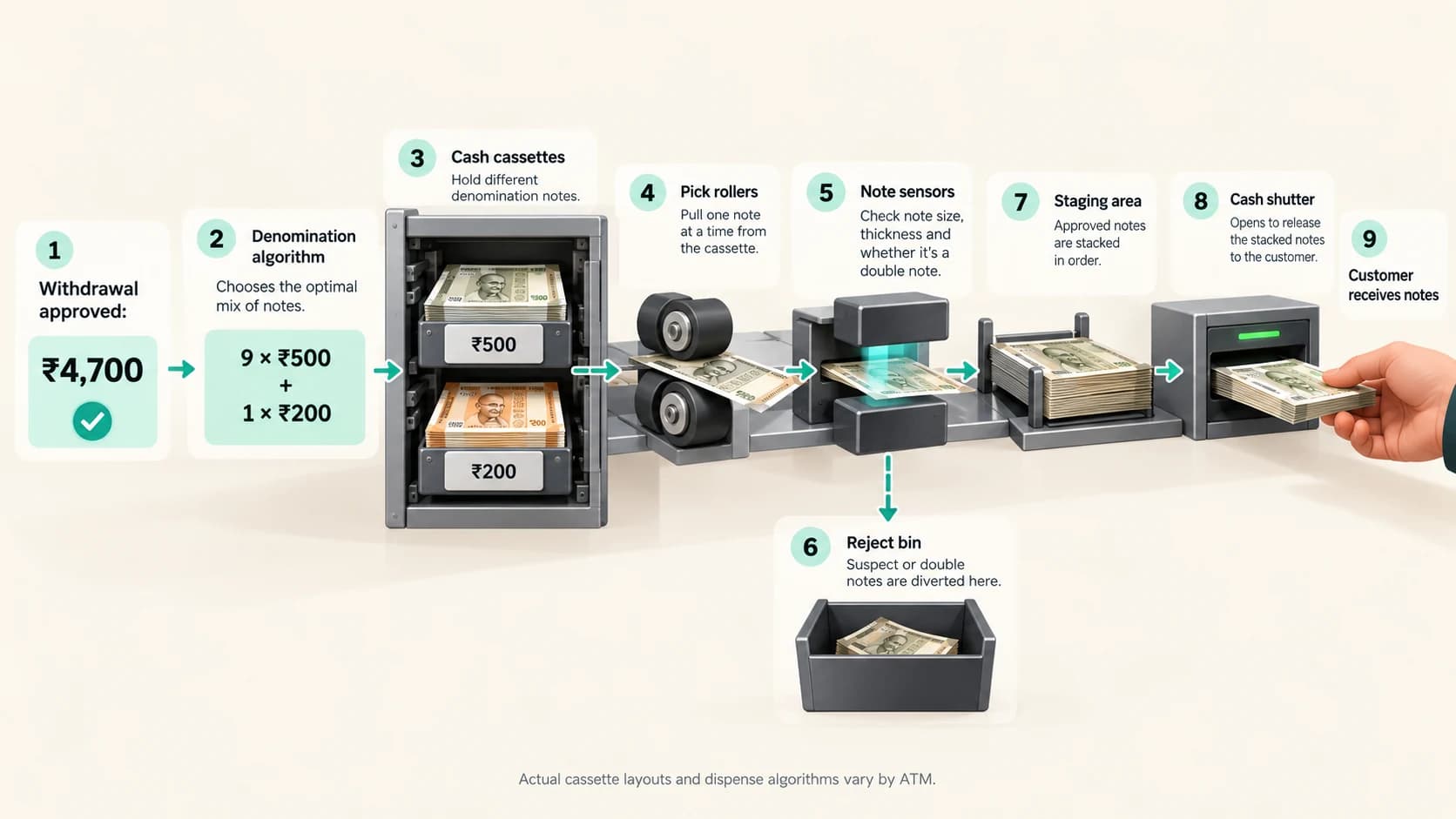
How Does It Choose the Correct Denominations?
Suppose you request:
₹4,700
The ATM software must find a valid combination using the denominations currently configured and available.
For example:
9 × ₹500 = ₹4,500
plus
1 × ₹200 = ₹200
Total:
₹4,700
But that is not the only possible combination.
If the machine has ₹100 notes, it could produce other valid combinations.
The exact dispensing algorithm can consider:
- denominations available,
- which cassettes have sufficient notes,
- cassette configuration,
- cash-management rules,
- note-distribution policies.
The customer normally sees only the result.
What If the ATM Has Enough Money—but Not the Right Combination?
This can happen.
Imagine the ATM physically contains ₹50,000, but only in ₹500 notes.
You request:
₹4,700
The machine cannot construct ₹4,700 from ₹500 notes alone.
So “ATM has plenty of cash” does not automatically mean every amount can be dispensed.
The machine needs a valid denomination combination.
This is one reason ATMs often restrict withdrawal amounts to values compatible with the denominations loaded.
Step 4: Notes Are Picked From the Cassettes
Once the software knows which notes to dispense, the cash-dispenser unit begins a mechanical sequence.
A simplified path is:
Cassette
↓
note-picking mechanism
↓
counting / sensing
↓
transport path
↓
presentation area
↓
cash shutter
ATM dispenser designs vary, but this general structure is common.
A note must travel individually through rollers or belts from the cassette toward the output.
The machine cannot simply open a cassette and release a stack.
It has to control each note carefully.
How Does the ATM Count the Notes?
The dispenser uses sensors.
Depending on the machine, these can detect:
- a note passing a point,
- double notes,
- abnormal thickness,
- jams,
- cassette presence,
- empty-cassette status,
- note position.
Official SBI ATM procurement specifications, for example, call for double-pick detection modules, multiple currency cassettes and a locked reject/divert bin.
ATM service documentation similarly describes photosensors and thickness/double-detect mechanisms inside dispensing units.
This means counting cash is not simply:
motor turns ten times = ten notes.
The machine tries to verify that the expected notes actually moved through the path.
What Happens If Two Notes Stick Together?
Cash is a difficult physical material.
Notes can be:
- worn,
- folded,
- slightly damaged,
- stuck together,
- affected by humidity or static.
If the dispenser tries to pick one ₹500 note but appears to detect two stuck together, it should not simply send them to the customer.
The system can reject the suspect note pair into an internal reject bin or divert cassette.
It then attempts to obtain the correct number of clean notes.
This is essential.
Without double-note detection, a ₹5,000 withdrawal could accidentally dispense ₹5,500 or ₹6,000.
What Is the Reject Bin?
The reject bin is an internal secure compartment.
It can receive notes that the dispenser does not trust enough to present.
Examples might include:
- possible double picks,
- problematic notes,
- notes involved in a dispense error.
The reject bin remains inside the ATM.
The customer never sees those notes.
Bank ATM specifications require the ATM to account for notes moved into the reject/divert bin so the machine's cash records can later be reconciled.
This is part of the machine's internal accounting.
The ATM Keeps Track of Physical Cash Too
The bank knows your account balance.
The ATM separately needs to know its own cash inventory.
Those are completely different balances.
Your balance
Held in banking systems.
ATM cash balance
Represents the physical notes expected to remain in the cassettes and internal bins.
The ATM may maintain denomination-level counters and electronic-journal records so operators can compare:
what the machine thinks it dispensed
with
what cash is physically left.
When the ATM is replenished or serviced, operators reconcile these records.
That is how missing or excess physical cash can be investigated.
Step 5: The ATM Stages the Cash Before Giving It to You
Many dispenser designs do not expose each note immediately as it is picked.
The machine may first assemble the requested notes internally.
Once the stack is complete and the system is satisfied with the dispense operation, the notes move to the presentation area and the shutter opens.
This reduces the risk of giving the customer only part of a planned dispense.
It also allows the machine to detect problems before cash is presented.
The customer experiences one simple event:
₹5,000 appears.
Inside the machine, several mechanical checks may already have happened.
What If You Do Not Take the Cash?
Some ATM designs can retract cash that was presented but not taken within the allowed time.
The notes may be drawn back into a retract/reject compartment.
This does not mean the customer's account status always fixes itself instantly.
The machine and banking systems must still reconcile what happened.
The electronic transaction and physical cash state have to agree.
That is why ATMs maintain detailed journals and error records.
The Hard Problem: Approved Withdrawal, but Cash Does Not Come Out
Suppose your bank approves ₹5,000 and debits the account.
Then the ATM encounters a mechanical failure:
- jam,
- dispenser fault,
- empty cassette,
- shutter failure,
- communication problem after approval.
Now the digital and physical worlds disagree.
Banking system: ₹5,000 withdrawal approved.
Physical machine: ₹5,000 not delivered.
This is why payment networks need reversal and reconciliation.
The ATM/acquirer side records the failure, and the transaction can be reversed so the customer's bank account is restored.
RBI's current ATM FAQ requires re-credit for a failed ATM cash withdrawal where the account was debited but cash not dispensed within a maximum of T+5 calendar days.
If the bank delays beyond that, RBI requires compensation of ₹100 per day.
Why Doesn't the ATM Wait to Debit Until After Cash Comes Out?
That sounds attractive, but payment systems have to coordinate two systems that cannot complete at precisely the same instant:
- bank authorization,
- mechanical dispense.
The bank must approve the withdrawal before the machine releases cash.
Otherwise, an ATM could dispense money without knowing whether the transaction was allowed.
So the sequence must contain an authorization point before dispense.
The system then relies on reversals to handle exceptional cases where approval succeeded but the machine failed afterward.
This is a common design pattern in distributed financial systems:
authorize first
perform physical action
reverse if the physical action fails.
How Does a Balance Enquiry Work at Another Bank's ATM?
Suppose:
Your card: Bank A
ATM: Bank B
When you choose Balance Enquiry, Bank B's ATM does not magically query Bank A's database directly.
The request can travel through the shared network:
Bank B ATM
↓
Bank B switch
↓
NFS / relevant network
↓
Bank A
Bank A retrieves the relevant balance information and returns it.
The ATM displays the response.
This is why an ATM can show your balance even when the machine belongs to another bank.
The network makes the banks interoperable.
Is the Number on Screen Always Your Total Account Balance?
Not necessarily.
Banks distinguish between concepts such as:
- ledger balance,
- available balance,
- uncleared funds,
- holds or liens.
The amount usable for an ATM withdrawal may not always be identical to a simple ledger total.
An ATM displays the balance information supplied under the relevant transaction and bank rules.
The important point for a withdrawal is whether the issuer's systems consider the requested amount available and eligible to be withdrawn.
The ATM does not independently calculate that from your banking history.
How Fast Can the Whole Process Happen?
Consider the timeline for one ordinary withdrawal.
1. Card is read
The ATM obtains the required card and chip information.
2. PIN is captured securely
Protected PIN information is prepared for authorization.
3. Withdrawal amount is selected
The ATM constructs the financial request.
4. Request reaches the issuer
Directly within the bank or through an interoperable network.
5. Bank checks the account
Balance, status, limits and security controls are evaluated.
6. Approval returns
The ATM receives permission to dispense the specified amount.
7. Denomination mix is selected
The ATM determines which cassettes to use.
8. Notes are picked and sensed
The dispenser counts notes and rejects suspicious picks.
9. Cash is presented
The customer receives the stack.
10. Electronic and physical records are stored
The ATM and banking systems retain transaction information for reconciliation.
That entire sequence can happen in less time than it takes to read this paragraph.
Why an ATM Needs Two Different Kinds of Intelligence
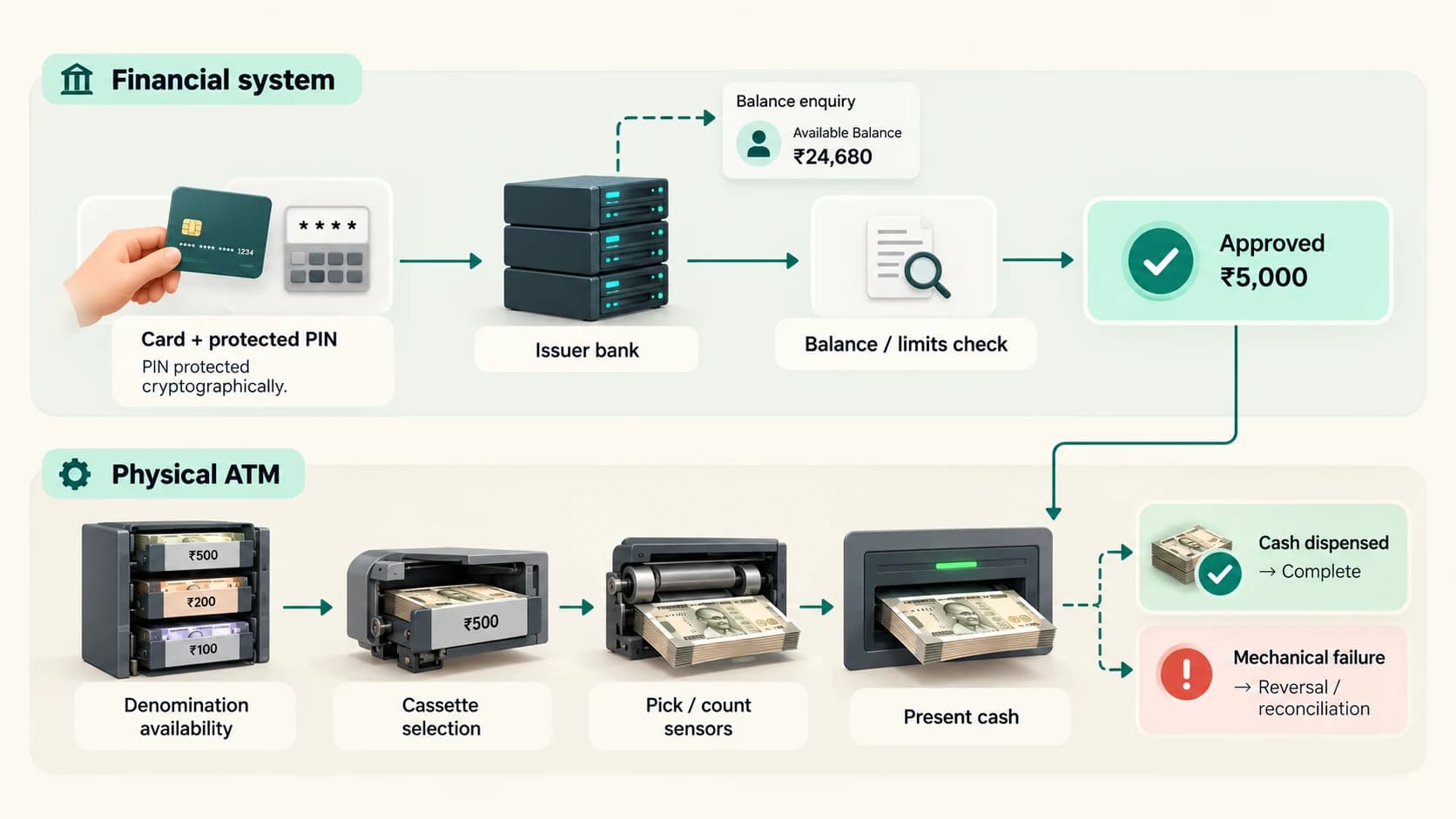
The ATM system solves two separate problems.
Financial intelligence
Handled mainly by bank/payment systems:
- Is the card valid?
- Is the PIN correct?
- Is the account active?
- Is enough money available?
- Is the transaction allowed?
Mechanical intelligence
Handled mainly by the ATM:
- Which denominations are loaded?
- Which cassettes contain them?
- How many notes should be picked?
- Did one note or two pass the sensor?
- Did the notes reach the presentation slot?
- Was there a jam?
Neither side can complete the transaction alone.
The bank can approve a withdrawal but cannot physically hand you the notes.
The ATM can hold lakhs of rupees in its cassettes but cannot safely decide that you are entitled to take them.
The ATM Does Not “Know” Your Balance in the Human Sense
That is the key idea.
When the screen shows:
Available balance: ₹27,400
the ATM has not remembered your finances.
It has just received information from the banking system.
When the machine gives you exactly ₹5,000, it has not understood money in the way a cashier does.
It has followed a carefully controlled mechanical plan:
pick these notes
↓
verify them
↓
reject uncertain ones
↓
present the correct stack.
The bank and the ATM therefore solve different halves of the same problem.
The bank answers:
May this person receive ₹5,000?
The ATM answers:
Can I physically construct and safely dispense ₹5,000 from the notes currently inside me?
Only when both answers are yes do the notes come out.
That is how a machine with no copy of your bank account can show your balance—and still dispense exactly the cash your bank has authorized.