How Do Banks Process Millions of Transactions Every Day?
Learn how core banking systems, payment switches, databases, queues, fraud checks, reconciliation and settlement let banks process enormous transaction volumes safely.
Imagine everything happening inside a large bank at the same time.
Customers are:
- paying through UPI,
- withdrawing cash from ATMs,
- using debit cards,
- transferring money through mobile banking,
- receiving salaries,
- paying EMIs,
- depositing cheques,
- using NEFT and RTGS,
- receiving interest,
- paying bills,
- shopping online.
Thousands of events may arrive every second.
Yet the bank has to maintain one extremely important promise:
Every valid transaction must affect the correct account, by the correct amount, exactly as intended.
That sounds simple until you remember that one customer may be using an ATM while another app transaction reaches the same account almost simultaneously.
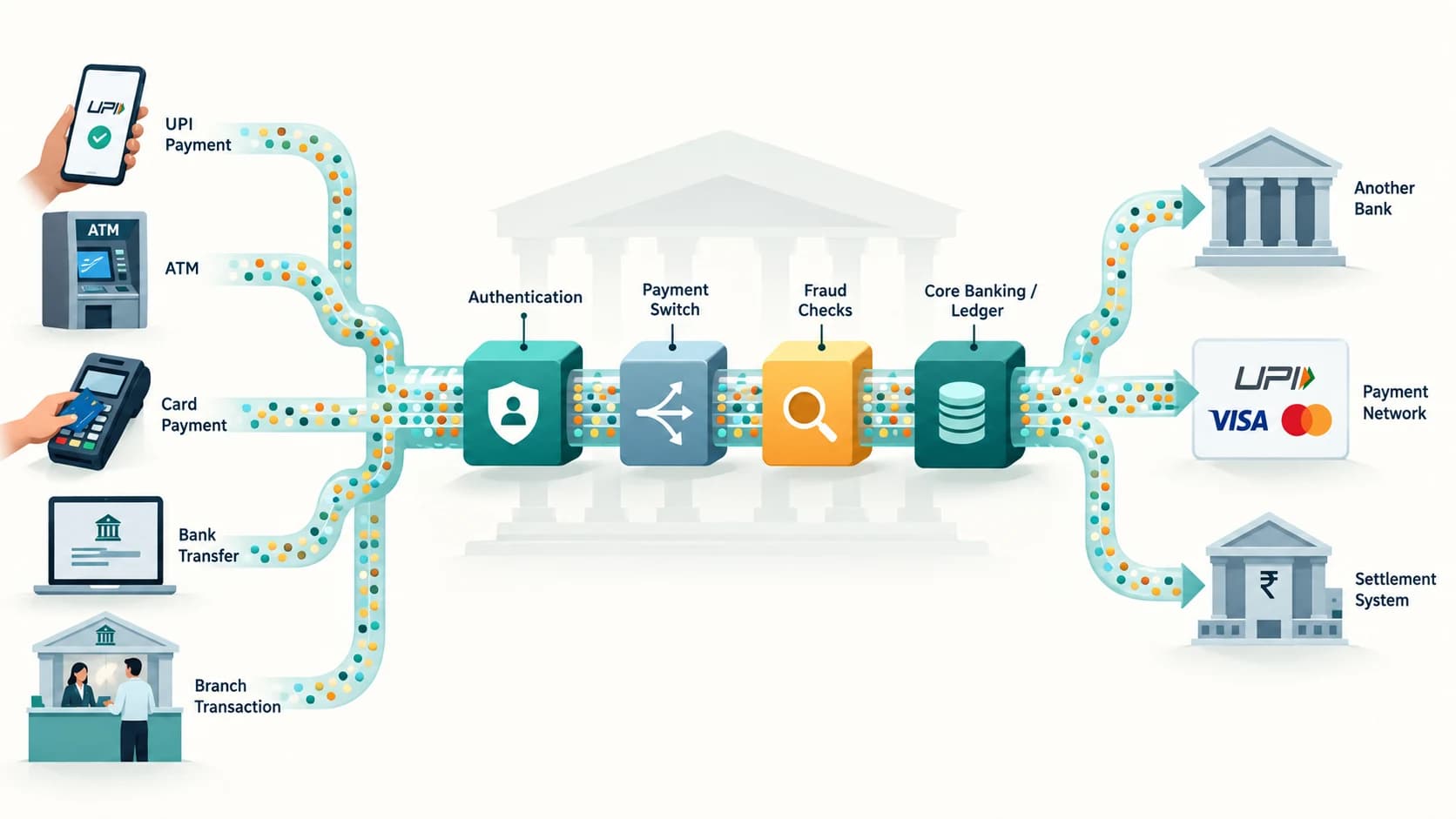
A modern bank solves this problem not with one giant computer, but with a layered transaction-processing architecture.
At a high level:
Customer app / ATM / branch / merchant
↓
Authentication + transaction channel
↓
Bank switch / payment service
↓
Fraud and business-rule checks
↓
Core banking / account ledger
↓
External payment network if another institution is involved
↓
Settlement + reconciliation
The scale can be enormous.
NPCI reported about 24.5 billion UPI transactions in August 2026 alone—an average of roughly 790 million transactions per day across the UPI ecosystem.
Those payments involve hundreds of participating institutions.
No human operator could process that volume manually.
The system works because most ordinary transactions are designed to move automatically from one machine to another.
The Core Idea: Banks Turn Money Movements Into Ledger Entries
A bank account is fundamentally a record in a ledger.
Suppose your account contains:
₹50,000
and you transfer:
₹5,000
to another account at the same bank.
The bank does not need to move physical ₹500 notes from one vault shelf to another.
Its systems update financial records.
Conceptually:
Your account: −₹5,000
Recipient account: +₹5,000
with transaction references and accounting entries recording what happened.
Modern banks use Core Banking Solutions (CBS) or similar centralized processing systems to maintain these records.
RBI has described core banking as a model in which centralized databases and processing allow customers to access banking services across branches and digital channels rather than each branch maintaining an isolated ledger.
This is the foundation that makes:
- internet banking,
- mobile banking,
- ATMs,
- nationwide branches,
- automated payments,
possible at scale.
But the Core Banking System Does Not Do Everything
It is tempting to imagine that every transaction goes directly from your phone into one enormous core-banking database.
Real banking architecture is usually more layered.
Different systems can handle different responsibilities.
For example:
Mobile banking system
Handles app requests and customer sessions.
ATM switch
Routes ATM transactions.
Card-management system
Handles debit or credit card activity.
UPI/payment switch
Handles UPI transaction flows.
Fraud-management system
Looks for suspicious behaviour.
Core banking system
Maintains authoritative account and ledger records.
External payment networks
Connect the bank to other institutions.
Reconciliation systems
Check whether different systems agree afterward.
This separation prevents the core ledger from having to understand every user interface and payment protocol directly.
Step 1: A Transaction Enters Through a Channel
Suppose you send ₹2,000 from your banking app.
The bank first receives the request through its digital-banking infrastructure.
Before any money moves, the system may establish:
- who you are,
- which account you selected,
- whether the session is valid,
- what transaction you requested.
The same principle applies to other channels.
An ATM provides:
- card data,
- protected PIN data,
- requested amount.
A card terminal provides:
- card or token information,
- merchant data,
- amount.
UPI provides:
- payer and beneficiary routing information,
- amount,
- authentication information.
Different front ends create different messages.
The bank's back end has to convert those requests into controlled financial operations.
Step 2: Authentication and Security Checks Happen
Banks cannot process a transaction merely because a message arrived.
The system may need to verify:
- password or MPIN,
- device registration,
- OTP or another factor,
- card PIN,
- UPI authorization,
- session validity.
RBI requires regulated entities to use strong authentication and digital-payment security controls appropriate to the transaction.
Security systems can also inspect the request for unusual behaviour.
For example:
- unusually large amount,
- new device,
- rapid sequence of transfers,
- newly added beneficiary,
- suspicious location or network pattern,
- repeated failed authentication.
The exact fraud models are proprietary.
The point is that transaction processing and fraud control happen together.
Step 3: The Bank Checks Business Rules
Even a correctly authenticated customer cannot necessarily perform every transaction.
The bank may check:
- available balance,
- daily transfer limit,
- account status,
- beneficiary restrictions,
- product rules,
- regulatory requirements,
- card or channel limits.
Suppose you try to transfer ₹20,000 from an account with only ₹12,000 available.
The system can decline the transaction before it reaches final posting.
This automated rule-checking is one reason banks can handle huge transaction volumes.
A human officer does not need to approve every ordinary ₹500 payment.
Step 4: The Ledger Must Be Updated Safely
This is where banking systems become particularly careful.
Suppose your account has exactly:
₹10,000
and two requests arrive almost at the same time:
Transaction A: withdraw ₹8,000
Transaction B: transfer ₹6,000
If both systems independently read the old ₹10,000 balance and approve themselves, the account could be overdrawn incorrectly.
Banks therefore need transaction controls that ensure financial updates happen in a controlled sequence.
Database systems use concepts such as:
- transactions,
- locking,
- atomic updates,
- consistency checks.
The exact implementation differs between banks and platforms.
But the objective is universal:
A financial transaction must not be half-completed or calculated from an invalid account state.
What Does “Atomic” Mean?
Imagine an internal transfer:
Account A → ₹1,000 → Account B
The bank should not end up with:
Account A debited
but
Account B never credited
because a server crashed halfway through.
A well-designed financial transaction treats related operations as one controlled unit.
Conceptually:
Either the complete valid operation succeeds
or
the system can roll back, reverse or recover from the incomplete state.
This does not mean every interbank payment is one single database transaction across two companies.
It means each participant needs controlled posting and recovery mechanisms so failures do not silently corrupt the ledger.
Payment Switches Are Like High-Speed Traffic Controllers
Banks often use switches to route transaction messages.
A switch examines the request and asks:
Where should this transaction go?
For example:
ATM
Is this our own card or another bank's card?
UPI
Which internal or external participant should receive this instruction?
Card payment
Which card network or issuer route applies?
Internal transfer
Can this remain within the bank?
The switch is not necessarily the final ledger.
Its job is often routing, message handling and orchestration.
This architecture lets banks connect many customer channels without building unique direct connections between every possible system.
Internal Transfers Are Easier Than Interbank Transfers
Suppose:
Sender: Bank A customer
Receiver: another Bank A customer
The bank can potentially process both sides inside its own systems.
Now suppose:
Sender: Bank A
Receiver: Bank B
Bank A cannot simply edit Bank B's customer database.
It must send the payment through an agreed payment network.
That is why India has systems such as:
- UPI,
- IMPS,
- NEFT,
- RTGS,
- card networks,
- NACH,
- NFS.
Each network solves a different payment or settlement problem.
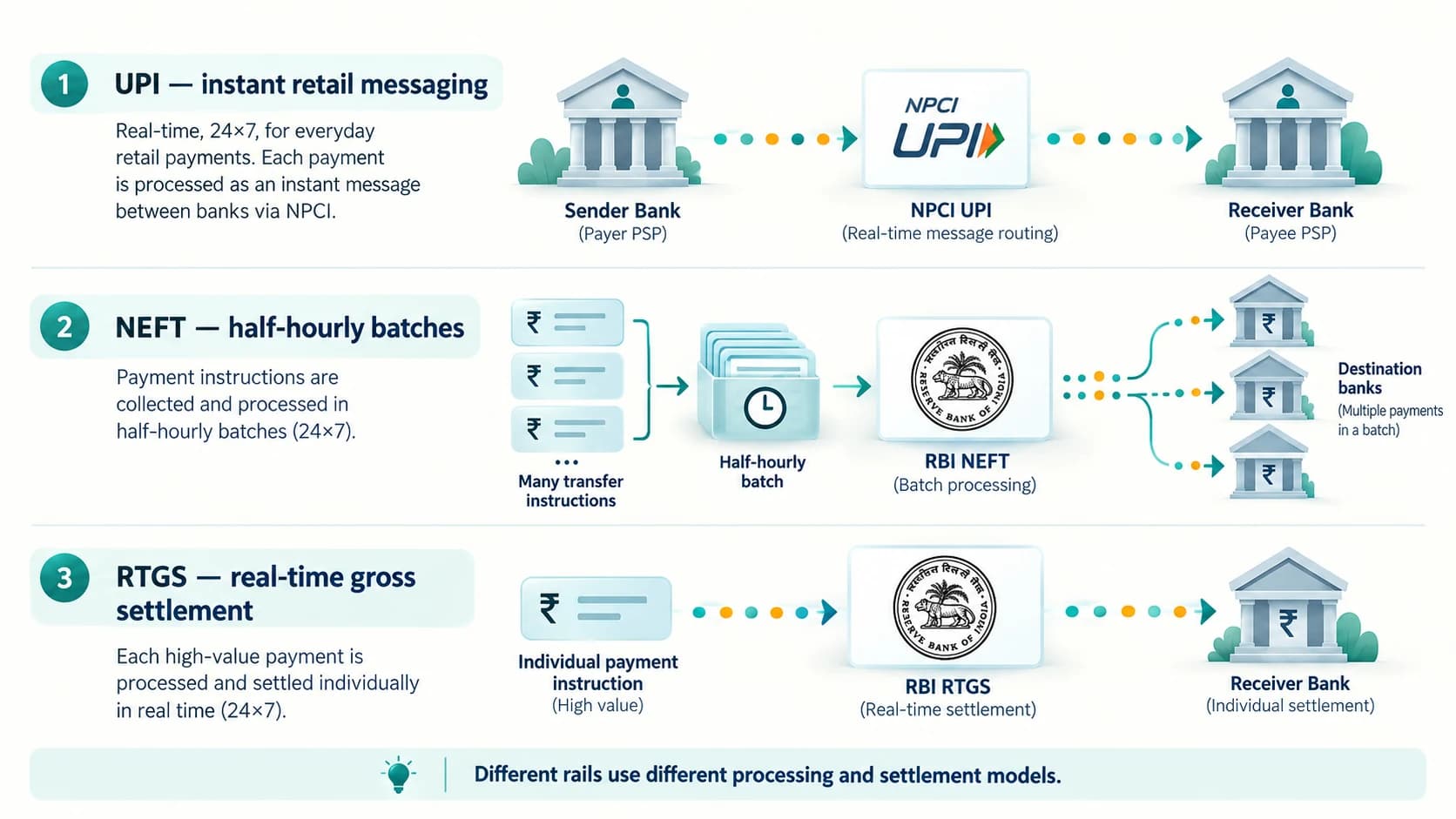
UPI: Huge Numbers of Small Real-Time Transactions
UPI is designed for instant, interoperable retail payments.
NPCI operates the UPI network.
A simplified interbank flow is:
Customer app
↓
payer-side systems
↓
NPCI UPI
↓
sender bank
↓
beneficiary bank
↓
payment result
By August 2026, NPCI reported 752 banks live on UPI and around 24.509 billion monthly transactions.
Handling that scale requires heavy automation.
The payment message is small.
What matters is that thousands of systems can process those messages consistently and quickly.
NEFT: Automated Processing in Batches
NEFT works differently.
RBI operates the National Electronic Funds Transfer system.
RBI's current FAQ states that NEFT is available:
24×7×365
and processes transactions in half-hourly batches.
There are 48 settlement batches each day.
That means an individual bank can collect eligible NEFT instructions, submit them into the central system and process resulting credits automatically.
RBI has emphasized Straight Through Processing (STP) for NEFT.
Straight-through processing means that once a valid instruction enters the system, machines can process it through subsequent stages with minimal or no manual re-entry.
This is essential for scale.
RTGS: Transaction-by-Transaction Settlement
RTGS is designed differently again.
RBI describes RTGS as:
Real Time Gross Settlement
where payment instructions are processed continuously, individually and in real time.
“Gross” means transactions are settled one by one rather than being netted together first.
RTGS settlement occurs in the books of RBI and is final and irrevocable once settled.
So:
NEFT
Many instructions are processed in recurring batches.
RTGS
Eligible transfers settle individually in real time.
UPI
Retail payment messages are routed instantly between participants, with separate clearing/settlement processes behind the network.
Different payment systems therefore scale using different designs.
There is no single universal way banks process every transaction.
Why Banks Use Queues
Imagine 100,000 requests arriving at once after salary credit or during a major online sale.
The bank does not want every application server competing chaotically for the same resources.
Large transaction systems often use message queues or similar event-processing layers.
A queue can temporarily hold requests in a controlled order until downstream systems are ready.
Conceptually:
Incoming transactions
↓
Queue
↓
processing workers
↓
ledger / payment systems
Queues can help with:
- smoothing traffic spikes,
- retrying temporary failures,
- separating systems,
- preventing overload.
They do not mean customers always wait visibly.
Many queues are processed in milliseconds.
Why “Retry” Is More Dangerous in Banking Than on an Ordinary Website
Suppose a shopping website fails to load an image.
Refreshing is harmless.
Now imagine a payment request times out.
If a system blindly sends it again, the customer could be charged twice.
Financial systems therefore use unique transaction identifiers and duplicate-detection logic.
A crucial concept is idempotency.
In simple terms:
If the same transaction request accidentally arrives twice, the system should recognize that it is the same payment rather than create a second payment.
The exact methods vary by network.
But transaction references, sequence numbers and reconciliation records are central to reliable payment processing.
Why Your Payment Can Show “Pending”
Distributed systems do not always respond in perfect synchronization.
Imagine:
- sender bank debits the account,
- network forwards the transaction,
- beneficiary bank processes it,
- one response message is delayed.
The customer's app may temporarily not know the final state.
So it displays:
Pending
rather than inventing a result.
Behind the scenes, the systems may:
- query transaction status,
- retry a safe status request,
- receive a late response,
- trigger reversal rules if required.
A pending state is therefore sometimes a sign of cautious system design.
The application is admitting:
We do not yet have enough evidence to show final success or failure.
Reconciliation Is the Bank's “Did Everyone Agree?” Check
A payment system cannot rely solely on live messages.
At the end of processing cycles, banks and payment networks compare records.
Suppose Bank A says:
We sent 1,000 successful payments.
The payment network says:
We recorded 1,000.
Bank B says:
We credited 1,000.
Good.
Now imagine one system reports:
999
That mismatch needs investigation.
This process is called reconciliation.
Banks compare:
- transaction counts,
- transaction values,
- reference numbers,
- success/failure status,
- reversals,
- settlement files.
Reconciliation is one of the less visible but most important parts of banking operations.
Real-time processing tells the customer what should have happened.
Reconciliation verifies that all systems recorded it consistently.
Clearing Is Not the Same as Settlement
Suppose customers of Bank A send a total of:
₹100 crore
to Bank B.
Customers of Bank B send:
₹90 crore
to Bank A.
At the retail level, individual customers may have seen immediate debits and credits.
But between the banks, some payment systems can calculate net obligations.
In this simplified example:
Bank A owes Bank B ₹10 crore net.
Clearing
Determines who owes what.
Settlement
Actually discharges those financial obligations through the designated settlement mechanism.
For centralized systems such as RTGS, settlement occurs in accounts at RBI.
RBI also notes that RTGS settles multilateral net settlement batch files from ancillary systems including NPCI.
This distinction allows retail payment systems to serve huge numbers of customers while banking institutions settle their obligations in an organized way.
Banks Do Not Use One Server
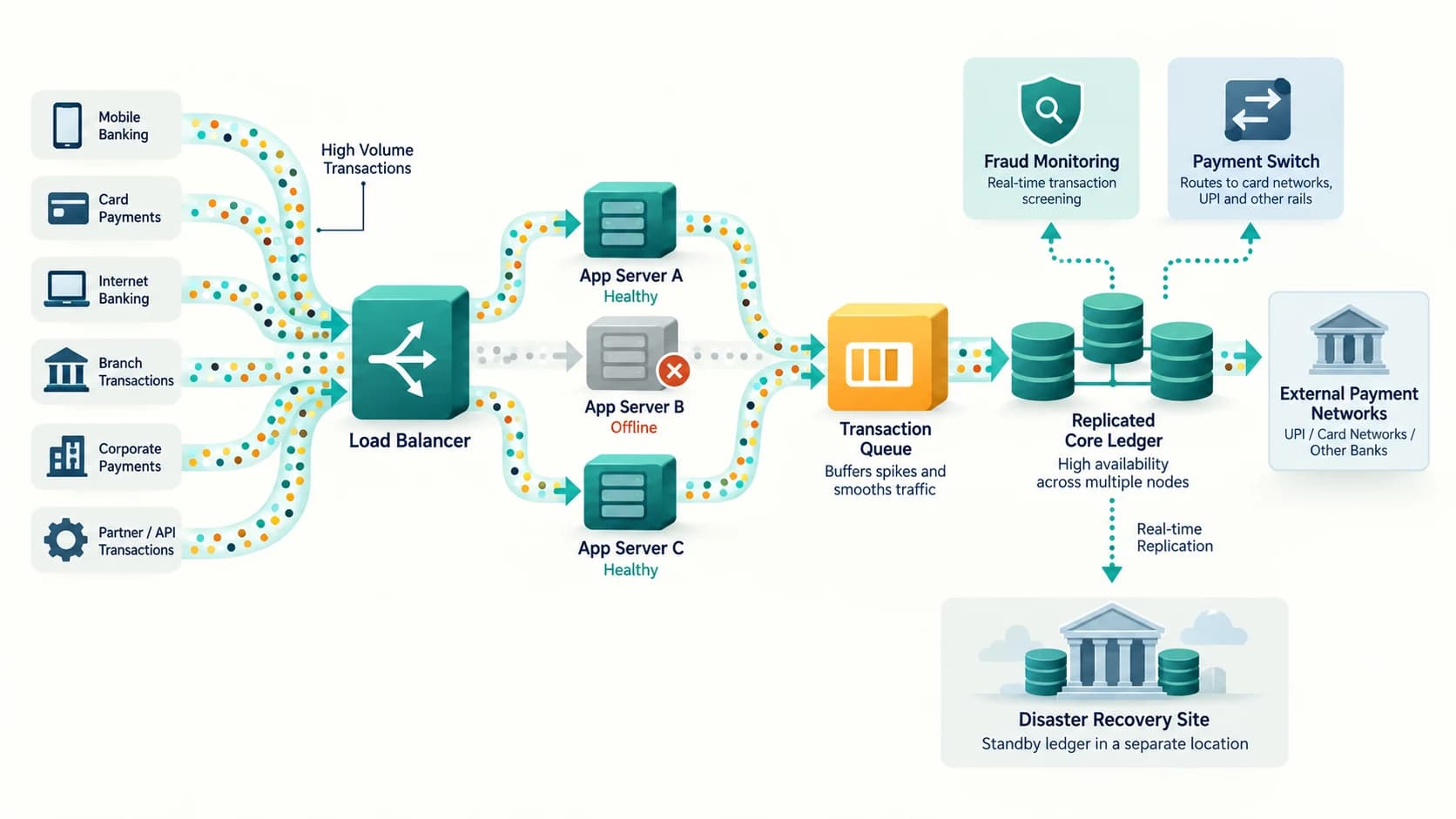
Processing millions of transactions requires redundancy.
A production banking environment can use combinations of:
- multiple application servers,
- database clusters,
- load balancers,
- network redundancy,
- primary and disaster-recovery sites,
- replicated storage,
- backup systems.
If one machine fails, the bank should not lose the entire service.
RBI's technology and cyber-resilience requirements emphasize:
- business continuity,
- disaster recovery,
- system availability,
- operational resilience.
The exact architecture is private and differs by institution.
But the design goal is clear:
No ordinary single hardware failure should be able to erase or corrupt millions of customer transactions.
What Is a Load Balancer?
Imagine one banking app receiving 200,000 customer requests.
Instead of directing every request to one server, a load balancer distributes the traffic across several application servers.
Conceptually:
100,000 requests
↓
Load balancer
↙ ↓ ↘
Server A — Server B — Server C
This improves:
- scalability,
- availability,
- maintenance flexibility.
If one server is removed for maintenance, others can continue working.
Again, the application servers are not necessarily the final ledger.
They handle requests and coordinate with deeper banking services.
Why Databases Need Replication
If the bank's only copy of critical data existed on one physical storage device, a hardware failure could be catastrophic.
Banks therefore use redundancy and backup strategies.
Possible techniques include:
- database replication,
- storage replication,
- disaster-recovery copies,
- backups,
- transaction logs.
But replication introduces its own engineering challenge.
Copies must remain consistent enough that systems do not disagree about account state.
Financial systems therefore place extraordinary importance on:
- ordering,
- transaction logs,
- recovery procedures,
- reconciliation.
Speed matters.
Correctness matters more.
Not Every Transaction Needs the Same Priority
A bank handles different workloads.
Time-critical
- UPI payment,
- ATM withdrawal,
- card authorization.
Important but less latency-sensitive
- statement generation,
- regulatory report,
- interest calculation,
- analytics.
A well-designed architecture does not let a huge monthly report consume the same resources needed for real-time payment authorization.
Banks therefore separate workloads and schedule background processing carefully.
This is one reason many traditional banking processes used to happen as end-of-day or batch jobs.
Modern systems increasingly operate continuously, but scheduled batch processing still exists for activities that do not need millisecond responses.
End-of-Day Processing Still Matters
Even in a 24×7 digital world, banks perform scheduled accounting and operational processes.
These can include:
- interest accrual,
- fee calculation,
- report generation,
- general-ledger updates,
- reconciliation,
- regulatory processing.
Modern architectures are designed to reduce the need to shut customer channels simply because a batch job is running.
But the concept remains important:
real-time customer transactions
and
background accounting operations
can happen on different processing schedules.
Fraud Detection Also Has to Scale
Imagine manually reviewing every UPI transaction.
At August 2026 ecosystem volumes, that would be impossible.
Banks therefore automate most risk checks.
A fraud engine may calculate risk from signals such as:
- amount,
- customer history,
- device,
- transaction velocity,
- beneficiary age,
- unusual behaviour.
Low-risk transactions continue automatically.
Higher-risk transactions may trigger:
- extra authentication,
- limits,
- temporary hold,
- investigation.
The challenge is balancing two errors.
Too little fraud control
Bad transactions get through.
Too much fraud control
Legitimate customers are blocked.
Modern banking therefore combines rules, analytics and human investigation for the small fraction of transactions that need special attention.
Logging Every Important Event Is Essential
At huge scale, nobody can remember what happened to one payment manually.
Systems need logs.
A transaction can carry identifiers through multiple stages:
customer request
↓
bank channel reference
↓
payment network reference
↓
issuer/beneficiary record
↓
settlement record
Those references let support teams answer questions such as:
Was the account debited?
Did the payment network receive it?
Did the other bank credit it?
Was a reversal generated?
Without traceable identifiers, resolving payment disputes at massive scale would become nearly impossible.
Automation Does Not Mean No Humans Are Involved
Most everyday payments should pass through without manual intervention.
But people remain essential for:
- fraud investigation,
- dispute handling,
- exception processing,
- system monitoring,
- cybersecurity,
- software development,
- reconciliation breaks,
- operations.
The goal is not to remove humans entirely.
It is to reserve human attention for the small number of cases that machines cannot safely resolve automatically.
This is the same principle used in many high-volume systems:
normal case → automated
exception → investigated
Why Banks Can Handle Monday Morning and Festival Peaks
Transaction traffic is not constant.
It can spike during:
- salary days,
- festivals,
- tax deadlines,
- IPO payments,
- major sales,
- benefit disbursements.
Banks and payment networks therefore plan for peak capacity, not merely average traffic.
Systems can use:
- horizontal scaling,
- additional processing nodes,
- queues,
- load balancing,
- capacity monitoring,
- pre-planned peak arrangements.
NPCI publishes uptime and transaction statistics for systems such as UPI, reflecting the operational importance of keeping nationwide payment infrastructure continuously available at enormous scale.
What Happens to One Payment?
Consider a simple ₹1,000 mobile-banking transfer.
1. Customer sends instruction
The app submits an authenticated request.
2. Channel validates the session
The bank checks customer and device/session controls.
3. Business rules are evaluated
Balance, limits and account status are checked.
4. Fraud controls run
The transaction receives automated risk checks.
5. Payment route is selected
Internal transfer, UPI, NEFT, RTGS or another path may apply.
6. Ledger posting occurs
The bank records the appropriate debit or reservation.
7. External network processes the interbank leg
If another bank is involved, the payment enters the appropriate network.
8. Beneficiary bank processes the credit
Its own systems validate and post the incoming amount.
9. Status returns
The customer sees success, failure or pending.
10. Reconciliation and settlement follow
The participating systems later confirm that transaction records and institutional obligations agree.
One customer sees:
₹1,000 sent.
Behind that message is an entire transaction-processing chain.
The Secret Is Not One Supercomputer
That is the most useful way to think about banking at scale.
Banks do not process millions of transactions by building one machine so powerful that it does everything.
They divide the problem.
Channels handle customers.
Authentication systems establish identity.
Switches route messages.
Fraud engines evaluate risk.
Core banking systems maintain accounts.
Payment networks connect institutions.
Queues absorb traffic spikes.
Databases protect ledger consistency.
Settlement systems move obligations between institutions.
Reconciliation systems verify that everyone recorded the same result.
Disaster-recovery infrastructure prepares for failures.
The architecture is complicated precisely so that the customer experience can remain simple.
You tap:
Pay ₹500
and the system hides the rest.
At modern payment volumes, that hidden machinery is one of the largest continuous computing operations in the economy.
The impressive part is not merely that millions of transactions can be processed.
It is that each one still has to be treated as if it were the only transaction that matters.