How Does an ATM Communicate With Your Bank?
Follow an ATM withdrawal from card insertion and encrypted PIN entry through the ATM switch, NFS or card network, bank authorization and cash dispensing.
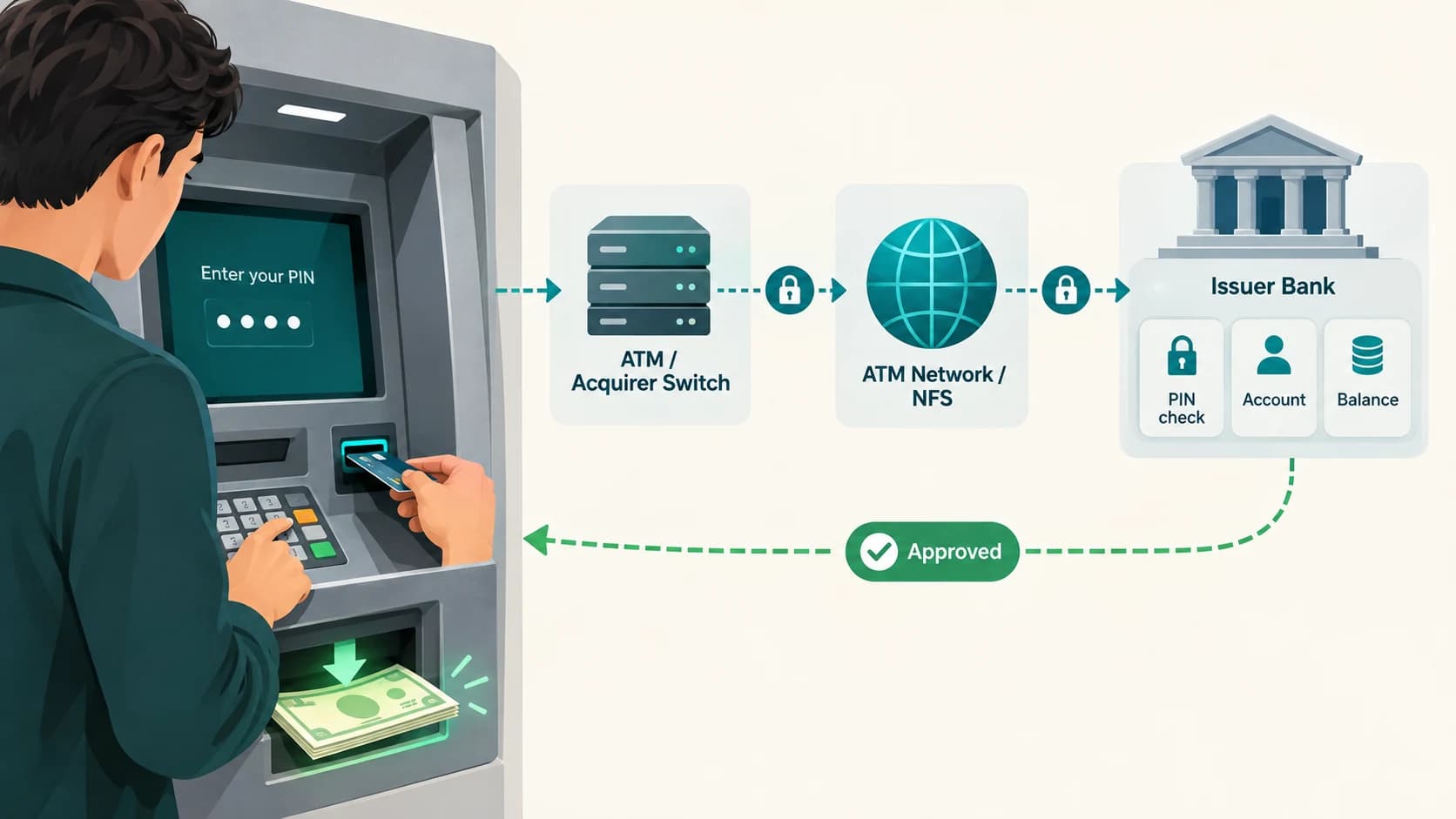
You insert your debit card into an ATM.
You enter your PIN.
You choose:
Cash Withdrawal → Savings → ₹5,000
For a brief moment, the screen says:
Processing...
Then the machine starts counting notes.
What happened during those few seconds?
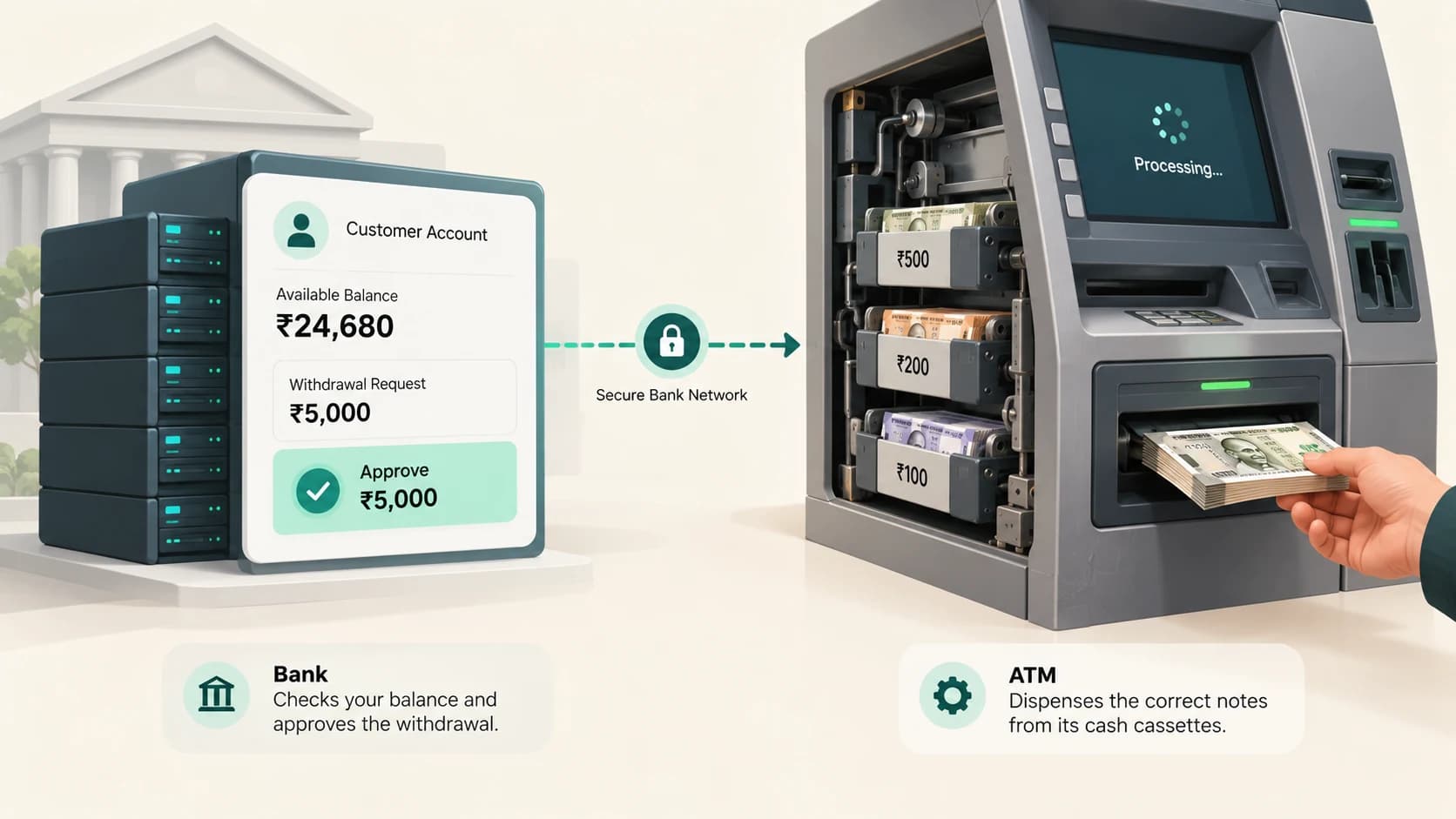
The ATM did not already know your account balance.
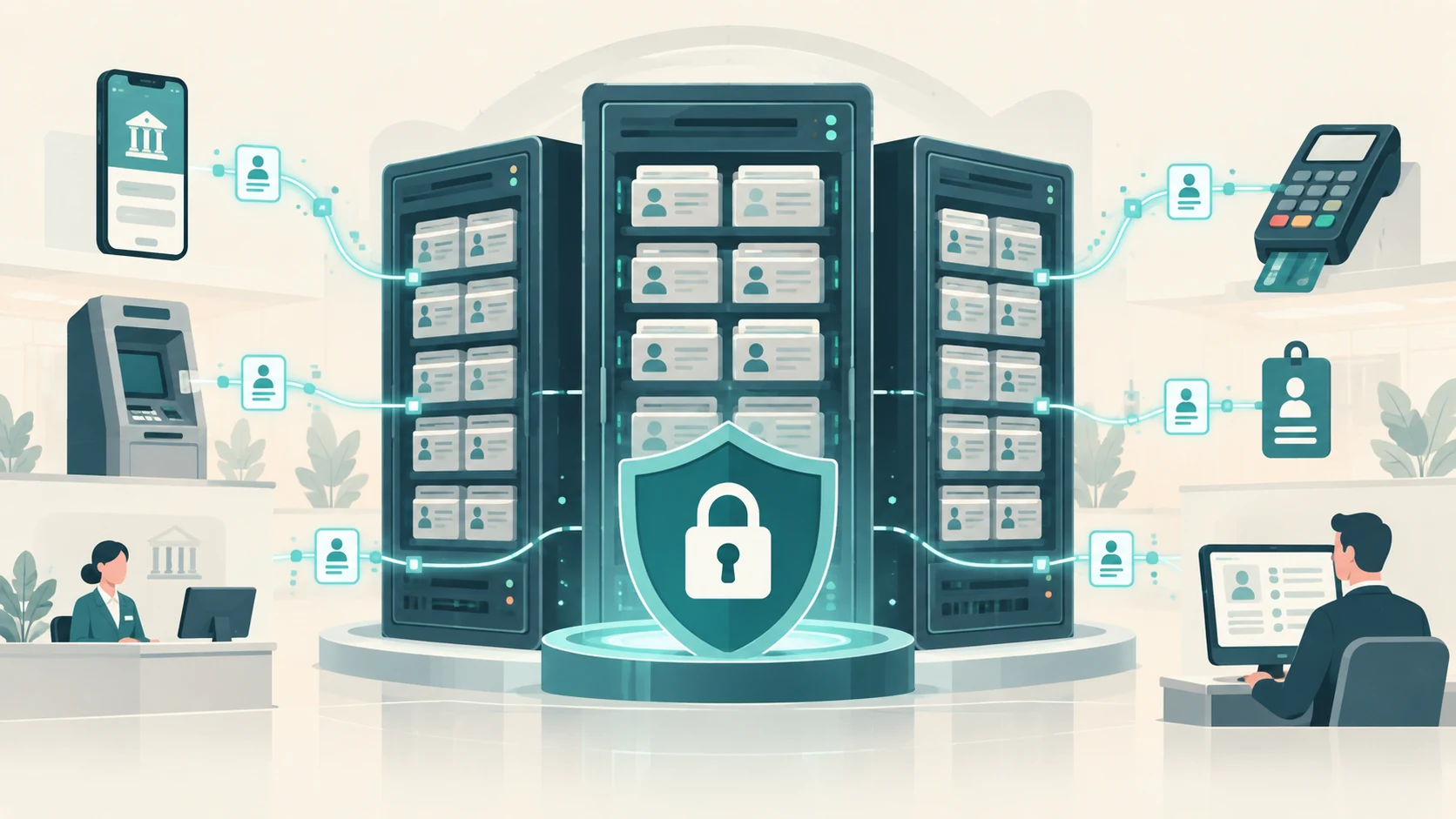
It did not contain a copy of your bank's customer database.
And if you were using another bank's ATM, that machine did not have direct access to your bank account either.
Instead, the ATM created a secure electronic request and sent it through a chain of payment systems.
For a withdrawal at your own bank's ATM, the route may remain largely inside that bank's infrastructure.
For a withdrawal at another bank's ATM, the request can travel through an interoperable ATM network such as NPCI's National Financial Switch (NFS) before reaching the bank that issued your card.
RBI describes NFS as the system connecting ATMs across India for card transactions, while NPCI describes it as the country's leading shared ATM network.
A simple withdrawal therefore involves two very different machines:
the ATM, which controls the physical cash
and
your bank's systems, which decide whether that cash may be given to you.
An ATM Is Mostly a Secure Banking Terminal
An ATM contains much more than a cash dispenser.
Depending on the model, it can contain:
- card reader,
- encrypted PIN keypad,
- display and function keys or touchscreen,
- receipt printer,
- cash cassettes,
- note-picking and dispensing mechanism,
- sensors,
- security modules,
- network connection,
- ATM application software.
Some ATMs can also accept deposits.
But the important point is that the machine is a terminal connected to banking infrastructure.
The ATM can collect your request and physically handle cash.
It is not the final authority on whether your account can be debited.
That decision normally belongs to the issuer—the institution that issued your card and maintains the relevant account or card relationship.
The Card Tells the ATM Which Banking Relationship to Use
When you insert an EMV chip debit card, the ATM reads information needed to process the transaction.
Modern Indian banking guidance strongly favours EMV chip-and-PIN cards rather than old magnetic-stripe-only cards.
EMVCo explains that an EMV contact chip can cryptographically authenticate card data and generate transaction-specific security information, making simple counterfeit-card reproduction much more difficult than with static magnetic-stripe data.
The ATM does not need to read:
“Akhilesh has ₹42,850 in Account X.”
That balance is not simply stored on the debit card for the ATM to trust.
Instead, the card provides identifiers and security data that allow the payment infrastructure to determine:
- which card scheme or network is relevant,
- which institution issued the card,
- what transaction information should be sent for authorization.
The live balance remains in the issuer's banking systems.
What Does Your PIN Actually Do?
Your PIN proves that the person using the card knows the secret credential associated with it.
But a well-designed ATM system does not simply send a message saying:
PIN = 1234
across the network.
Payment systems use cryptography to protect PIN information.
RBI's card-payment security directions require sensitive PIN-related cryptographic processing to be handled using secure infrastructure such as Hardware Security Modules (HSMs).
RBI specifically requires decryption and validation of keys and PINs to take place within HSM-controlled environments and requires secure PIN-block handling.
An HSM is a specialized cryptographic device built to protect secret keys and sensitive payment operations.
So a useful simplified mental model is:
You type the PIN
↓
ATM's secure PIN-entry device protects it cryptographically
↓
protected PIN information travels with the authorization request
↓
issuer-side secure systems verify it
The ATM operator should not receive your PIN as ordinary readable text.
Step 1: You Build a Withdrawal Request
Suppose you choose:
Savings account
₹5,000 withdrawal
The ATM now has enough information to create a transaction request.
Conceptually, the message can include fields such as:
- card/account-related identifier,
- transaction type,
- requested amount,
- ATM identifier,
- date and time,
- protected PIN information,
- EMV chip data,
- routing and network information.
Financial institutions commonly exchange card-originated transaction messages using standards and network profiles based on the ISO 8583 family.
The current ISO 8583:2023 standard defines a common interface and structured message format for exchanging financial-card transaction messages between acquirers and issuers.
It does not define every detail of how each network transports or settles those messages.
Think of ISO 8583 as a structured language in which systems can express ideas such as:
“Card X is requesting a ₹5,000 cash withdrawal at ATM Y.”
The real network message is far more compact and technical.
Step 2: The ATM Sends the Request to Its Acquiring Side
Every ATM belongs to, or is operated for, an institution that accepts the transaction.
That side is generally called the acquirer.
If you are standing at Bank B's ATM while using a debit card issued by Bank A:
Bank A = issuer
Bank B = ATM acquirer/operator side
The ATM normally connects first to the acquiring institution's ATM switch or processor.
A switch is a routing system.
Its job is to examine the transaction and decide where it should go next.
The ATM itself does not maintain direct private connections to every bank whose cards could ever be inserted.
That would be extremely difficult to scale.
Shared networks solve that problem.
On-Us: When the ATM and Card Belong to the Same Bank
Suppose:
Card issued by Bank A
and
ATM operated by Bank A
RBI calls this an On-Us transaction.
The request can remain largely within Bank A's own transaction infrastructure.
A simplified route could be:
Bank A ATM
↓
Bank A ATM switch / card system
↓
Bank A authorization systems / HSM
↓
Bank A core banking or account system
↓
approval or decline
↓
Bank A ATM
There is no need to route the transaction to another bank merely to ask whether Bank A's own customer can withdraw money from Bank A's own ATM.
Off-Us: When You Use Another Bank's ATM
Now suppose:
Card issued by Bank A
but
ATM belongs to Bank B
RBI calls this an Off-Us transaction.
Bank B does not know whether Bank A's customer:
- entered the correct PIN,
- has enough money,
- has exceeded a withdrawal limit,
- has a blocked card.
So Bank B must ask Bank A.
This is where an interoperable ATM network becomes important.
A simplified Indian domestic route can look like:
Bank B ATM
↓
Bank B acquirer switch
↓
NPCI National Financial Switch
↓
Bank A issuer switch
↓
Bank A secure authorization / account systems
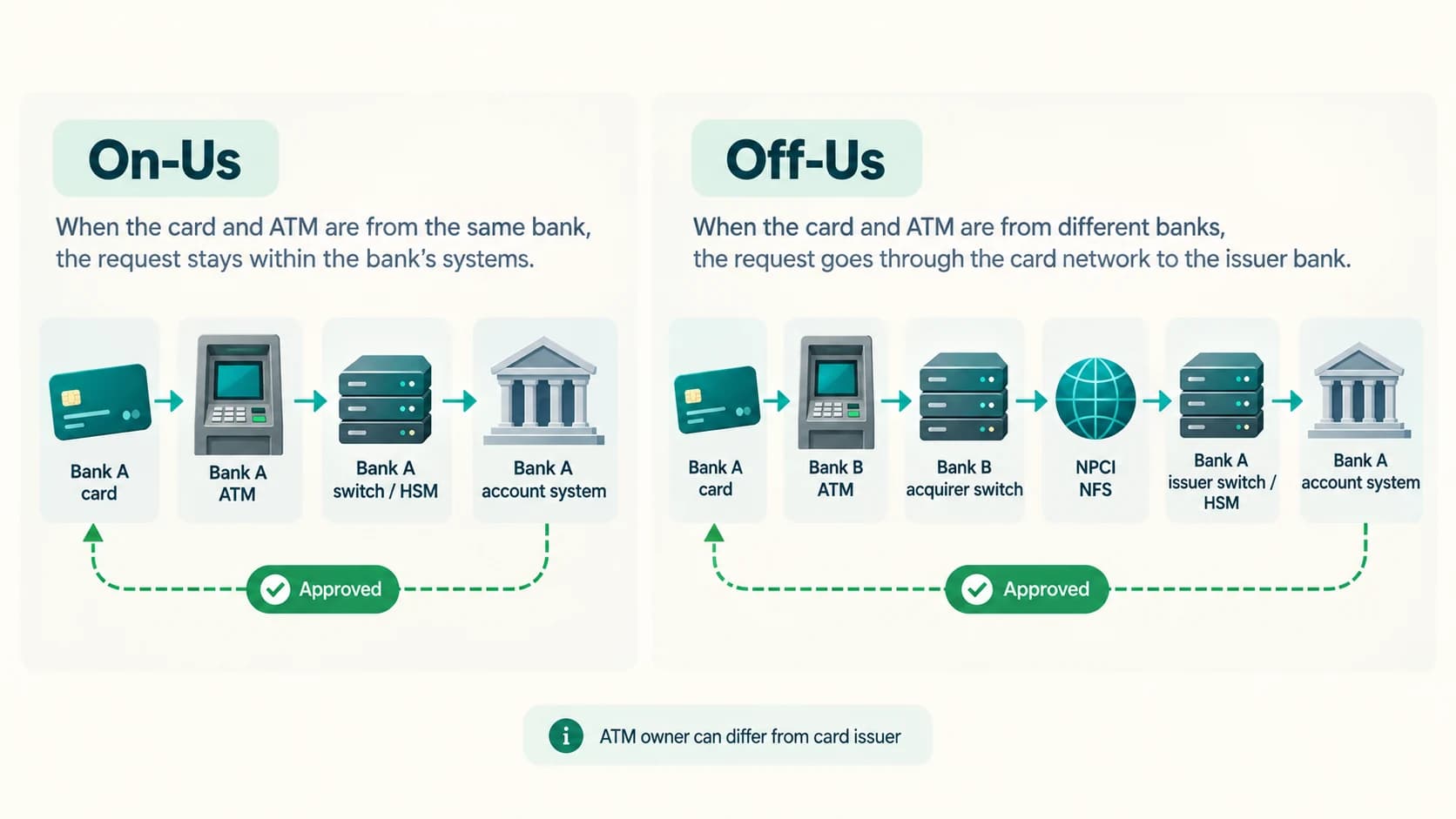
NPCI's NFS material describes the network as enabling interbank ATM transactions, and an NPCI NFS process note illustrates this same basic architecture: an acquiring ATM and switch route a card-and-PIN request through NFS to the issuer switch and issuer core-banking environment.
NFS Is the Traffic Junction Between Banks
The National Financial Switch does not need to know your complete banking life.
Its main role in this flow is network interoperability and switching.
It allows one member's ATM to communicate with another member that issued the card.
That is what makes this possible:
Insert Bank A's debit card into Bank B's ATM and still withdraw money.
Without a shared switch, every bank would need many separate bilateral ATM connections.
A network creates a common junction.
NPCI says NFS is India's leading ATM network and provides services such as:
- ATM cash withdrawal,
- balance enquiry,
- PIN-related services,
- additional interoperable services where enabled.
RBI similarly describes NFS as connecting ATMs across the country for card transactions.
Step 3: Your Bank Receives the Authorization Request
The request eventually reaches the issuer—your card-issuing bank.
Now the real decision begins.
Your bank may check several things very quickly:
- Is the card valid and active?
- Is the PIN valid?
- Is the account allowed to perform this transaction?
- Is sufficient balance available?
- Is the requested amount within applicable limits?
- Does the transaction trigger fraud or risk controls?
- Is the card/account restricted?
The exact checks differ between institutions and card products.
The important point is:
the ATM asks; the issuer decides.
If the issuer approves the ₹5,000 withdrawal, the account is debited or the transaction is otherwise posted according to the bank's processing design.
The issuer then creates an approval response.
If something fails, it creates a decline response with an appropriate response code.
Why Does the Bank Response Arrive So Fast?
The transaction message is tiny compared with video, photos or other internet traffic.
It does not need to transmit a bank statement or download your whole account.
The systems exchange only the information needed for the authorization.
They are also designed specifically for low-latency financial messaging.
So the full round trip:
ATM → switch → network → issuer → response
can happen in seconds.
A customer's perception is simply:
Processing...
Behind that screen, several computers may have exchanged multiple secure messages.
Step 4: The Approval Travels Back to the ATM
For an off-us transaction, the response travels back roughly along the reverse route:
Bank A issuer
↓
NFS
↓
Bank B acquiring switch
↓
Bank B ATM
The ATM receives something conceptually like:
Approved — dispense ₹5,000
or:
Declined — do not dispense
Only after approval does the physical cash-handling system become the main actor.
Step 5: The ATM Counts the Notes
Inside the ATM are cash cassettes loaded with notes.
The machine knows the denominations available in its cassettes.
To dispense ₹5,000, the ATM's software determines an appropriate note combination.
The mechanical dispenser then:
- picks notes from the required cassette,
- moves them through internal rollers,
- uses sensors to detect note movement,
- checks for problems such as double picks or jams,
- stages or presents the notes at the cash slot.
If the machine detects a note it cannot safely dispense, that note can be diverted internally rather than given to the customer.
This physical stage is separate from bank authorization.
Your bank says:
₹5,000 is approved.
The ATM's mechanics still have to successfully produce ₹5,000 in cash.
Why Does the ATM Need Sensors After Approval?
Because digital approval does not guarantee mechanical success.
An ATM can encounter:
- empty cassette,
- jammed note,
- double-note detection,
- shutter problem,
- communication failure,
- power interruption.
The machine therefore needs to know whether the cash was actually dispensed.
This distinction explains one of the most frustrating ATM problems:
account debited, but cash not received.
The banking authorization may have succeeded even though the physical cash operation failed.
What Happens If the Account Is Debited but No Cash Comes Out?
Payment networks include reversal and reconciliation processes for this situation.
If a withdrawal fails after authorization, the ATM/acquiring side can generate transaction information indicating that the cash was not successfully completed.
The issuer can then reverse the debit.
RBI's current ATM FAQ states that a failed ATM transaction in which the customer's account is debited but cash is not dispensed must be re-credited within a maximum of T+5 calendar days, where T is the transaction date.
RBI also requires compensation of ₹100 per day for delay beyond that limit.
The customer should still report the failed transaction promptly to the card-issuing bank or ATM owner.
A reversal is not the ATM “sending the notes back electronically.”
It is another financial message correcting the account after the cash-delivery part failed.
How Does the Bank Know Whether Cash Was Actually Dispensed?
ATMs and switches maintain detailed electronic records.
These can include:
- authorization request and response,
- ATM journal,
- transaction identifiers,
- cash-dispenser status,
- reversal messages,
- cassette counters,
- error codes.
The issuer, acquirer and network can reconcile these records.
If the customer says:
“My account was debited but I received nothing,”
the dispute can be investigated by comparing what the different systems recorded.
RBI says disputes involving failed ATM transactions between issuer and acquirer are handled through the ATM system provider's dispute-resolution mechanism.
What About Balance Enquiries?
A balance enquiry follows a similar network pattern but without dispensing cash.
For an off-us enquiry:
ATM
↓
acquirer switch
↓
NFS / network
↓
issuer
The issuer retrieves the appropriate account information and sends back the permitted balance result.
The ATM then displays it.
Again, the other bank's ATM does not need to contain a copy of your account.
It simply asks your issuer through the network.
Why Can Your Card Work at Almost Any Bank's ATM?
Because the front of the ATM and the back-end banking network are separated.
The machine needs to support the relevant card/network rules.
The switches need to route the message correctly.
The issuer must recognize and authorize the card.
RBI's ATM FAQ says cards issued by banks in India can be used at other banks' ATMs or White Label ATMs, subject to the relevant card and account conditions.
This interoperability is one of the major achievements of shared ATM networks.
It is also why the logo printed on the ATM does not necessarily have to match the logo on your debit card.
What Is a White Label ATM?
A White Label ATM, or WLA, is an ATM operated by an authorized non-bank entity rather than a traditional bank branch network.
From the customer's perspective, the machine can still accept supported bank-issued cards and route transactions through the interoperable ATM ecosystem.
RBI treats a transaction at a WLA using another institution's card as an off-us transaction.
The underlying principle remains:
ATM operator and card issuer can be different organizations.
The network connects them.
Where Does the Cash Actually Come From?
This creates an interesting distinction.
If you use Bank B's ATM with Bank A's card:
your account at Bank A is debited
but
the physical notes come from Bank B's ATM cash inventory.
So Bank A is not transporting ₹5,000 in notes across the network to the ATM.
Digital systems record the financial obligations created by the withdrawal.
The ATM gives you cash that was already inside its cassettes.
Interbank clearing and settlement processes later account for the money owed between participants.
This is another example of why transaction authorization and financial settlement should not be confused.
Does the ATM Send Your Entire Card Number Everywhere?
Payment networks need identifiers to route and authorize card transactions, but card data is subject to strict security controls.
RBI's card-payment security directions require regulated entities to secure:
- card data,
- cryptographic keys,
- PIN processing,
- ATM infrastructure,
- network communications.
EMV chips also reduce dependence on static magnetic-stripe data by adding transaction-specific cryptographic security.
This does not make card fraud impossible.
It does make the modern ATM flow far more complex than simply:
read card number + send PIN.
Why Can't Someone Just Record the PIN Message and Reuse It?
Payment systems use layered security.
At a high level, these protections can include:
- encrypted PIN handling,
- protected cryptographic keys,
- HSMs,
- EMV chip transaction data,
- ATM terminal security,
- issuer fraud monitoring,
- transaction-specific information.
PCI's Hardware Security Module standard describes HSMs as devices used for cryptographic key management and protection of sensitive payment data, including PIN processing.
RBI requires banks and other regulated entities to use secure PIN-block formats and HSM controls for sensitive card-payment processing.
The exact cryptographic keys and internal issuer logic are deliberately not exposed to ATM users—or attackers.
The ATM Is Not “Connected Directly to Your Account”
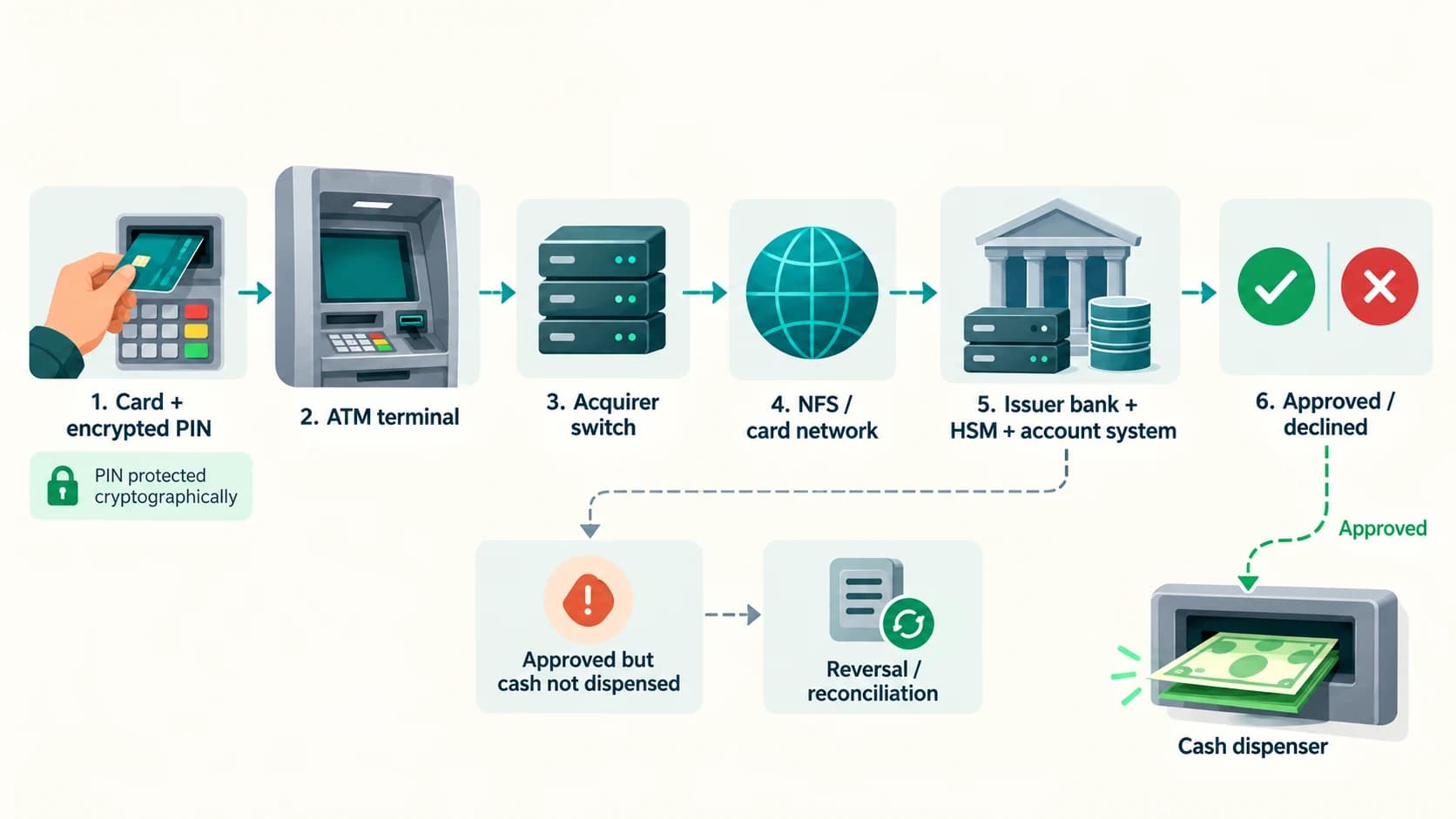
A better mental model is:
Physical layer
The ATM reads the card, receives the PIN and handles cash.
Acquiring layer
The ATM owner's switch receives and routes the request.
Network layer
NFS or another relevant card network routes an off-us request toward the issuer.
Issuing layer
Your bank verifies credentials, account status and funds.
Response layer
Approval or decline travels back.
Cash layer
The ATM dispenses cash only after approval.
This separation makes the system scalable.
A Bank B ATM does not need special software for every possible Bank A customer.
It only needs to speak the agreed network protocols.
What Happens in Those Few Seconds?
A typical off-us cash withdrawal can be simplified into this sequence:
1. Card is inserted
The ATM reads supported card and EMV data.
2. PIN is entered
The secure PIN-entry system cryptographically protects the PIN information.
3. Amount is selected
The ATM builds an authorization request.
4. ATM sends the request to its acquirer switch
The machine's owner/operator begins routing the transaction.
5. The shared ATM network routes it
For a domestic NFS transaction, NPCI's switch identifies the issuer destination.
6. Your bank authorizes the request
The issuer verifies the card, protected PIN, account status, balance and applicable controls.
7. Approval returns to the ATM
The authorization response travels back through the network.
8. Cash is dispensed
The ATM's mechanical cash unit picks, checks and presents the notes.
9. Records are reconciled
Issuer, acquirer and network maintain records for clearing, settlement and dispute handling.
The entire chain can happen before you have finished wondering why the machine is taking so long.
The Screen Is Simple Because the Network Is Complicated
From the user's point of view, an ATM withdrawal contains only a few choices:
Insert card
Enter PIN
Choose amount
Take cash
That simplicity hides several specialized systems:
- EMV chip technology,
- secure PIN encryption,
- ATM terminal software,
- bank switches,
- NPCI NFS or other card networks,
- issuer authorization systems,
- HSMs,
- core banking,
- cash-dispenser sensors,
- reconciliation and reversal systems.
None of them alone is “the ATM transaction.”
The withdrawal works because they agree on how to talk to one another.
The ATM controls the machine in front of you.
The acquirer controls the connection from that machine.
The network finds your issuer.
Your bank decides whether the withdrawal is allowed.
And only after that approval returns does the ATM turn a digital authorization into physical currency.
That is how an ATM communicates with your bank—even when your bank may be hundreds of kilometres away and the machine belongs to somebody else.