Why Do Banks Give Credit-Card Rewards? The Business Behind Cashback and Points
Learn how banks can afford cashback, points and miles, and how interchange, fees, interest and partnerships make credit-card rewards work.
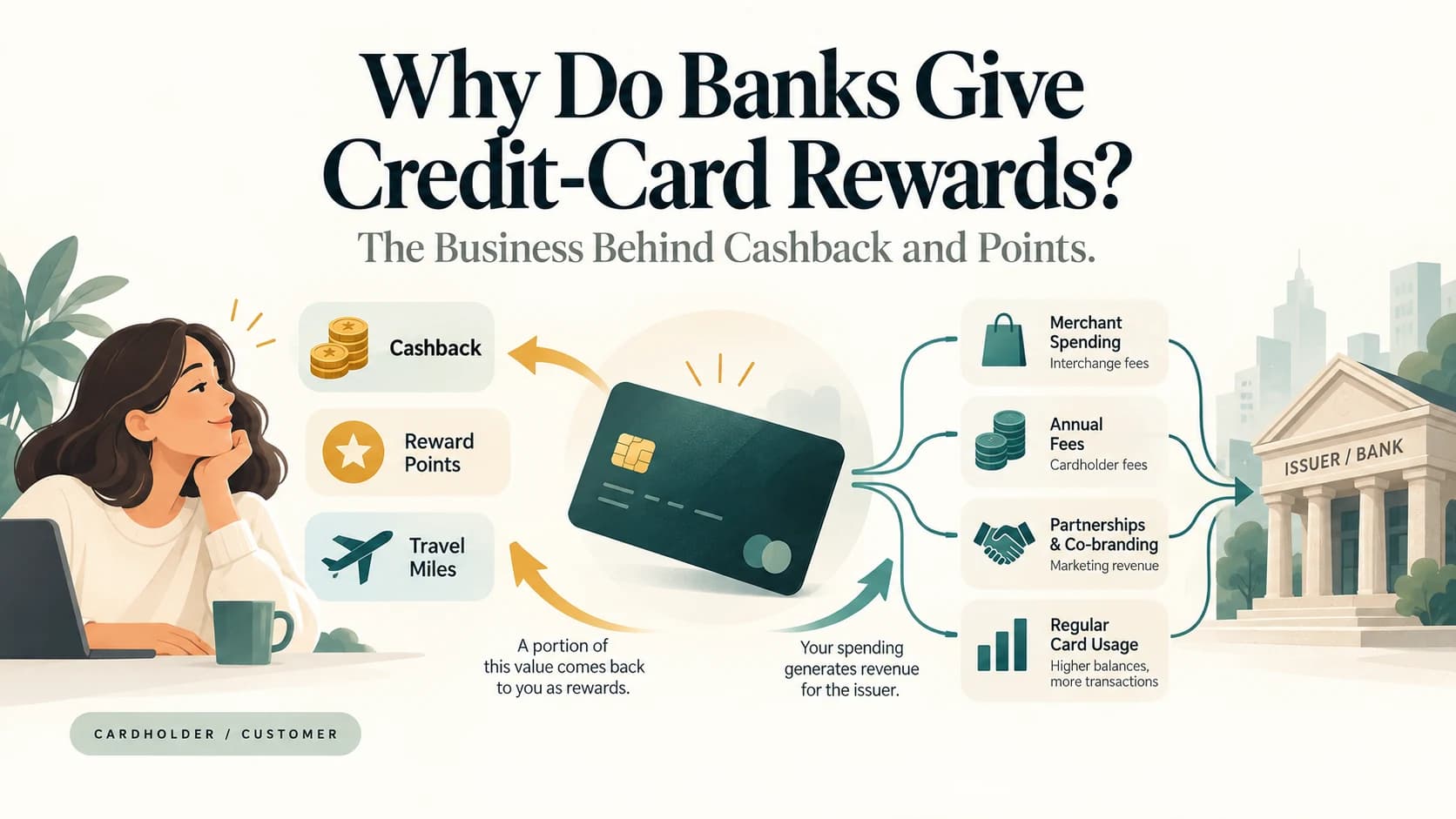
A credit card can give you 1% cashback, airline miles, shopping vouchers, lounge access or reward points that can be converted into something of real value.
At first glance, that seems odd.
If you spend ₹10,000 and the bank gives you ₹100 or ₹500 back, why would it willingly reduce what it earns? And if you always pay your bill in full and never pay interest, is the bank actually making any money from you?
Usually, yes.
Credit-card rewards are not gifts in the ordinary sense. They are part of the economics of the card business. Banks and card issuers use them to encourage spending, attract customers, keep cards active and compete for a larger share of your everyday payments.
To understand why rewards exist, we need to follow the money behind a card transaction.
A card payment involves more than you and the shop
Suppose you use a credit card to buy something for ₹5,000.
To you, the transaction looks simple:
You → merchant → ₹5,000 purchase
Behind the scenes, several parties may be involved:
- Cardholder: you.
- Merchant: the shop or website accepting the card.
- Acquirer: the bank or payment provider that enables the merchant to accept card payments.
- Card network: such as Visa, Mastercard or RuPay, which connects the participants and provides payment-network rules and infrastructure.
- Issuer: the bank or card company that issued your credit card and extends credit to you.
The merchant does not usually receive the full ₹5,000 without any payment-processing cost. Under its agreement with the acquirer, it typically pays a merchant discount or merchant service charge.
That merchant-side fee should not be confused with the issuer's reward to you.
Part of the transaction economics can flow through the system as interchange: a fee transferred from the acquiring side to the card-issuing side under the rules of the relevant card network.
Visa describes interchange as a transfer fee between acquiring and issuing institutions. NPCI similarly describes interchange as a fee payable by the acquirer to the issuer in card-payment arrangements.
So a simplified transaction looks like this:
Merchant pays acquiring/processing charges → acquirer and network participate in the payment economics → issuer may receive interchange
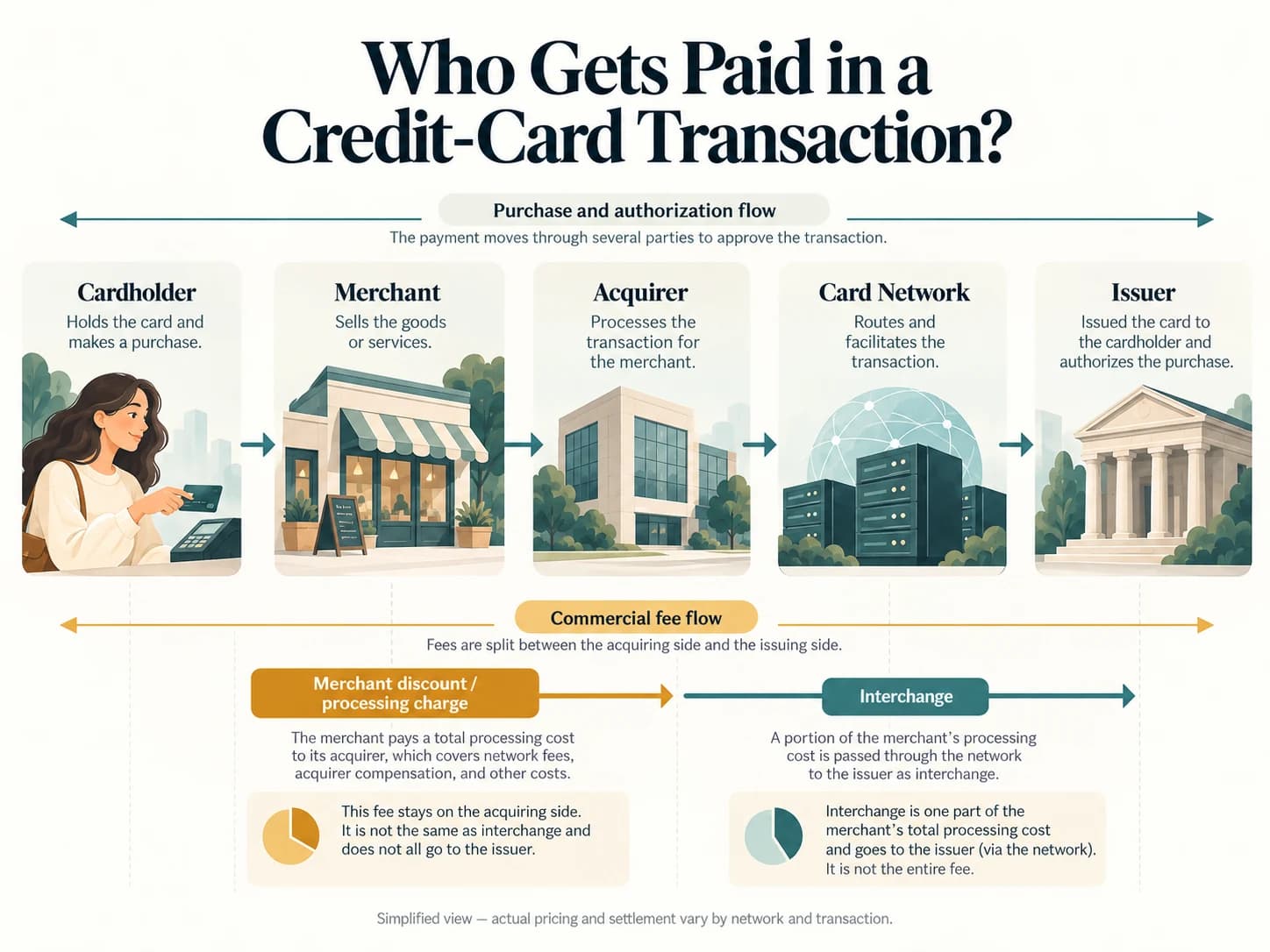
The exact fee structure varies by network, card type, merchant category, transaction type and commercial arrangement. The merchant's total fee is not simply handed to your bank as profit.
That distinction matters.
Interchange is one reason spending can be valuable to the card issuer
Every time you use the card for an eligible purchase, the issuer may earn spend-linked interchange income.
That creates a basic business incentive:
More card spending can mean more transaction-linked revenue.
This is why rewards are often designed around spending.
NPCI has explicitly described credit-card reward points as a lever to drive card spending. In 2024, it also directed issuers to provide comparable rewards and benefits on eligible RuPay credit-card UPI transactions, with an exception for transactions where the issuer does not earn interchange.
That does not mean every rupee of cashback is paid directly out of interchange.
It does show that the revenue generated by a transaction can matter to the economics of rewards.
But interchange is only one source of credit-card revenue
A card issuer can make money in several ways.
1. Interest and finance charges
A credit card is also a revolving credit facility.
If a cardholder does not pay the full amount due and carries an eligible balance forward, the issuer can charge interest according to the card's terms.
This can be a major revenue source.
RBI requires card issuers to disclose the Annual Percentage Rate and explain how finance charges are calculated. The actual rates vary by issuer and card.
This is why carrying a balance purely to earn rewards makes little financial sense in most situations. A few percentage points of cashback can easily be outweighed by the cost of revolving credit.
2. Annual and membership fees
Many cards charge joining, annual or renewal fees.
Premium cards can charge substantial fees in return for benefits such as higher reward rates, travel privileges, lounge access or hotel and airline benefits.
Some cards waive the annual fee when the customer crosses a particular yearly spending threshold.
That waiver is itself an incentive.
The issuer is effectively saying:
Use this card enough, and we will give up the renewal fee.
Why would it do that? Because the extra spending can make the relationship more valuable through transaction income and continued customer engagement.
3. Other card fees and services
Depending on the product and customer behaviour, issuers can also earn revenue from permitted charges and services such as certain cash advances, EMI conversions, balance transfers, late-payment charges or other card-related services.
These vary widely between cards and must be disclosed under applicable rules.
4. Partnerships and co-branded cards
Many cards are built around airlines, hotels, retailers, food-delivery platforms or other brands.
In these arrangements, the economics can involve more than the issuing bank.
A merchant or co-brand partner may fund part of a promotion. A card network may provide volume-linked incentives. The issuer may receive income for marketing or other agreed services. Benefits may also be purchased from partners at commercial rates rather than at the customer's perceived retail value.
SBI Card's financial disclosures, for example, describe income from interchange, memberships, co-brand and promotional arrangements, and business-development incentives from network partners.
So when a card offers a large discount at a particular merchant, it is not safe to assume the bank alone is paying for the entire offer.
The bank does not need you to pay interest to make you valuable
This is one of the biggest misconceptions about credit cards.
Cardholders are sometimes divided informally into two broad groups.
A transactor uses the card and generally pays the full statement balance, avoiding revolving interest.
A revolver carries some balance and may pay finance charges.
A transactor can still be commercially valuable.
Imagine a customer who spends heavily on the card every month, pays on time and keeps the card for years. That customer can generate interchange, may pay an annual fee, may use paid services, and helps the issuer achieve transaction volume.
The issuer also gets a long-term customer relationship that may support other financial products.
A revolver can generate interest income, but lending money also has costs. The issuer needs funding, must manage credit risk and can suffer losses when borrowers default.
So it is too simplistic to say:
"Credit-card companies give rewards because they want you to get into debt."
Debt and interest are part of the business model, but rewards also make economic sense for customers who never pay interest.
Why give some of the revenue back as rewards?
Because the issuer is competing for your behaviour.
Most people can pay using several methods: UPI, debit card, another credit card, cash or a different bank's card.
If you have three credit cards in your wallet, only one can usually get the transaction.
Rewards give you a reason to choose a particular card.
For the issuer, a ₹100 reward can be worthwhile if it changes which card receives thousands of rupees of future spending.
This creates several business benefits.
Rewards encourage card usage
A card sitting unused in a drawer generates little transaction activity.
A card that earns cashback on groceries, fuel, travel or online shopping has a reason to stay at the front of the wallet.
Rewards improve retention
Accumulated points create another reason not to cancel a card.
If you have points waiting to be redeemed, a useful annual benefit or a spending milestone coming up, you are more likely to keep using the product.
Rewards can increase "share of wallet"
Banks do not merely want you to have their card. They want their card to become the one you use most often.
If one card offers 5% back on online shopping while another offers 1%, the reward can redirect spending toward the first issuer.
Rewards help differentiate similar products
Credit cards are fundamentally similar payment-and-credit products.
Rewards allow banks to create different propositions: travel cards, cashback cards, fuel cards, shopping cards and premium lifestyle cards.
The reward structure becomes part of the product design.
Why do some purchases earn 5% while others earn only 1%?
If rewards were simply a fixed share of bank profit, every transaction could earn the same amount.
They do not.
A bank may offer:
- a high rate on selected merchants or categories;
- a lower base rate on ordinary spending;
- monthly or yearly reward caps;
- milestone bonuses after a spending threshold;
- no rewards on certain transaction categories; or
- special promotions for a limited period.
There are several reasons.
The issuer may have a commercial partnership with a particular merchant. The transaction may generate different economics. A temporary offer may be jointly funded. The bank may want to encourage a particular type of spending. Or the higher reward may simply be a customer-acquisition cost that cannot be sustained on unlimited spending.
This is why a card advertising "5% cashback" may not mean 5% on everything.
Caps, exclusions, eligible merchant categories and redemption rules are part of the economics.
Why are reward caps so common?
Consider an unlimited high cashback rate.
A customer could route very large amounts of spending through the card while the issuer pays rewards on every rupee. If the reward cost rises faster than the revenue associated with those transactions, the product stops making economic sense.
A cap limits that risk.
For example, a card may offer an accelerated rate only up to a certain number of points or cashback amount per month, then revert to its normal base reward.
Caps let the issuer advertise an attractive headline benefit while controlling the maximum cost.
They also help prevent unusual or manufactured spending patterns from turning a consumer reward programme into an arbitrage opportunity.
Why are some transactions excluded from rewards?
You may find that a card gives rewards for shopping but not for categories such as rent, wallet loading, government payments, fuel, education or certain EMI transactions.
There is no universal exclusion list. It depends on the card.
But the principle is straightforward: not every transaction has the same economics.
Some transaction types may produce lower revenue, have special fee structures, be expensive to process, be subject to different commercial arrangements or create opportunities for misuse.
An issuer can therefore decide that paying the standard reward rate on those transactions is uneconomic.
Current card terms should always be checked because reward exclusions and caps change regularly.
Why do premium cards give expensive-looking benefits?
A premium card may include airport lounge access, hotel memberships, airline miles, dining privileges or concierge services.
Those benefits can appear more expensive than the annual fee.
But the retail price you see is not necessarily what the issuer pays.
Banks and card networks can negotiate commercial arrangements with lounges, airlines, hotels and other partners. Benefits may also be limited by visits, spending thresholds, geography or eligibility rules.
Premium-card customers are often expected to spend more, maintain the card for longer and use a broader set of services.
That makes the total relationship potentially more valuable even when the visible benefits are generous.
What happens to reward points the bank gives you?
Reward points are not costless accounting magic.
RBI defines card loyalty and reward programmes as benefits with monetary value and requires discounts, cashback, reward points and similar benefits to be offered transparently, including disclosure of their source.
Issuers also have to account for reward obligations in their financial statements.
The eventual cost can depend on the programme: what the points can be redeemed for, what the issuer pays partners, whether redemption fees apply, and how many points are actually redeemed under the programme's rules.
This helps explain why issuers periodically change point values, redemption options, caps or exclusions.
A reward programme has to remain financially sustainable.
A simple way to see the economics
Imagine you make an eligible card purchase.
The economics, simplified, can look like this:
Merchant sale
↓
Merchant pays its acquiring/processing fee
↓
Acquirer, card network and issuer participate in the payment economics
↓
Issuer may earn interchange
↓
Issuer gives you part of the value back through points or cashback
↓
You have a reason to use that card again
Around that core transaction, the issuer can also earn annual fees, finance income, service fees, partner income and network incentives.
Against those revenues are substantial costs: rewards, funding, technology, fraud prevention, customer service, card acquisition, network costs, marketing and credit losses.
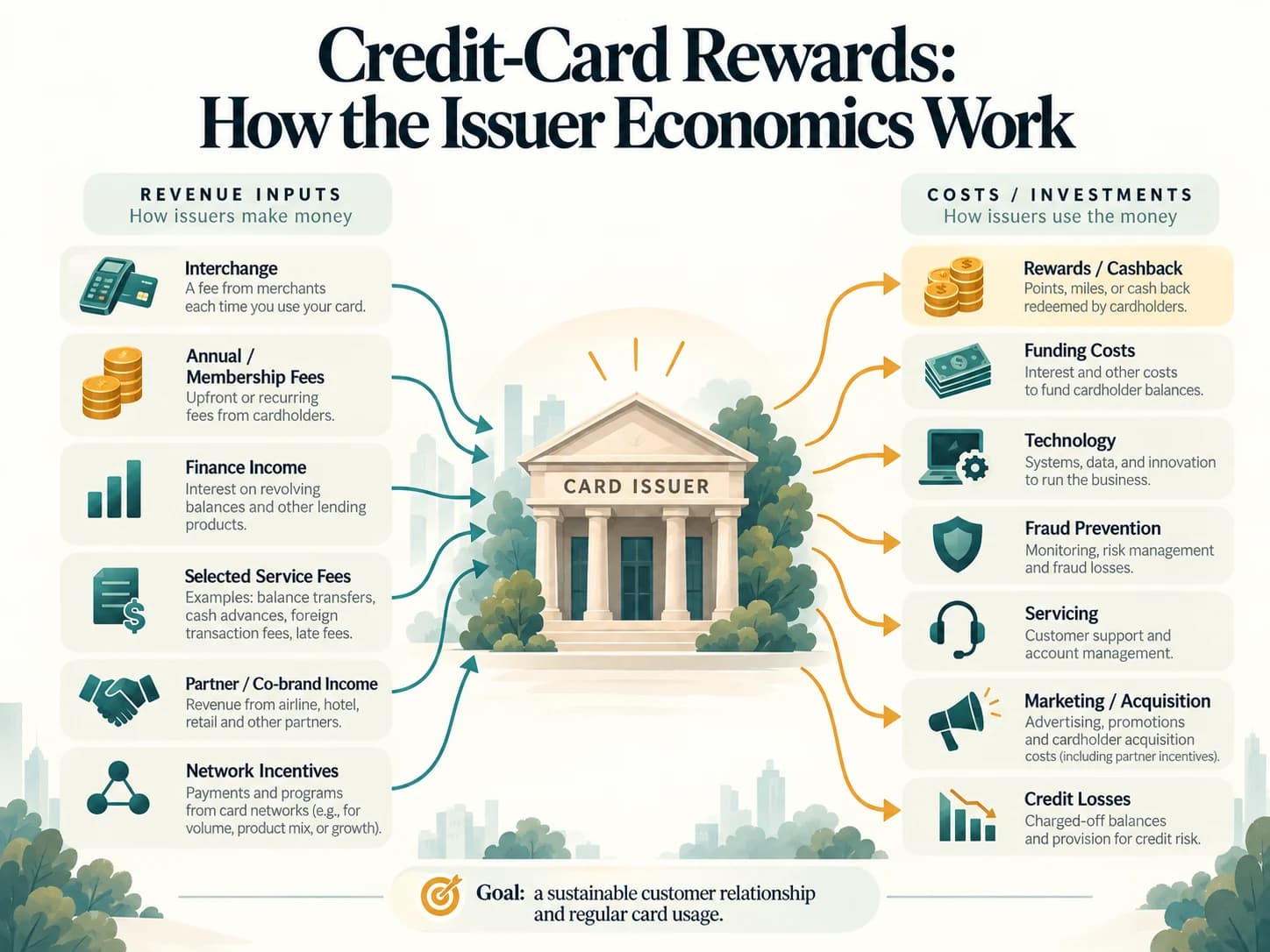
The issuer is therefore not asking whether one ₹5,000 purchase is profitable in isolation.
It is managing the economics of a large portfolio of customers over time.
Are rewards really "free"?
For a disciplined cardholder, they can be a genuine benefit.
If you were going to spend ₹10,000 anyway, you pay the full statement balance by the due date, and the card gives you useful cashback with no extra cost that outweighs it, the reward has real value.
But rewards stop being attractive if they cause you to spend more than you otherwise would or carry expensive debt.
The easiest rule is:
Treat rewards as a discount on planned spending, not as a reason to spend.
A 5% reward on an unnecessary ₹10,000 purchase has not saved you ₹500.
It has encouraged you to spend ₹9,500 net.
And paying interest to chase points can erase their value very quickly.
The next time a bank offers you cashback, look at the other side of the transaction
Credit-card rewards work because a card is more than a borrowing product.
It is also a payment network, a customer-retention product, a merchant ecosystem and a recurring financial relationship.
The bank or card issuer may earn money when you spend, when you maintain a paid card, when you use certain services, through partnerships and, for customers who carry balances, through finance charges.
Rewards give some of that economic value back to the cardholder in exchange for something the issuer wants: your spending, your loyalty and your continued use of the card.
That is why even a customer who never pays a rupee of credit-card interest can still be worth rewarding.