Cash, Debit Card or UPI: Which Should You Use—and When?
Compare cash, debit cards and UPI for everyday payments, security, reliability, online shopping, emergencies and spending control in India.
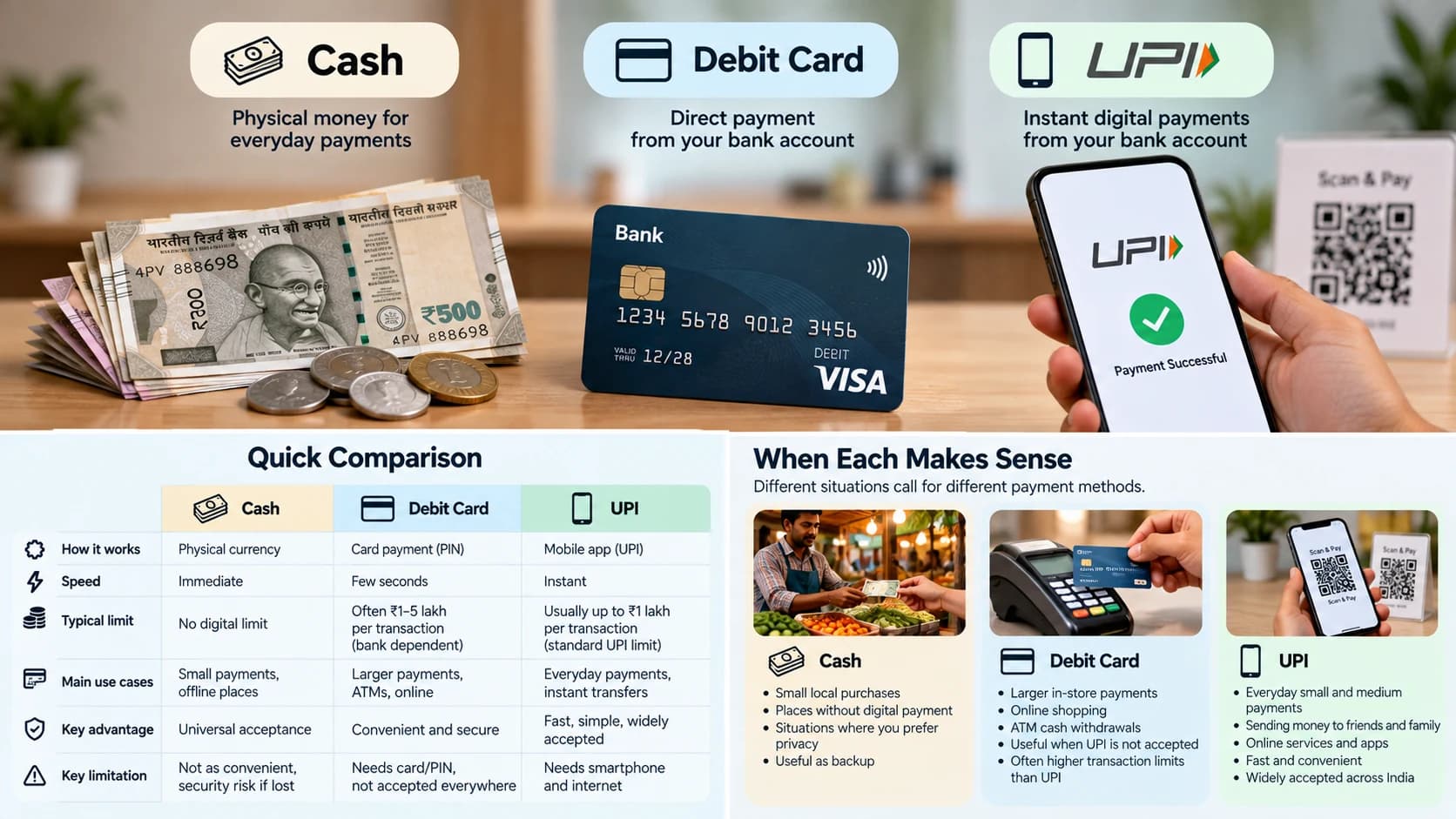
You are standing at a shop counter with three perfectly valid ways to pay: cash in your wallet, a debit card in your pocket, and UPI on your phone.
Which one is best?
There is no universal winner.
UPI is usually the quickest option for everyday payments in India. A debit card can be more useful for some online, international or card-based transactions. Cash still does something neither of them can fully guarantee: it works without a phone, battery, app, QR code or bank server at the moment of payment.
The useful question is therefore not “Which payment method is best?”
It is:
“Which payment method fits this particular situation?”
To answer that, compare them on convenience, acceptance, reliability, spending control, security and what happens when something goes wrong.
The basic difference: they move money in different ways
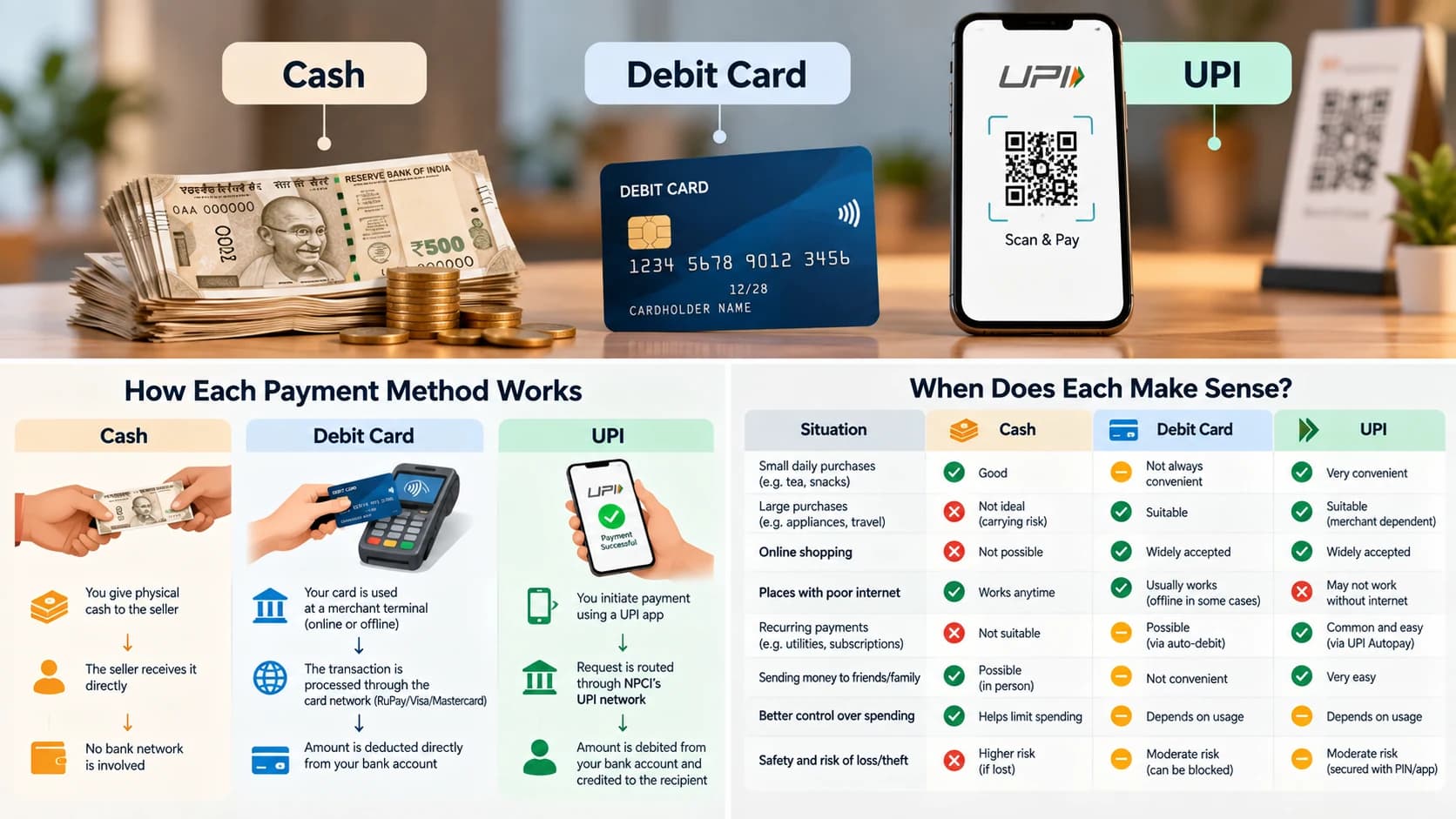
Although all three can pay the same ₹500 bill, they do not work in the same way.
Cash is the payment itself
When you hand over a ₹500 note, no bank needs to authorise the purchase in real time.
Physical rupee banknotes issued by the Reserve Bank of India and valid rupee coins are legal tender subject to the applicable currency rules.
The payment is direct:
You → merchant
Once the merchant accepts the cash and gives you the goods, there is normally no electronic payment system in the middle.
A debit card is an instruction to your bank
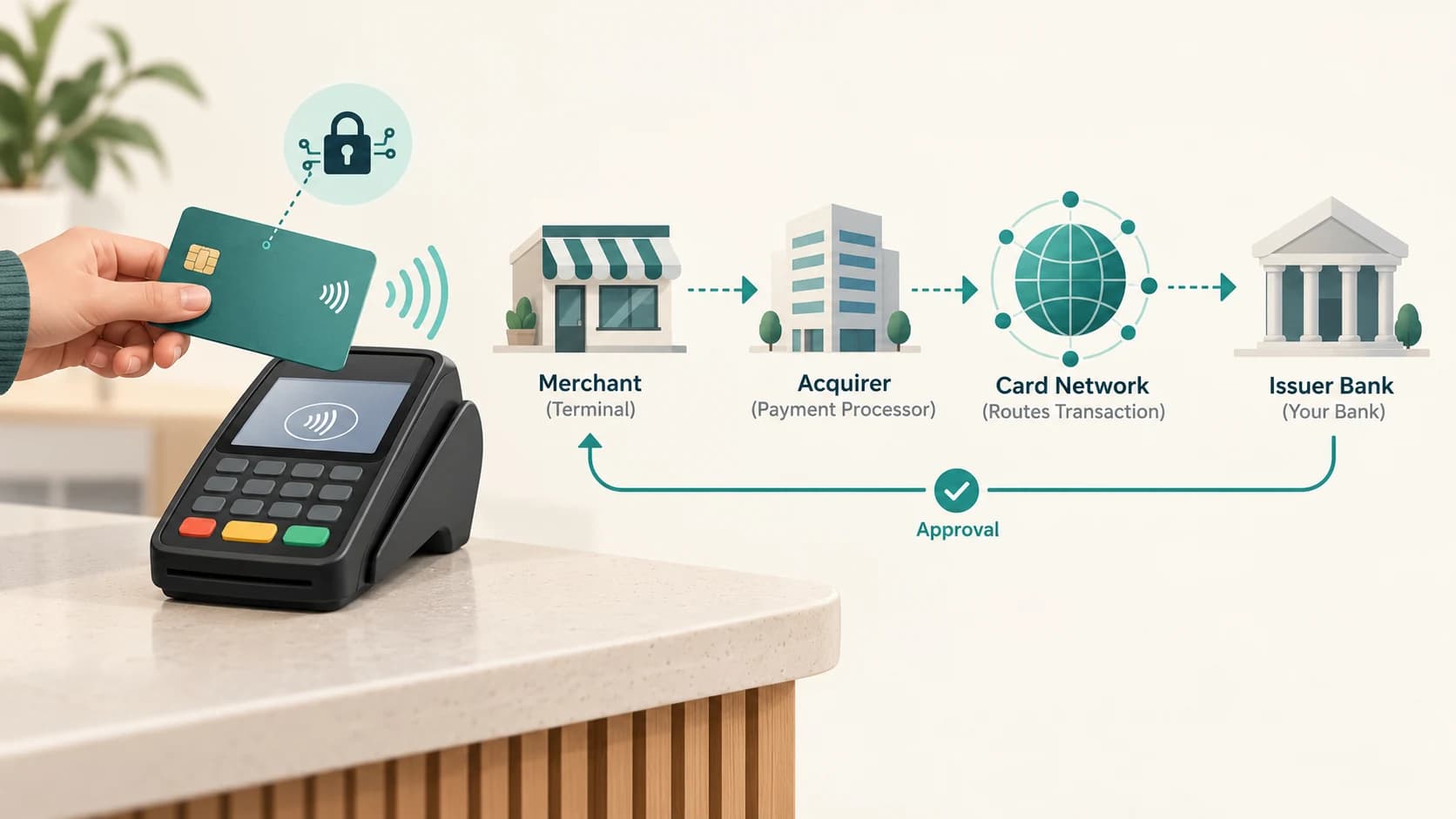
A debit card gives you access to money in your bank account through a card-payment network.
At a shop, the transaction typically passes through the merchant's payment infrastructure, the acquiring side, the card network and your issuing bank.
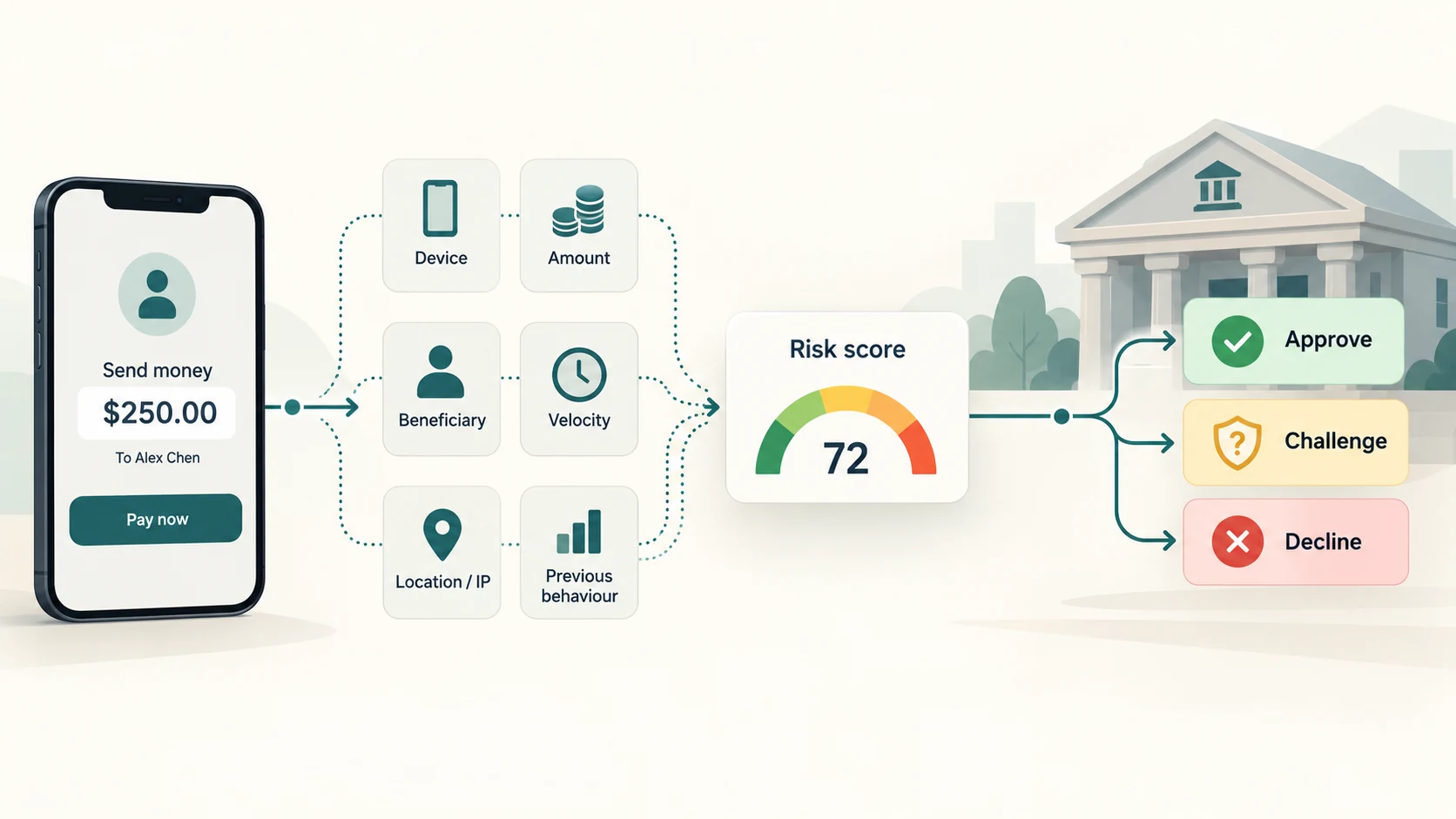
Your bank checks the transaction and, when approved, the amount is debited from the linked account.
The physical card is therefore not money. It is a payment instrument connected to your account.
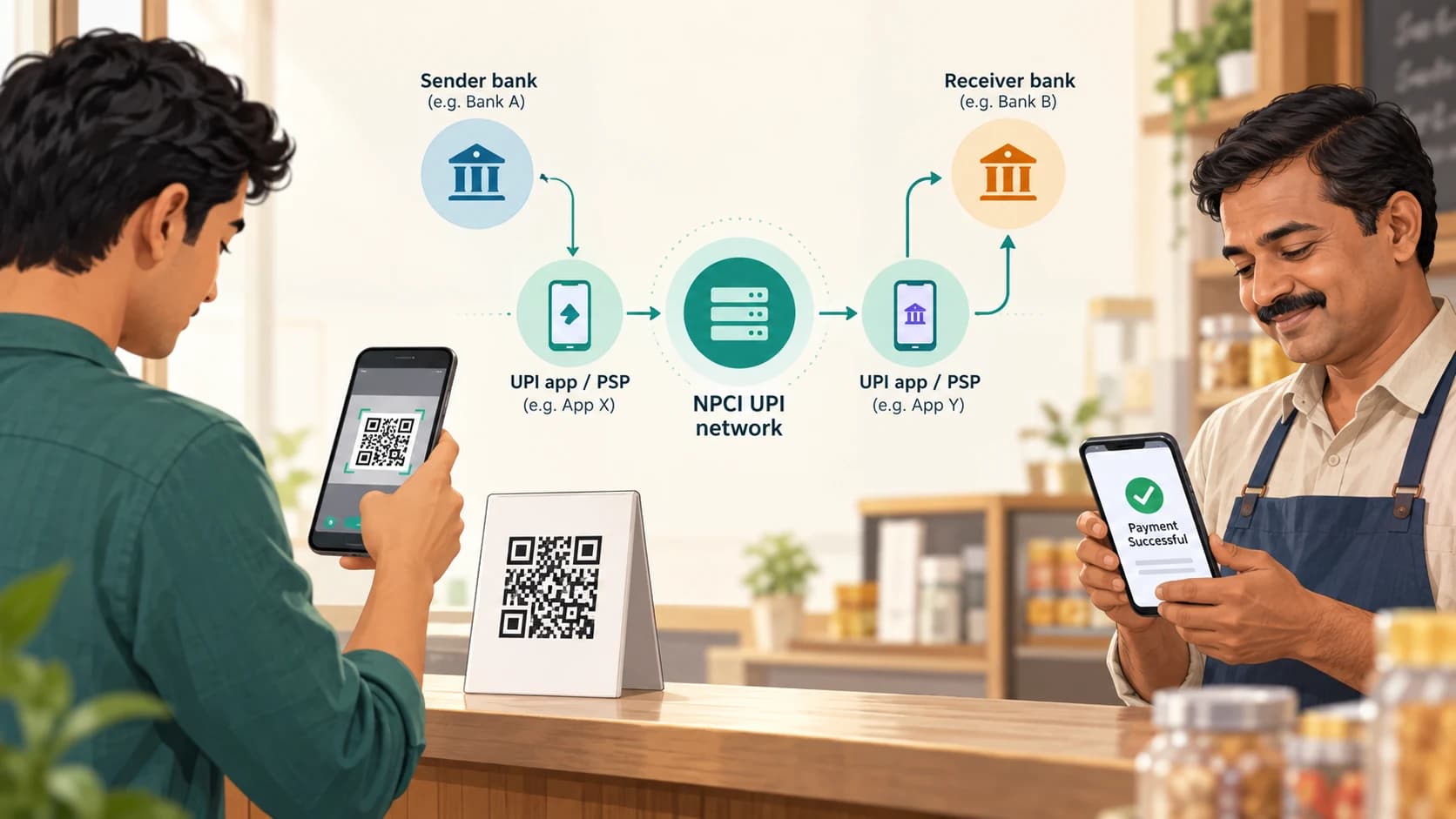
UPI is an account-to-account payment system
UPI also usually draws money from a linked bank account, but instead of presenting a card you initiate the payment through a UPI app.
You might scan a merchant's QR code, enter a UPI ID or choose a saved beneficiary.
The transaction is then routed through the UPI ecosystem between the participating institutions.
So all three can produce the same result—₹500 leaves you and reaches the seller—but the path is very different.
When UPI makes the most sense
For ordinary payments in India, UPI is often difficult to beat on convenience.
A small roadside seller may not have a card terminal but can display a QR code. You do not need to carry change. You can pay a friend without knowing their bank account number and IFSC. And the transaction creates a digital record in your app and bank account.
UPI is particularly useful for:
- small and medium everyday purchases;
- paying local shops and service providers;
- sending money to friends or family;
- splitting restaurant or household expenses;
- paying a merchant that accepts QR payments but not cards; and
- situations where you want an immediate digital record.
For normal UPI transactions, NPCI's public FAQ states a standard ceiling of up to ₹1 lakh per transaction. Higher limits apply to certain specified categories, and NPCI expanded some verified-merchant categories in 2025 to limits as high as ₹5 lakh per transaction. Banks can still set their own internal limits within the overall framework.
So you should not assume that every UPI payment has the same limit.
Why UPI is so convenient for small payments
With cash, you may need exact change.
With a card, the merchant needs card-acceptance infrastructure.
With UPI, the merchant can accept a payment with a printed QR code while the payer uses their own phone.
That makes it particularly suited to India's enormous range of merchants—from supermarkets to small neighbourhood stores.
What UPI depends on
UPI's biggest strength is also its weakness: it is a live digital payment system.
A normal payment can fail or become inconvenient if:
- your phone battery is dead;
- mobile data or connectivity is poor;
- your bank or the beneficiary bank is experiencing technical problems;
- the UPI app is unavailable;
- you have reached a bank or transaction limit; or
- you cannot access your phone.
NPCI itself distinguishes between business declines, such as exceeding limits or entering incorrect information, and technical declines caused by system or network problems.
That is why relying on UPI as your only means of payment is less resilient than carrying a backup.
When a debit card makes more sense
UPI has replaced many day-to-day card payments in India, but debit cards still have useful jobs.
A debit card can make sense when:
- a merchant accepts cards but does not support your preferred UPI method;
- you are making an online payment where card checkout is more convenient or specifically supported;
- you are using an ATM;
- you need a card for an international transaction and international usage is enabled;
- a website or service is built around card credentials or tokenised card payments; or
- your phone is unavailable but the physical card and merchant terminal are working.
Debit cards can work independently of your phone
A physical debit card does not normally require you to open a mobile app just to make a standard card-present purchase.
That can be useful if your phone is discharged, damaged or temporarily unavailable.
The card transaction still depends on banking and payment-network infrastructure, so it is not as infrastructure-independent as cash. A terminal or network outage can still stop the transaction.
Cards give you useful control settings
RBI requires issuers to give cardholders facilities to switch transaction channels on or off and set or modify transaction limits through specified channels.
That means you can, for example, keep international, online or contactless usage disabled when you do not need it and enable it when required, subject to your bank's implementation.
For online card payments, tokenisation also reduces the need for merchants to store your actual card number. Under RBI's framework, entities in the payment chain other than card issuers and card networks are generally not permitted to store actual card-on-file data.
None of this makes a card impossible to misuse. It simply gives the payment system additional controls.
When cash still makes sense
Digital payments are convenient enough that cash can feel old-fashioned—until the digital system you need is unavailable.
Cash is valuable because it does not require real-time electronic authorisation.
That makes it useful for:
- keeping a small emergency payment reserve;
- places with weak or unreliable connectivity;
- very small transactions where cash is easier for both sides;
- situations where the merchant does not accept your digital method;
- budgeting methods where physically separating money helps you control spending; and
- circumstances where you do not want the payment itself to depend on a phone or payment network.
Cash also has an unusual privacy characteristic: an ordinary cash purchase does not automatically create the same bank-account transaction trail that a card or UPI payment creates.
That does not make cash anonymous in every legal or commercial situation, nor does it override tax, reporting or other legal requirements. It simply means the payment instrument itself does not generate a bank transaction record.
Cash has serious disadvantages too
If you lose a ₹2,000 note, there is no "block cash" button.
If someone steals your wallet, the bank cannot reverse the physical notes that were taken.
Cash can also be inconvenient for large amounts, difficult to replace when lost, and harder to track for personal budgeting unless you record spending yourself.
And for remote purchases, cash may not be practical at all.
So cash is an excellent fallback, but often an inefficient primary method for every transaction.
Which method is safer?
There is no single answer because the risks are different.
Cash risk: possession
With cash, security mainly depends on physical possession.
Lose it, and recovery may be impossible.
But cash cannot be drained from your bank account because you clicked a malicious link or entered a payment PIN into a fraudulent digital flow.
Debit-card risk: card and account credentials
A card can be lost, copied, fraudulently used online or misused if credentials are compromised.
The advantage is that cards can be blocked and transaction channels can be controlled.
RBI also has a customer-liability framework for unauthorised electronic banking transactions.
Where the fault lies with the bank, the customer can have zero liability. In certain third-party breaches where neither the bank nor customer is at fault, reporting the unauthorised transaction within three working days can also result in zero liability. If the loss resulted from customer negligence, such as sharing payment credentials, the customer's liability can be different until the transaction is reported.
The practical rule is simple:
Report unauthorised electronic transactions immediately.
UPI risk: authorising the wrong payment
UPI's most common danger is not someone "hacking the QR code". It is the user being manipulated into approving something they did not intend.
A fraudster may send a collect request, replace a merchant QR code, impersonate customer support or persuade someone to enter a UPI PIN.
Your UPI PIN is used to authorise payments. You do not need to enter it merely to receive an ordinary UPI payment.
And once a UPI payment is initiated, NPCI says a stop-payment request cannot simply be placed on it.
So before authorising:
check the recipient, amount and purpose.
What happens when a digital payment fails?
This is another area where cash behaves differently.
A cash transaction usually either happens or does not happen. There is little ambiguity.
Digital systems can produce a more confusing state:
Account debited, but merchant says payment failed.
RBI has standard turnaround-time and compensation rules for failed transactions in authorised payment systems.
For example, where a UPI fund transfer debits the sender but does not credit the beneficiary, the prescribed auto-reversal timeline is generally T+1 day. For a UPI merchant payment where the account is debited but confirmation does not reach the merchant, the framework provides for auto-reversal within T+5 days. The same framework covers failed card transactions, with timelines depending on the type of transaction.
If the prescribed reversal is delayed, compensation provisions can apply.
That does not mean you should simply pay again immediately whenever a screen says "failed".
First check the transaction status and your account, particularly for a large purchase.
What about cost?
For an ordinary consumer choosing how to pay, cash has no payment-network fee charged at the moment you hand over the notes.
Debit-card economics include merchant-side payment fees under the card system, though what a consumer personally pays depends on the transaction, merchant and applicable rules.
UPI's fee structure changed in September 2026.
Person-to-person UPI transactions remain free to users. The Government also states that customers do not pay the newly introduced UPI merchant discount rate. That MDR applies only to specified merchant-side transactions, while most merchant transactions remain outside it.
So for a consumer making a normal UPI payment, MDR is not an extra fee added to your payment by the UPI system.
As always, a separate business or platform may have its own service or convenience charges for the underlying product or service; that is different from UPI charging the consumer for transferring the money.
The most useful comparison
| Situation | Cash | Debit Card | UPI |
|---|---|---|---|
| Small everyday shop payment | Good | Good if terminal available | Excellent where QR accepted |
| Send money to another person | Poor | Usually inconvenient | Excellent |
| Phone unavailable | Excellent | Good | Usually poor |
| Weak/no connectivity | Excellent | Depends on terminal/network | Can be unreliable for normal UPI |
| Online purchase | Usually poor | Good | Good where supported |
| ATM cash withdrawal | Not applicable | Excellent | Some specialised UPI cash-withdrawal facilities exist, but card remains widely familiar |
| International use | Local currency needed | Useful if enabled and accepted | Depends on supported country/merchant arrangement |
| Automatic digital record | Poor | Good | Good |
| Recover after physical loss | Poor | Card can be blocked | App/account access can be secured |
| Budgeting by physically limiting spending | Excellent | Depends on habits | Depends on habits |
This table is not a ranking. "Best" depends on the job.
A practical approach: do not depend on one payment method
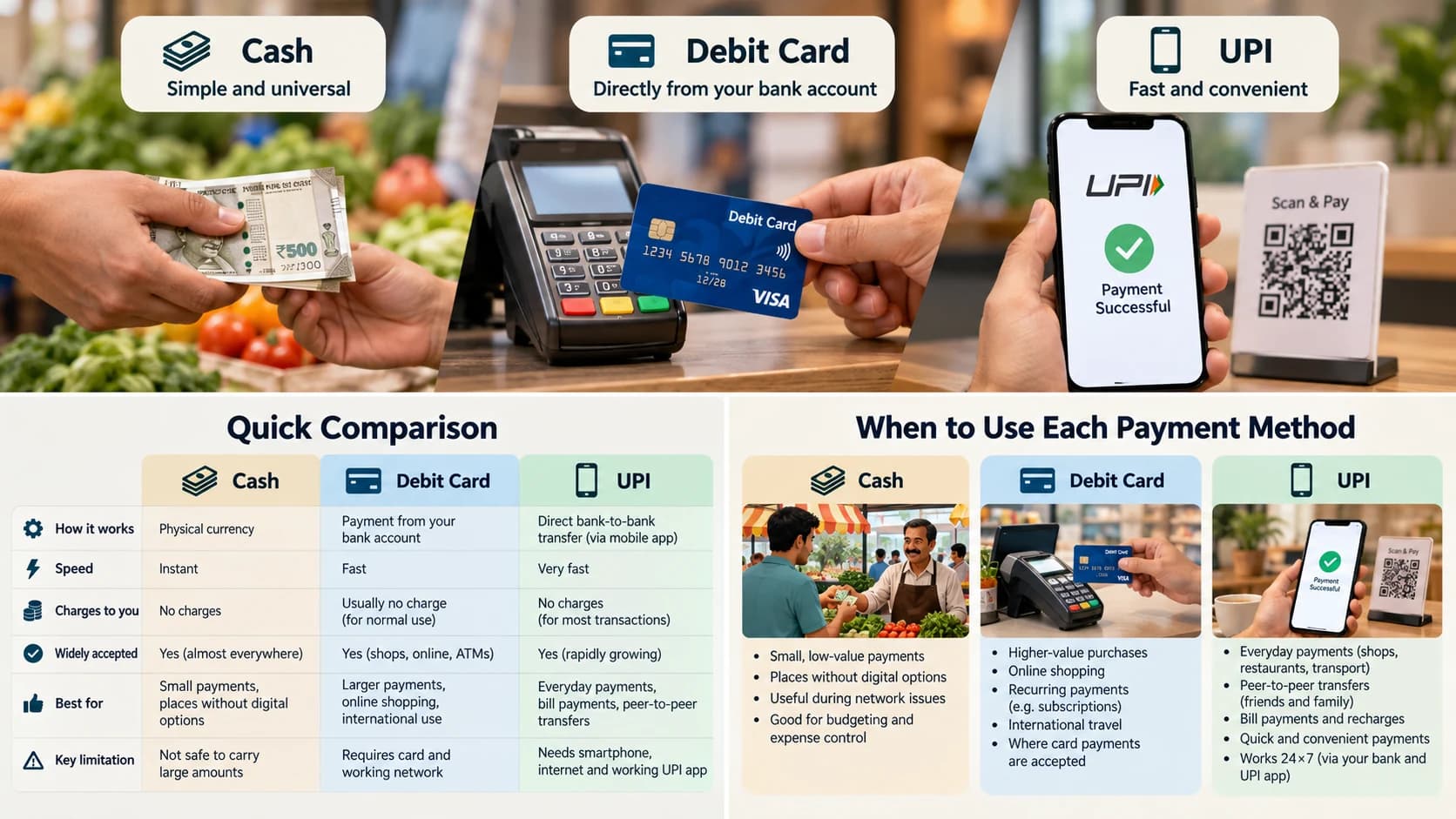
For many people, the most resilient setup is not to choose one of the three permanently.
It is to give each one a role.
Use UPI for most routine person-to-person transfers and QR-based everyday purchases.
Keep a debit card for ATMs, card-based online payments, international use when enabled, and situations where the card network is the more suitable payment channel.
Carry a modest amount of cash for emergencies, connectivity failures and places where digital acceptance is uncertain.
That combination gives you something no individual method can provide: redundancy.
If your phone dies, you have the card.
If the card terminal fails, you may have UPI.
If both electronic options are unavailable, you still have some cash.
The payment method matters less than the habit behind it
UPI can make spending almost frictionless. A debit card can do much the same. Cash makes the reduction in your wallet physically visible.
For some people, that difference affects behaviour more than technology does.
If digital payments make it difficult for you to notice how much you are spending, cash may be useful for selected discretionary categories.
If detailed transaction records help you budget, UPI or a debit card may be more useful.
And if you regularly make important payments, keeping more than one payment method available is simply good operational planning.
The sensible question at the counter is therefore not "Which payment technology is superior?"
It is:
"For this payment, what matters most—speed, acceptance, reliability, record-keeping, control or a fallback?"
Once you answer that, the choice between cash, debit card and UPI is usually straightforward.