How Do Banks Detect Suspicious Transactions Within Seconds?
Learn how banks use real-time rules, transaction history, device signals, fraud models, risk scores and human review to detect suspicious payments within seconds.
Imagine you normally use your banking app from the same phone and make transfers of a few thousand rupees.
Then, within a few minutes, the account suddenly shows:
- login from a new device,
- a new beneficiary,
- several failed authentication attempts,
- a much larger transfer than usual,
- another transfer immediately afterward.
A bank does not need a human employee to notice all of this manually.
Modern fraud-monitoring systems can evaluate the transaction while it is being processed.
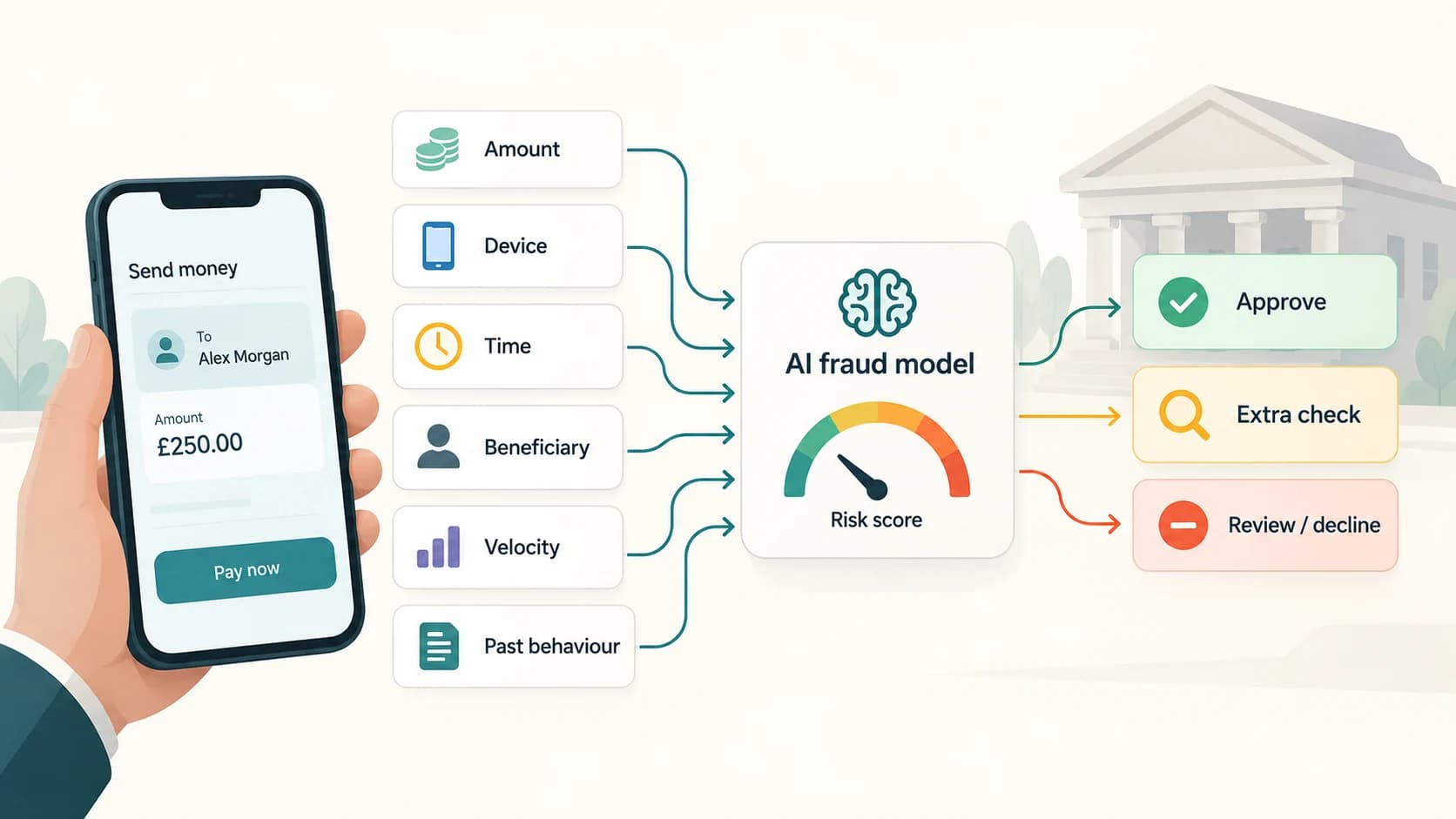
Before the payment is finally approved, the bank may ask dozens—or even hundreds—of small questions:
Is this the customer's normal device?
Has this beneficiary been used before?
Is the amount unusual?
Have several transactions happened unusually quickly?
Is the IP address suspicious?
Has this merchant or payment address appeared in previous fraud cases?
The answers become signals.
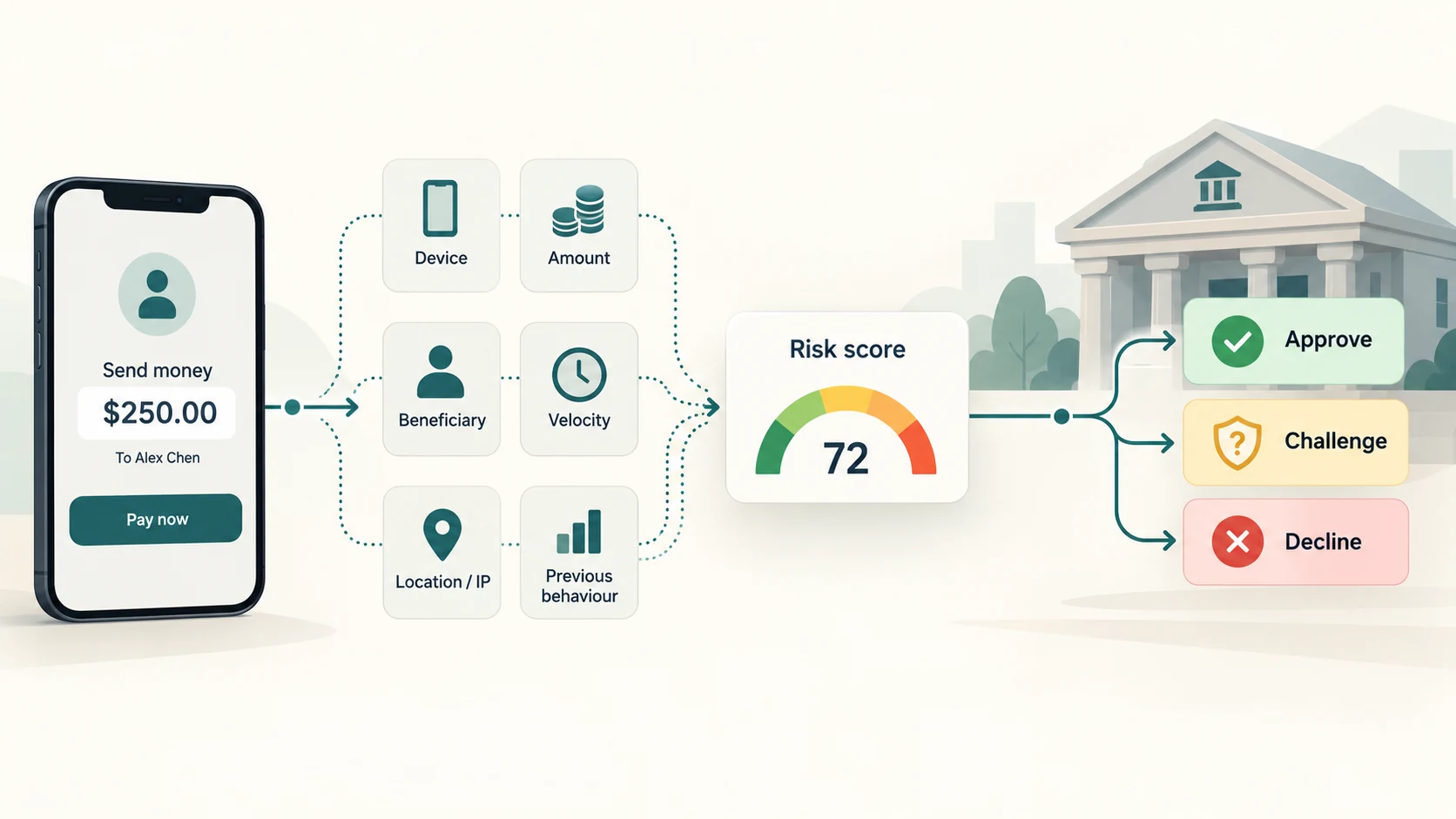
Those signals are combined by rules, statistical models and sometimes machine-learning systems to estimate how risky the transaction appears.
If the risk is low, the payment may continue without the customer noticing anything unusual.
If the risk is higher, the bank may:
- request additional authentication,
- decline the transaction,
- temporarily restrict the channel,
- send an alert,
- route the event for further investigation.
The customer sees one simple result:
Payment successful
or
Transaction declined.
Behind it may have been a real-time fraud decision.
The Bank Is Not Asking “Is This Definitely Fraud?”
This is the first important idea.
Fraud-detection systems rarely know with certainty that a transaction is criminal.
Instead, they estimate risk.
Suppose you transfer ₹75,000 at midnight from a new phone.
That may be completely legitimate.
Perhaps you bought a new device and urgently needed to pay someone.
The same pattern could also occur after an account takeover.
So the system does not simply ask:
Fraud or not fraud?
It asks:
How unusual and risky is this transaction compared with what we know?
The output may be represented internally as:
- a risk score,
- a set of triggered rules,
- a probability,
- a risk category.
The bank then decides what action should follow.
Fraud Detection Starts With Rules
Before sophisticated machine learning, banks already used rule-based fraud detection.
Rules remain extremely important today.
A rule might say:
Alert if five fund transfers occur within two minutes.
Another might say:
Flag a high-value payment immediately after a new beneficiary is added.
Or:
Block repeated incorrect PIN attempts.
RBI's Digital Payment Security Controls specifically require regulated entities to configure systems for identifying suspicious transactional behaviour and to monitor parameterised alerts.
The RBI lists examples such as:
- transaction velocity,
- cash withdrawals,
- electronic payments,
- adding beneficiaries,
- high-risk merchant categories,
- repeated invalid CVVs or PINs,
- excessive activity on new accounts,
- time zones,
- geolocation,
- IP-address origin,
- behavioural biometrics,
- known points of compromise,
- suspicious wallets, mobile numbers or UPI addresses,
- declined transactions.
That list shows how different modern fraud monitoring is from simply checking whether the customer has enough money.
What Is Transaction Velocity?
“Velocity” means how quickly related activity is happening.
One transaction may look normal.
Twenty similar transactions in three minutes may not.
Imagine:
12:00:10 — ₹4,900
12:00:28 — ₹4,900
12:00:51 — ₹4,900
12:01:07 — ₹4,900
The amount itself may be ordinary.
The speed and repetition may be the suspicious part.
Velocity rules can look at:
- number of payments,
- total value,
- number of beneficiaries,
- ATM withdrawals,
- failed PINs,
- login attempts,
- card transactions.
Fraud systems therefore analyse sequences, not only individual transactions.
The Bank Compares the Payment With Your Normal Behaviour
The same ₹50,000 transaction can look very different for two customers.
Customer A
Frequently sends ₹40,000–₹80,000 to suppliers.
Customer B
Normally spends ₹500–₹3,000 and has never transferred more than ₹10,000.
A ₹50,000 payment may fit Customer A's normal pattern but stand out sharply for Customer B.
This is where behavioural profiling becomes useful.
A fraud system can build a model of normal activity from factors such as:
- usual transaction amounts,
- common beneficiaries,
- time of day,
- preferred channels,
- device history,
- typical transaction frequency.
The system is not trying to understand the customer's life in a human sense.
It is identifying statistical patterns.
Device Information Can Be a Strong Signal
Suppose you normally use:
Device A
for mobile banking.
Suddenly a login appears from:
Device B
That alone does not prove fraud.
But it changes the context.
The bank may consider:
- whether the device has been seen before,
- whether the app has been freshly registered,
- operating-system and device characteristics,
- SIM or service information where applicable,
- whether the device appears compromised.
RBI requires device binding for regulated mobile payment applications covered by its digital-payment security directions.
Device information therefore becomes one more layer in the risk decision.
Location and IP Address Can Add Context
A digital transaction also has network context.
Depending on the channel and available information, a fraud engine may examine:
- IP address,
- broad geolocation,
- known malicious infrastructure,
- unusual country or region,
- rapid changes between locations.
RBI explicitly lists geo-locations and IP-address origin among parameters that may be used for suspicious-transaction alerts.
But location must be interpreted carefully.
People travel.
Mobile networks can route traffic unexpectedly.
VPNs and corporate networks can affect apparent location.
So location is usually a signal, not a verdict.
A strong fraud model combines it with other evidence.
A New Beneficiary Can Increase Risk
Adding a beneficiary changes where money can go.
Imagine this sequence:
10:00 — new device registered
↓
10:04 — new beneficiary added
↓
10:06 — ₹1,00,000 transfer attempted
Each step may be legitimate on its own.
Together they may deserve more scrutiny.
RBI specifically includes beneficiary additions among actions for which digital-payment security controls and monitoring are important.
Banks may respond by using:
- additional authentication,
- transaction limits,
- delay or cooling controls where applicable,
- enhanced monitoring.
The exact design differs by bank and payment product.
Merchant Type Can Matter
Card payments carry information about the merchant category.
A transaction at:
a supermarket
does not carry exactly the same risk context as one at:
a high-risk merchant category
or an unusual international online merchant.
RBI explicitly lists high-risk Merchant Category Codes, or MCCs, as possible monitoring parameters.
That does not mean a merchant in a high-risk category is fraudulent.
It means the category may affect the transaction's risk score.
Risk systems operate on combinations of signals.
Known Fraud Intelligence Can Be Shared Into the Decision
Banks do not analyse only the customer's behaviour.
They also maintain or receive information about known suspicious destinations and fraud patterns.
A system may consider whether the transaction is going to:
- a previously reported UPI address,
- suspicious mobile number,
- known mule account,
- compromised merchant,
- device associated with previous fraud,
- known point of compromise.
RBI's digital-payment directions specifically mention transactions to mobile wallets, mobile numbers and VPAs for which vishing or other fraud has been recorded.
That allows the bank to ask not only:
Is this unusual for the sender?
but also:
Is the receiver or destination already associated with risk?
What Is a Mule Account?
A mule account is an account used to receive or move fraud proceeds on behalf of criminals.
Sometimes the account holder knowingly participates.
Sometimes people are recruited with promises such as:
“Receive money in your account and keep a commission.”
Fraud-detection systems may look for patterns such as:
- sudden incoming funds,
- rapid outgoing transfers,
- many unrelated senders,
- money leaving shortly after it arrives.
These patterns can also overlap with legitimate activity, so investigation and context remain important.
Fraud analytics is largely a problem of separating suspicious networks from normal financial behaviour.
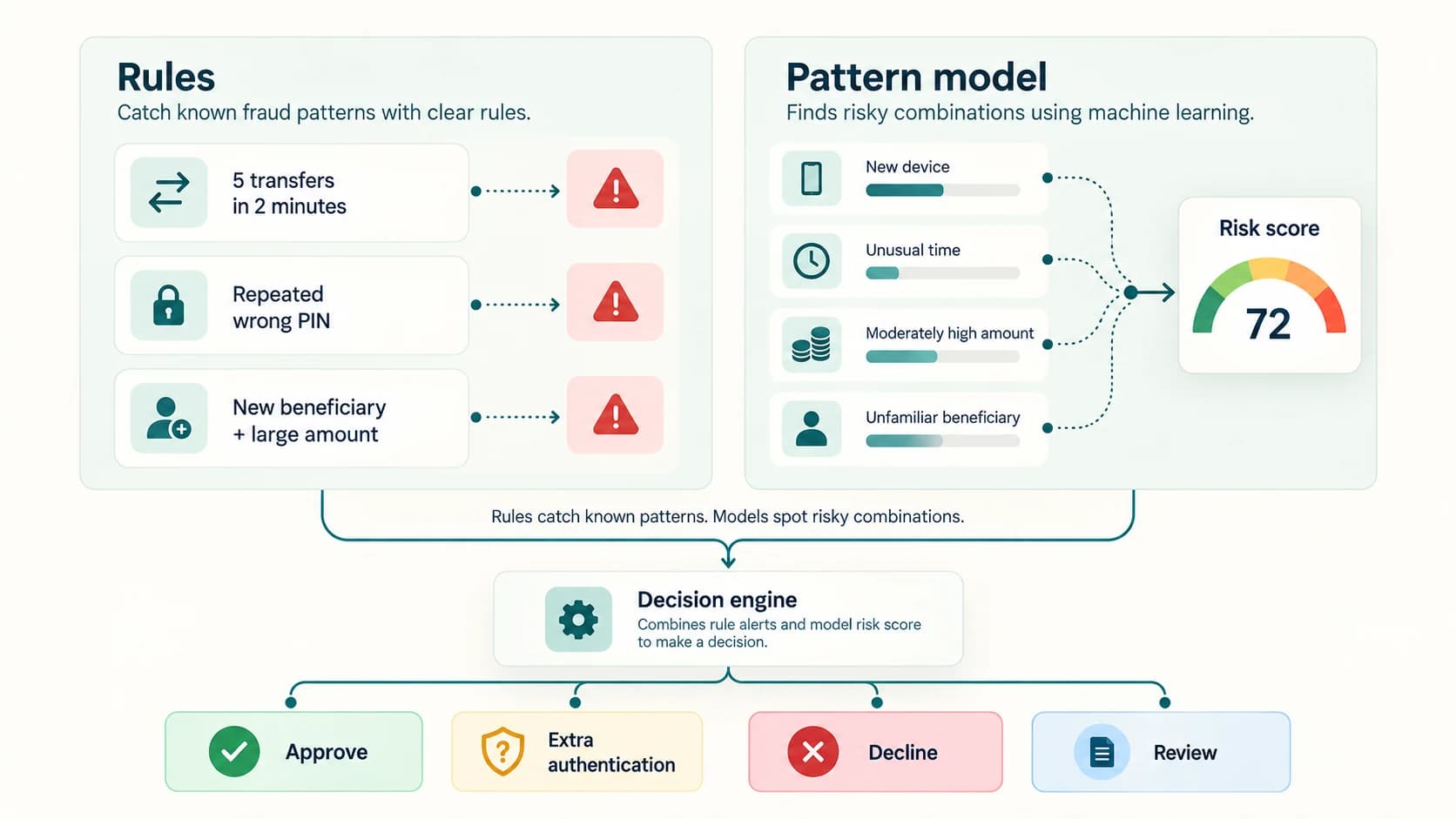
Machine Learning Looks for Patterns That Rules May Miss
Rules are excellent for known patterns.
But criminals adapt.
Suppose fraudsters learn that:
Transactions above ₹50,000 receive extra scrutiny.
They may split ₹80,000 into several smaller transfers.
A machine-learning model can potentially detect patterns that are harder to describe with one simple threshold.
A model might analyse a combination such as:
- amount is moderately unusual,
- device is new,
- beneficiary is new,
- transaction time is unusual,
- velocity is high,
- customer rarely uses this channel.
No single factor is decisive.
Together they can produce a much higher risk score.
RBI's KYC directions explicitly permit regulated entities to consider artificial intelligence and machine-learning technologies to support effective ongoing monitoring.
That does not mean every bank uses the same AI model.
Banks choose their own technologies, rules and risk thresholds.
How Does a Fraud Model Learn?
A simplified machine-learning workflow might use historical transactions labelled with outcomes such as:
- legitimate,
- confirmed fraud,
- disputed,
- chargeback,
- account takeover.
The model learns statistical relationships between transaction features and past outcomes.
For example, it may discover that certain combinations of:
- new device,
- new beneficiary,
- unusual amount,
- rapid transfers
appear more often in confirmed fraud cases than in normal activity.
When a new transaction arrives, the model calculates how similar it is to risky historical patterns.
The result may be a score such as:
Low risk
Medium risk
High risk
The exact models and thresholds are proprietary.
Fraud Models Also Need Real-Time Data
A model is useful only if it receives the relevant information quickly enough.
For instant digital payments, the fraud engine may need access to:
- the current transaction,
- previous transactions from recent minutes,
- customer profile,
- device information,
- beneficiary history,
- known fraud lists.
That information can be held in fast data stores or streaming systems designed to respond quickly.
The bank does not need to scan every transaction the customer has made in their entire lifetime from scratch.
It can maintain precomputed features such as:
- number of payments in last 10 minutes,
- average payment value,
- whether device is new,
- whether beneficiary is new.
This makes real-time scoring practical.
A Risk Score Must Be Produced Before the Customer Gets Impatient
Instant payments create an engineering challenge.
The customer expects the transaction to complete in seconds.
The bank cannot spend ten minutes investigating every payment.
So real-time fraud systems are designed to make a fast automated decision for the overwhelming majority of transactions.
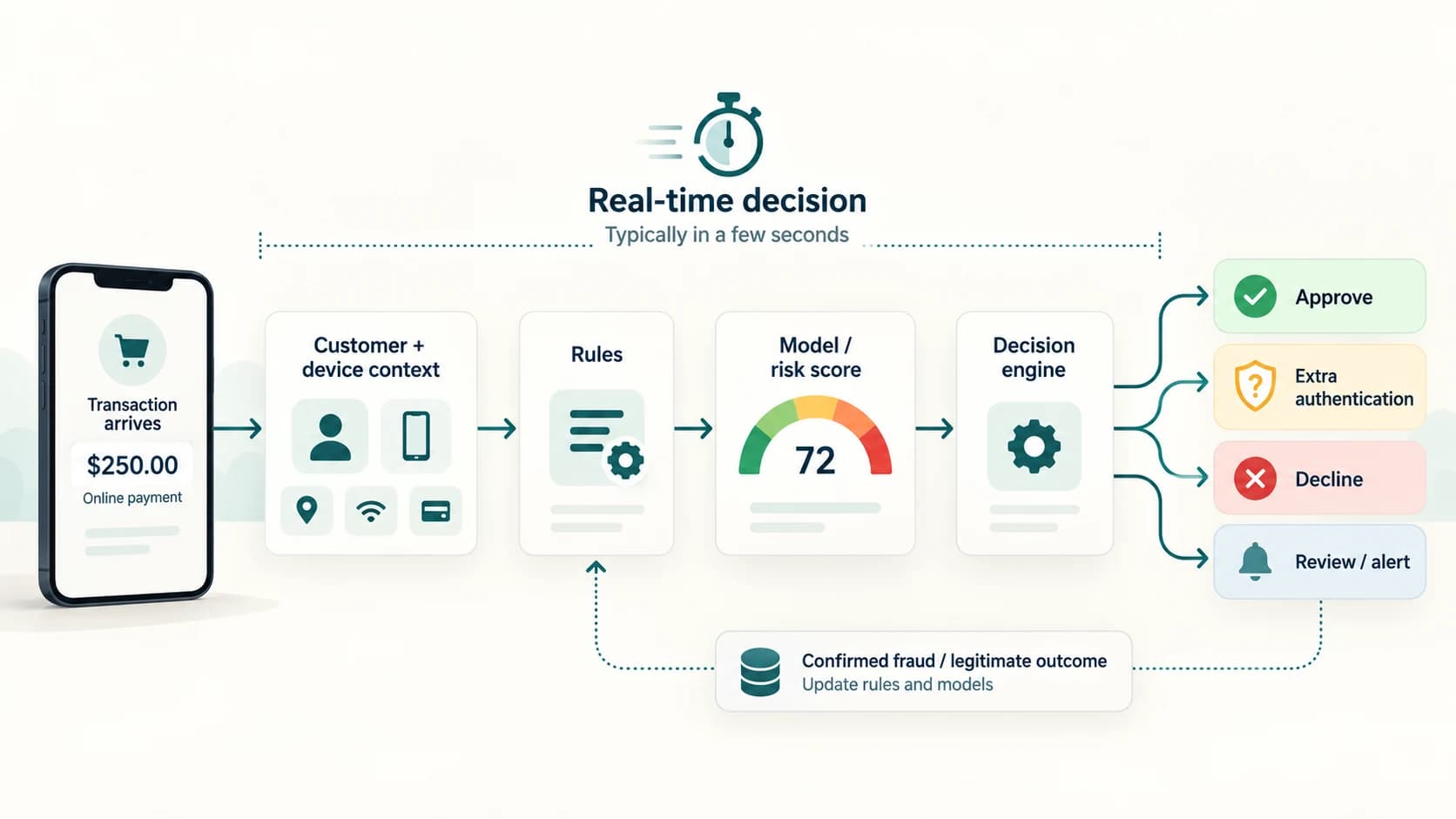
A simplified sequence is:
transaction arrives
↓
rules evaluate
↓
risk features retrieved
↓
model calculates score
↓
decision engine applies policy
↓
approve / challenge / decline / review
The fraud check is only one part of the overall payment authorization, so its processing time must usually be very small.
There is no universal number of milliseconds that every bank uses.
The important requirement is that real-time channels need real-time risk decisions.
What Can the Bank Do With a High-Risk Transaction?
A suspicious transaction does not always produce the same response.
Depending on the payment type and severity, the bank may:
Approve
Risk appears acceptable.
Step up authentication
Ask for another factor or confirmation.
Decline
Do not allow the transaction.
Temporarily restrict the channel
Useful when account takeover is suspected.
Send an alert
Ask the customer to verify or report the activity.
Route for manual investigation
Especially where the transaction does not require immediate customer-facing authorization or where post-event investigation is appropriate.
The risk system therefore does more than detect.
It supports a decision.
Why Banks Cannot Simply Block Every Unusual Transaction
Imagine travelling abroad for the first time.
You make a legitimate card purchase in a country you have never visited before.
A crude fraud rule might say:
New country = block.
That would protect against some fraud.
It would also frustrate many real customers.
This problem is called a false positive.
True positive
Fraud system flags a genuinely fraudulent transaction.
False positive
Fraud system flags a legitimate transaction.
Banks try to maximize the first while minimizing the second.
This is difficult because criminals deliberately try to imitate ordinary customer behaviour.
Fraud detection is therefore an optimization problem, not a simple blacklist.
The Same System Can Treat Two Identical Payments Differently
Suppose two customers each make:
₹25,000 payment
to the same type of merchant.
The bank might approve one immediately and challenge the other.
Why?
Because the surrounding context differs.
Customer A
- usual device,
- usual location,
- established merchant,
- normal spending range.
Customer B
- new device,
- new location,
- first large card purchase,
- several failed logins earlier.
The amount is the same.
The risk profile of the event is different.
That is why fraud systems need many signals.
Fraud Monitoring and Anti-Money-Laundering Monitoring Are Related—but Different
This distinction is important.
Real-time payment fraud monitoring
Often focuses on questions such as:
Is someone trying to steal money from this account right now?
The response may need to happen within seconds.
AML / KYC transaction monitoring
Often asks broader questions such as:
Does this pattern of transactions make sense for the customer and source of funds?
RBI's KYC directions require ongoing due diligence so transactions remain consistent with the bank's knowledge of the customer, business, risk profile and source of funds or wealth.
They specifically call for monitoring of:
- large and complex transactions,
- unusual patterns,
- transactions above thresholds,
- high turnover inconsistent with account balance.
These patterns may emerge over days, weeks or months.
So not every “suspicious transaction” is a real-time card-fraud alert.
The phrase can refer to different financial-crime systems.
AI Does Not Automatically Decide That Someone Is a Criminal
This is another important limitation.
A model may say:
high risk
That does not prove criminal intent.
A bank still needs:
- policies,
- investigation,
- evidence,
- regulatory procedures,
- human oversight.
RBI's 2024 Fraud Risk Management Directions emphasize governance, prevention, early detection, investigation and reporting.
Machine-learning output is therefore one input into a controlled fraud-risk framework.
It is not a court judgment.
Human Fraud Analysts Still Matter
What happens to the small number of transactions or accounts that automated systems cannot confidently classify?
They can become cases.
A fraud analyst may inspect:
- account history,
- transaction sequence,
- beneficiary connections,
- customer contact,
- device history,
- previous alerts.
RBI's digital-payment security directions require fraud-control staff to be trained in:
- fraud tools,
- investigation,
- data analysis,
- operating rules,
- exception monitoring,
- separating false positives from genuine concerns.
Automation handles scale.
Humans handle ambiguity.
Network Analysis Can Reveal Fraud Rings
Fraud is often not one account acting alone.
Imagine:
100 victims
↓
send money to
10 mule accounts
↓
which rapidly transfer to
3 central accounts
A system that looks at one transaction at a time may miss the pattern.
Graph or network analysis can model:
- accounts as nodes,
- transfers as links.
Repeated relationships can reveal clusters that deserve investigation.
Banks and financial-crime platforms increasingly use relationship analysis for fraud and AML detection.
The exact algorithms are institution-specific.
The key idea is that who is connected to whom can be as important as the amount of one transaction.
Why Real-Time Alerts Matter
Suppose a suspicious ₹40,000 transfer is approved but the customer immediately receives:
₹40,000 debited. If this was not you, report immediately.
Fast notification can limit further loss.
RBI requires multi-factor authentication and alerts for digital payment transactions and requires regulated entities to provide mechanisms for reporting unauthorized transactions.
The fraud system therefore continues after the payment decision.
Customer alerts become another detection layer.
Sometimes the customer is the fastest person who can confirm:
That transaction was not mine.
What Happens After Fraud Is Confirmed?
Once a transaction or account is confirmed as fraudulent, the information can improve future detection.
The bank may update:
- blocked identifiers,
- device-risk information,
- beneficiary-risk lists,
- fraud rules,
- model training data,
- investigation patterns.
RBI requires fraud analysis to identify why fraud occurred and determine mechanisms to prevent recurrence.
This creates a feedback loop:
fraud occurs
↓
investigation identifies pattern
↓
rules/models are updated
↓
future transactions are checked against the new pattern
Fraud detection therefore evolves continuously.
Reconciliation Can Reveal Problems That Real-Time Monitoring Missed
Not every suspicious issue is detected before authorization.
RBI requires real-time or near-real-time reconciliation frameworks for digital payment transactions, with reconciliation no later than 24 hours from receipt of settlement files under the specified framework.
Reconciliation compares records between:
- banks,
- payment networks,
- processors,
- payment gateways,
- other participants.
Differences can reveal:
- duplicate transactions,
- missing credits,
- unusual reversals,
- inconsistent transaction status.
Real-time fraud monitoring and reconciliation solve different problems but reinforce each other.
Why Fraudsters Keep Changing Their Methods
Once a fraud pattern becomes well known, banks build rules against it.
Fraudsters adapt.
For example:
Old pattern: one large transfer.
Bank responds with large-value rules.
New pattern: several smaller transfers.
Bank adds velocity rules.
New pattern: compromise a genuine customer's device.
Bank strengthens device analysis.
This creates a continuous contest.
Fraud systems therefore need:
- new rules,
- updated models,
- threat intelligence,
- customer education.
There is no final fraud-detection algorithm that will work forever.
What Happens During One Suspicious Payment?
Imagine a ₹90,000 transfer from a mobile banking app.
1. Customer submits the payment
The bank receives the transaction details.
2. Authentication is verified
The session, device and required credentials are checked.
3. Fraud features are created
The system asks:
- new device?
- new beneficiary?
- unusual amount?
- unusual time?
- high transaction velocity?
- suspicious IP?
4. Rules run
Known suspicious patterns are checked.
5. Model scores the transaction
If used, statistical or machine-learning models estimate risk.
6. Decision engine combines the results
The bank applies its policies and thresholds.
7. One of several outcomes follows
- approve,
- request stronger authentication,
- decline,
- alert,
- investigate.
8. The result becomes new data
Later confirmed fraud or legitimate activity can help improve future monitoring.
The entire first part can happen while the payment screen still says:
Processing...
The System Is Looking for Context, Not Just Big Numbers
That is the best way to understand modern fraud detection.
A suspicious transaction is not necessarily:
a very large transaction.
It may be:
a normal-sized transaction in a very abnormal context.
Banks therefore analyse:
- who,
- what,
- where,
- when,
- how often,
- from which device,
- to whom,
- after what previous activity.
The best fraud systems combine several kinds of protection:
fixed rules
for known threats,
behavioural models
for customer patterns,
machine learning
for complex combinations,
fraud intelligence
for known bad destinations,
and
human analysts
for ambiguous cases.
All of this has to happen quickly enough that legitimate customers can continue paying without noticing the machinery.
That is why a payment can take only two or three seconds while the bank still manages to ask dozens of security questions behind the scenes.
The transaction may look simple.
The decision behind it is anything but.