How Does Artificial Intelligence Help Banks Detect Fraud?
Learn how banks use AI and machine learning to analyse transaction patterns, devices, beneficiaries and account behaviour to detect fraud in real time.
Imagine a bank processing millions of digital transactions.
Most are completely normal:
- salary payments,
- grocery purchases,
- UPI transfers,
- ATM withdrawals,
- bill payments,
- online shopping.
Hidden inside that enormous flow may be a small number of fraudulent transactions.
Perhaps someone has stolen a customer's credentials.
Perhaps a fraudster is moving money through mule accounts.
Perhaps a card is suddenly being used in a way that does not match its normal pattern.
The bank has only a short time to react.
If it manually reviewed every payment, digital banking would become unusably slow.
That is where artificial intelligence and machine learning become useful.
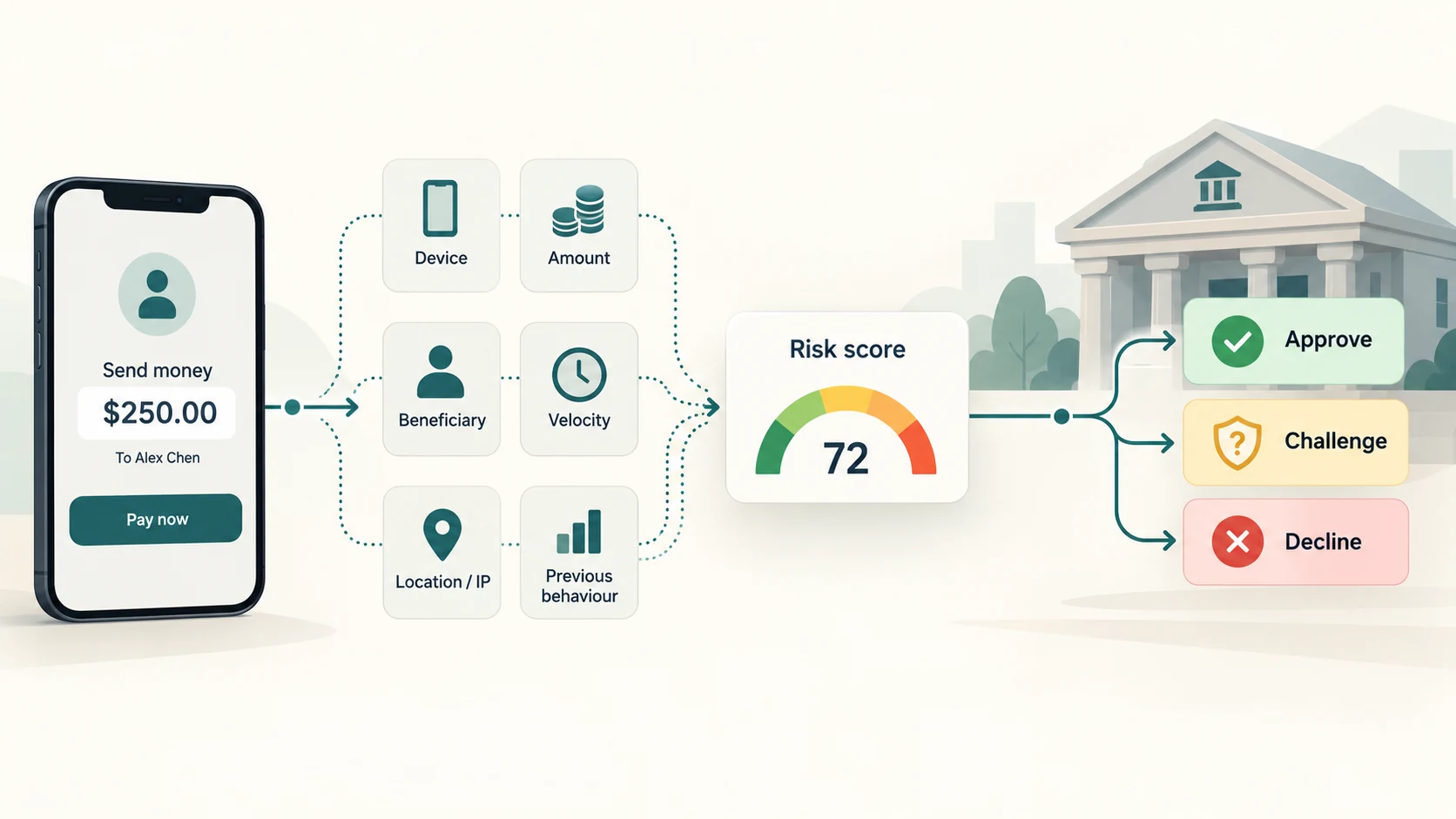
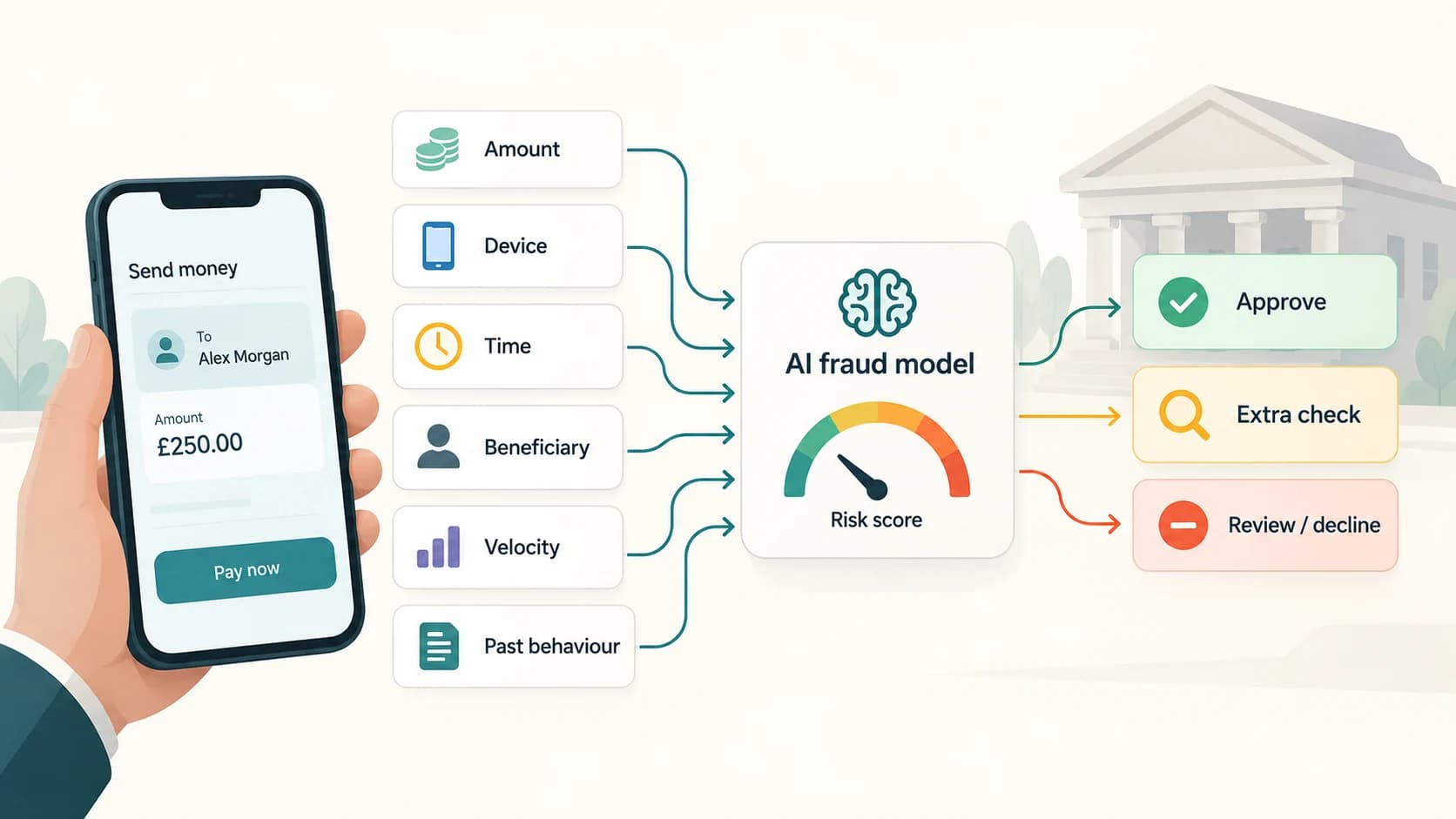
AI can analyse many signals around a transaction at the same time, compare them with historical behaviour and produce a risk estimate before the payment is completed.
A fraud system might consider:
- transaction amount,
- customer's previous behaviour,
- device,
- time,
- beneficiary,
- transaction frequency,
- merchant type,
- location or IP information,
- recent failed attempts,
- known fraud intelligence.
Instead of saying:
“This transaction is definitely fraud.”
the system is more likely to say something conceptually like:
Low risk
Medium risk
or
High risk
The bank then decides what to do.
It may:
- approve the transaction,
- request extra authentication,
- decline it,
- send an alert,
- temporarily restrict activity,
- send the case for investigation.
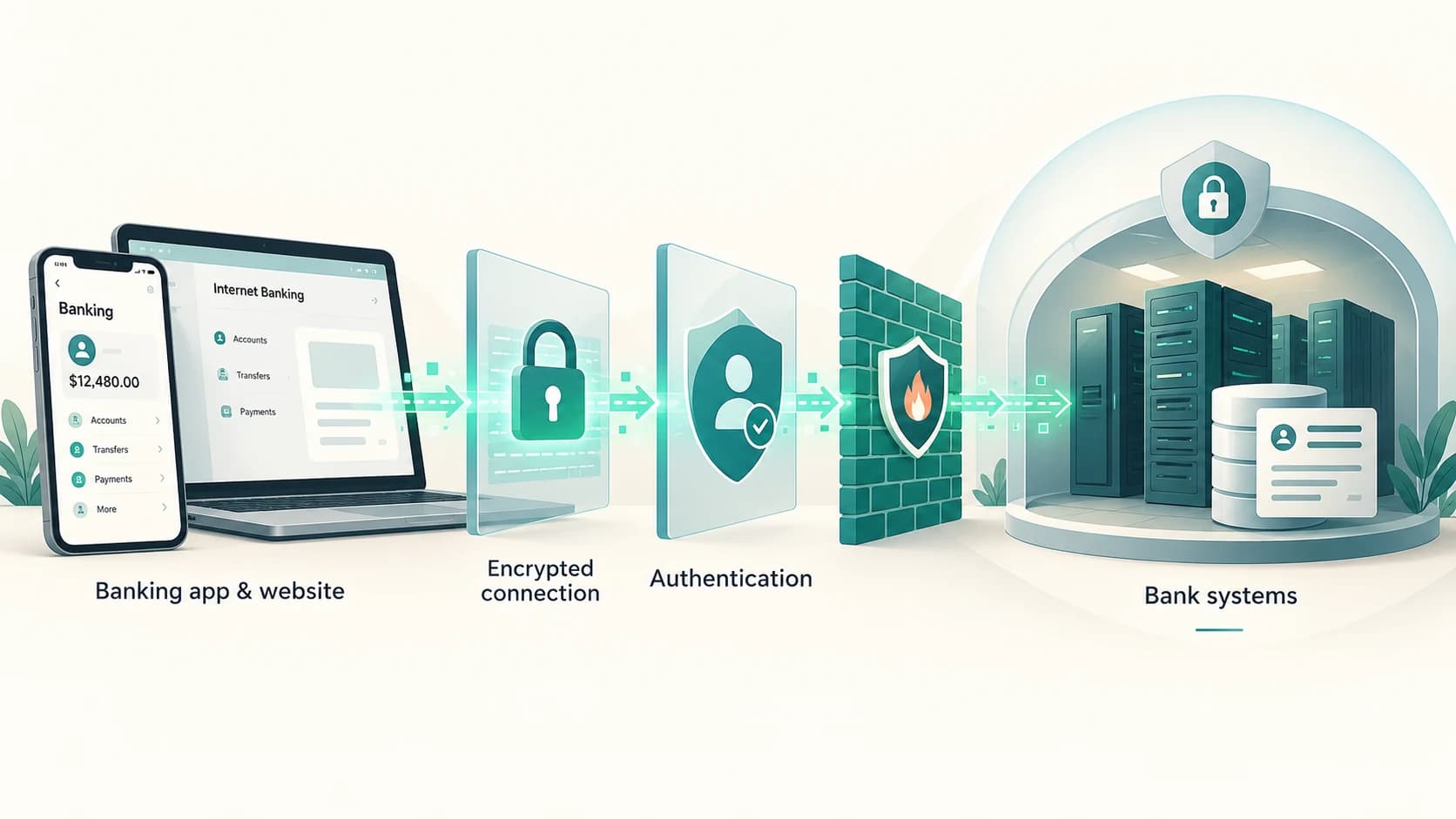
AI therefore does not replace the bank's security system.
It becomes one powerful layer inside it.
Why Banks Need AI in the First Place
Traditional fraud monitoring relied heavily on fixed rules.
A bank might create rules such as:
Block after several wrong PIN attempts.
Flag five transfers within two minutes.
Review a very large transaction from a new device.
Rules are still extremely useful.
The problem is scale and complexity.
Fraudsters can deliberately stay below obvious thresholds.
Instead of transferring ₹1 lakh once, they may transfer smaller amounts several times.
Instead of using one known suspicious account, they may route money through many newly created accounts.
A rule-based system can keep adding more rules, but eventually the interactions become difficult to manage.
NPCI's 2024 best-practice guidance for member institutions explicitly noted that AI and machine-learning capabilities are important for fraud monitoring and identification of mule accounts when transaction volumes become so large that a typical rule-based approach becomes ineffective.
AI helps because it can combine many weak clues that would not look suspicious on their own.
AI Learns From Patterns
Suppose a customer normally:
- uses one phone,
- pays mostly during daytime,
- sends ₹500–₹5,000,
- transfers to a small group of familiar people.
Then the bank sees:
- a new device,
- 2:10 a.m. login,
- first transfer to a new beneficiary,
- ₹80,000 amount,
- two more transfers immediately afterward.
No single signal proves fraud.
But the combination is very unusual.
A machine-learning model can be trained to recognise combinations like this.
It does not “think” like a human investigator.
It performs mathematical pattern recognition.
It compares the new transaction with patterns learned from very large datasets.
What Does a Fraud Model Learn From?
Banks can train models using historical transaction data.
Each past transaction can include features such as:
- amount,
- timestamp,
- payment channel,
- merchant category,
- device,
- beneficiary,
- account age,
- transaction frequency,
- previous customer behaviour.
Where a reliable outcome is known, the transaction may also have a label such as:
- legitimate,
- confirmed fraud,
- disputed,
- chargeback,
- account takeover.
The model learns which combinations of features have historically been associated with fraud.
When a new transaction arrives, it estimates how strongly that transaction resembles risky historical patterns.
This approach is called supervised machine learning when the model learns from labelled examples.
Not Every Fraud Pattern Has Been Seen Before
Supervised learning has an obvious limitation.
What happens when criminals invent a new method?
A system trained only to recognize known fraud could miss it.
That is why banks can also use anomaly detection.
Anomaly detection asks:
Does this behaviour look unusually different from what is normally expected?
Imagine an account that receives:
₹300
₹1,100
₹650
for ordinary personal payments.
Then it suddenly receives money from 40 unrelated accounts and transfers almost all of it onward within minutes.
The system may not need an exact historical fraud example.
The behaviour itself is unusual enough to investigate.
Anomaly detection is particularly useful for finding emerging patterns.
AI Can Personalise What “Normal” Means
A major advantage of machine learning is that it does not need one universal definition of normal behaviour.
Consider two customers.
Customer A
Runs a business and regularly transfers ₹2 lakh.
Customer B
Normally spends less than ₹5,000 per transaction.
A ₹1.5 lakh transfer may be ordinary for Customer A and highly unusual for Customer B.
So the fraud system can learn a behavioural profile for each customer or customer segment.
That profile may include:
- average transaction amount,
- normal transaction times,
- usual channels,
- common beneficiaries,
- typical device,
- normal transaction frequency.
The same transaction can therefore receive different risk scores for different people.
AI Looks at Sequences, Not Just Individual Payments
Fraud often becomes visible only when several events are connected.
For example:
11:02 — password reset
↓
11:05 — new device registration
↓
11:08 — new beneficiary
↓
11:10 — ₹75,000 transfer
A model that examines only the final transfer misses the story.
Modern fraud systems can analyse recent sequences and create features such as:
- number of transfers in the last five minutes,
- amount sent in the last hour,
- number of newly added beneficiaries,
- number of failed logins,
- time since password reset.
This is known broadly as velocity and behavioural analysis.
RBI's digital-payment security directions specifically identify transaction velocity, beneficiary additions, geolocation, IP origin, behavioural biometrics and other contextual signals as useful parameters for suspicious-transaction monitoring.
Rules and AI Work Better Together
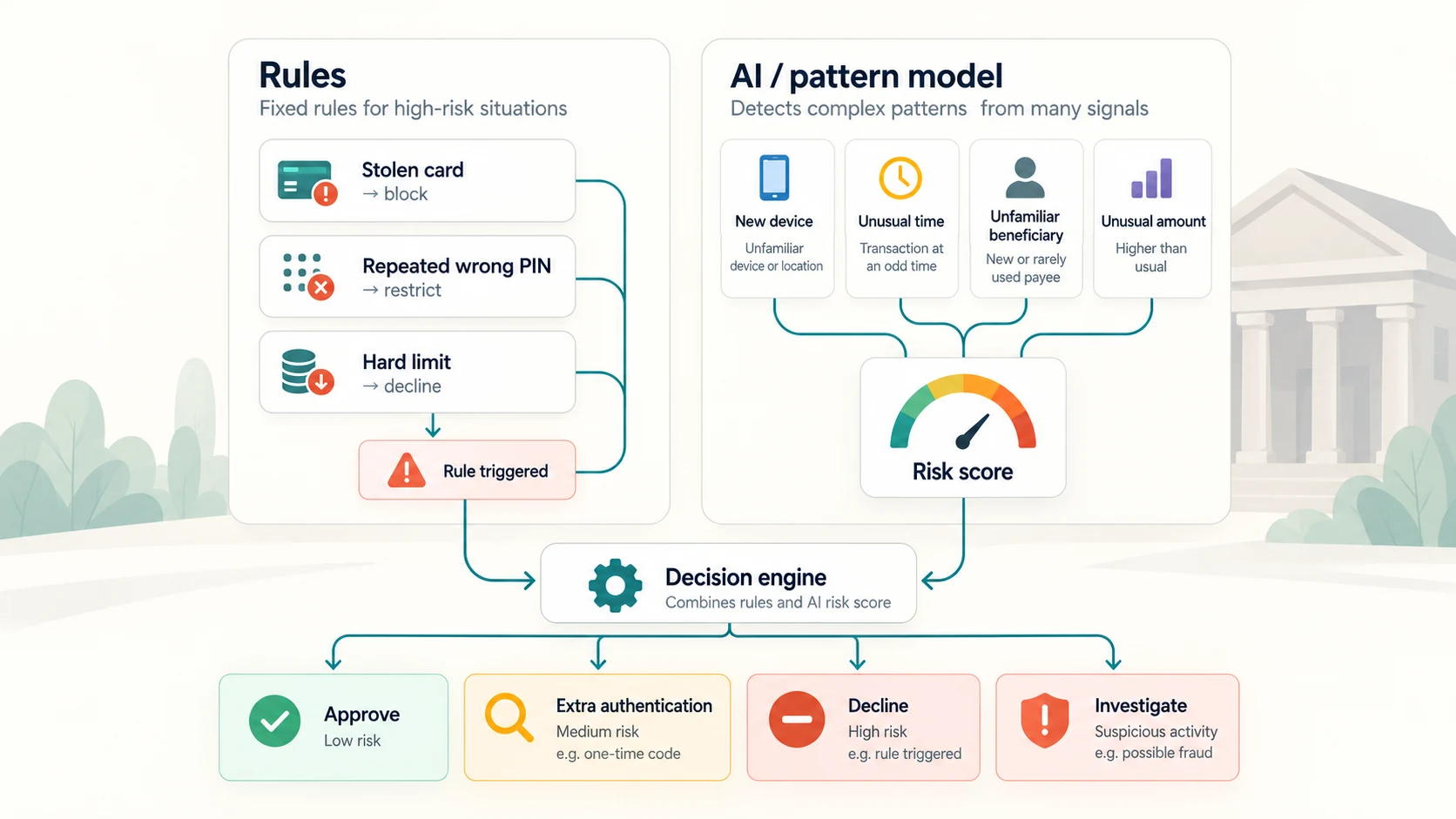
It would be a mistake to think that banks replace every fraud rule with AI.
Rules remain excellent for clear situations.
For example:
Card marked stolen → decline.
PIN failed repeatedly → restrict.
Transaction exceeds hard regulatory/product limit → reject.
AI is most useful where the answer is less obvious.
For example:
- amount is moderately unusual,
- device is new,
- time is unusual,
- beneficiary has limited history,
- transaction velocity is slightly elevated.
Each signal is weak.
Together they may be important.
A practical fraud platform can therefore combine:
rules
machine-learning risk score
known fraud intelligence
bank policy
to produce the final decision.
What Is a Risk Score?
Imagine a model produces a value from 0 to 100.
Conceptually:
0–20: very low risk
21–50: ordinary risk
51–75: elevated risk
76–100: high risk
Real systems use their own scales and thresholds.
The important idea is that the model produces a score, not a legal verdict.
The bank then defines actions around that score.
For example:
low score → approve
medium score → request additional authentication
high score → decline or investigate
This separation lets banks change policy without retraining the entire AI model every time.
AI Can Analyse Devices Too
Fraud is often associated with changes in the device used to access an account.
The bank may examine signals such as:
- new device,
- operating-system characteristics,
- device registration history,
- app version,
- SIM/service information where applicable,
- unusual device behaviour.
RBI requires device binding for regulated mobile payment applications covered by its Digital Payment Security Controls.
AI can combine device information with transaction context.
A new phone alone is not suspicious.
A new phone plus a new beneficiary plus a large transfer may be much more important.
Behavioural Biometrics Can Add Another Signal
Some security systems analyse how a person interacts with a device.
This can include patterns such as:
- typing rhythm,
- navigation behaviour,
- touch or swipe characteristics,
- interaction speed.
These are known as behavioural biometrics.
RBI includes behavioural biometric analysis among possible parameters for digital-payment fraud monitoring.
The idea is not:
“This typing pattern proves who you are.”
It is:
“Does this interaction look consistent with the expected user, or has something changed?”
Behavioural biometrics are therefore another risk signal, not a perfect identity test.
AI Can Examine the Receiver, Not Just the Sender
Fraud monitoring historically focused heavily on the account being debited.
But the receiving account can be just as important.
NPCI's 2024 best-practice guidance recommends monitoring on both:
- remitter side,
- beneficiary side.
Why?
Because fraud money has to go somewhere.
A receiving account may display patterns such as:
- money arriving from many unrelated people,
- rapid movement of funds onward,
- high transaction volume despite low end-of-day balance,
- sudden activity after a quiet period.
These can be signs of a mule account.
AI can help identify such patterns across large transaction datasets.
AI Can Detect Mule Accounts
A mule account is used to receive or move fraud proceeds.
Imagine this pattern:
Victim 1 → Account X
Victim 2 → Account X
Victim 3 → Account X
then:
Account X → Account Y → Account Z
A simple system examining one payment at a time may see ordinary transfers.
A system that studies relationships between accounts may notice the structure.
This is where graph analytics can help.
Graph AI Looks at Networks of Relationships
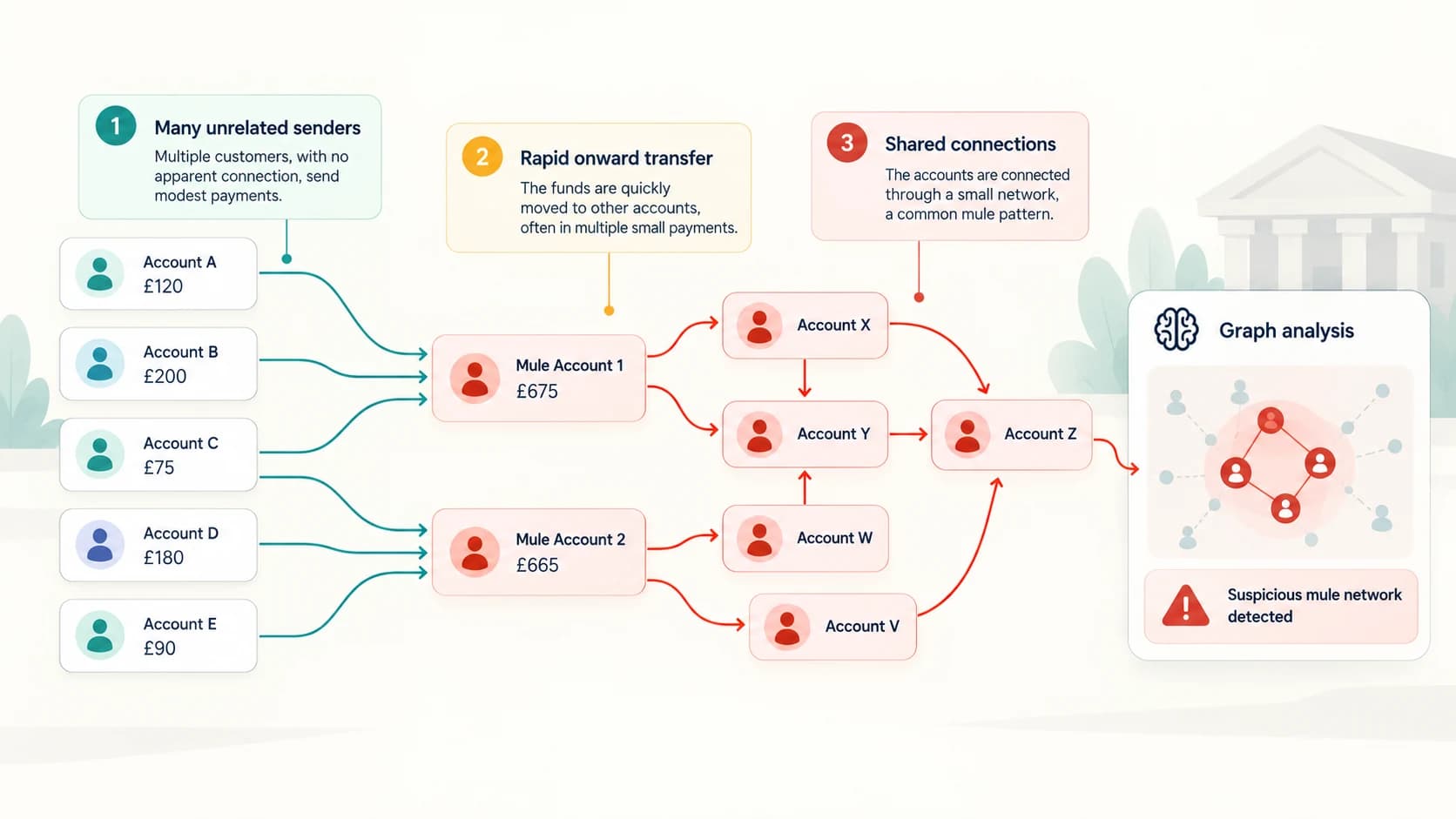
In a graph model:
- accounts are nodes,
- transactions are links.
Now the system can search for patterns such as:
- many unrelated senders feeding one account,
- rapid chains of transfers,
- circular movement of funds,
- groups of accounts repeatedly transacting with one another,
- common devices or identifiers across accounts.
This allows fraud detection to move beyond:
“Is this transaction suspicious?”
toward:
“Is this account part of a suspicious network?”
NPCI has publicly discussed the use of AI/ML in real-time fraud-risk monitoring and has also referred to initiatives aimed at identifying mule accounts using payment-system data.
AI Can Use Ecosystem-Level Intelligence
A bank sees only part of the financial system.
A payment network can sometimes see patterns across multiple participants.
For example, one receiving account may attract complaints from customers of several different banks.
That wider context can create useful fraud intelligence.
NPCI's published best-practice guidance says banks should use NPCI's enterprise fraud-risk-management capabilities to complement their own monitoring and should act promptly on ecosystem-level alerts.
This does not mean every bank shares all customer data freely.
Payment systems operate under legal, privacy and security controls.
The important idea is that fraud intelligence can exist at both:
- bank level,
- payment-network level.
Why AI Must Make Decisions Extremely Fast
A customer expects a UPI or card payment to finish in seconds.
Fraud detection therefore cannot take several minutes for every transaction.
A real-time system needs to:
- receive the transaction,
- retrieve relevant customer/device information,
- calculate features,
- run rules,
- run the model,
- produce a risk score,
- apply a decision.
This requires highly optimized computing infrastructure.
Frequently used risk features can be prepared in advance.
For example, instead of recalculating the customer's entire history, the system may already maintain:
- transactions in last 10 minutes,
- average amount,
- number of new beneficiaries,
- whether the device is known,
- recent failed attempts.
The model can then score the event very quickly.
AI Is Particularly Useful at Huge Payment Volumes
The value of AI grows with scale.
Imagine a fraud team reviewing:
10,000 transactions per day.
Manual sampling might still be possible.
Now imagine:
millions or billions of ecosystem transactions.
Manual inspection is impossible.
NPCI's guidance explicitly links the need for AI/ML fraud capabilities to very high transaction volumes.
AI acts as a filtering layer.
It allows the institution to send only a tiny fraction of high-risk events to human investigators.
That turns:
millions of transactions
into:
a manageable number of cases.
False Positives Are One of the Biggest Problems
A fraud model can be too aggressive.
Suppose you travel abroad and make a legitimate purchase from a new device or location.
The model may decide:
unusual = suspicious.
Your genuine payment gets blocked.
That is a false positive.
Banks have to balance two competing goals:
Catch more fraud
Stricter model.
Block fewer legitimate customers
More tolerant model.
Improving this balance is one of the main reasons banks invest in more sophisticated models.
A good fraud system should identify subtle risky patterns without treating every unusual customer action as criminal.
AI Can Adapt Better Than Static Rules
Fraud changes.
Once criminals discover that a bank blocks one pattern, they modify their behaviour.
For example:
Old method: one large transfer.
Bank adds a rule.
New method: ten smaller transfers.
Bank adds velocity controls.
New method: use several mule accounts.
Bank adds network analysis.
Machine-learning systems can be retrained as new fraud examples arrive.
That makes fraud detection a continuous process:
observe
↓
detect
↓
investigate
↓
label outcome
↓
retrain or update
↓
monitor again
But AI Models Can Also Become Outdated
This is called model drift.
Suppose customer behaviour changes dramatically.
Maybe a new payment product becomes popular.
Maybe transaction amounts rise.
Maybe customers begin using a new channel.
A model trained on older behaviour may start producing too many false alarms.
Banks therefore need to monitor the models themselves.
They may track:
- detection rate,
- false-positive rate,
- changes in input data,
- score distribution,
- performance against recent fraud cases.
AI is not “train once and forget.”
The Model Needs Good Data
A sophisticated algorithm cannot compensate for unreliable inputs.
If device data is wrong, beneficiary information is incomplete or confirmed-fraud labels are inconsistent, the model can learn the wrong patterns.
This is the familiar principle:
garbage in → garbage out.
Banks therefore need:
- data quality checks,
- consistent transaction identifiers,
- accurate fraud outcomes,
- controlled feature definitions,
- reliable data pipelines.
The AI layer is only as useful as the information feeding it.
AI Can Be Biased by Its Training Data
Another challenge is bias.
Suppose historical fraud investigations disproportionately focused on one type of customer or transaction.
A model trained on those outcomes could learn that historical investigative bias rather than genuine risk.
This is why model governance matters.
Banks need to understand:
- what data was used,
- what features drive the model,
- whether performance differs across relevant groups,
- whether the output can be justified and audited.
Financial AI needs more than accuracy.
It needs control.
Explainability Matters
Imagine the system blocks a ₹1 lakh transfer.
A fraud analyst asks:
Why did the model consider this risky?
A useful system should provide meaningful reasons such as:
- new device,
- unusually large amount,
- beneficiary created five minutes earlier,
- high recent transaction velocity.
That is much more useful than:
“AI score = 94.”
Explainability helps with:
- investigation,
- model validation,
- customer support,
- audit,
- regulatory oversight.
Not every AI model is equally easy to explain, so banks have to balance predictive power with governance needs.
Human Investigators Still Make Important Decisions
AI works best as a force multiplier.
Imagine the model flags 500 events out of 10 million transactions.
Human analysts can focus on those 500.
They may examine:
- account history,
- beneficiary network,
- customer confirmation,
- device changes,
- prior complaints,
- linked accounts.
RBI's digital-payment security framework requires fraud-control staff to be trained in fraud tools, investigation and data analysis, including differentiating genuine concerns from false positives.
AI narrows the search.
Humans handle ambiguity, context and escalation.
AI Fraud Detection and AML Are Not the Same Thing
These topics overlap, but they are not identical.
Payment fraud AI
Often asks:
Is somebody trying to steal money from this customer right now?
The decision may need to happen in seconds.
AML transaction monitoring
Often asks:
Does this broader pattern make sense given what the bank knows about the customer?
The pattern may emerge over days or months.
RBI's KYC directions require ongoing due diligence and allow regulated entities to consider AI and machine-learning technologies for effective monitoring.
So AI can help both problems.
But the objectives and time horizons are different.
Generative AI Is Not the Main Tool for Real-Time Fraud Scoring
When people hear “AI” today, they often think of chatbots and large language models.
But real-time transaction fraud detection is usually better suited to other types of AI and analytics, such as:
- supervised machine learning,
- anomaly detection,
- gradient-boosted models,
- neural networks,
- graph analytics,
- behavioural models.
Generative AI can still help in supporting tasks such as:
- summarizing investigation cases,
- helping analysts search internal information,
- explaining patterns,
- drafting reports.
But the core question:
“Should this payment be considered high risk?”
is usually a structured prediction problem rather than a chatbot problem.
AI Does Not Remove the Need for Customer Awareness
A major share of digital fraud involves social engineering.
A criminal may convince a customer to:
- reveal an OTP,
- enter a UPI PIN,
- install a remote-access app,
- transfer money voluntarily,
- approve a fraudulent request.
From the system's perspective, the genuine customer may appear to be authorizing the action.
AI can still detect unusual behaviour, but no model can perfectly distinguish every manipulated customer from every genuine customer.
That is why banks and NPCI continue to emphasize fraud awareness.
Technology and customer judgement have to work together.
What Happens During One AI-Assisted Fraud Check?
A simplified real-time flow might look like this.
1. Transaction arrives
Example:
₹60,000 transfer
2. System gathers context
- customer history,
- device,
- beneficiary,
- time,
- recent transaction velocity.
3. Fixed rules run
Known high-risk conditions are checked.
4. AI model calculates a risk score
The transaction is compared with learned patterns.
5. Network intelligence is considered
Known suspicious destinations or ecosystem alerts may add risk.
6. Decision engine applies policy
Possible outcomes:
- approve,
- additional authentication,
- decline,
- temporary restriction,
- investigation.
7. Later outcome becomes feedback
If the transaction is confirmed as fraud or legitimate, that information can improve future detection.
All of this can happen while the customer still sees:
Processing...
AI Is Powerful Because Fraud Is a Pattern Problem
That is the central idea.
Fraud rarely announces itself with a label saying:
THIS IS FRAUD.
It leaves traces.
A transaction may be unusual because of:
- amount,
- timing,
- device,
- beneficiary,
- frequency,
- location,
- connected accounts,
- previous activity.
Humans are good at recognizing patterns when there are a few transactions.
AI is useful when there are millions.
It can compare every new event with enormous volumes of historical behaviour, calculate risk quickly and surface the tiny fraction that deserves extra attention.
The best fraud system therefore is not:
AI instead of rules
or
AI instead of humans.
It is:
rules + AI + payment-network intelligence + human investigators + customer awareness.
That combination is what allows banks to make digital payments feel almost instant while still examining each transaction for signs that something may be wrong.