
How to Score a Cricket Match: Scorebooks, Extras, Wickets and Bowling Figures
Learn to score cricket ball by ball, record extras and dismissals, calculate bowling figures and check your scorebook with a worked over.
Quick Answer
To score a cricket match, record each delivery against the correct batter and bowler, update the team total and track wickets and valid balls. Keep extras separate from individual batting runs.
Remember three checks:
- Batters' runs + extras = team total.
- A standard over contains six valid balls; wides and no-balls do not count towards the six.
- Bowler's conceded runs exclude byes, leg-byes and separate penalty runs.
This guide uses standard six-ball cricket under the MCC Laws. For school, academy, club and tennis-ball tournaments in India, confirm any modified rules before play.
1. Set up your scorebook
Record the teams, date, venue, toss, innings, player names and agreed match format. Identify the opening batters, striker and opening bowler. Use a paper scorebook or the tournament's approved scoring app.
| Scorebook section | What to record |
|---|---|
| Batting | Runs, balls faced, fours, sixes and dismissal details |
| Bowling | Delivery-by-delivery marks, overs, maidens, runs and wickets |
| Extras | Wides, no-balls, byes, leg-byes and penalty runs |
| Running total | Team runs and wickets |
| Fall of wickets | Score, dismissed batter and over at each dismissal |
New Zealand Cricket's scoring resources include downloadable paper scoresheets. MCC Law 3 provides for two scorers to cross-check their records and acknowledge umpire signals.
2. Record each delivery
- Identify the striker and bowler.
- Watch the delivery and wait for the umpire's decision or signal.
- Enter the outcome in the batting or extras section and bowling analysis, then update the team total.
- Count the delivery if valid and check who will face next.
For ordinary completed runs, an odd number changes the striker; an even number does not. At the end of the over, bowling switches ends. A standalone wide or no-ball penalty does not itself change strike. For dismissals and unusual incidents, confirm the batters' ends with the umpires.
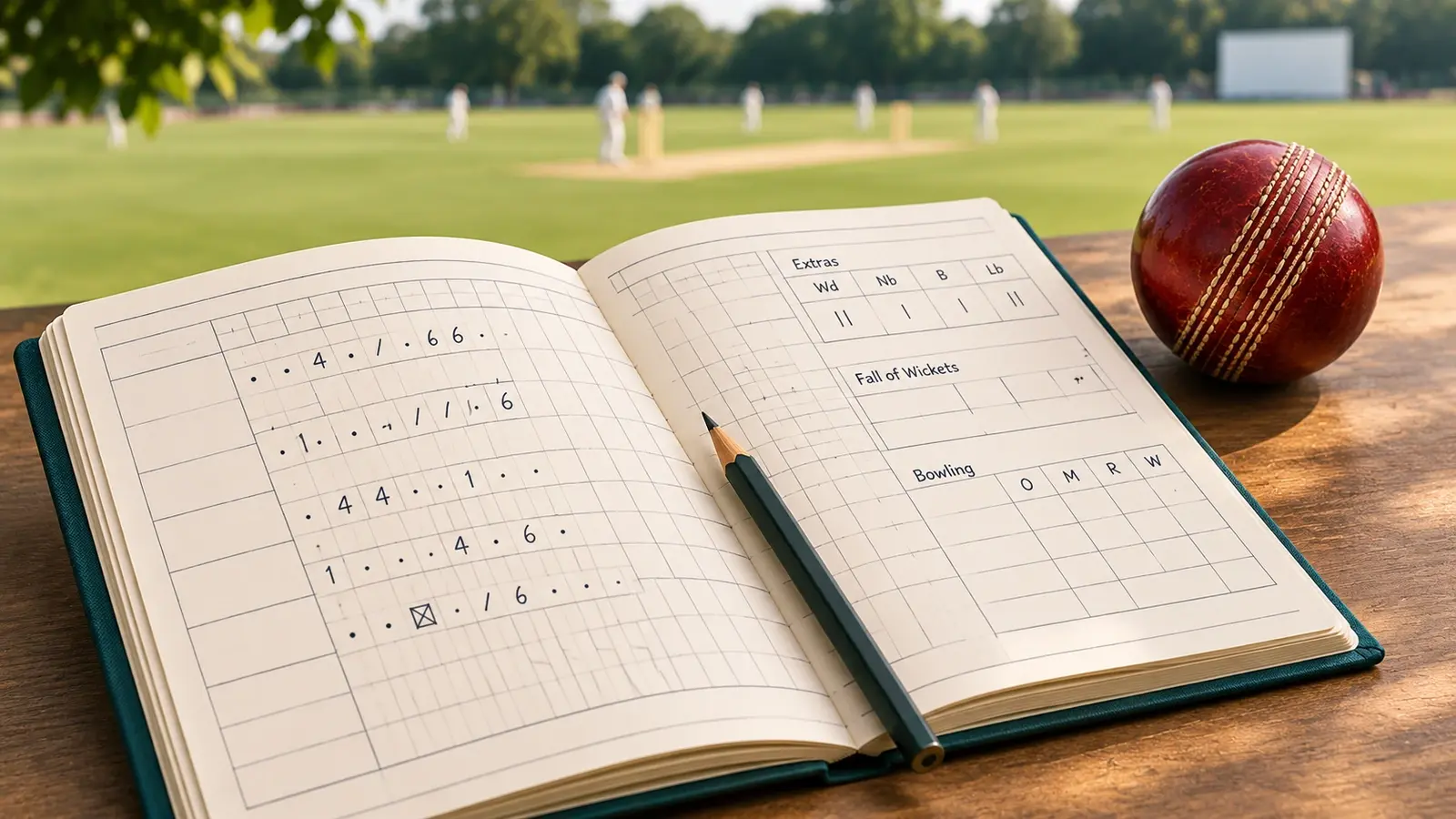
Use a consistent legend: . for no run, 1–6 for runs off the bat, Wd for wide, Nb for no-ball, B for bye, Lb for leg-bye and W for wicket. Traditional books may use circles, crosses or other symbols. Follow your competition's notation; see NSWCUSA scoring guidance.
3. Score extras correctly
| Event | Add to team total | Charged to bowler? | Valid ball? |
|---|---|---|---|
| Wide | One plus any additional wide runs | Yes | No |
| No-ball | One extra, plus any other runs | No-ball extra and bat runs only | No |
| Bye | Runs without bat/body contact, on a non-wide delivery | No | Yes, unless no-ball or otherwise invalid |
| Leg-bye | Runs off the body, if allowed | No | Yes, unless no-ball or otherwise invalid |
| Separate penalty runs | As awarded by the umpire | No | Depends on delivery |
Examples:
- No-ball hit for four: team +5, batter +4, bowler +5.
- No-ball passing untouched for two byes: team +3, one no-ball extra and two byes; bowler +1.
- Wide reaching the boundary untouched: normally five wides, not four byes.
Leg-byes generally require an attempt to play the ball or avoid being hit. No-ball overrides wide. For free hits, follow the match's playing conditions and umpire signals. See MCC Laws 18, 21–23 in the 2026 Laws of Cricket.
4. Record wickets and batting figures
| Dismissal | Bowler credited? |
|---|---|
| Bowled, caught, LBW, stumped, hit wicket | Yes |
| Run out, obstructing the field, hit the ball twice, timed out, retired out | No |
Record the actual dismissal, relevant fielder and bowler where applicable. Retired hurt is not a wicket. A run out may also involve completed runs; confirm with the umpire before recording the fall of wicket.
Batting strike rate = runs ÷ balls faced × 100. Wides do not count as balls faced. Follow the competition’s scoring convention for recording no-balls against the striker’s balls faced. No-balls do not count towards the six valid deliveries of the over. Track boundaries separately from completed runs.
5. Calculate bowling figures
Bowling figures are commonly displayed as O–M–R–W: overs, maidens, runs conceded and wickets credited to the bowler.
- Overs: 3.4 means three overs and four valid balls, not 3.4 decimal overs.
- Maiden: a complete over with no runs charged to the bowler; byes alone need not spoil it.
- Economy: runs conceded ÷ (valid balls ÷ 6).
For example, 20 runs from 3.2 overs (20 valid balls) gives an economy of 6.00.
6. Worked example: score one over
A and B open; A faces first. C replaces A when dismissed. This is an illustrative over, not actual match data.
| Delivery | Outcome | Score | Valid balls |
|---|---|---|---|
| 1 | A dot | 0/0 | 1 |
| 2 | A four | 4/0 | 2 |
| 3 | A single | 5/0 | 3 |
| 4 | Wide to B | 6/0 | 3 |
| 5 | B hits no-ball for two | 9/0 | 3 |
| 6 | B takes one bye | 10/0 | 4 |
| 7 | A bowled | 10/1 | 5 |
| 8 | C scores two | 12/1 | 6 |
Batting (counting the hit no-ball as a ball faced): A 5 (4), B 2* (2), C 2* (1). Extras: 3 (Wd 1, Nb 1, B 1). Fall of wicket: 10/1 (A, 0.5 overs). Bowling: 1–0–11–1. B faces the next over.
7. Check before closing the scorebook
- Reconcile batting runs plus extras with the total.
- Reconcile bowling runs plus byes, leg-byes and separate batting-side penalty runs with the total.
- Match valid balls, wickets and batter dismissals against the other scorer's record.
- Confirm the official target and result with the umpires; use their approved revised target if rain interrupts play.
Practise scoring an innings from a replay before taking responsibility for a live match. For more on electronic score delivery, read how live cricket scores update.
Once you have reliable delivery records, see how to analyse a batter’s scoring patterns and how to analyse a bowler’s spell.