How Does a Cricket Score Update Almost Instantly Around the World?
Learn how a cricket score travels from the ground to data providers, servers, APIs, apps and websites around the world within seconds.
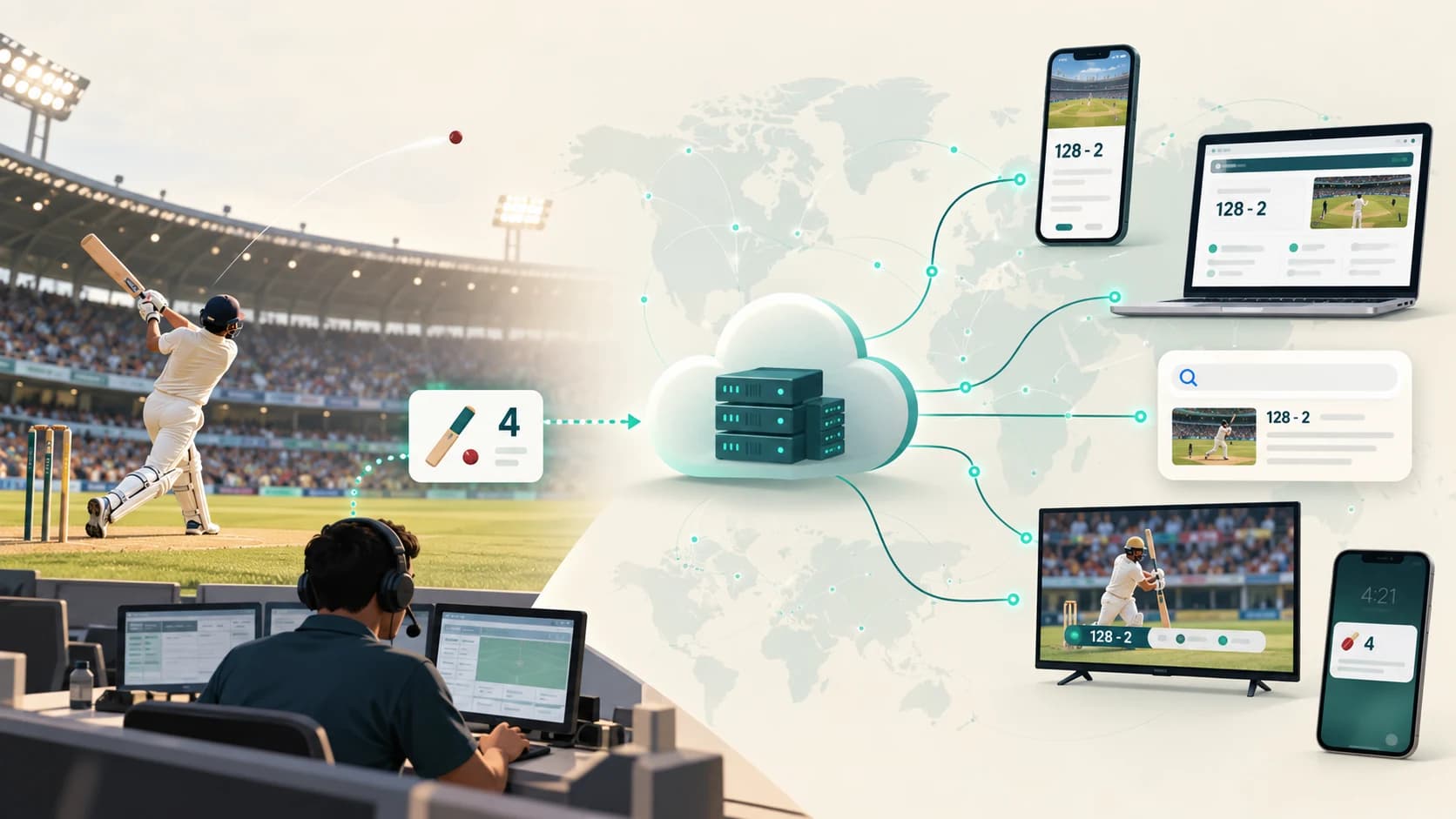
A batter hits a four.
Within moments, the score changes on:
- a cricket website,
- a sports app,
- a search result,
- a fantasy platform,
- a television graphic,
- and perhaps a notification on your phone.
Millions of people in different countries can see the update almost immediately.
It can feel as if every company watching the match has its own person entering the score at exactly the same time.
Usually, that is not what is happening.
Modern live scoring works more like a real-time data distribution network.
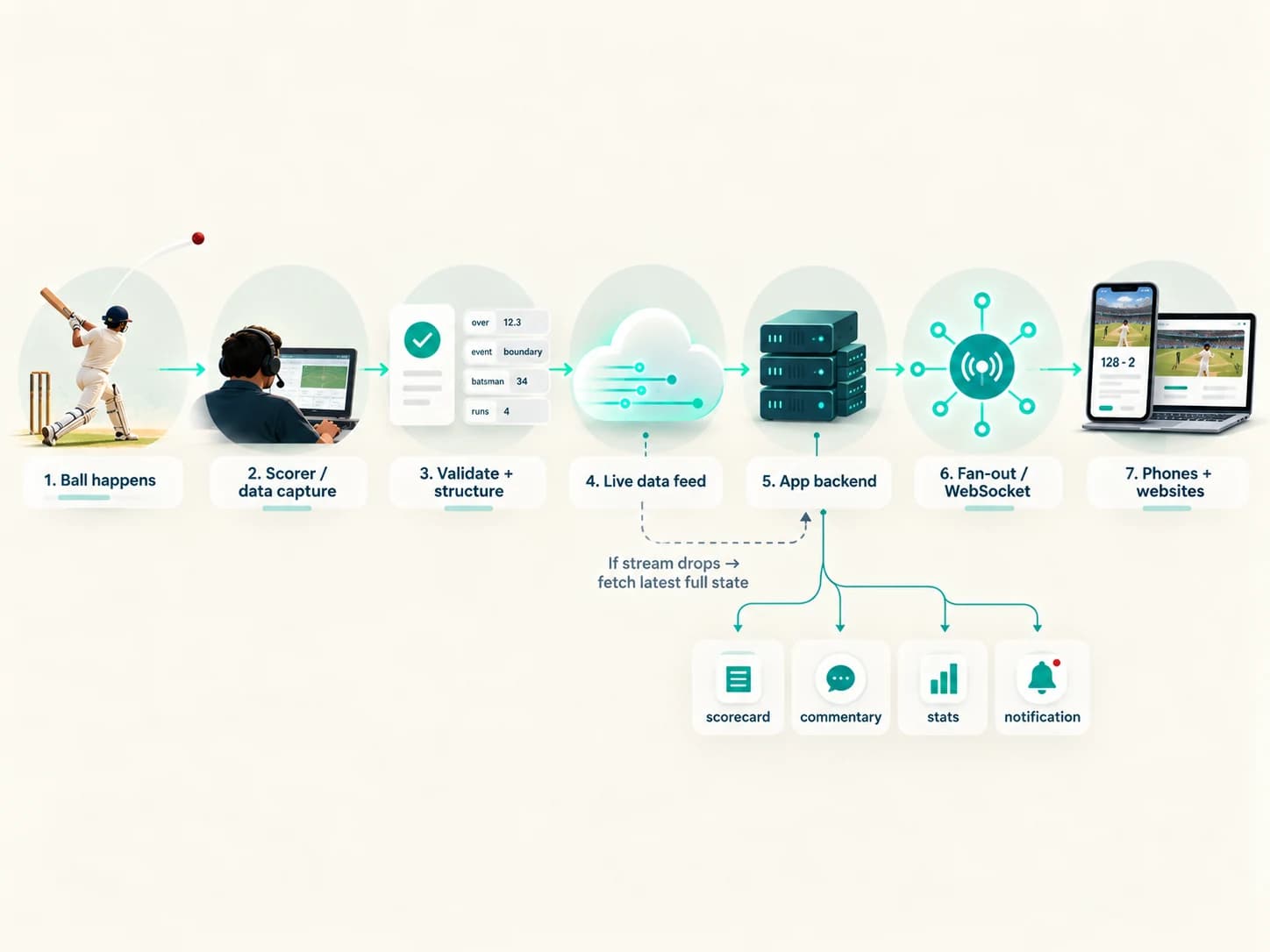
Someone or some system close to the match records what happened. That event becomes structured digital data. A data provider distributes it through live feeds. Apps and websites receive the update, recalculate the score and statistics they need, and send the new information to users.
For major cricket, the journey can look roughly like this:
Ball happens on the field
↓
Official or professional data collector records the event
↓
Live data platform validates and structures it
↓
Feed/API distributes the event
↓
App or website backend receives it
↓
Update is pushed to connected users
The reason this can happen so quickly is that a score update is tiny.
A video stream may require millions of bits every second.
A scoring event might need only a compact message saying, in effect:
delivery 17.3 → batter scored 4 → team total becomes 126/3.
That message can travel around the world extremely quickly.
The Score Usually Starts With a Human or an Official Data-Capture System
The first step is surprisingly ordinary:
someone has to record what happened.
Cricket is too complex for a scoreboard to update simply by watching whether the ball crossed a boundary.
A scorer or data operator may need to record:
- runs off the bat,
- extras,
- wickets,
- dismissal type,
- bowler,
- batter,
- over and delivery,
- fielding involvement,
- boundary type,
- sometimes shot location and other advanced data.
At professional matches, specialist data companies may have trained operators at the venue or dedicated scoring systems connected to the match.
Stats Perform says its Opta operation uses expert analysts, including in-stadium analysts, to record key events live before the information is structured, validated and delivered to customers.
Historically, the ICC has also used official data providers with personnel at venues. In 2013, for example, the ICC said Opta statisticians would score matches at the ground and supply live ball-by-ball information to ICC platforms, partners and third parties.
The technology around the process has improved enormously, but the fundamental requirement remains:
Before a score can reach your phone, the match event must first become reliable digital data.
The Scorer Is Not Just Typing “Four”
Cricket data is richer than the number visible on the scoreboard.
Imagine this delivery:
A right-handed batter faces a fast bowler.
The delivery is the third ball of the 18th over.
The batter drives through cover for four.
The structured event may contain fields representing things such as:
- match ID,
- innings number,
- over number,
- ball number,
- striker,
- non-striker,
- bowler,
- runs off the bat,
- extras,
- total runs,
- wicket status,
- team score,
- timestamp.
More advanced feeds may include:
- shot type,
- fielding position,
- pitch coordinates,
- delivery type,
- wagon-wheel location,
- commentary information.
Sportradar's current Cricket API, for example, offers real-time scoring and detailed ball-by-ball data at its higher coverage levels, including additional pitch and field information where available.
The key idea is that the event becomes structured data, not simply a sentence.
Instead of sending:
“Great cover drive! FOUR!”
the system can send something much closer to a machine-readable record.
That makes it easy for thousands of different products to use the same underlying event in different ways.
One Ball Can Trigger Many Calculations
Suppose the score was:
122/3 after 17.2 overs
and the batter hits four.
One scoring event can update all of these:
- team score → 126/3
- batter score → +4
- bowler conceded runs → +4
- current over → updated
- partnership → +4
- run rate → recalculated
- required run rate → possibly recalculated
- boundary count → +1
- fantasy points → potentially updated
- live commentary → generated or edited
- charts → updated
The app does not need a human to type every one of those numbers separately.
Once the event data says what happened, software can derive much of the rest.
That is one of the reasons digital sports products can update so quickly.
The system is processing a small event and applying rules, not rebuilding the entire scorecard from scratch after every delivery.
How Does the Data Leave the Stadium?
Once the event has been captured, it has to reach the data provider's infrastructure.
That usually happens over network connections from the venue to backend systems.
At this point, several things may happen very quickly:
- the event is checked for obvious inconsistencies,
- IDs are attached so the system knows which match, team and players are involved,
- cumulative statistics are updated,
- the event is placed into a live data stream,
- clients subscribed to that match can receive it.
Professional systems are built with redundancy because live sport cannot simply stop updating when one connection fails.
Sportradar's Cricket API documentation, for example, describes automated monitoring and redundancy as part of its live cricket-data platform.
Stats Perform similarly emphasizes real-time collection, validation and scalable delivery.
The exact architecture is proprietary and differs between providers, but the goal is the same:
turn the scorer's event into a reliable data message as quickly as possible.
The Score Is Distributed Through APIs and Live Feeds
This is where the internet side becomes important.
A sports website does not normally need to phone the stadium every ball and ask:
What's the score now?
Instead, it can subscribe to or query a data feed.
Commercial sports-data companies provide structured feeds that customers can integrate into:
- apps,
- websites,
- television graphics,
- fantasy games,
- sportsbooks,
- stadium displays.
Stats Perform says its data can be delivered through:
- RESTful APIs,
- WebSockets,
- push feeds,
- pull feeds,
- other structured delivery methods,
with formats including JSON and XML.
A JSON message might conceptually resemble this:
{
  "match_id": "match_123",
  "innings": 1,
  "over": 17,
  "ball": 3,
  "runs": 4,
  "wicket": false,
  "score": "126/3"
}
Real provider schemas are more detailed, but this illustrates why the update can move quickly.
That entire object is tiny compared with even one second of high-definition video.
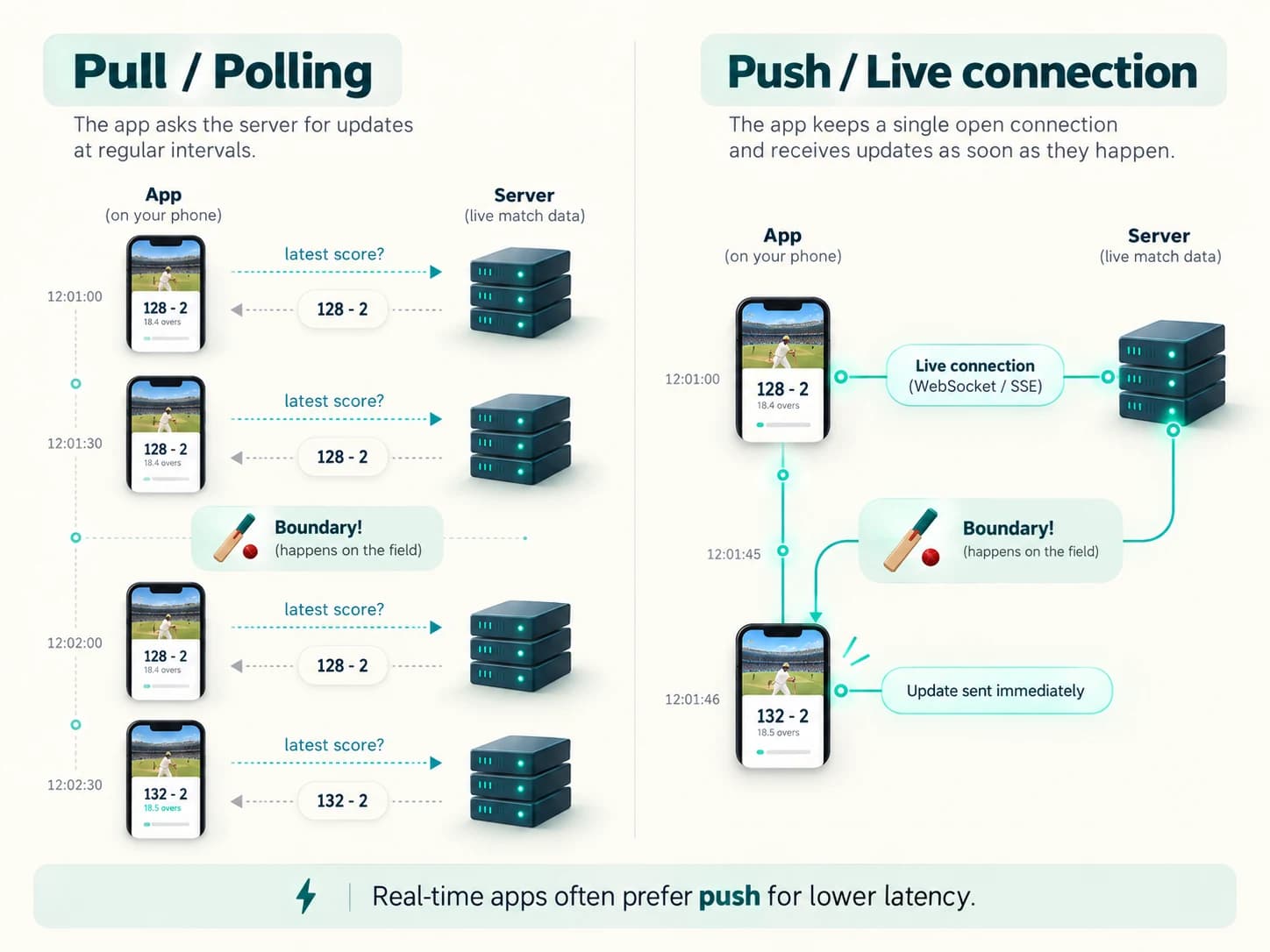
Push vs Pull: Two Ways an App Can Learn the Score Changed
There are two broad ways a digital product can receive live updates.
Pull: “Has anything changed?”
The app or its backend repeatedly asks the data provider for the latest information.
For example:
request latest score
wait one second
request latest score
wait one second
request latest score
This is simple but can be inefficient.
If nothing changed, the system still made a request.
If the polling interval is five seconds, the app could also remain stale for almost five seconds after a boundary.
Push: “Tell me when something changes.”
A live connection stays open.
When a new event becomes available, the provider sends it immediately.
Sportradar documents this approach in its push-feed systems: a client subscribes once and receives new JSON data whenever an event or statistic changes instead of repeatedly polling.
Stats Perform also lists WebSockets and push feeds among its delivery methods.
For very time-sensitive products, push-style architecture is attractive because the update can begin moving through the system as soon as it exists.
What Is a WebSocket?
Normally, when your browser loads a web page, it asks a server for information and receives a response.
That model is perfect for ordinary pages.
Live scoring often benefits from a connection that stays open.
A WebSocket is one way to do that.
Cloudflare describes WebSockets as persistent connections between a client and server that allow information to move back and forth without repeatedly establishing a new session.
AWS similarly uses WebSocket-based subscriptions as a reference architecture for real-time sports applications.
So while you keep a live score page open, the site may maintain a live connection.
When a wicket occurs, the backend does not have to wait for you to refresh the page.
It can effectively say:
New event available.
and send the update immediately.
The App Usually Has Its Own Backend in the Middle
The path is rarely:
data company → directly into your phone
A large cricket app normally has its own servers.
Those servers may:
- receive the raw sports feed,
- verify the sequence of events,
- store the latest match state,
- generate commentary,
- calculate custom statistics,
- apply fantasy rules,
- translate text,
- decide which users should receive notifications,
- serve millions of app and web clients.
So the path is more accurately:
Stadium
↓
Data provider
↓
Cricket app's backend
↓
Your device
That additional layer allows each platform to create a different product from similar raw information.
One app may emphasize:
- ball-by-ball commentary.
Another may emphasize:
- advanced statistics.
Another may show:
- fantasy points.
Another may display only:
- score, wickets and overs.
The underlying event can be the same.
How Can Millions of Phones Receive the Same Boundary?
Imagine India needs six runs to win and the batter hits a six.
Millions of people may be looking at the match simultaneously.
The app cannot handle that efficiently by performing one slow custom process for every person.
Modern cloud infrastructure is designed to fan out one event to a very large number of connected clients.
AWS has published reference architectures specifically for live sports updates in which a third-party sports feed enters a streaming system, backend services process it, and real-time subscriptions distribute updates to web and mobile users.
AWS AppSync documentation describes secure WebSocket subscriptions that can push new data to connected clients while the service manages the scaling of large numbers of connections.
Conceptually:
1 scoring event
↓
1 backend update
↓
100,000 or 1,000,000+ connected clients receive the change
The expensive part is not the size of the cricket score.
It is managing all those simultaneous users reliably.
Why Doesn't Everyone See the Update at Exactly the Same Time?
Because “live” does not mean zero latency.
Different viewers take different paths through the system.
An update may spend small amounts of time in:
- event entry,
- validation,
- provider transmission,
- app processing,
- database updates,
- network travel,
- WebSocket or polling intervals,
- phone notification services.
One app may use a very low-latency commercial feed.
Another may update its backend less frequently.
One user's internet connection may be excellent.
Another may be on a weak mobile network.
So two phones sitting beside each other can update at slightly different moments.
Stats Perform currently says its live feeds can be delivered with sub-second latency in some products, but that does not mean every consumer app using sports data will show the event to the end user in under one second.
There are several additional systems between the original data and the display.
Why Can a Score Notification Arrive Before the TV Picture?
This surprises many viewers.
You are watching a live stream.
Your phone suddenly says:
WICKET!
But on the video, the bowler is still running in.
The app has not predicted the future.
The two streams simply have different delays.
A score update is tiny structured data.
A video stream must go through much more processing:
camera capture
↓
production switcher
↓
graphics/audio
↓
video encoding
↓
distribution
↓
content delivery network
↓
player buffering
↓
screen
Online video players deliberately buffer some data so playback remains smooth when the network fluctuates.
Live television distribution can also introduce production and transmission delays.
The scoring message does not need to carry:
- 50 frames of video each second,
- multiple audio channels,
- high-resolution images.
It may only need to transmit a few fields of text and numbers.
So under some viewing conditions, the score-data path reaches you before the video path.
Why Can Google, an App and a Cricket Website Show Similar Scores?
They may be using:
- the same data provider,
- different licensed providers,
- their own internal scoring operation,
- feeds derived from an official data source.
There is no universal pipeline used by every cricket product.
Data rights are commercial assets.
The ICC, cricket boards and tournament operators can appoint official data partners and license information for different purposes.
For example, the ICC announced in 2024 that Stats Perform would serve as its official data partner through 2027 for the exclusive collection and distribution of official data and live streams to licensed betting operators for major ICC events.
In an earlier rights cycle, the ICC used Sportradar as its official data distribution partner and said live ball-by-ball information captured through its cricket scoring technology would feed media platforms and ICC digital products.
The partner can change.
The principle does not:
a trusted live data source can feed many downstream products.
What Happens If the Scorer Makes a Mistake?
Live scoring is fast, but accuracy matters more than pretending every first entry is permanent.
Imagine a fielder saves a boundary.
Initially the scorer enters:
4 runs
A replay or umpire signal then establishes that only:
3 runs
should count.
The data provider can issue a correction.
Downstream systems update the match state.
This is why you may occasionally see:
- a score change backward,
- a wicket temporarily disappear,
- an extra reclassified,
- a batter's total corrected,
- a delivery edited.
Professional feeds maintain identifiers for matches, players and events so corrections can be applied to the right record rather than simply adding another unrelated event.
Live data platforms also use validation processes to catch inconsistencies.
Stats Perform describes its live data as being structured and validated before distribution.
Accuracy and speed therefore work together.
The fastest possible update is not very useful if it is wrong.
What Happens If a Live Connection Drops?
Suppose an app is receiving a push stream.
It receives:
17.1 → 1 run
17.2 → dot
Then its connection briefly fails.
While disconnected:
17.3 → four
17.4 → wicket
The app cannot simply reconnect and assume nothing happened.
Live sports architectures therefore often combine streaming updates with a second method for recovering the latest full state.
Sportradar's push-feed documentation explicitly says its push feeds are not stateful and recommends using the corresponding REST feed to recover missed information after a disconnection.
That gives a useful general architecture:
Push stream for speed
regular API/state endpoint for recovery
If the stream fails, the app can ask:
What is the complete score now?
Then continue receiving new events.
Why Is a Cricket Score So Well Suited to Real-Time Data?
Cricket may feel complicated, but digitally it has a useful characteristic:
the match changes through discrete events.
Each delivery is a natural data unit.
A ball can produce:
- 0,
- 1,
- 2,
- 3,
- 4,
- 5,
- 6 runs,
- an extra,
- a wicket,
- or combinations allowed by the Laws.
That means software can model a match as a sequence of events.
Conceptually:
Ball 1 → 1 run
Ball 2 → dot
Ball 3 → four
Ball 4 → wicket
Ball 5 → wide
Ball 5 → 2 runs
...
Every new event changes the current state.
This event-driven nature makes cricket particularly suitable for:
- live scorecards,
- notifications,
- charts,
- win probability,
- fantasy scoring,
- automated commentary.
The entire digital match can be reconstructed from a sufficiently rich sequence of ball-by-ball events.
Do AI Systems Automatically Watch the Match and Score It?
Sometimes automation assists data collection, but it would be wrong to assume that every major live score is produced by AI watching television.
Current sports-data companies combine several methods.
Stats Perform says its broader Opta collection operation uses expert human analysts together with technologies such as optical tracking, computer vision and proprietary AI.
Different competitions can use different workflows.
Human operators remain valuable because cricket contains ambiguous situations that require interpretation:
- byes versus runs off the bat,
- dismissal classification,
- substitute fielders,
- unusual extras,
- corrections after umpire signals.
Automation can reduce workload and add richer tracking information.
But the official live score still needs to be accurate under cricket's scoring rules.
What Happens Between the Boundary and Your Screen?
Imagine a batter hits four at 8:42:15 p.m.
A simplified journey could be:
8:42:15.0 — The ball reaches the boundary
The cricket event physically happens.
A moment later — The event is captured
The scorer/data operator records four runs to the batter.
Data platform updates the match
The delivery receives its identifiers and the team total, batter score and other statistics are updated.
A live feed publishes the change
Subscribed customers receive a small structured message.
The cricket app's backend processes it
Its database becomes:
126/3
The app may also generate:
FOUR!
or recalculate win probability and fantasy points.
Connected users are updated
WebSocket, subscription or similar real-time infrastructure sends the new state to active users.
Background users may receive a notification
A mobile push-notification service can wake the device with the score alert.
The whole chain can be extremely fast because almost everything after the initial scoring decision is automated.
The Score Is Small; the Infrastructure Is Huge
That is the paradox of live cricket scoring.
The piece of information you need is tiny:
126/3, 17.3 overs
But delivering it correctly to millions of people requires a substantial system behind the scenes:
- trained scorers,
- data rights,
- venue connectivity,
- validation,
- low-latency feeds,
- APIs,
- databases,
- streaming infrastructure,
- global cloud servers,
- mobile notification systems,
- app and website code.
When the system works well, you notice none of this.
You tap a cricket app and the number simply changes.
That simplicity is the result of many layers working together.
So the next time a six is hit and your phone updates almost before the replay begins, remember what actually happened.
The score did not somehow appear independently in thousands of apps.
One cricket event was turned into data.
That data was distributed through a fast digital pipeline.
And within moments, software around the world transformed the same tiny event into millions of synchronized scoreboards.