How Does UltraEdge Know Whether the Cricket Ball Touched the Bat?
Learn how UltraEdge combines sensitive audio with synchronized slow-motion video to help umpires decide whether a cricket ball touched the bat or glove.
A fast bowler sends the ball past the outside edge.
The wicketkeeper catches it.
The fielding team appeals.
The umpire says not out.
A review is taken.
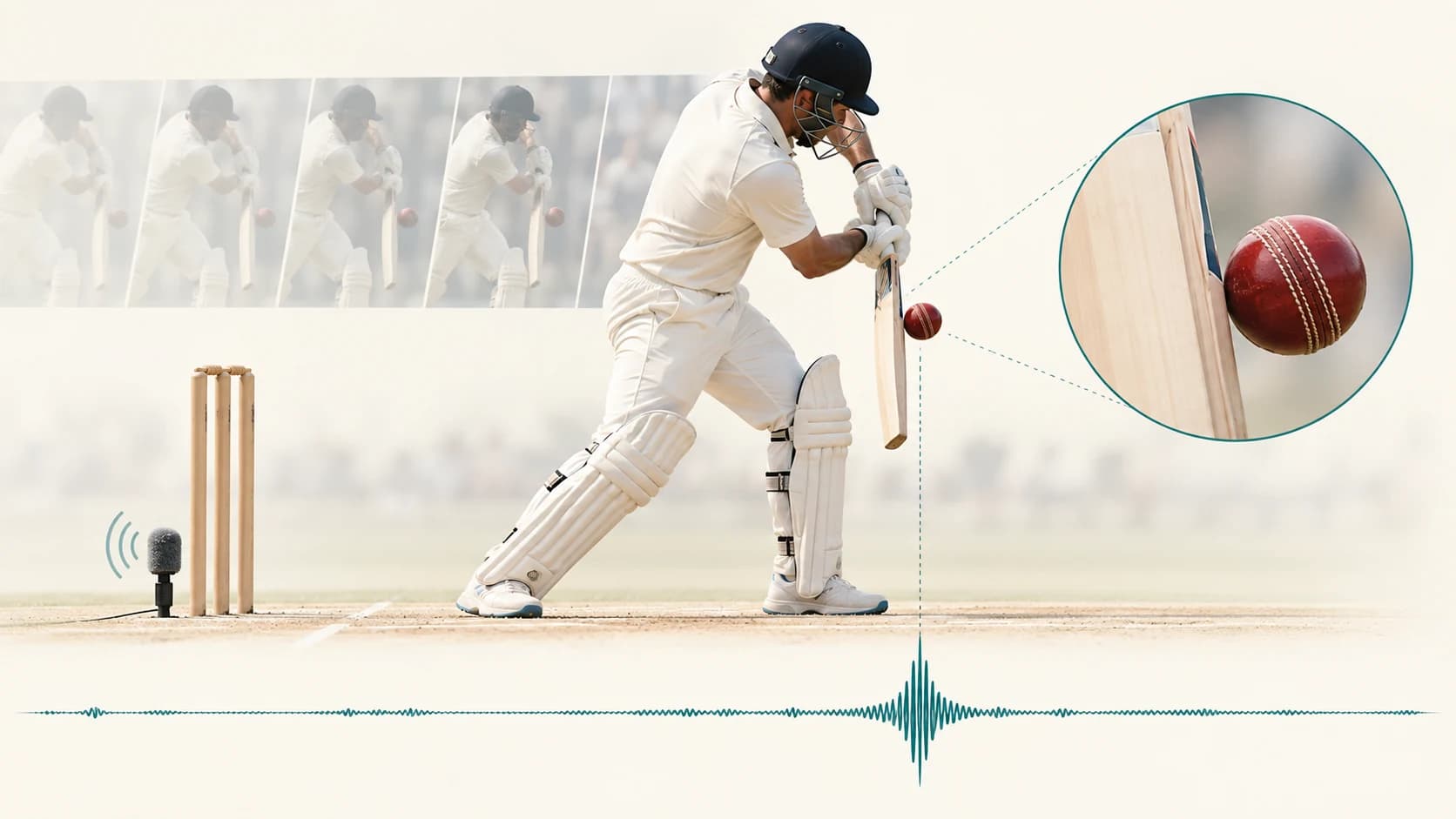
On the television screen, the ball is shown passing the bat in slow motion. Beneath the replay is a horizontal waveform. For a moment it remains almost flat.
Then, exactly as the ball reaches the edge of the bat:
a sharp spike appears.
The third umpire concludes that there was contact.
To viewers, UltraEdge can look like an electronic detector that somehow knows the difference between leather touching willow and leather missing it by a millimetre.
The reality is both simpler and more interesting.
UltraEdge is an approved sound-based edge-detection technology used within cricket's Decision Review System. The ICC currently lists UltraEdge from Hawk-Eye Innovations alongside BBG Sports' Real-Time Snickometer as approved sound-based edge-detection systems.
At its core, the method combines two kinds of evidence:
what the cameras show
and
what the microphones hear.
The sound is represented as a waveform and synchronized with the video. The third umpire can then ask:
Did a meaningful sound occur at the same instant the ball was next to the bat or glove?
That timing is what makes UltraEdge useful.
A spike somewhere in the delivery is not enough.
The spike has to make sense when compared with what was happening on screen at that exact moment.
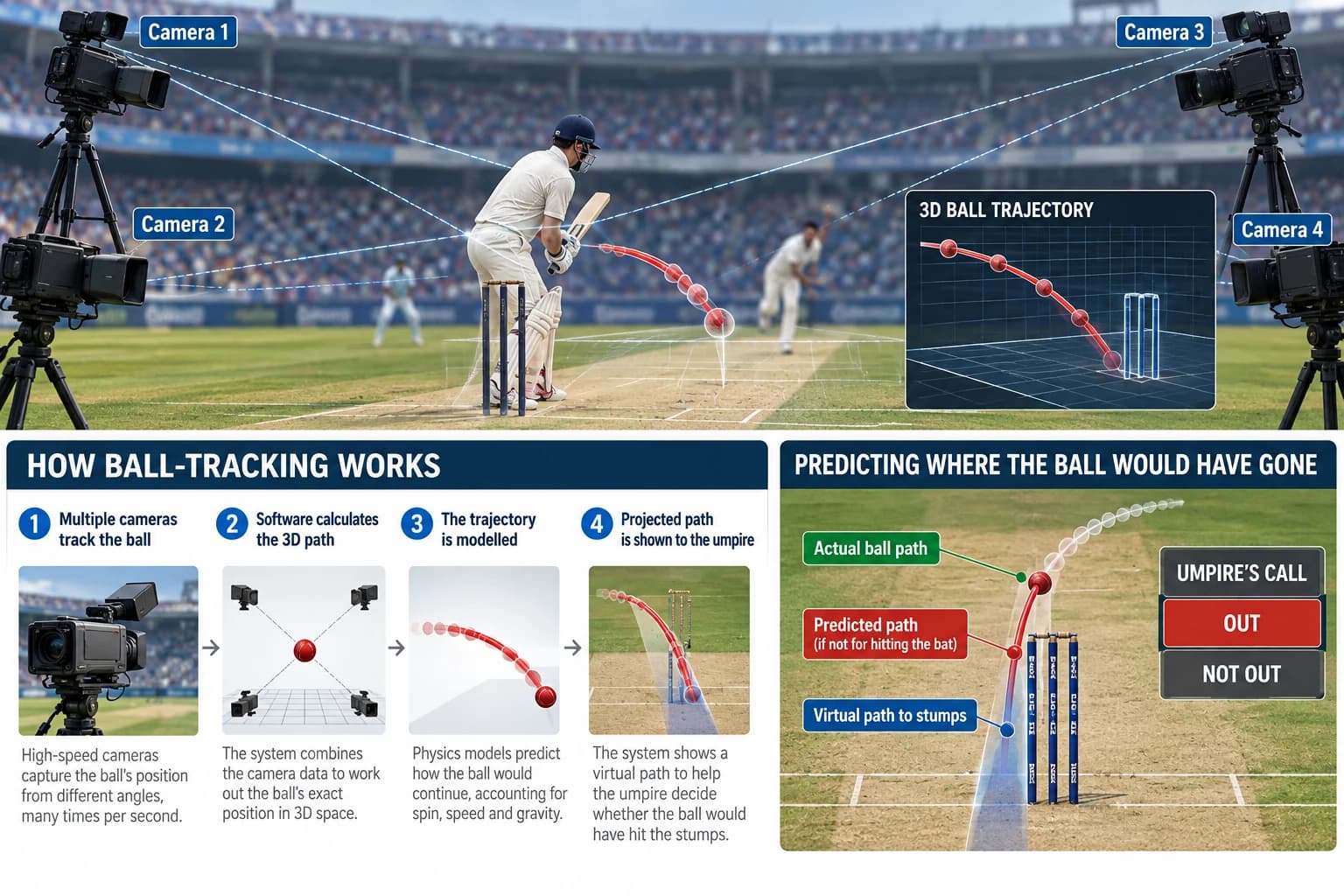
UltraEdge Does Not Work Like Ball Tracking
UltraEdge and ball tracking often appear one after another during an LBW review, which can make them seem like parts of the same measurement.
They answer completely different questions.
UltraEdge asks:
Did the ball touch the bat or qualifying glove?
Ball tracking asks:
If the ball had not been stopped, where would it have gone?
For an LBW review, the order matters.
Current ICC DRS procedures require the third umpire first to determine whether the ball touched the bat before it struck the batter's person. Only if the batter is still eligible to be out LBW does the review move on to ball tracking.
So when you hear:
“No bat involved. We can move to ball tracking.”
the third umpire has finished one technological question and is beginning another.
The Main Ingredient Is Sound
When a cricket ball touches a bat, even very lightly, the collision can create a vibration and sound.
The same is true when:
- the ball strikes the pad,
- the bat hits the pad,
- the bat clips the ground,
- the ball touches a glove,
- equipment moves or makes contact.
The human ear sometimes hears a clear nick.
But tiny edges can be difficult to judge because a cricket ground is noisy.
There may be:
- crowd noise,
- commentary,
- players shouting,
- bat and pad movement,
- shoe contact,
- wind,
- wicketkeeper gloves,
- the ball striking the pitch.
Sound-based edge detection helps by recording sensitive audio close to the action and presenting it in a form the umpire can inspect alongside video.
The ICC's current DRS rules explicitly allow the third umpire to use sound from the stump microphones with normal-speed and slow-motion replays, and separately list UltraEdge and Real-Time Snickometer as approved sound-based edge-detection technologies.
What Is the Waveform Actually Showing?
The familiar UltraEdge line is a graphical representation of an audio signal changing over time.
When the recorded sound is relatively quiet, the trace stays close to its baseline.
A sudden sound produces a larger variation.
That appears as a spike.
A simplified waveform might look like this:
___________________/\___________________
                   ^
                 sound
The important thing is that the horizontal direction represents time.
The waveform therefore gives the third umpire a timeline of acoustic events during the delivery.
A spike does not literally mean:
BALL HIT BAT
It means:
A noticeable sound event occurred here.
The video provides the context needed to understand what caused it.
Why Video Synchronization Is So Important
Imagine a delivery where three things happen in rapid succession:
- the ball passes the bat,
- the bat hits the pad,
- the ball hits the pad.
Those events may be separated by only tiny fractions of a second.
The microphone may record several sounds.
If the umpire looked only at the waveform, there could be no reliable way to know which spike belonged to which physical event.
Now synchronize the waveform with slow-motion video.
The umpire can move through the incident frame by frame and compare:
ball beside bat
with
waveform at the same time.
If a spike appears only when the bat later hits the pad, that is not evidence of a bat-ball edge.
If a spike appears exactly when the ball passes the bat, it can support the conclusion that there was contact.
Hawk-Eye describes its officiating systems as using synchronized video and audio capture and playback, allowing officials to review evidence together rather than as separate streams.
This synchronization is the key improvement over simply listening to the stump microphone.
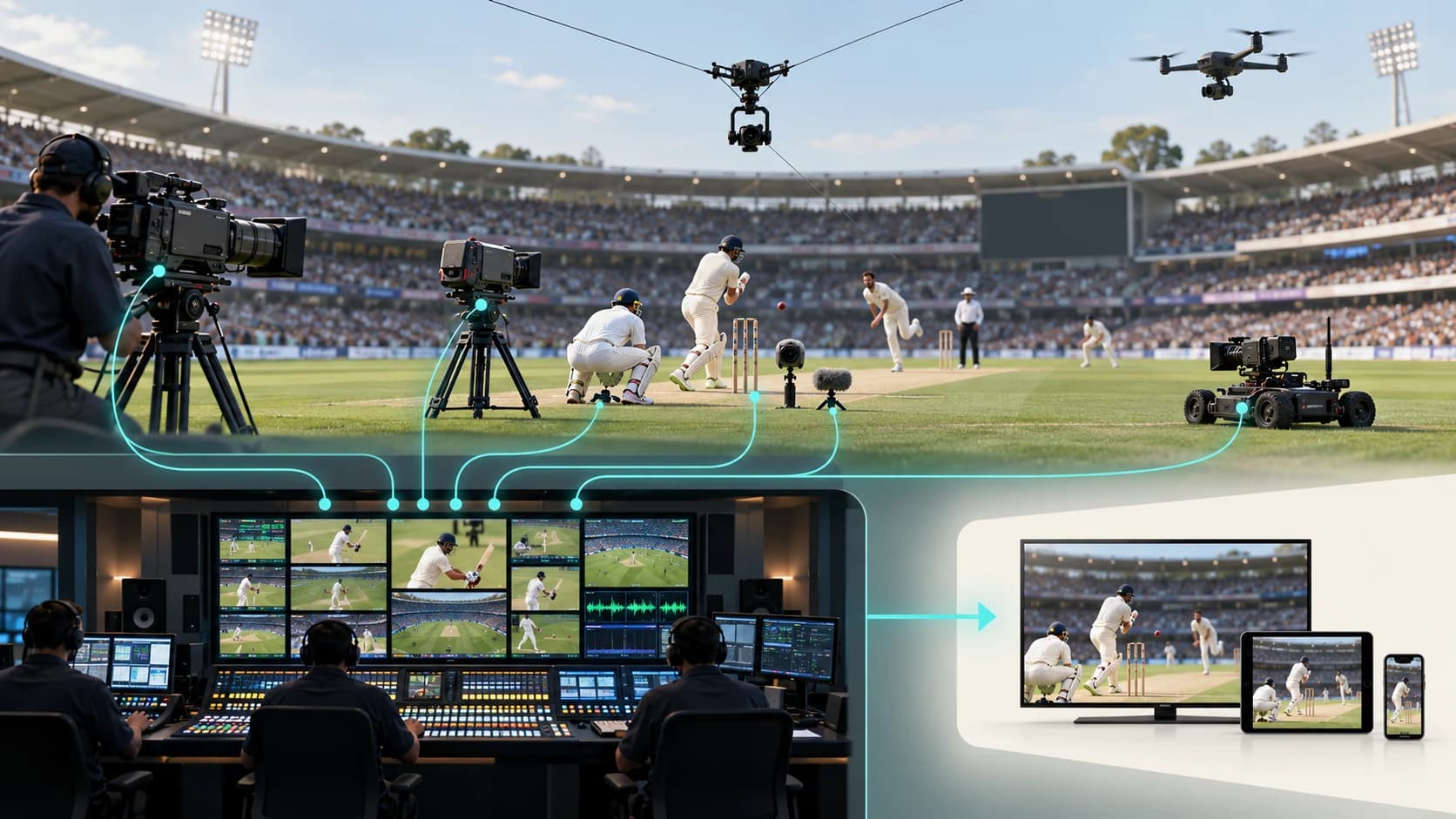
Step 1: The Delivery Is Recorded
During the delivery, broadcast and officiating systems capture:
- video from several camera angles,
- match audio from microphones around the wicket,
- synchronized timing information.
The system must preserve the relationship between the sound and the pictures.
If the audio were shifted slightly forward or backward relative to the video, a real bat-pad sound could appear to occur when the ball was beside the bat.
That is why timing is critical.
Step 2: The Audio Becomes a Visual Trace
The audio signal is processed into a waveform that can be displayed beneath or alongside the video.
The exact proprietary signal-processing details used by current UltraEdge are not fully published by Hawk-Eye, so it would be misleading to pretend there is one public formula describing every filtering step.
Conceptually, however, the system is doing something straightforward:
record sound
↓
represent how the signal changes over time
↓
align that timeline with the video
The result lets an umpire inspect an extremely short moment much more carefully than by simply listening once in real time.
Step 3: The Video Is Slowed Down
A cricket ball travelling at high speed can move a significant distance between ordinary visual moments perceived by the human eye.
Slow-motion replay makes the relationship easier to inspect.
The third umpire looks for the moment when the ball is:
- beside the outside edge,
- beside the inside edge,
- close to the glove,
- or moving past without apparent contact.
At the same time, the waveform is examined.
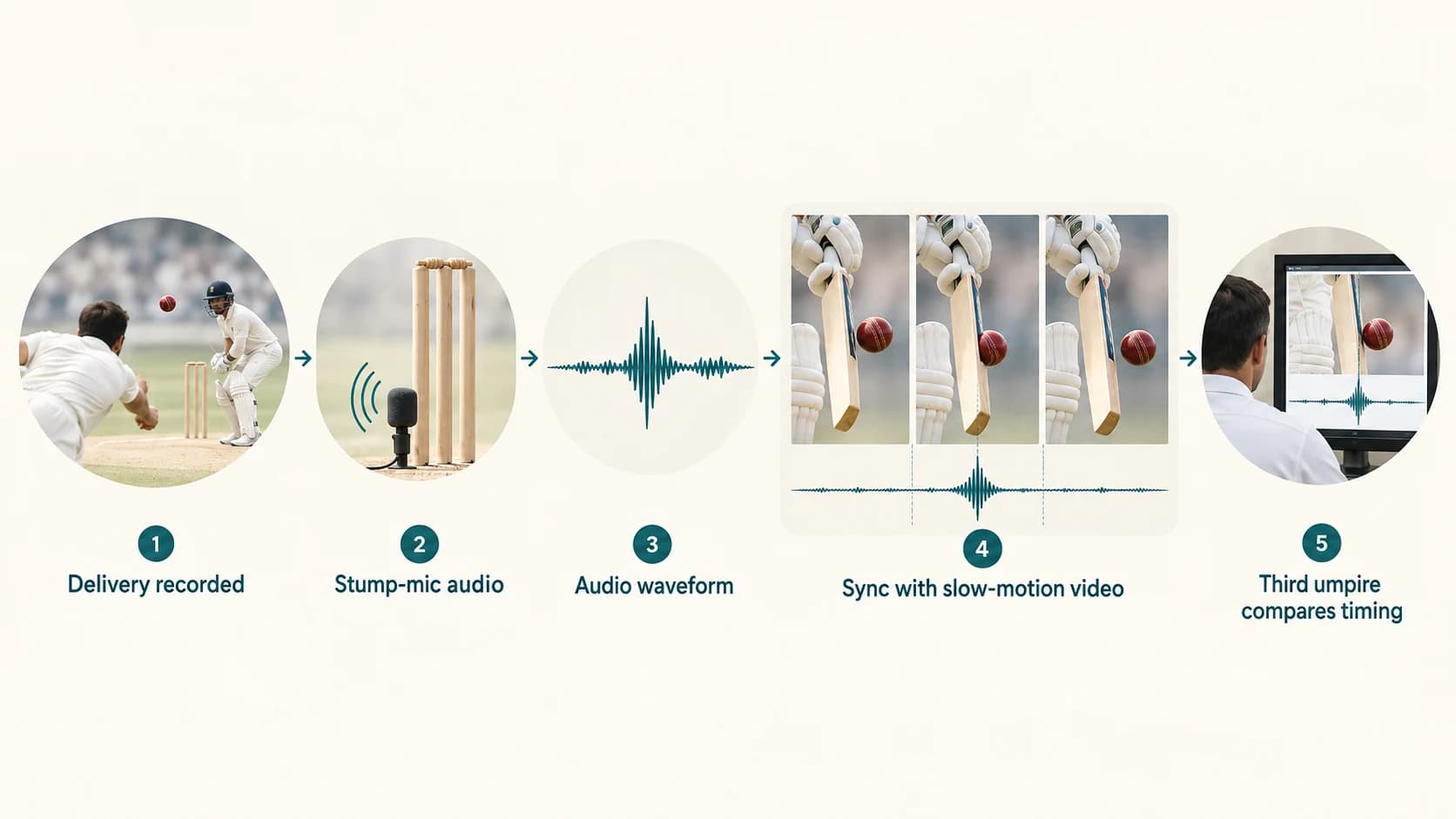
The question becomes not merely:
Is there a spike?
but:
Is there a spike when the ball is in a position where this contact could have created it?
Step 4: Other Possible Sounds Must Be Ruled Out
This is one of the most important parts of the process.
Cricket is full of noises.
Suppose the waveform spikes at almost the same moment that:
- the bat passes the ball,
- the bat clips the front pad.
The umpire now has two plausible explanations for the same sound.
That can make the evidence more difficult to interpret.
The third umpire may inspect:
- another camera angle,
- the separation between bat and pad,
- the exact timing of the spike,
- whether there appears to be daylight between ball and bat,
- whether the ball changes direction,
- other available technology.
UltraEdge is therefore evidence, not an automatic electronic verdict.
The ICC's DRS framework explicitly recognises that technological evidence can sometimes be inconclusive. A review is not treated as a technology failure merely because the available technology worked normally but could not provide a conclusive answer.
Does Every Spike Mean an Edge?
No.
This is probably the most important misconception about UltraEdge.
The system is sensitive to sound.
Cricket contains many sources of sound.
A spike can potentially correspond to:
- ball on bat,
- ball on glove,
- ball on pad,
- bat on pad,
- bat on ground,
- another nearby contact.
The umpire therefore cares about synchronization and context.
Suppose the screen shows:
ball near bat → flat line
then, several frames later:
bat hits pad → spike
That supports the conclusion that the sound came from bat-pad contact rather than an edge.
Now reverse it:
ball beside bat → spike
then:
bat reaches pad → no new spike
That is much stronger evidence of bat-ball contact.
The waveform alone does not identify the material that produced the noise.
The combination of sound and pictures does the useful work.
Can the Shape of the Spike Tell Bat From Pad?
Different kinds of contact can create different acoustic signatures.
Historically, Snickometer descriptions often noted that a fine bat-ball contact tends to produce a short, sharp acoustic event, while other contacts can create different-looking traces.
But it is safer not to treat waveform shape as a universal fingerprint.
The sound of a contact can depend on:
- how hard the collision was,
- where on the bat it occurred,
- bat construction,
- ball speed,
- pad and glove materials,
- microphone position,
- other simultaneous noises.
Modern UltraEdge is a proprietary system, and Hawk-Eye does not publish a simple public chart saying:
this exact waveform = willow
this exact waveform = pad.
In an actual review, timing with the visual evidence is crucial.
What About the Glove?
In cricket law, some glove contact counts the same as contact with the bat.
Current ICC playing conditions state that the ball is regarded as striking or touching the bat when it contacts:
- the bat itself,
- the batter's hand holding the bat,
- the part of a glove worn on the hand holding the bat,
- certain permitted additional materials associated with the bat.
So during a caught-behind or LBW review, the question may not literally be:
Did the ball touch the wooden bat?
It can instead be:
Did it touch something the Laws treat as part of the bat?
This is why the third umpire may carefully check whether a ball passed close to:
- the bat edge,
- the thumb,
- the glove.
UltraEdge can provide timing evidence for any of these contacts, but video is needed to determine what was next to the ball when the sound occurred.
How UltraEdge Helps in a Caught-Behind Review
Consider a typical caught-behind appeal.
The ball passes the outside edge and goes into the wicketkeeper's gloves.
The umpire gives the batter not out.
The fielding side reviews.
The third umpire can:
- confirm the delivery and catch circumstances,
- view the ball passing the bat,
- inspect the UltraEdge waveform,
- compare the sound spike with the ball's position,
- decide whether the evidence shows contact.
If there is a clear spike synchronized with the ball beside the bat, and the subsequent catch is fair, the original decision may be overturned.
If the line stays flat while the ball passes the bat, that supports the conclusion that there was no detectable edge.
But the third umpire still makes the decision.
UltraEdge does not put up its own electronic OUT signal.
How UltraEdge Changes an LBW Review
Now imagine the umpire gives a batter out LBW.
The batter immediately signals for a review because he believes he inside-edged the ball onto his pad.
Before asking whether the ball would have hit the stumps, the third umpire must answer the edge question.
The ICC's DRS protocol says that, in reviewing an LBW decision, the third umpire first considers whether the delivery was fair and then whether the ball touched the bat before being intercepted by the batter's person.
If UltraEdge shows convincing bat contact first, the LBW enquiry ends.
The batter cannot be out LBW on that delivery because the ball touched the bat before the relevant body interception.
If there is no bat contact, the review can continue to:
- pitching,
- impact,
- projected wicket.
So UltraEdge can completely change which technology is considered next.
What Is the Difference Between UltraEdge and Snicko?
The names are related because they solve the same general problem using sound.
Original Snickometer
The original Snickometer became famous as a broadcast tool.
It displayed a waveform from microphone audio alongside video so viewers could investigate possible edges.
Real-Time Snickometer
Real-Time Snickometer, developed by BBG Sports with original Snickometer developer Allan Plaskett, improved the workflow so synchronized edge information could be produced quickly enough for DRS use.
The ICC currently lists it as an approved sound-based edge-detection technology.
UltraEdge
UltraEdge is Hawk-Eye Innovations' sound-based edge-detection system.
The ICC also currently approves it for DRS.
In everyday commentary, people sometimes casually use “Snicko,” “UltraEdge” and “edge detection” as if they are identical names.
Technically, Real-Time Snickometer and UltraEdge are different approved products from different providers, although they use the same broad idea of synchronized acoustic and visual evidence.
How Is UltraEdge Different From Hot Spot?
Hot Spot uses a completely different physical signal.
It is a heat-based edge-detection technology.
Infrared cameras can look for a small thermal mark produced by friction when the ball contacts the bat or other equipment.
Under current ICC playing conditions:
- UltraEdge and Real-Time Snickometer are listed as sound-based technologies.
- Hot Spot is listed as heat-based technology.
These systems therefore do not measure the same thing.
One looks for acoustic evidence.
The other looks for thermal evidence.
When more than one technology is available, the evidence can sometimes complement each other.
Why Can an Edge Exist Even If You Cannot Hear It on Television?
The television audio you hear at home is not necessarily equivalent to the evidence available to the officiating system.
Broadcast audio may be mixed with:
- commentary,
- crowd sound,
- other microphones,
- level adjustments.
A tiny contact can also be too subtle for a viewer to identify confidently by ear.
The purpose of displaying the waveform is to make a brief audio event visible and place it on the same timeline as the slow-motion replay.
A sound you barely notice can still create a visible change in the recorded signal.
Conversely, a loud noise does not automatically mean the ball hit the bat.
Again, timing matters.
Can UltraEdge Detect an Infinitely Small Nick?
No measurement technology should be described as infinitely sensitive.
Every real system has limits involving:
- microphone sensitivity,
- background noise,
- signal processing,
- video timing,
- available camera angles,
- overlapping sounds.
A contact may also happen at nearly the same moment as another noisy event.
This is why the ICC does not say that approved technology can never be inconclusive.
It explicitly provides procedures for situations where available technological evidence cannot properly resolve a review.
The useful question is not:
Is UltraEdge perfect?
It is:
Does the synchronized evidence provide a clear enough basis for the umpire to make or overturn the decision?
Why a Spike Can Be Misleading Without the Pictures
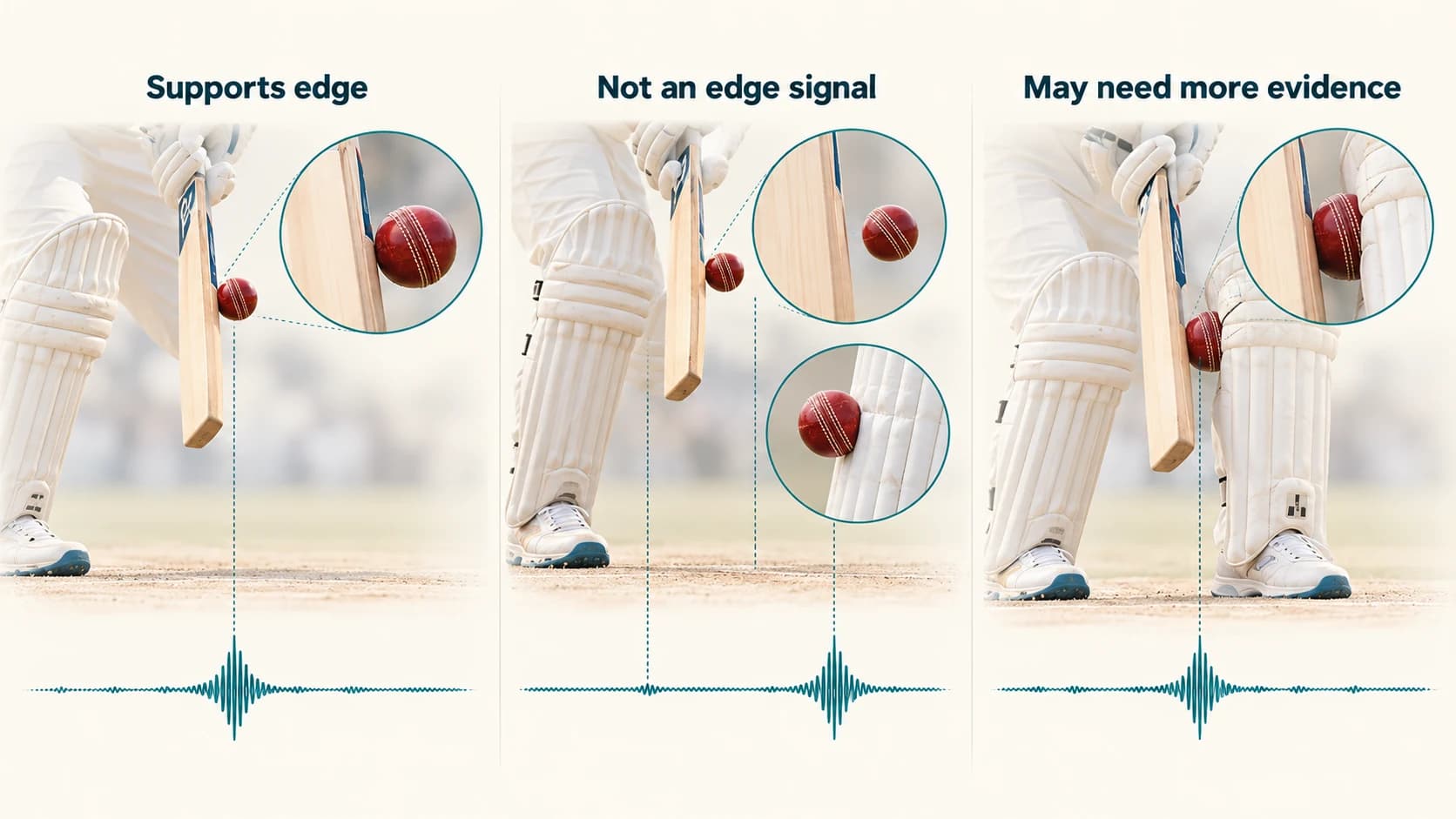
Consider three hypothetical deliveries.
Case A: Clean edge
The ball reaches the bat.
A spike appears at that same moment.
The bat is nowhere near the pad or ground.
Strong evidence of an edge.
Case B: Bat hits pad
The ball passes the bat with no spike.
A few frames later, the bat strikes the pad and a spike appears.
The spike is not evidence of ball-bat contact.
Case C: Everything happens together
The ball is extremely close to the bat at almost the same moment the bat touches the pad.
One spike appears.
Now the source of the sound may be harder to establish.
The third umpire may need other angles or other available evidence.
This is why a screenshot of the waveform by itself is not enough to analyse a controversial decision.
You need the synchronized sequence.
The Technology Detects Sound; the Umpire Interprets the Event
UltraEdge is often described in conversation as though it were a yes/no sensor:
spike = edge
flat = no edge
That shorthand is useful for simple cases but hides the real process.
A better model is:
microphones capture sound
↓
the audio is represented as a waveform
↓
the waveform is synchronized with slow-motion video
↓
the ball reaches the bat/glove area
↓
the umpire checks whether a sound occurs at that moment
↓
other possible sources of the sound are considered
↓
the umpire makes the decision
The cleverness of UltraEdge is not that it understands cricket.
It does not know what a caught-behind appeal means.
It does not know whether a batter is nervous about a review.
And the graph itself does not know that the object beside the ball is a bat.
What the technology gives the umpire is something humans struggle to obtain in real time:
a precisely timed visual record of a tiny sound.
That is why a touch too faint to see—and too brief to hear confidently—can become visible as a spike beneath a slow-motion replay.
And that is also why the spike only becomes meaningful when you know exactly what was happening when it appeared.