What Technologies Are Working Behind a Modern Cricket Broadcast?
Discover how dozens of cameras, slow-motion replay, stump microphones, Hawk-Eye, live data, graphics, drones, Spidercam and streaming systems work together during a modern cricket broadcast.
A fast bowler runs in.
The batter edges the ball.
Within seconds, television viewers may see:
- the live shot,
- a close-up of the batter,
- a super-slow-motion replay,
- UltraEdge,
- a ball-tracking graphic,
- the updated score,
- the bowler's speed,
- a wagon wheel,
- a Spidercam view,
- and perhaps a tactical replay from a completely different perspective.
All of this can happen before the next delivery.
Watching at home, it is easy to think of a cricket broadcast as a collection of cameras being switched by a director.
That is only the visible surface.
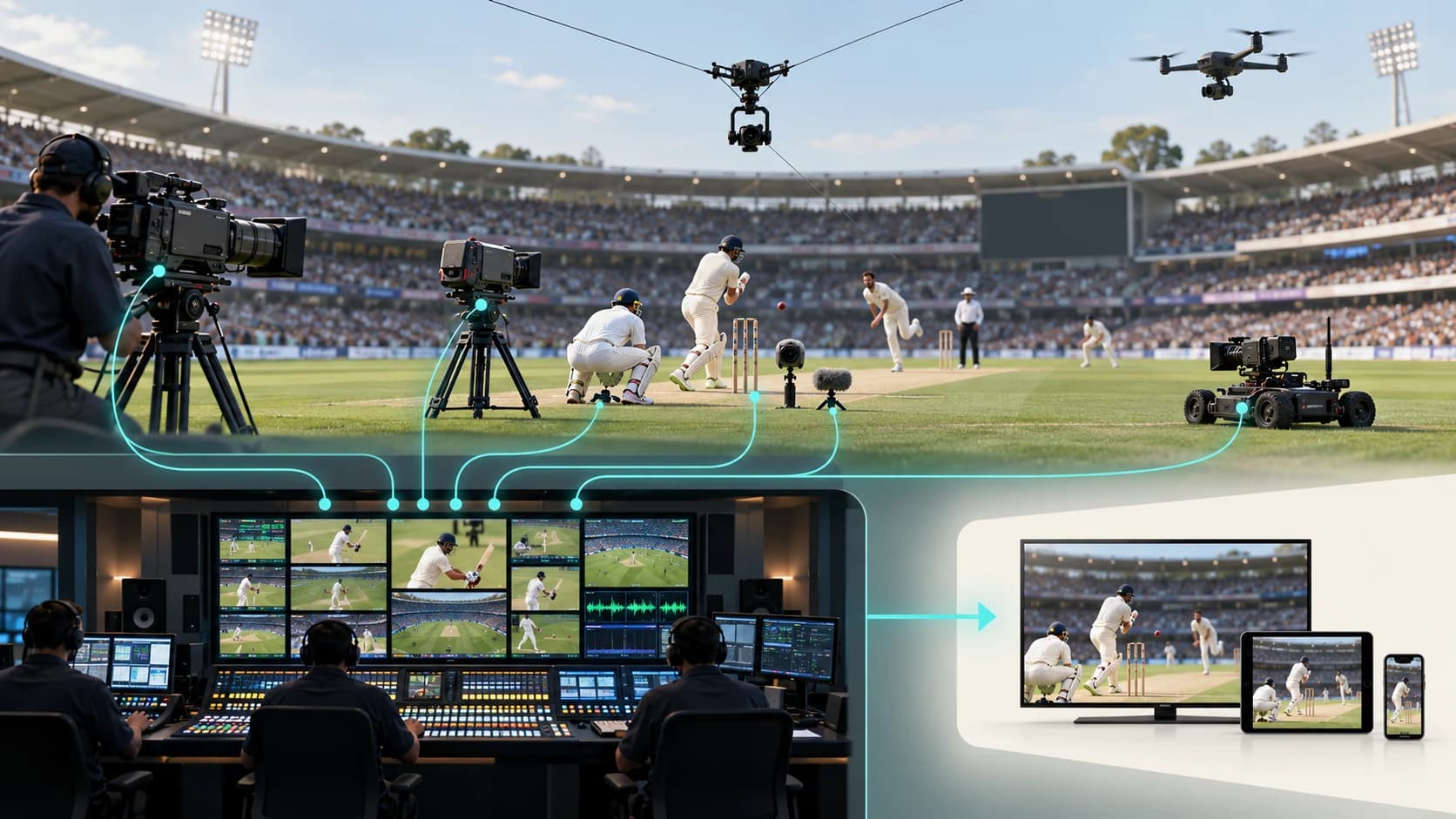
A major international broadcast is really a large real-time technology system.
At the ICC Men's T20 World Cup 2026, the ICC said its production operation would use up to 45 cameras at matches. The 2026 Women's T20 World Cup used 35 to 41 cameras per match and added technologies including HawkVision, Magic 360 and Viz Libero.
Behind those pictures are several connected systems:
cameras
↓
audio
↓
replay
↓
scoring and tracking data
↓
graphics
↓
officiating technology
↓
production control
↓
broadcast and internet distribution
The impressive part is not that any one of these technologies exists.
It is that all of them have to stay synchronized while the match continues live.
It Starts With Far More Than One Camera
The basic job of the camera system is simple:
Make sure the important action can be seen from the right angle at the right moment.
Doing that well requires many different cameras because no single position can show everything.
A major broadcast can include:
- main end-on cameras,
- side-on cameras,
- close-up cameras,
- high-speed cameras,
- stump cameras,
- boundary cameras,
- Spidercam,
- drone cameras,
- roving ground-level cameras,
- specialist cinematic cameras.
The ICC's 2025 World Test Championship Final coverage used a minimum of 48 cameras, including high-speed fixed cameras, Spidercam, drone-based aerial coverage and a roving buggy camera.
The goal is not merely to have more pictures.
Different cameras solve different storytelling problems.
The Main Cameras Show the Cricket Clearly
Most deliveries still depend on relatively conventional broadcast cameras.
The familiar end-on view lets you see:
- the bowler's run-up,
- the batter,
- the pitch,
- the wicketkeeper,
- much of the field behind the wicket.
Side-on and tighter cameras are useful for:
- batting technique,
- bowler action,
- reactions,
- catches,
- run-outs,
- player emotion.
A television director can choose among these feeds in real time.
During the live ball, the priority is usually clarity.
After the ball, the director has much more freedom to show:
- close-ups,
- alternative angles,
- replays,
- crowd reactions,
- tactical graphics.
The camera network therefore captures much more than viewers see at any one moment.
High-Speed Cameras Let You See What the Eye Misses
A normal-speed camera can show a delivery clearly.
But some cricket events happen too quickly for ordinary video to reveal much detail.
Think about:
- a thin edge,
- the seam hitting the pitch,
- a bat flexing,
- a catch entering the fingers,
- a bail leaving the stumps.
High-speed cameras record many more frames during the same short period.
When those frames are played back slowly, the motion remains smooth.
That produces the familiar super-slow-motion replay.
At the 2025 World Test Championship Final, ICC TV used specialist high-speed fixed cameras from BBG Sports to capture key moments in greater detail.
Slow motion is not just visual entertainment.
It can also help explain technique and support replay review.
Stump Cameras Put the Viewer Inside the Action
One of cricket's most distinctive broadcast angles comes from the wicket itself.
Small cameras can be built into or positioned around the stumps to provide views from extremely close to the batter, wicketkeeper and crease.
They can reveal:
- the ball passing the bat,
- a stumping,
- a run-out,
- a bowled dismissal,
- the wicketkeeper's movement.
The result feels dramatically different from a camera 50 metres away.
Cricket broadcasts have used front- and reverse-facing stump-camera arrangements for years, and modern multi-camera productions continue to include close-to-action viewpoints.
But video is only half of what the wicket contributes.
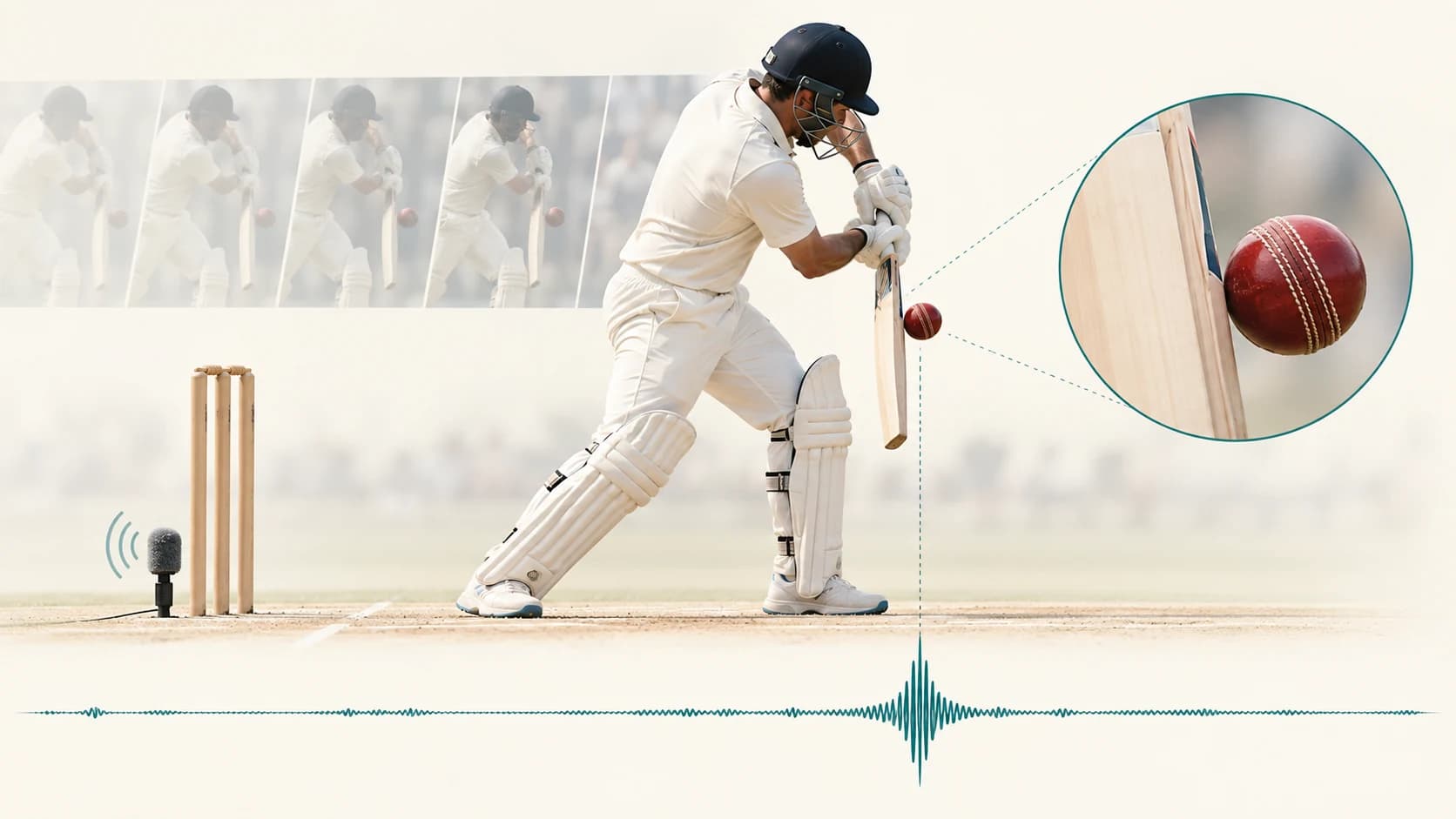
Stump Microphones Capture the Sounds of Cricket
The crack of bat on ball.
The ball hitting the pad.
The wicketkeeper's gloves.
The stumps being disturbed.
Much of the sound that makes cricket feel close comes from microphones placed around the playing area, especially near the wicket.
Stump-microphone sound is important enough that current ICC DRS rules explicitly allow it to be used alongside normal-speed and slow-motion replay during player reviews.
Audio engineers then have to mix several elements:
- on-field microphones,
- crowd ambience,
- commentary,
- sometimes effects from other locations around the ground.
The final television sound is therefore not simply whatever one microphone happens to hear.
It is a carefully mixed audio production.
Spidercam Is a Camera Flying on Cables
The sweeping aerial camera that moves above the field is commonly known as Spidercam.
It does not fly like a drone.
The camera platform is suspended from cables connected to high points around the stadium.
By changing the effective length of those cables, the system can move through three-dimensional space above the playing area.
That allows shots that fixed cameras cannot provide:
- travelling above the field,
- following players,
- revealing field placements,
- moving behind the bowler,
- creating dramatic transitions.
ICC productions regularly use Spidercam as a specialist aerial system.
Because it moves over the playing field, its operation has to be carefully coordinated with the match and production crew.
Drones Provide a Different Kind of Aerial View
A drone camera solves another problem.
Rather than moving on fixed stadium cables, it can capture wider exterior and venue shots.
Modern ICC productions have used drone cameras for:
- stadium establishing shots,
- surrounding landscapes,
- aerial transitions,
- event atmosphere.
The 2025 Champions Trophy production, for example, combined a drone camera with Spidercam and a roving buggy camera.
A drone is normally more useful for broad visual storytelling than for following every live delivery.
Spidercam and drones may both appear to provide “aerial coverage,” but they are different tools.
The Buggy Cam Brings the Camera Back to Ground Level
Not every innovation is about getting higher.
A roving buggy camera can move around the venue at ground level and produce dynamic shots close to players and the boundary.
That can be useful for:
- celebrations,
- team entrances,
- boundary-side reactions,
- movement between areas of the stadium.
The purpose is immersion.
The broadcast can move from an enormous aerial view of the venue to a low camera travelling beside the action.
Every Camera Feed Has to Reach Production Control
Imagine 40 cameras recording simultaneously.
Someone has to decide which one appears on television.
Those camera feeds are routed into a production environment—traditionally an outside-broadcast truck or production facility, although modern workflows can also involve remote and cloud-based components.
The director sits in front of a wall of monitors showing many sources at once.
A simplified workflow looks like:
Camera feeds
↓
Production switcher
↓
Director selects live source
↓
Graphics / replay / audio added
↓
Programme feed
The director may call for:
- Camera 1 live,
- Camera 7 next,
- replay from Camera 12,
- then back to the main end-on camera.
This happens continuously.
The broadcast you watch is one carefully selected output created from a much larger pool of live material.
Replay Servers Record the Feeds Continuously
When a wicket falls, the broadcast does not wait for someone to find and reload the footage.
Replay systems continuously capture incoming camera feeds.
Operators can quickly mark the relevant moment and play it back:
- at normal speed,
- slow motion,
- frame by frame,
- from another angle.
If several cameras caught the event, the producer can choose the clearest one.
More advanced systems synchronize several angles so officials or producers can move through the same event from different viewpoints.
At the 2025 World Test Championship Final, Hawk-Eye's Smart Replay system was used to provide synchronized multi-angle replay for officiating.
That synchronization is especially valuable when the third umpire has to compare:
- one view of the crease,
- another view of the ball,
- stump audio,
- edge-detection information.
DRS Is Connected to the Broadcast—but It Is Not Just a TV Graphic
The Decision Review System shares some of the broadcast infrastructure, but it serves an officiating purpose.
Current ICC playing conditions allow the third umpire to use:
- replays from available broadcast cameras,
- stump-microphone sound,
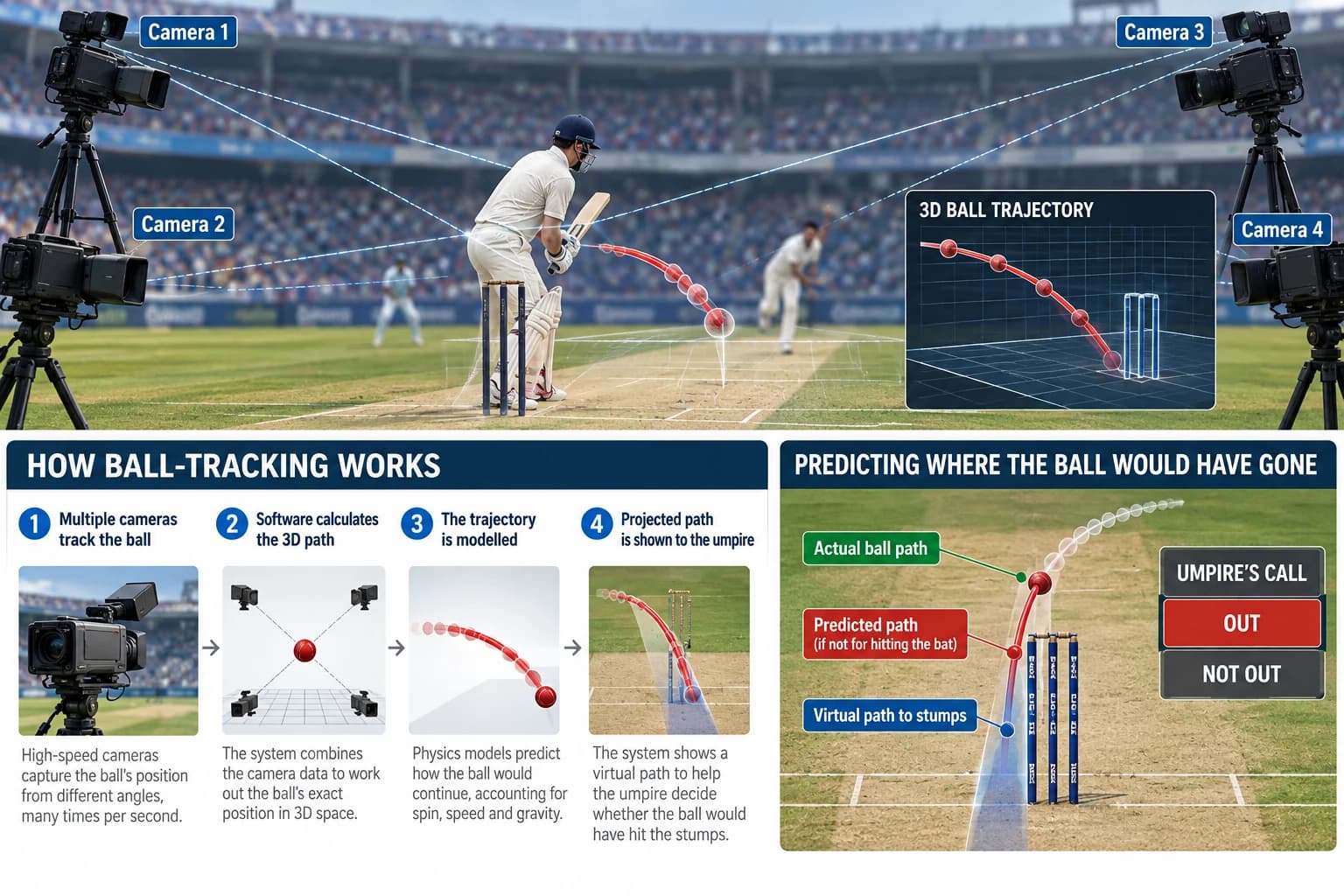
- approved ball tracking,
- approved sound-based edge detection,
- approved heat-based edge detection where available.
Approved systems listed by the ICC include:
- Hawk-Eye or VirtualEye for ball tracking,
- UltraEdge or Real-Time Snickometer for sound-based edge detection,
- Hot Spot as an approved heat-based system.
So when an LBW review begins, several technologies can enter the workflow.
Ball tracking
Multiple calibrated cameras track the ball and reconstruct its trajectory.
UltraEdge or Real-Time Snickometer
Audio is synchronized with video so the umpire can examine whether a sound occurred when the ball was beside the bat or glove.
Slow-motion replay
Broadcast cameras help examine catches, run-outs, stumpings and other incidents.
The DRS output eventually becomes part of the programme viewers see, but its purpose is decision support for officials, not merely entertainment.
Live Graphics Are Built From Data, Not Typed From Scratch Every Time
Look at a modern broadcast and you may see:
- score,
- overs,
- batter statistics,
- bowler figures,
- required run rate,
- ball speed,
- partnerships,
- wagon wheels,
- pitch maps,
- records,
- win probability.
These graphics can update almost immediately because they are connected to structured match data.
At the 2025 Champions Trophy, ICC TV used WT Vision for on-air graphics and CricViz for detailed cricket analytics. Other ICC events have used AE Live for graphics with CricViz data.
The exact suppliers can change from tournament to tournament.
The principle is the same.
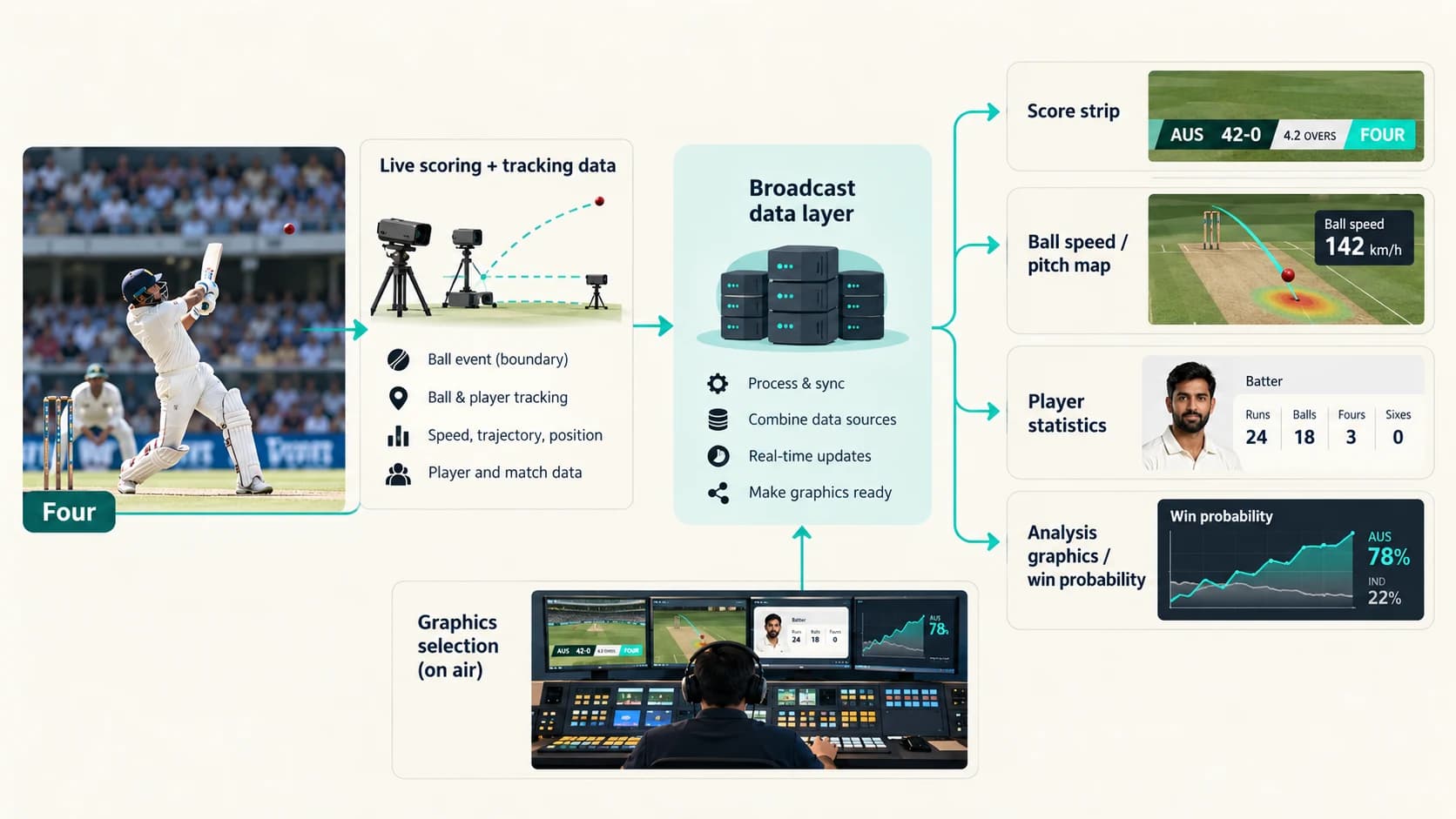
A scoring event enters the data system.
That information can then populate predefined graphic templates.
For example:
Batter hits four
↓
score database updates
↓
team total changes
↓
batter score changes
↓
run rate recalculates
↓
graphics engine receives new values
↓
score strip updates on screen
The operator is controlling presentation.
Software is doing much of the repetitive calculation.
Ball Speed Is Another Data Product
The speed number shown after a fast bowler's delivery is not guessed by a commentator.
Tracking systems can measure the ball and produce speed information that is fed into the broadcast.
ICC technical requirements for tracking providers have required rapid delivery of ball-speed references so they can be used during live coverage.
That measurement can then appear:
- beside the score,
- in a replay,
- in bowler analysis,
- in comparison graphics.
The same tracking infrastructure can also contribute to:
- pitch maps,
- trajectory graphics,
- release information,
- tactical analysis.
A single ball therefore creates both video and data.
Analytics Adds Context to What You Just Saw
Live statistics become more valuable when they explain the match rather than simply repeat the scorecard.
CricViz and similar analytics providers can add information such as:
- batter-bowler matchups,
- scoring zones,
- phase comparisons,
- pitch maps,
- win probability,
- historical records.
This allows commentary to move from:
“The batter is struggling.”
to something more specific:
“The batter has scored far more slowly against this bowling type in the middle overs.”
The statistic is not the story by itself.
It gives the commentators evidence with which to tell the story.
Virtual Graphics Can Put Analysis Onto the Field
Modern sports graphics do not have to remain in a rectangular box at the bottom of the screen.
Systems such as Viz Libero can calibrate the television image to the playing surface and add:
- lines,
- zones,
- measurements,
- player markers,
- virtual camera movements,
- 3D analysis graphics.
The ICC's 2026 Women's T20 World Cup used Viz Libero for richer tactical analysis and visual explainers.
Vizrt describes the technology as capable of combining ordinary television footage with telestration, live data and virtual 3D views.
That means a commentator can pause a replay and visually demonstrate:
- where a fielder moved,
- which area was left open,
- how a bowling plan changed,
- where a batter scored.
It turns analysis into something viewers can see rather than merely hear.
Field 360° Reconstructs the Field for Tactical Explanation
Another broadcast technology used in recent ICC events is Quidich's Field 360°.
The idea is to create a virtual field representation showing positions and strategy in a clearer way than a conventional camera angle sometimes allows.
For example, viewers can understand:
- how the field is spread,
- where gaps exist,
- which boundary areas are protected.
The ICC used Field 360° at the 2024 Men's T20 World Cup and again in subsequent major-event production.
This is a good example of a modern broadcast doing more than recording reality.
It is reconstructing information to make the cricket easier to understand.
Newer Systems Can Create Virtual Replays
Broadcast technology is moving beyond conventional replay.
At the 2026 Women's T20 World Cup, the ICC highlighted technologies including:
- Magic 360,
- HawkVision,
- Viz Libero,
- Arcturus,
- Comet Cam.
The ICC described Quidich's Magic 360 as producing dynamic spatial replay sequences.
These systems can use several camera perspectives and processing to create views that were not captured by one conventional camera sitting at that exact virtual position.
The result can feel as if the viewer is moving around a frozen or reconstructed moment.
This does not mean the broadcast has a physical camera everywhere.
Software is using available images and spatial information to create another perspective.
One Match Can Now Have More Than One Broadcast
For decades, a cricket match was mainly produced as one horizontal television programme.
That is changing.
At the 2026 Men's T20 World Cup, the ICC announced:
- conventional television and digital feeds,
- a dedicated vertical live feed for mobile viewers,
- 360-view options,
- multi-camera choices on JioHotstar.
The multi-camera feature allowed viewers to select specific perspectives such as:
- Hero,
- Stump,
- Battery,
- Field view,
- Multi-View.
That means the modern production system may create several parallel viewing experiences from the same match.
A mobile viewer does not necessarily receive the television picture merely cropped into a vertical rectangle.
A dedicated vertical production can make different camera and framing choices for a phone screen.
The “World Feed” Is the Core Version of the Match
At major ICC events, ICC TV creates a world feed.
Think of it as the central broadcast production of the match.
Rights-holding broadcasters in different countries can then take that feed and distribute it to their audiences.
Depending on the agreement and production setup, a broadcaster may add elements such as:
- local-language commentary,
- studio presentation,
- local advertising,
- additional graphics,
- digital features.
This is why viewers in two countries can be watching the same cricket action while hearing different commentators and seeing somewhat different presentation around it.
The core match is shared.
The final product can be localized.
How Does the Video Reach Your Television or Phone?
Once the director has created the programme feed, it still has to reach viewers.
The signal can travel through several distribution systems.
For traditional television, that can involve broadcast contribution links, satellite, cable or terrestrial networks depending on the market.
For streaming, the video must be:
- encoded into a digital video stream,
- prepared at suitable bitrates and resolutions,
- distributed through internet infrastructure,
- delivered to the viewer's app or browser,
- buffered enough to play smoothly.
The streaming version may therefore arrive slightly later than events at the ground.
The amount of delay depends on the broadcaster, delivery technology, internet connection and device.
This is why a live-score notification can occasionally reveal a wicket before the streaming video reaches that ball.
The score message is tiny.
The video pipeline is far more complicated.
Your Phone May Receive a Different Video Quality From Someone Else's
Internet streaming can adapt to network conditions.
If your connection is strong, the player can request a higher-quality stream.
If bandwidth falls, it can switch to a lower bitrate to reduce buffering.
This is called adaptive bitrate streaming.
The match itself is the same.
But two viewers may receive different encoded versions depending on:
- screen size,
- connection speed,
- device capability,
- streaming service.
This is one reason streaming platforms prepare multiple versions of the same live programme.
Commentary Is Its Own Production Layer
The commentator you hear is not simply speaking over raw match footage.
Commentary has its own technical chain.
The production must handle:
- commentator microphones,
- communication with producers,
- replay cues,
- statistics,
- monitor feeds,
- crowd sound,
- audio mixing.
Commentators may receive data and analytical information during the match so they can explain:
- records,
- matchups,
- milestones,
- tactical trends.
At large global events there may also be many language feeds built around the same central match production.
The 2026 Men's T20 World Cup broadcast in India, for example, offered multiple language feeds across television and digital platforms.
So one delivery can simultaneously produce several versions of commentary for different audiences.
What Happens After One Wicket?
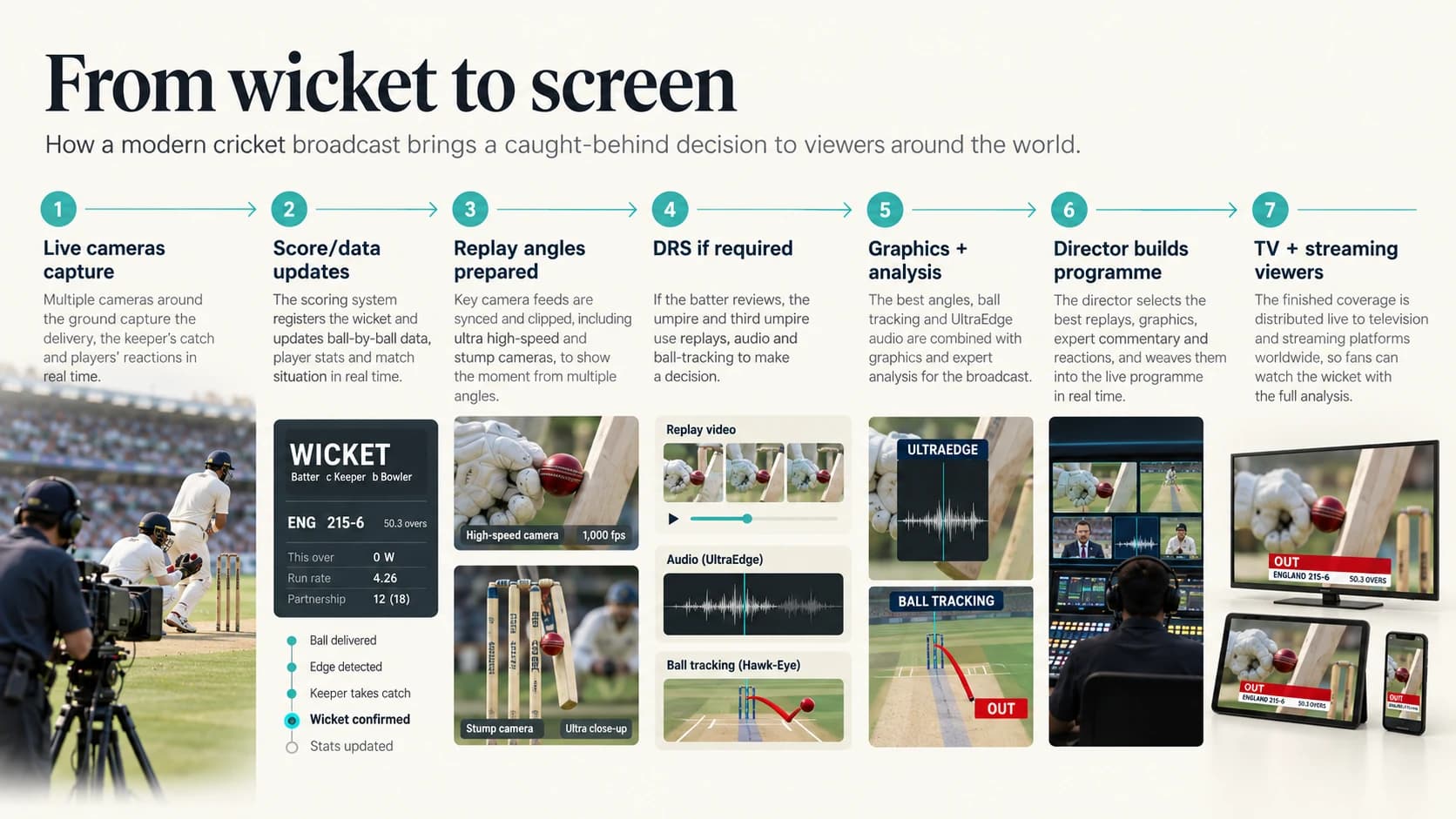
Imagine a fast bowler produces an outside edge that is caught behind.
Here is what may happen behind the scenes.
The live camera captures the ball
The director keeps the main view on air.
Other cameras also record the event
Side-on, close-up, stump and high-speed cameras may all have different views.
The score system records the wicket
The total and player statistics update.
Replay operators mark the moment
Several angles become available almost immediately.
The producer selects the best replay sequence
Perhaps:
front-on
→ slow-motion side-on
→ stump camera
If reviewed, DRS technology enters the process
The third umpire may receive:
- synchronized video,
- stump audio,
- UltraEdge,
- other permitted tools.
Graphics update
The broadcast may show:
- wicket type,
- batter score,
- bowler figures,
- partnership,
- dismissal analysis.
Commentary explains the moment
The commentators can combine replay and data.
The programme feed continues around the world
Television broadcasters and streaming platforms distribute the same event to millions of viewers.
All of that can happen in less time than the new batter takes to reach the crease.
The Broadcast Is Really Several Systems Pretending to Be One
When a cricket broadcast works well, the technology disappears.
You do not think:
The replay server has selected Camera 14.
You think:
That was an incredible catch.
You do not think:
A data feed has populated a graphic template.
You think:
The bowler is now 3 for 22.
You do not think:
Multiple calibrated cameras have reconstructed a trajectory.
You think:
The ball was hitting leg stump.
That invisibility is the sign of a good production.
Behind one smooth programme are dozens of systems doing very different jobs:
camera technology captures the action
microphones capture its sound
replay systems preserve the moment
tracking systems measure the ball
data systems describe the match
graphics systems explain the numbers
analysis tools reveal tactics
DRS technology helps officials
production crews choose what viewers see
distribution networks carry it around the world
The next time a cricket broadcast cuts from a live six to a Spidercam shot, then to super slow motion, then to a wagon wheel and a replay from a virtual angle, it is worth remembering:
You are not watching one camera feed.
You are watching a real-time technology operation built to make a complicated sport feel effortless to follow.