Why Can a Red Cricket Ball Behave Differently From a White One?
Learn why red and white cricket balls can swing, seam, wear and feel different—and why colour itself is only part of the story.
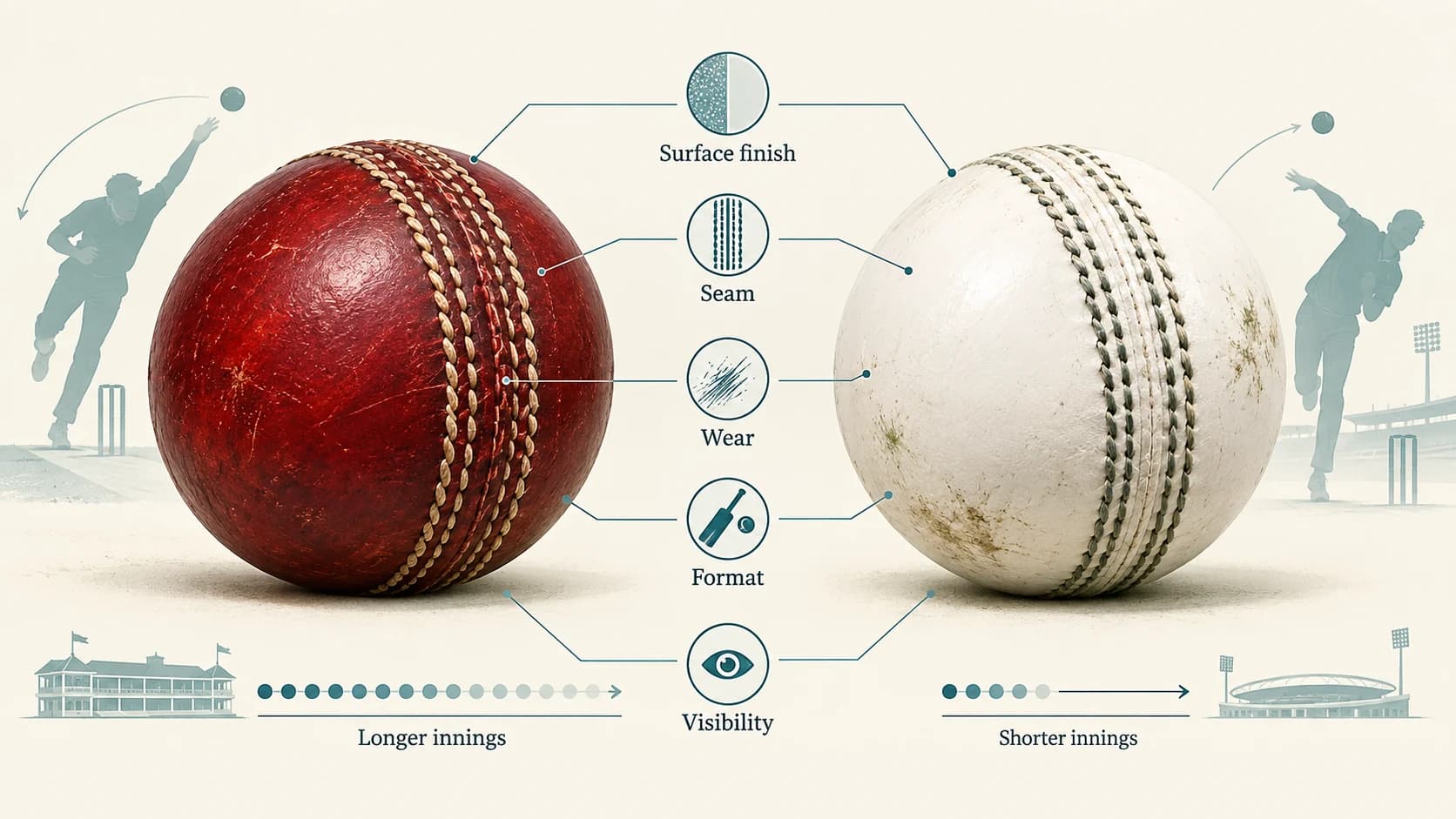
Watch a Test match and the fast bowlers may spend overs carefully polishing one side of a red ball.
Watch an ODI or T20I and the white ball may seem to swing sharply when it is new, then behave very differently as the innings continues.
This naturally creates a question:
Is a white cricket ball physically different from a red one, or is it simply the same ball in another colour?
The best answer is:
both are fundamentally cricket balls built to the same basic size-and-weight requirements, but colour is not the only thing that can differ.
The outer finish, lacquer, seam geometry, leather treatment, manufacturer, age of the ball and the format in which it is used can all affect how a particular ball behaves.
And there is another complication:
red and white balls are usually seen in different match environments.
Red balls are traditionally associated with multi-day cricket, where one ball can remain in use for up to 80 overs before a second new ball becomes available.
White balls are used in limited-overs cricket, where the ball is exposed to different rules, fielding patterns and innings lengths.
So when somebody says:
“The white ball swings more.”
or:
“The red ball seams more.”
they may be noticing a real difference—but the colour pigment alone is not enough to explain it.
To understand what is happening, we need to separate three things:
the colour
the construction and surface finish
the conditions in which the ball is used.
Red and White Balls Share the Same Basic Job
Under MCC Law 4, a new men's cricket ball must weigh between 155.9 g and 163 g and have a circumference between 22.4 cm and 22.9 cm.
The Laws do not define one completely different aerodynamic object for red-ball cricket and another for white-ball cricket.
Both are hard leather cricket balls with:
- a dense internal core,
- tightly constructed inner layers,
- a leather outer shell,
- a raised primary seam,
- stitched quarter seams,
- an outer finish.
The same fundamental physics applies to both.
When either ball swings, the movement comes from asymmetric airflow around the ball.
When it seams, the deviation happens because the ball interacts with the pitch after bouncing.
When it becomes older, wear changes the surface.
So there is no special “white-ball force” or “red-ball force.”
The differences come from how the physical ball is manufactured, finished, maintained and used.
Colour Was Introduced Mainly for Visibility
The traditional cricket ball is red because cricket was historically played in daylight while players wore white clothing.
The dark ball provided strong visual contrast.
When one-day cricket began to be played under floodlights with coloured clothing, a red ball became much harder to track in low light.
A white ball solved an important visibility problem.
Kookaburra says it developed a white cricket ball for World Series Cricket in the late 1970s so limited-overs matches could be played into the evening.
Today, Kookaburra states that its white Turf ball is used in international ODIs and T20Is, while red balls from Kookaburra and other manufacturers are used in Test and first-class cricket depending on the country.
The main reason for changing the colour was therefore not:
“We want a ball that swings differently.”
It was:
“We need a ball players and viewers can see under different lighting and clothing conditions.”
But making leather bright white is not necessarily identical to making it dark red.
That is where practical differences can begin.
The Surface Finish Matters More Than the Colour Name
Aerodynamically, air does not care whether humans call a surface red or white.
It cares about things such as:
- roughness,
- seam height,
- small surface defects,
- shape,
- rotation,
- speed.
A 2024 review from researchers at the University of Cambridge emphasized that cricket-ball swing is highly sensitive to the condition of the ball's surface and seam.
The researchers compared different match-grade balls and found that balls from different manufacturers and colours could move between conventional- and reverse-swing regimes at different speeds.
Importantly, the authors did not conclude that the colour itself caused those differences.
They pointed instead to factors such as:
- seam geometry,
- quarter-seam details,
- surface texture,
- roughness.
This is the crucial distinction.
A white ball can behave differently from a red ball because the two physical products may not have exactly the same exterior properties—even if their overall size and purpose are similar.
White Balls May Need a Different Finish to Stay White and Visible
White leather has an obvious problem.
A cricket ball spends its life:
- hitting a brown pitch,
- rolling across grass,
- striking advertising boards,
- being thrown from hand to hand.
It gets dirty.
If a white ball quickly became brown or grey, its visibility advantage would disappear.
Manufacturers therefore have to consider durability and colour retention when designing the surface finish.
Public descriptions from manufacturers do not provide a universal recipe because exact production methods vary and are commercially sensitive.
However, cricket-ball makers use lacquered finishes, and reporting on ball production notes that white balls can receive finishing treatments intended to preserve their brightness and surface.
That can affect the ball's initial feel and smoothness.
A slightly different finish can influence:
- how easily a bowler grips the ball,
- how quickly the surface becomes scuffed,
- how the seam feels in the fingers,
- how airflow behaves around the ball.
But there is no safe universal statement that every white ball has exactly “one extra layer of lacquer” compared with every red ball.
Different brands and generations of ball can be made differently.
A New White Ball Can Feel Smoother
Players sometimes describe a new white ball as:
- glossier,
- smoother,
- more slippery.
That perception is plausible because the outer finish is designed partly around maintaining a bright white surface.
But feel is not controlled by colour alone.
A new red ball can also be highly lacquered and glossy.
The 2024 Cambridge review notes that new Kookaburra, Dukes and SG balls are all lacquered.
So when a bowler says:
“The white ball feels different in my hand,”
the most accurate explanation is not:
“White dye is slippery.”
It is that the complete outer finish and seam design of that particular ball may differ from the red ball the bowler normally uses.
The Seam Can Be Different Too
The seam is one of the most important features on a cricket ball.
It influences:
- finger grip,
- seam stability,
- aerodynamic flow,
- movement after pitching.
Not all match balls have identical seam geometry.
The Cambridge review compared different ball types and specifically highlighted differences in primary and secondary seam features.
For example, one white Kookaburra tested in previous research had a particularly prominent quarter-seam feature, which affected the speed at which its aerodynamic behaviour changed.
This means comparing:
a red Dukes ball
with
a white Kookaburra
is not merely comparing two colours.
You are also comparing two manufacturers with different ball designs.
That is why statements such as:
“White balls always swing more than red balls.”
are too simplistic.
Which white ball?
Which red ball?
Which manufacturer?
Which speed?
Which condition?
Why Either Ball Can Swing
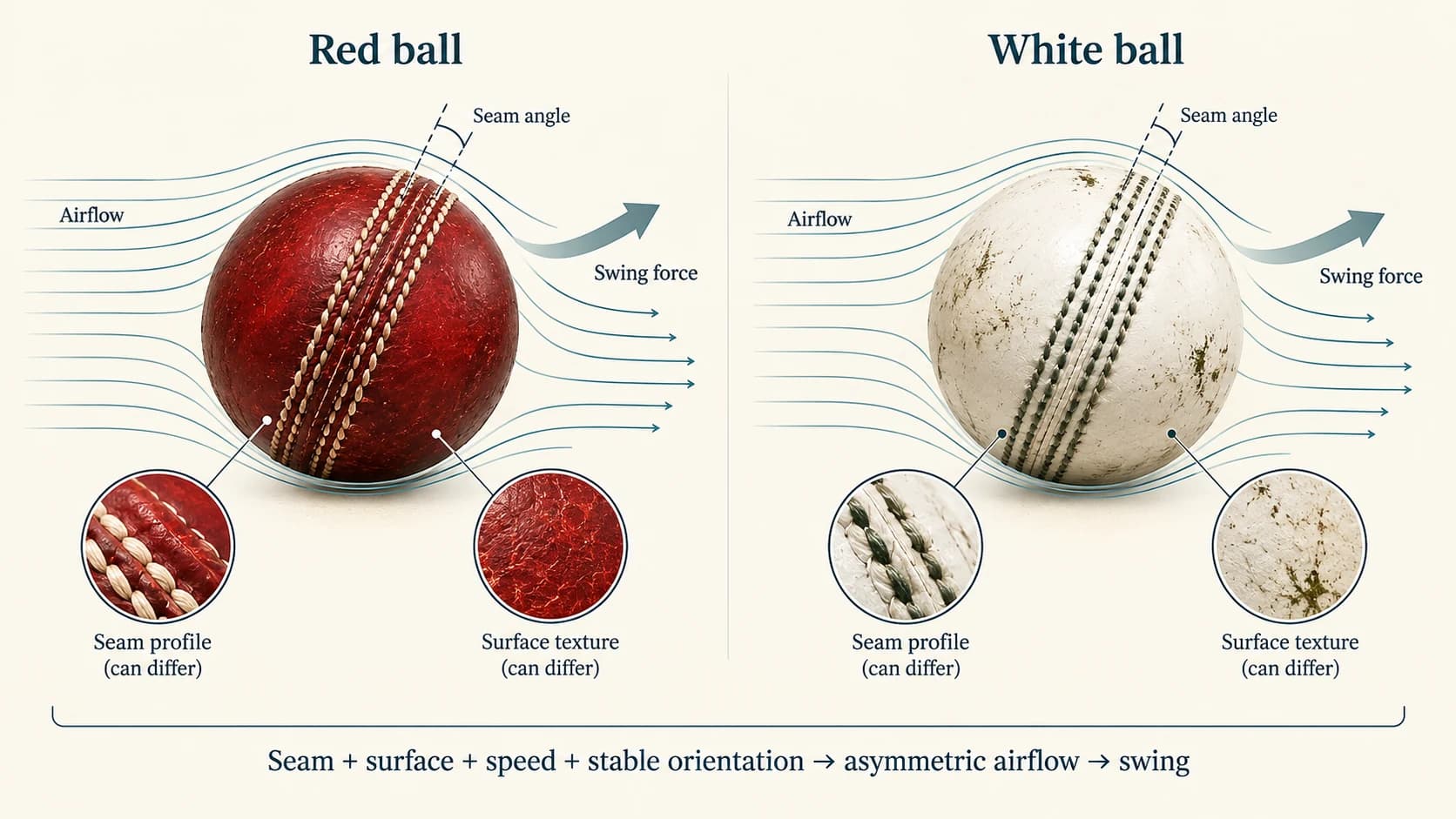
To make a cricket ball swing, a fast bowler typically releases it with the seam angled relative to the direction of travel.
Air passes around both hemispheres.
Because the seam and surface cause the airflow to behave differently on the two sides, the air separates from the ball at different positions.
That creates an unequal pressure distribution.
The result is a sideways force.
For conventional swing, under suitable conditions, that force moves the ball in the familiar direction associated with the seam.
The 2024 Cambridge review updated an older simplified explanation and found that the raised seam behaves more like a set of vortex-generating features than merely a single “trip wire.”
But the practical principle remains:
seam + surface + speed + stable orientation → asymmetric airflow → swing.
That applies to both red and white balls.
So Which One Swings More?
There is no scientifically responsible universal answer.
Laboratory testing shows that different match-grade balls can generate different amounts of swing under the same broad speed range.
But colour, manufacturer, seam shape and surface texture are usually changing together.
The University of Bath tested match-worn cricket balls and found that conventional swing was strongest with a new, polished ball and generally decreased as wear accumulated.
That finding applies to the condition of the surface more than to the visual colour.
A white ball that is new, smooth and strongly seamed may swing significantly.
A red ball in comparable condition can also swing significantly.
The correct question is therefore less:
Red or white?
and more:
What are the surface condition, seam design, speed and age of this particular ball?
Why White-Ball Swing Often Seems Like an Early-Innings Event
Limited-overs cricket creates a strong association between the white ball and early swing.
The opening bowlers receive a brand-new ball.
They attack while it is:
- hard,
- smooth,
- well-seamed,
- least damaged.
Those are favourable conditions for conventional swing.
Later in the innings:
- the surface has changed,
- the seam has worn,
- the ball may have softened,
- scoring tactics have changed,
- bowlers may be using cutters and slower balls instead.
So viewers experience a clear tactical transition.
That can make it feel as though:
“The white ball swings for only a few overs.”
But there is no universal over number at which swing must disappear.
It depends on the specific ball and conditions.
Red-Ball Cricket Lets You Watch the Ball Age Much Further
This is where format becomes especially important.
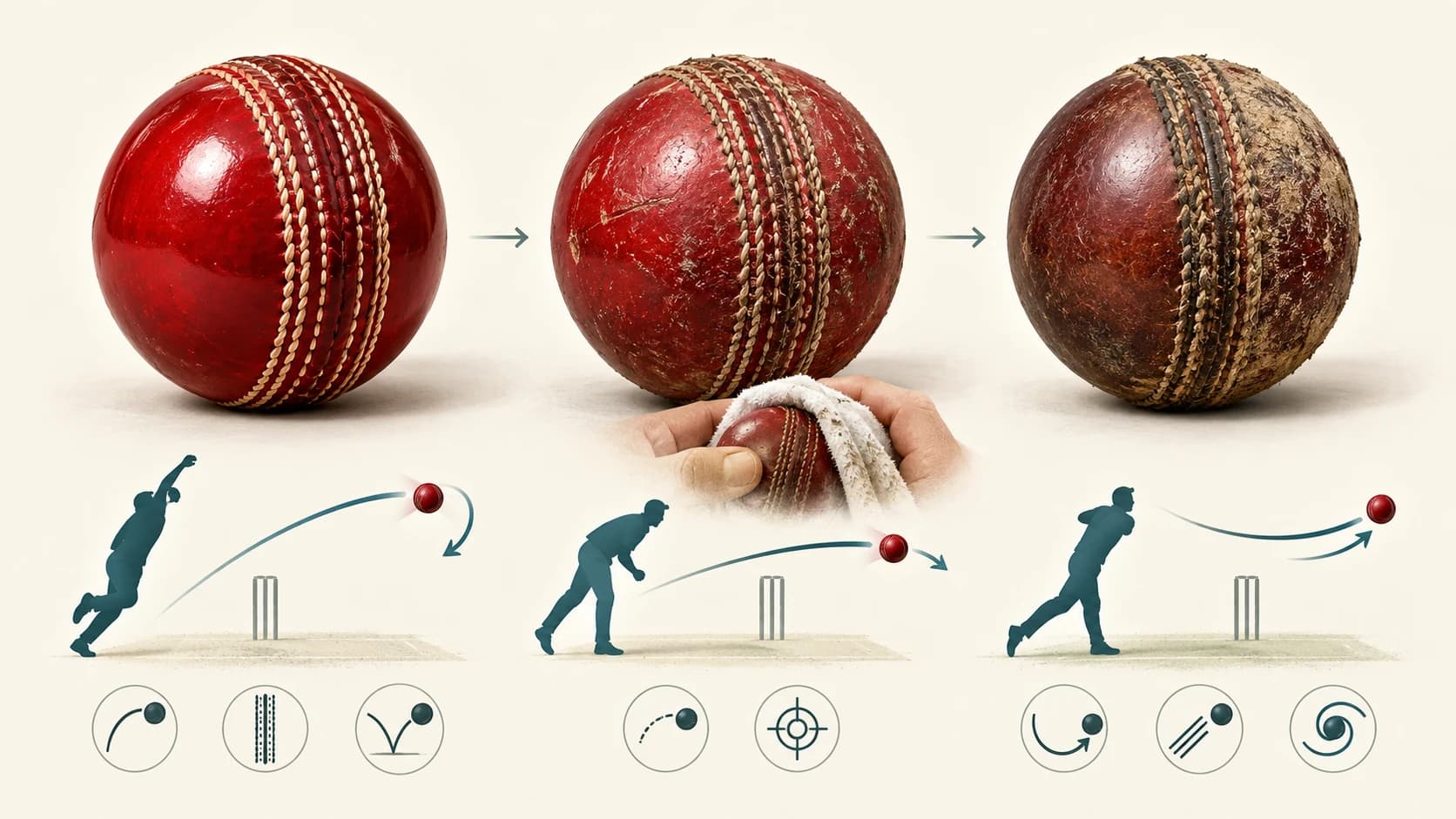
In a multi-day match, the same red ball can remain in use for a very long period.
Under MCC Law 4, a fielding captain in a match lasting more than one day may demand a second new ball once 80 overs have been bowled with the old one.
During those 80 overs, the ball can pass through several stages:
fresh and glossy
↓
lightly worn
↓
rougher and less glossy
↓
strongly asymmetric surface
This gives red-ball cricket time for completely different bowling methods to emerge.
A ball that originally produced conventional swing may later become suitable for:
- reverse swing,
- cutters,
- spin,
- cross-seam bowling.
White-ball innings are much shorter.
The viewer does not usually see exactly the same ageing process.
ODI Rules Also Change How Old the White Ball Becomes
Modern ODI cricket does not simply use one white ball for 50 consecutive overs.
Under the ICC playing conditions introduced in July 2025:
- two new balls are used for the first 34 overs of an innings,
- after that, the fielding side selects one of those balls,
- the chosen ball is used for the final 16 overs.
Before the 2025 change, two balls were used from opposite ends throughout a full 50-over innings.
This matters enormously to any red-versus-white comparison.
A ball used from only one end ages roughly half as quickly in delivery count as a ball used every over.
So for many years, an ODI white ball was effectively much younger at the death than a single Test ball would have been after the same number of innings overs.
The 2025 change was partly intended to allow a more naturally aged ball to play a role later in the innings.
In T20 cricket, the innings is only 20 overs long, so the ball remains relatively young anyway.
This Is Why Reverse Swing Is Associated More Strongly With Red-Ball Cricket
Reverse swing generally becomes relevant when the ball develops substantial surface asymmetry.
One side is kept comparatively smooth within the Laws.
The other accumulates natural wear.
At sufficiently high speed and under suitable aerodynamic conditions, that change can reverse the direction of the swing force.
A Test ball has far more time to reach this state.
A white ball in a 20-over innings often does not.
And in ODI cricket, ball-use rules affect how quickly each white ball accumulates wear.
So the apparent difference:
“Red balls reverse; white balls don't.”
is not fundamentally a colour rule.
It is largely an age-and-condition rule.
White balls can also become rough enough for different aerodynamic behaviour.
They are simply used in a format that often does not age them in the same way.
The Pitch Changes the Comparison Too
Now imagine two experiments.
Match A
A red ball is used in England on a green Test pitch.
Match B
A white ball is used on a dry, flat T20 pitch.
If the red ball seams more, was that caused by the colour?
Not necessarily.
The pitch itself may have produced the difference.
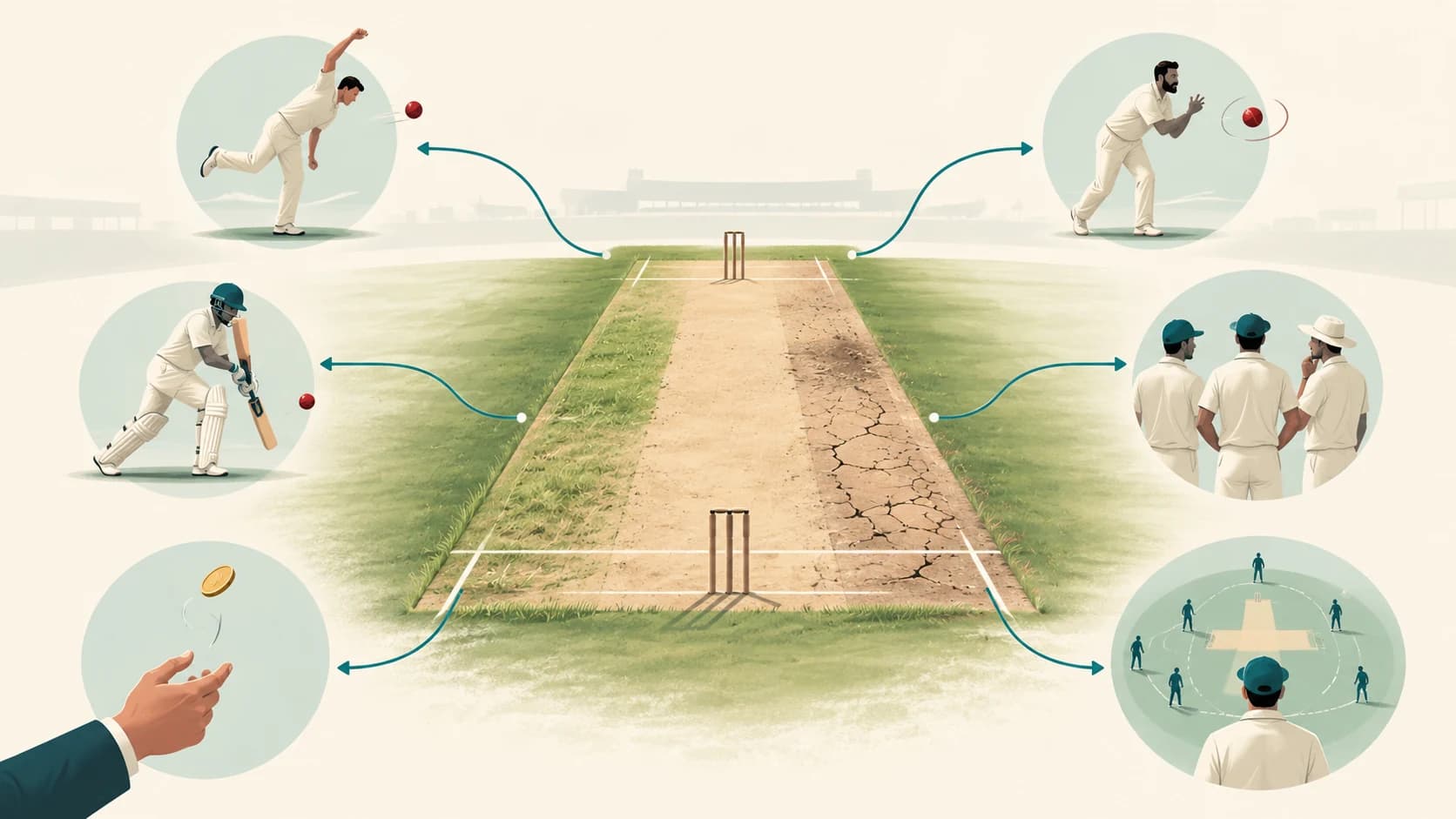
Red-ball and white-ball cricket are often played:
- at different times of day,
- on differently prepared surfaces,
- with different field restrictions,
- with different tactical priorities.
This makes real-world comparison difficult.
To isolate the effect of ball colour scientifically, you would ideally need:
- otherwise identical construction,
- identical seam,
- identical surface texture,
- same manufacturer,
- same pitch,
- same speed,
- same environmental conditions.
Professional cricket rarely gives us such a clean experiment.
The Bowler's Tactics Are Different in the Two Formats
The ball does not act alone.
Bowlers use it differently.
With the red ball
A fast bowler may prioritize:
- upright seam,
- longer attacking spells,
- consistent channel bowling,
- conventional swing,
- later reverse swing.
With the white ball
A bowler may need:
- yorkers,
- slower balls,
- wide lines,
- cutters,
- defensive variations.
Those tactical choices alter the deliveries viewers see.
A white-ball fast bowler deliberately using cross-seam slower balls will not make the ball behave like a Test bowler trying to hold the seam perfectly upright.
So some of the perceived difference comes from how the ball is being bowled, not just the ball itself.
Visibility Is a Real Difference
Colour may not directly create swing, but it absolutely matters to human vision.
A 2024 study measured the visibility of red, white and pink balls against:
- grass,
- pitch,
- crowd,
- sky,
- different lighting conditions.
It found that visibility depends on both:
- ball colour,
- ball age.
The white ball generally provides strong contrast against many darker backgrounds, which is why it works well for limited-overs cricket under floodlights.
But there is no perfect colour for every viewing condition.
Even white balls can become harder to distinguish against certain backgrounds and lighting conditions.
The study also found that worn balls can change substantially in visibility because their surface colour deteriorates with use.
So colour matters enormously—but mostly for seeing the ball, not because red light and white light obey different aerodynamics.
What About the Pink Ball?
Pink exists because neither traditional option is ideal for day-night Test cricket.
A red ball can become difficult to see in darkness.
A white ball creates other practical problems for multi-day use and cannot be used against traditional white clothing with the same visual contrast.
So manufacturers developed a pink ball intended to remain visible from:
daylight
through
dusk
into
floodlights.
Modern research shows that pink-ball visibility is itself complicated.
The 2024 visibility study found situations in which pink balls, especially worn ones, could have poor contrast against some backgrounds.
A 2026 study further examined how colour-vision deficiency can affect those differences.
This reinforces an important point:
ball colour is primarily a visual-design choice operating alongside aerodynamic and durability requirements.
The Manufacturer May Matter as Much as the Colour
Test cricket itself proves this.
Different countries have historically used different red-ball brands.
Kookaburra says its red ball is supplied to most major Test-playing nations, while other markets use balls such as Dukes or SG.
Players frequently discuss differences in:
- seam prominence,
- hardness,
- how long shine lasts,
- how quickly the ball becomes soft.
The Cambridge review confirms that different ball brands have measurable differences in seam geometry.
So a player moving from one country to another may notice a much larger difference between:
red ball A
and
red ball B
than between two colours of one carefully matched design.
That is why “red versus white” is only one layer of the comparison.
A Better Way to Think About It
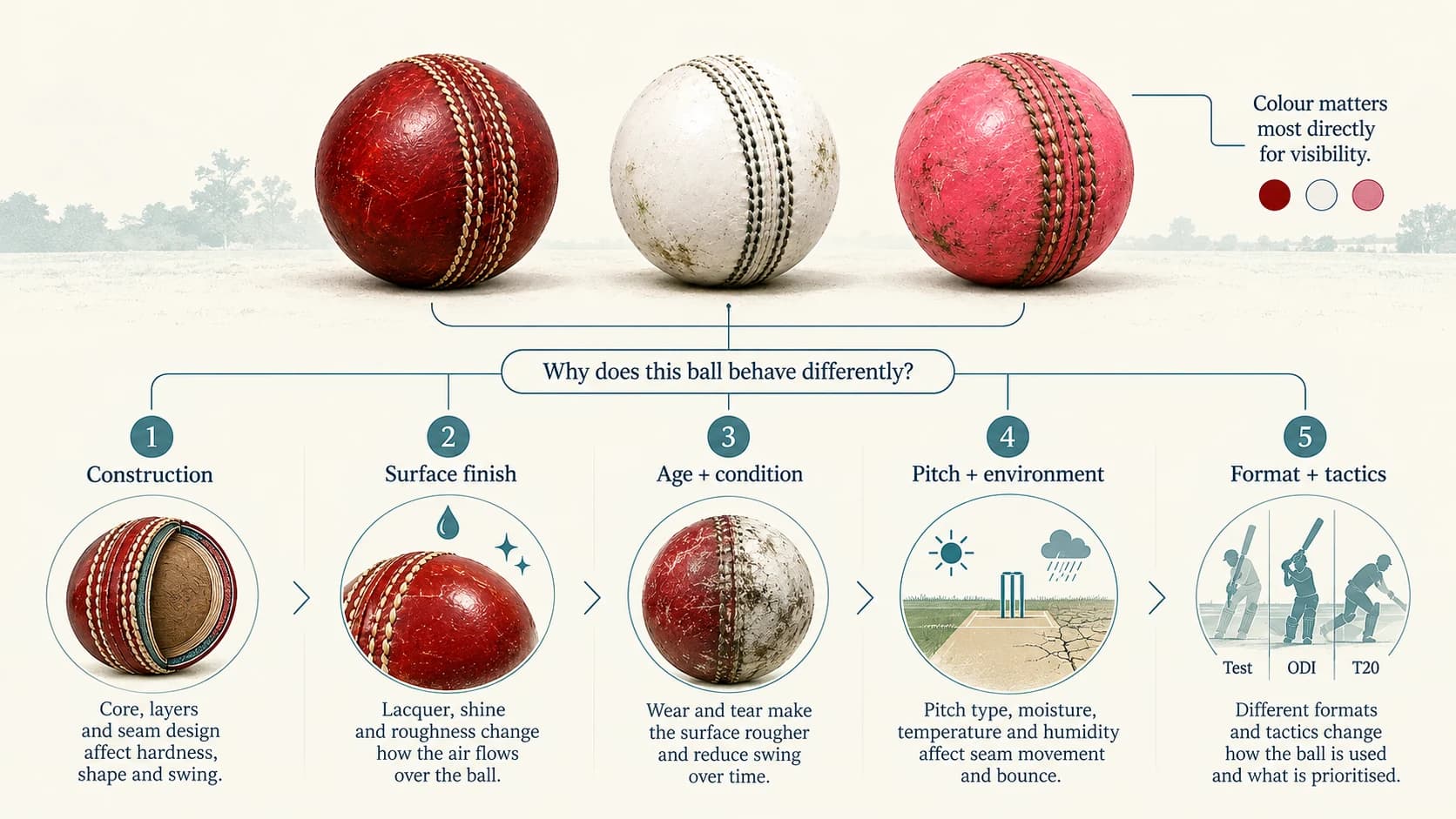
When a cricket ball behaves differently, think of five layers.
1. Construction
- core,
- leather,
- stitching,
- seam geometry.
2. Surface finish
- lacquer,
- smoothness,
- small surface defects,
- wear resistance.
3. Age and condition
- new or worn,
- shiny or scuffed,
- hard or softened,
- symmetric or asymmetric surface.
4. Match environment
- pitch,
- outfield,
- weather,
- lighting.
5. How it is used
- Test,
- ODI,
- T20,
- number of balls,
- bowling tactics.
Colour interacts with some of these—especially visibility and manufacturing finish—but it does not sit above all of them as the single cause.
The Colour Is the Most Visible Difference, Not Always the Most Important One
That is the key idea.
Put a red ball and a white ball next to each other and colour is obviously the first difference you notice.
Airflow notices something else.
It notices:
- surface roughness,
- seam shape,
- rotation,
- speed.
The pitch notices:
- seam position,
- hardness,
- impact,
- surface texture.
The bowler notices:
- grip,
- seam feel,
- shine,
- condition.
And the batter notices:
- visibility,
- movement,
- bounce,
- pace.
That is why red and white balls can genuinely behave differently in a match while still obeying the same physics.
The difference is not simply:
red dye versus white dye.
It is the complete package of:
manufacturing + finish + seam + wear + format + conditions.
So when a commentator says that the white ball is doing something the red ball did not, the observation may be completely valid.
The explanation just requires a better question:
What is physically different about these two balls—and how differently have they been used?
That is where the real answer begins.