Why Does the Cricket Pitch Shape the Entire Strategy of a Match?
Learn how grass, moisture, hardness, wear and bounce influence batting, fast bowling, spin, team selection, the toss and match strategy in cricket.
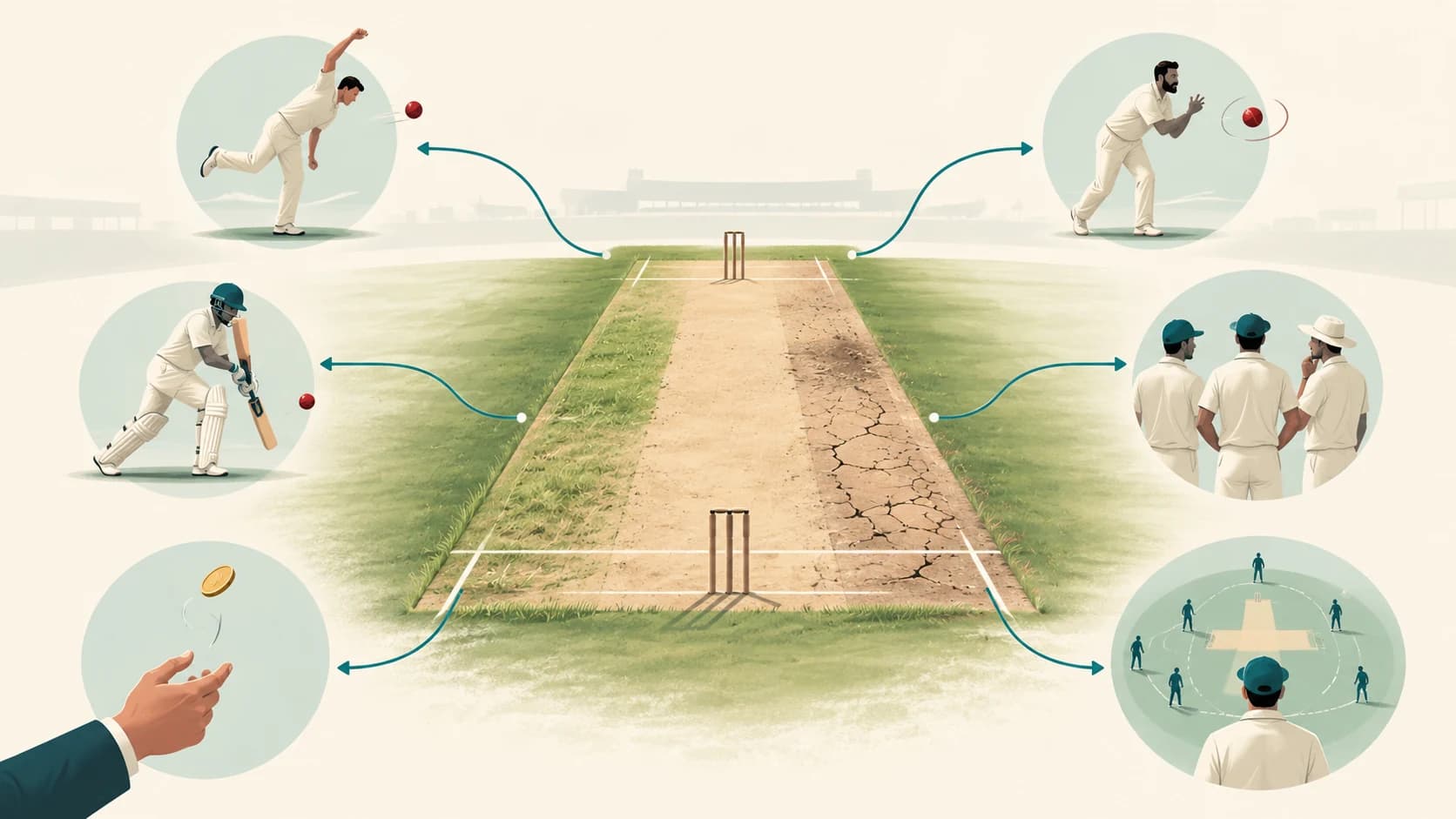
Two cricket teams can contain exactly the same players and yet approach two matches completely differently.
On one ground, the captain may want three fast bowlers and attack with the new ball.
On another, the same team may select two specialist spinners.
A batter who drives confidently through the line on one surface may play much later and more cautiously on another.
And before the first ball has even been bowled, the captain winning the toss may spend several minutes staring at a strip of soil and grass before deciding whether to bat or bowl.
Why can such a small piece of ground matter so much?
Because almost every delivery interacts with it.
The cricket pitch determines how much speed the ball retains after bouncing, how high it rises, whether the seam can make it deviate, how much grip a spinner can find and how predictable the bounce remains as the match continues.
The MCC Laws define the pitch itself as a rectangular area 22 yards (20.12 m) long and 10 feet (3.05 m) wide. The ground authority prepares it before the match; once play begins, its use and maintenance come under the umpires' control.
That small strip becomes the physical environment through which almost every bowling and batting plan must work.
The pitch does not literally decide the match.
Players still have to execute.
Weather matters.
The ball matters.
The outfield matters.
But the pitch changes which skills are easiest to use—and which mistakes are most heavily punished.
A Cricket Pitch Is Not Just “Hard” or “Dry”
When commentators describe a surface, you may hear words such as:
- green,
- dry,
- hard,
- soft,
- cracked,
- flat,
- slow,
- tacky,
- two-paced.
These are not merely visual descriptions.
They are clues about how the surface may interact with the ball.
Professional pitch assessment can consider factors such as:
- moisture,
- hardness,
- grass cover,
- grass height,
- colour,
- rolling,
- weather conditions.
The ECB's current pitch regulations explicitly include these types of preparation information in match-referee pitch reporting.
The surface itself is a managed combination of:
soil
moisture
grass
compaction
wear
Different combinations create different playing characteristics.
Why Hardness Affects Pace and Bounce
Think about dropping a ball onto two surfaces.
One is firm and compact.
The other is soft enough to deform.
The soft surface absorbs more energy.
A firm cricket pitch generally gives the ball a more energetic rebound than a soft one, although the exact result also depends on soil, moisture, grass and the ball's impact.
That is why harder surfaces can produce:
- stronger carry,
- higher bounce,
- greater pace off the pitch.
A fast bowler on such a surface may be able to attack with:
- back-of-a-length bowling,
- bouncers,
- steep bounce,
- edges carrying to the slips.
Perth is a famous example of a surface associated with pace and bounce. Cricket Australia has described the WACA/Perth pitch character as involving strong bounce and carry and has linked that character partly to its clay-based soil profile and local conditions.
Now imagine a slower surface where more energy is absorbed.
The batter may have extra time after the bounce.
But that does not necessarily make batting easy.
A slower ball can make timing difficult because shots arrive early relative to the ball.
Moisture Can Change How the Surface Behaves
Water is central to pitch preparation.
Groundstaff use irrigation, drying and rolling to control the surface before a match.
The ECB notes that water is used in fine-turf pitch preparation to help achieve suitable playing characteristics and safe conditions.
Moisture influences how the soil responds to the ball and to rolling.
Too much moisture can leave a surface softer.
As it dries, the pitch can become firmer.
But excessive drying can also produce cracking and reduce consistency.
ECB/Cranfield rolling guidance notes that further drying can increase rebound while also increasing the risk of inconsistent behaviour as cracking develops.
This is why a pitch cannot be understood simply by looking at its colour.
A surface may appear dry on top while retaining meaningful moisture below.
Why Grass Can Help Fast Bowlers
A visible layer of grass often makes viewers expect seam movement.
There is some logic behind that expectation, but it should not be simplified into:
more grass = guaranteed wickets for fast bowlers.
Grass can affect:
- surface protection,
- moisture retention,
- friction,
- how the seam interacts with the surface.
If the ball lands upright on the seam and the surface allows it to bite rather than skid straight through, it may deviate sideways.
The ICC's pitch-monitoring criteria treat seam movement as one of the important characteristics of a pitch. A very good Test surface can offer some seam movement and good carry while remaining consistent enough to provide a fair contest.
Too much unpredictable seam movement, however, can become a problem.
The ICC's pitch-monitoring process specifically identifies excessive seam movement as one possible reason a pitch may receive a substandard rating.
So the aim is not simply to create maximum movement.
The aim is to create a competitive but reasonably predictable surface.
Why a Dry Surface Can Help Spin
Spin bowling depends heavily on what happens when a rotating ball grips the pitch.
A spinner wants the ball to interact with the surface rather than simply skid through.
A drier, more abrasive or worn surface can provide greater opportunity for that interaction.
This can lead to:
- more turn,
- more variation,
- stronger bite,
- unpredictable bounce from damaged areas.
Cricket Australia has deliberately created training surfaces using different soil and clay characteristics to reproduce conditions that offer greater spin and different bounce.
But “dry” does not automatically mean “spinner's paradise.”
A dry pitch can also be very hard and good for batting.
What matters is the complete surface:
- hardness,
- texture,
- cracks,
- wear,
- grass,
- soil characteristics.
The Same Pitch Can Change During the Match
This is one of the biggest reasons pitch strategy matters so much in Test cricket.
A Test can last up to five days.
The same strip is repeatedly used.
Fast bowlers land thousands of times around the crease.
Balls repeatedly strike similar lengths.
Batters move across the surface.
The pitch dries.
Grass can wear away.
Footmarks develop.
Small cracks can grow.
The ICC's Test pitch criteria explicitly acknowledge this expected progression. Its description of a very good Test pitch allows limited seam movement and consistent bounce early, followed by natural wear that becomes increasingly responsive to spin later in the match.
This creates one of Test cricket's defining strategic ideas:
the conditions you choose at the toss may not be the conditions you face on Day 4.
Why Spinners Become More Dangerous as a Test Wears On
A spinner can exploit deterioration in several ways.
The surface may become:
- rougher,
- drier,
- more cracked,
- less uniform.
Footmarks can be especially important.
A right-arm fast bowler running over the wicket to a right-handed batter lands outside one side of the pitch. Repeated use can create rough patches.
A spinner bowling from the opposite end may then try to land the ball into those damaged areas.
Now the same ball can:
- grip sharply,
- bounce differently,
- skid,
- turn more than expected.
That uncertainty makes batting much harder.
It is not only the amount of turn that matters.
Variation is often more dangerous than predictable turn.
Consistent Bounce Is One of the Most Important Pitch Qualities
A pitch does not need to be easy for batting to be good.
It can:
- seam,
- bounce,
- spin.
What matters is whether the challenge remains reasonably playable and consistent.
The ICC's monitoring process places significant emphasis on consistent bounce and carry.
Why?
Because batters can adapt to a predictable challenge.
If every ball on a certain length rises sharply, the batter can change technique.
If one ball rises chest-high and the next stays near the ankle from a similar spot, the task becomes far harder.
Recent ICC pitch reports illustrate this distinction clearly. Surfaces have been criticized where excessive seam movement or variable bounce shifted the balance too strongly toward bowlers.
A difficult pitch and an unfairly unpredictable pitch are not necessarily the same thing.
Why the Toss Can Become Strategically Important
The toss itself is random.
What happens afterward is strategic.
The captain must decide:
bat
or
bowl.
The pitch is one of the largest inputs into that decision.
A green, moist-looking surface
A captain may expect:
- new-ball seam movement,
- extra assistance for fast bowlers,
- difficult early batting.
That can encourage bowling first.
A dry surface expected to deteriorate
A captain may think:
- batting will be easiest early,
- spin will become more dangerous later,
- chasing in the fourth innings could be difficult.
That can encourage batting first.
A flat white-ball pitch with dew expected later
The pitch alone may not dominate the choice.
The captain may prefer chasing because evening dew could make bowling harder.
The important point is that the toss decision is not based only on what the pitch looks like now.
It is based on how the captain expects the entire match environment to change.
Pitch Conditions Influence Team Selection Before the Toss
The pitch can shape strategy even before the final XI is announced.
Suppose a team inspects a dry surface expected to turn significantly.
It may choose:
- two specialist spinners,
- an all-rounder who bowls spin,
- batters considered strong against spin.
On a fast, grassy surface, the same team might choose:
- an extra fast bowler,
- fewer specialist spinners,
- a stronger slip cordon.
This is why team balance can vary so much between venues.
Selection is not only about choosing the eleven best individual players.
It is about choosing the eleven whose skills best fit the expected conditions.
Bowling Length Changes With the Surface
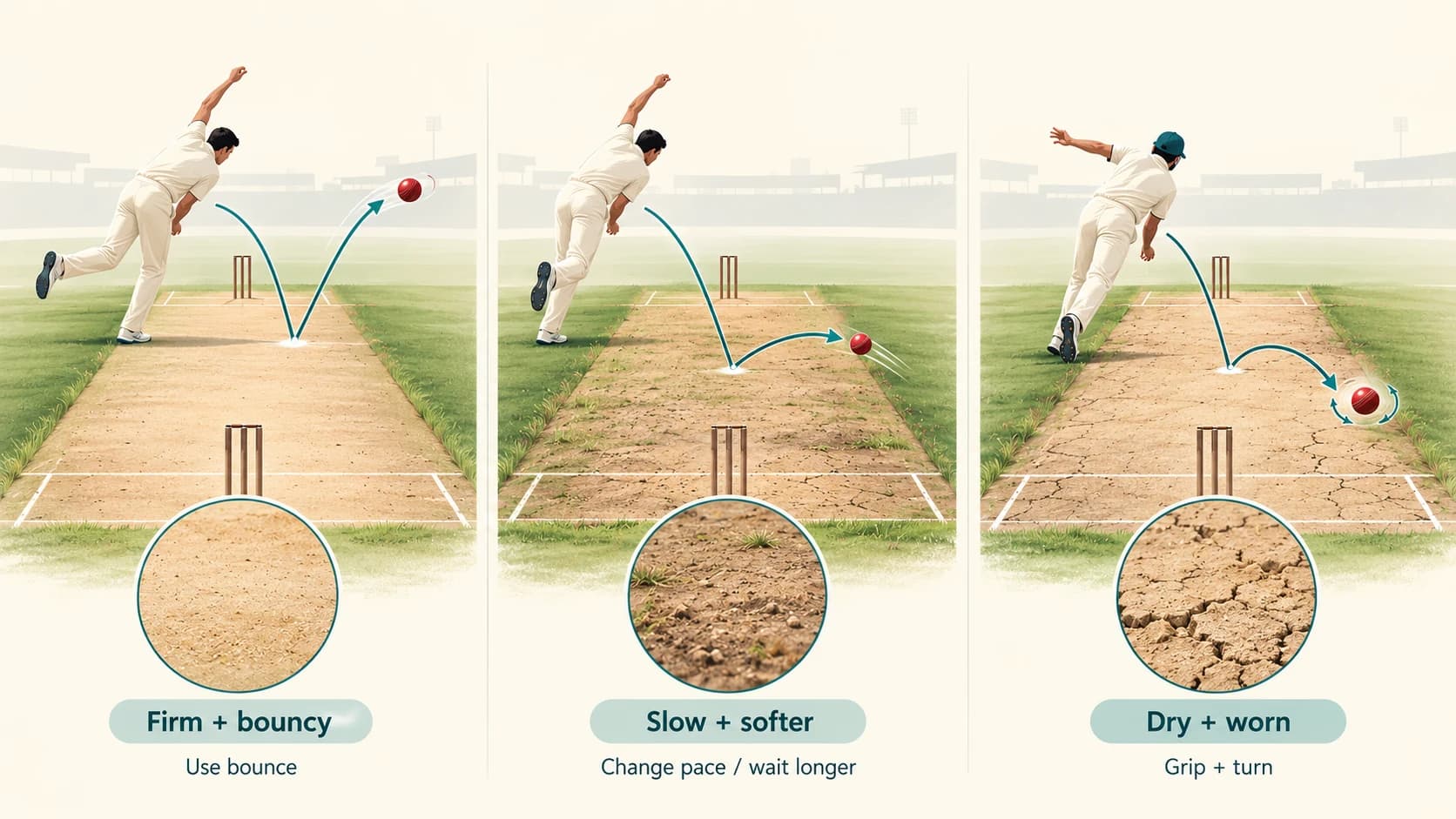
A “good length” is not a fixed physical location that works equally everywhere.
On a fast, bouncy surface, a slightly shorter delivery may still threaten the stumps or force the batter onto the back foot.
On a slow pitch, the same ball may sit up comfortably and be easy to attack.
Fast bowlers may therefore adjust:
- length,
- pace,
- use of cutters,
- bouncers,
- fuller deliveries.
Spinners may adjust:
- pace through the air,
- trajectory,
- length,
- use of the crease.
A slow surface may encourage a fast bowler to take pace off the ball.
A hard surface may reward hitting the deck aggressively.
The pitch changes the value of the same delivery.
Batting Technique Changes Too
Batters respond to the pitch just as bowlers do.
On a fast, bouncy pitch
A batter may:
- play later,
- leave more balls,
- avoid hard hands outside off stump,
- be prepared for the short ball.
On a slow pitch
A batter may need to:
- wait longer,
- generate more power,
- avoid committing too early,
- expect slower timing.
On a turning pitch
A batter may:
- use the feet,
- sweep,
- play with the spin,
- play late,
- defend with softer hands.
The correct technique depends partly on how predictable the bounce and turn are.
This is why batters often spend time before a series training on surfaces designed to imitate expected conditions.
Field Placements Change With the Pitch
The pitch can even determine where fielders stand.
If the new ball is seaming and carrying well, the captain may attack with:
- several slips,
- gully,
- short leg.
Why?
Because edges are more likely to carry.
On a slow pitch, the edge may not reach the same catching positions.
Against spin on a turning surface, the captain may instead use:
- slip,
- short leg,
- silly point,
- leg slip.
Again, the field is not chosen independently.
It is built around the type of mistake the pitch and bowler are trying to create.
White-Ball Cricket Has Different Pitch Questions
In T20 and ODI cricket, the pitch usually does not deteriorate over several days in the same way because the match is shorter.
But pitch behaviour still matters enormously.
Teams ask:
- Is this likely to be a high-scoring surface?
- Will the ball grip?
- Will cutters work?
- Will the new ball seam?
- Is stroke play easy?
- Is chasing likely to become easier or harder?
On a flat batting pitch, teams may prioritize:
- power hitting,
- aggressive powerplays,
- high boundary rates.
On a slow surface, teams may value:
- strike rotation,
- spin,
- cutters,
- slower balls,
- batters who can generate their own pace.
The same target—say 170 in a T20—can be mediocre on one pitch and match-winning on another.
“Par Score” Is Really a Pitch-Dependent Idea
Commentators often talk about a par score.
There is no universal T20 score that is always good.
A competitive total depends on:
- pitch,
- ground dimensions,
- weather,
- bowling attacks,
- dew,
- match situation.
On one surface:
190 may be ordinary.
On another:
145 may be extremely difficult to chase.
That changes batting strategy.
A team that misreads the pitch may spend the first ten overs chasing a 200-run tempo that the surface does not support, losing wickets unnecessarily.
Good teams continually reassess.
Why Reading the Pitch Is Still Difficult
If pitch behaviour could be determined perfectly from appearance, captains would rarely misread it.
But they do.
A pitch can look:
- green but play flat,
- dry but offer little turn,
- cracked but remain consistent,
- hard but slower than expected.
That is because visual inspection shows only part of the system.
The behaviour depends on:
- soil profile,
- moisture below the surface,
- compaction,
- grass roots,
- weather,
- rolling,
- wear.
ECB pitch regulations therefore consider actual preparation information such as moisture and hardness readings rather than relying only on appearance.
The first few overs often provide better evidence than a pre-match photograph.
Weather and Pitch Cannot Be Separated Completely
A pitch exists inside a changing environment.
Sun can accelerate drying.
Cloud and humidity can change atmospheric conditions, although swing through the air should not be confused with movement caused by the pitch.
Rain can delay play and affect surface moisture.
Covers can slow drying or protect the pitch from rain.
The MCC Laws state that the pitch must not be watered during the match.
So once play begins, natural weather and permitted maintenance can influence how the surface evolves.
This matters especially in Tests, where five days of changing weather can alter the same pitch significantly.
The Outfield Is Different From the Pitch
The terms are sometimes mixed together.
The pitch is the central 22-yard strip.
The outfield is the much larger grass area surrounding it.
A slow outfield can reduce boundaries because the ball loses speed after leaving the bat.
A wet outfield can make fielding difficult.
But these are different effects from:
- seam movement,
- spin,
- bounce,
which are primarily associated with the ball interacting with the pitch.
A match can therefore have:
a fast pitch but slow outfield
or
a slow pitch but fast outfield.
Both affect strategy, but in different ways.
What Happens When a Team Misreads the Pitch?
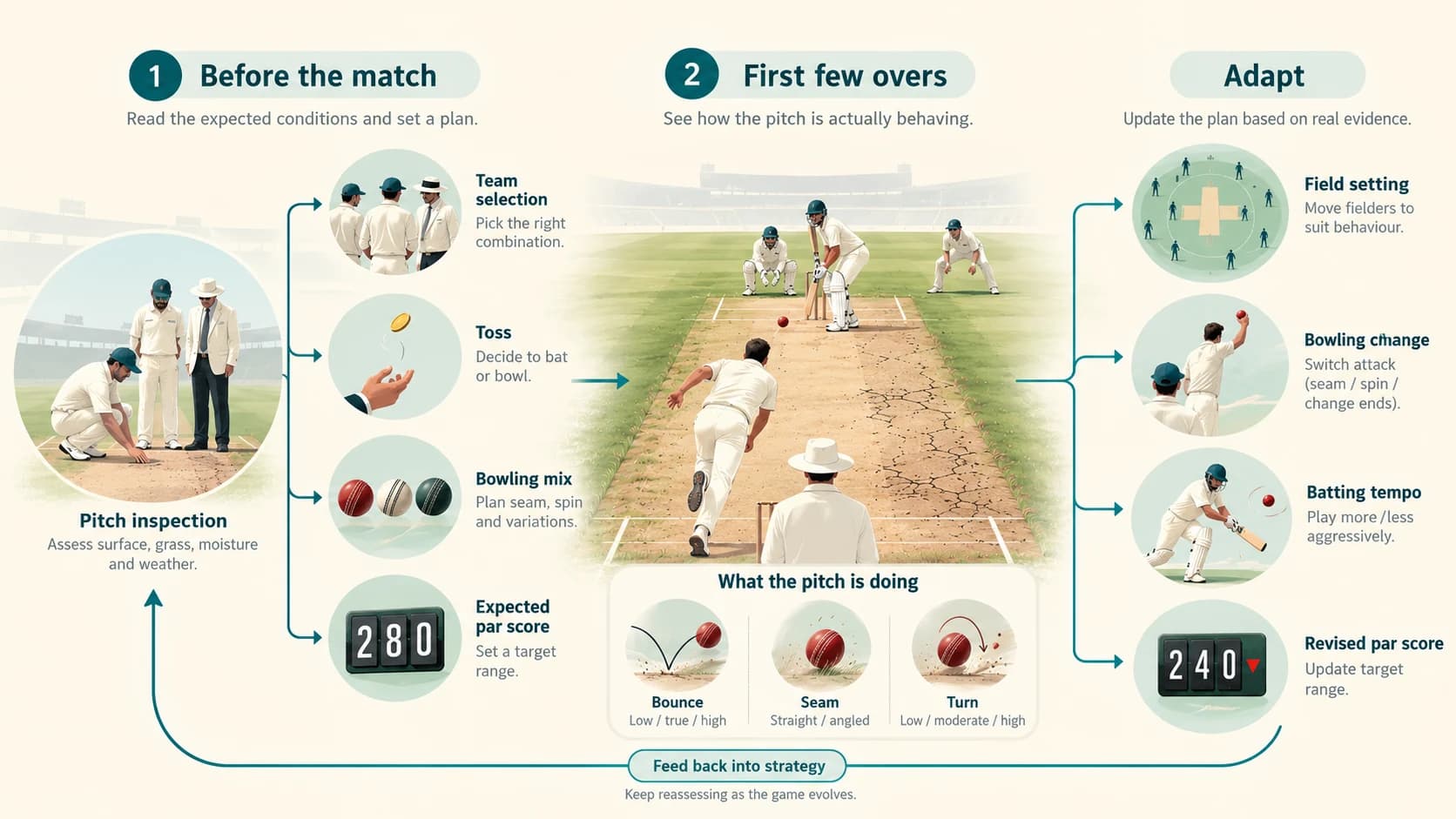
Imagine a team expects a flat batting surface.
It selects only one specialist spinner.
Then the pitch turns sharply from the first session.
Now several problems appear.
Selection problem
The team may not have enough spin bowling.
Batting problem
Batters prepared to attack through the line may need to change technique.
Scoring problem
The expected par score may have been too high.
Tactical problem
The captain may need to use part-time spin earlier than planned.
The same can happen in reverse.
A team may select several spinners expecting a dry surface, only to discover strong seam movement and bounce.
Pitch reading is therefore not just prediction.
It is also about how quickly a team adapts when the prediction is wrong.
A Good Pitch Does Not Mean a Flat Pitch
This is an important distinction.
A pitch that produces 600 runs does not automatically qualify as excellent.
A pitch that produces wickets does not automatically qualify as bad.
The ICC's monitoring approach is based on the idea of a fair contest between bat and ball.
For Tests, a strong surface can provide:
- useful carry,
- some seam movement,
- consistent bounce,
- natural wear,
- increasing assistance for spin later.
What becomes undesirable is excess:
- excessive seam movement,
- excessive uneven bounce,
- excessive early spin,
- or a surface so lifeless that bowlers receive almost no assistance.
The objective is not to remove the pitch from the contest.
The pitch is supposed to be part of the contest.
The Pitch Changes the Value of Every Cricket Skill
A 145 km/h fast bowler is not equally dangerous everywhere.
A wrist-spinner is not equally valuable everywhere.
A powerful hitter cannot use the same method on every surface.
The pitch modifies every skill.
Conceptually:
Pitch characteristics
↓
Ball behaviour
↓
Which bowling styles are effective
↓
Which batting methods are safe or dangerous
↓
Field placements
↓
Team selection
↓
Toss decision
↓
Match strategy
That is why players inspect the surface.
That is why commentators discuss cracks.
That is why groundspeople spend days preparing a strip only 22 yards long.
And that is why two matches between the same teams can look completely different.
The pitch does not decide who wins.
But it defines the physical problem both teams must solve.
The better a team understands that problem—and the faster it adapts when the answer changes—the more likely its strategy is to make sense.