Can AI Predict a Batter’s or Bowler’s Next Move?
Learn how cricket AI uses ball-by-ball data, player matchups, recent sequences and match context to estimate what may happen next—and why it can never know for certain.
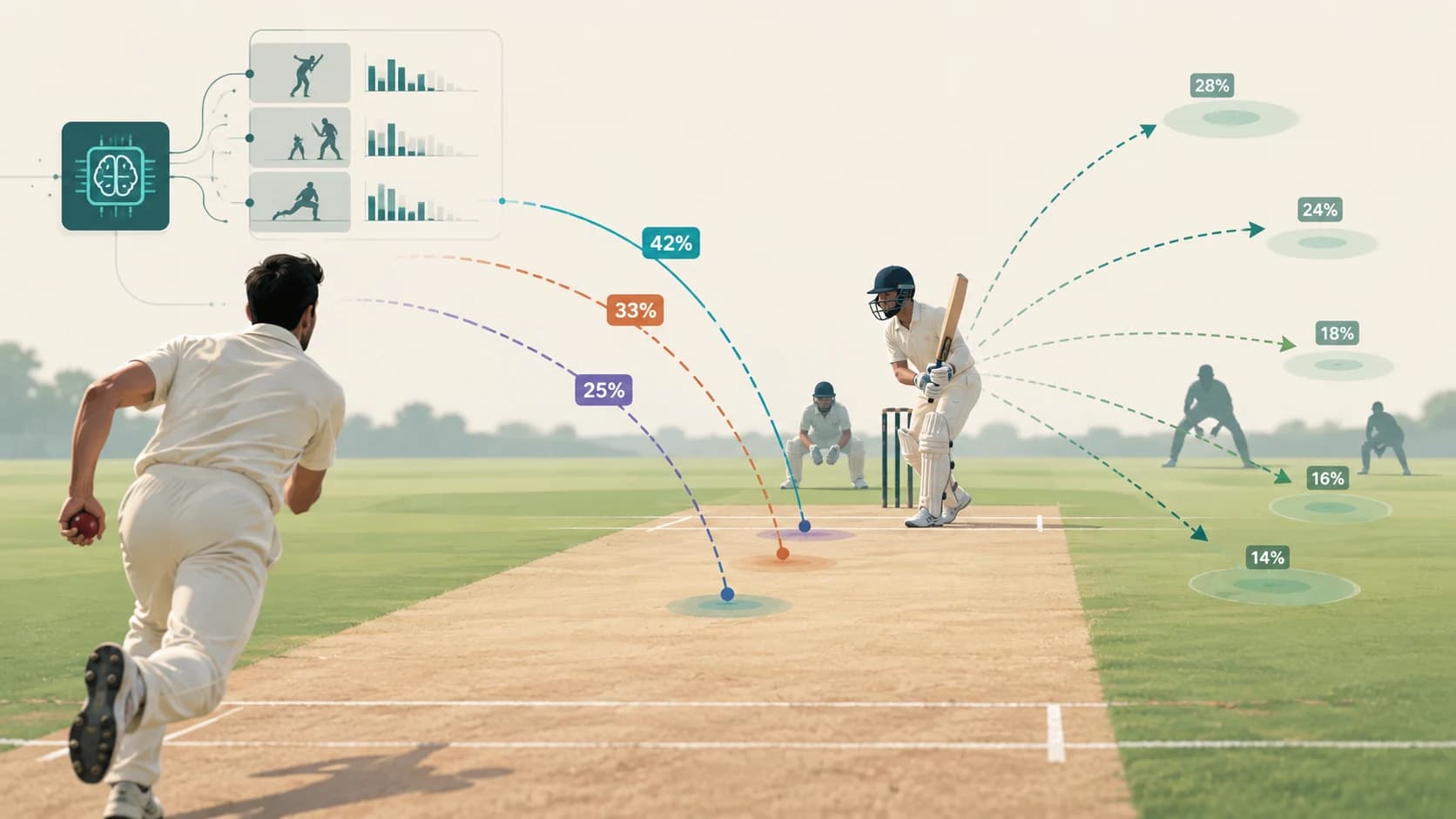
The bowler walks back to the top of the run-up.
The batter settles into position.
The field is set.
Before the next ball is delivered, could a computer already know what is about to happen?
Could artificial intelligence predict:
- whether the bowler will bowl short or full,
- whether the batter will attack or defend,
- where the shot will go,
- whether the next ball will be a dot, four, six or wicket?
Not with certainty.
But it can estimate which outcomes are more likely than others.
Modern cricket analytics already uses machine-learning models trained on enormous ball-by-ball datasets. Stats Perform says its OptaAI cricket models are trained on detailed historical data and include a Next Ball Predictor, live win probability and team/player score predictions that update after every delivery.
That does not mean the AI sees the future.
It means that, given a particular batter, bowler and match situation, it can compare the current moment with patterns learned from thousands or millions of previous deliveries and produce a probability distribution.
For example, instead of saying:
“The next ball will definitely be a four.”
a model might conceptually say:
Dot ball: 39%
1 run: 27%
Boundary: 18%
Wicket: 7%
Other outcomes: 9%
That difference is crucial.
AI can make cricket more predictable.
It cannot make cricket predetermined.
What Does “Predicting the Next Move” Actually Mean?
There are several different prediction problems hiding inside this question.
Predicting the next outcome
This asks:
What will happen on the next delivery?
Possible outputs include:
- dot,
- single,
- two,
- four,
- six,
- wicket,
- wide,
- no-ball.
Stats Perform's current Next Ball Predictor is an example of this approach: it estimates the most likely runs from the next delivery and the probability of a dismissal.
Predicting the batter's intention
This asks:
What kind of shot is the batter likely to attempt?
For example:
- defend,
- drive,
- cut,
- pull,
- sweep,
- slog,
- leave.
Predicting the shot location
This asks:
Which part of the field is the batter most likely to target?
Predicting the bowler's next delivery
This could mean:
- pace or slower ball,
- yorker or short ball,
- off-stump or leg-stump line,
- stock ball or variation,
- over or around the wicket.
These are related problems, but they are not equally difficult.
Predicting the chance of a dot ball is much easier than claiming with confidence that:
“The bowler will bowl a slower bouncer and the batter will pull it behind square.”
The more specific the prediction becomes, the less certain it usually becomes.
AI Begins With What Players Have Done Before
Machine-learning models learn from examples.
Cricket produces an enormous number of them.
Stats Perform says detailed Opta data is collected from more than five million deliveries each year across cricket formats. CricViz also maintains a large ball-by-ball database and says its collection systems capture detailed information about delivery type, shot selection, fielding and match context.
For each delivery, a model may have access to information such as:
- batter,
- bowler,
- batting hand,
- bowling style,
- line,
- length,
- pace,
- delivery type,
- previous balls,
- runs required,
- wickets remaining,
- over number,
- innings phase,
- venue,
- match format,
- current score.
Where richer tracking is available, the dataset can include:
- release speed,
- swing,
- spin,
- bounce,
- pitching coordinates,
- trajectory.
Individually, these facts do not reveal the next ball.
Together, they create context.
A Batter Is Not “Average Batter”
Suppose the next delivery is a short ball outside off stump.
A generic model might know that this type of delivery is often cut or pulled.
But professional analysis becomes more useful when it learns who is batting.
One batter may aggressively cut almost every available short ball.
Another may leave or defend.
A third may target the upper cut.
This is called personalisation.
A 2020 MIT Sloan Sports Analytics Conference paper developed a personalised deep-learning model that used:
- ball-by-ball match context,
- delivery trajectory,
- recent delivery sequences,
- batter-specific history,
- bowler-specific history.
The model produced probabilities for where a particular batter would hit a particular type of delivery in a particular game situation.
That is much closer to the question a cricket captain actually cares about:
What is this batter likely to do against this bowler right now?
The Previous Balls Matter Too
Cricket is sequential.
The next delivery is influenced by what happened before it.
Imagine this sequence:
Ball 1: dot
Ball 2: dot
Ball 3: dot
Now the batter may feel pressure to score.
Or imagine:
Ball 1: six
The bowler may respond with:
- a slower ball,
- a yorker,
- a wider line,
- a short delivery.
A model that examines only the current batter and bowler misses this evolving context.
The MIT Sloan study compared several modelling approaches and found that a Long Short-Term Memory network—a type of neural network designed for sequences—improved prediction when it considered a window of recent deliveries.
The researchers used a six-delivery lookback, matching the length of a conventional over.
The lesson is broader than the exact architecture:
what happened on the previous balls can change what is likely to happen on the next one.
How an AI Model Turns Cricket Into Probabilities
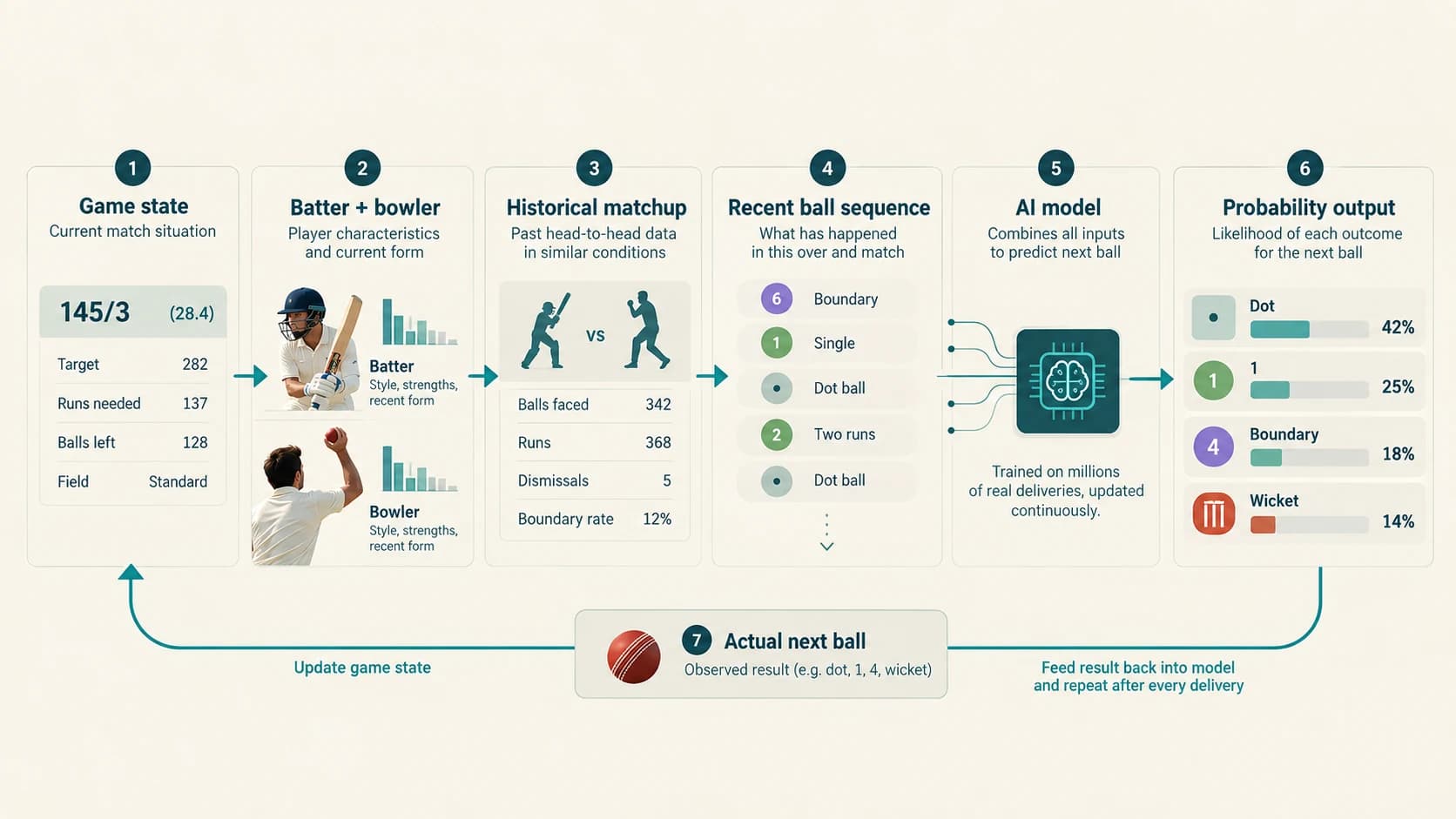
A simplified prediction pipeline might look like this.
1. Read the current game state
For example:
- T20 match,
- 18.4 overs,
- 162/5,
- 19 required from 8 balls.
2. Identify the players
The model knows:
- which batter is on strike,
- which bowler is operating.
3. Retrieve relevant history
It may examine:
- batter against this bowling style,
- bowler against this batting hand,
- death-over performance,
- similar venues,
- direct head-to-head history.
4. Add the recent sequence
For example:
4, 1, dot, 6
5. Calculate probabilities
The model may output probabilities for:
- runs,
- wicket,
- shot region,
- projected score,
- other target variables.
6. Update after the delivery
Whatever actually happens becomes part of the next game state.
The model runs again.
This creates a continuously changing prediction.
Why AI Is Better at Probabilities Than Exact Answers
Suppose a model predicts the following shot-zone probabilities:
Midwicket: 24%
Long-on: 18%
Cover: 15%
Point: 13%
Other areas: 30%
If the batter then hits through cover, the model was not necessarily “wrong” in the ordinary sense.
It had already said cover was possible.
Probability models should be evaluated over many events.
If an event assigned a 20% probability happens approximately one time in five across a large sample, the model may be well calibrated.
This is why a useful AI system does not need to call every delivery correctly.
It needs to make the probabilities meaningfully better than a simple baseline.
Exact Shot Prediction Is Extremely Difficult
The 2020 MIT Sloan paper illustrates just how difficult specific cricket prediction can be.
Its personalised model attempted to predict one of 17 shot zones.
A naïve model achieved about 10.9% accuracy.
A random forest improved that to 19.9%.
A feed-forward neural network reached 20.3%.
An LSTM using sequential information reached 21.0%.
Adding personalised batter and bowler features improved the result to about 22.1% on a holdout set of 86,941 deliveries.
At first glance, 22.1% may not sound impressive.
But predicting one exact zone from 17 possibilities is an unusually specific task.
More importantly, it demonstrates the correct way to think about AI in cricket.
The model found useful signal.
It did not turn batting into a solved problem.
Before the Ball and After Release Are Different Problems
There is another important distinction.
Suppose AI tries to predict a batter's shot before the bowler begins the run-up.
It knows:
- history,
- matchup,
- score,
- field,
- recent balls.
But it does not yet know exactly what delivery is coming.
Now imagine predicting the shot after the ball has been released.
A tracking system may now know:
- speed,
- line,
- length,
- movement,
- trajectory.
That makes the batter's response much easier to model.
The MIT Sloan shot-prediction work used detailed delivery information such as line, length and movement to estimate likely shot behaviour.
So when someone says:
“AI predicted the batter's shot,”
the next question should be:
At what point was the prediction made?
Predicting before the delivery exists is far harder than predicting after the trajectory has become visible.
A Batter's Shot Is Part Plan and Part Reaction
Cricket batting is not entirely premeditated.
A batter may decide:
“I am going to attack this ball.”
But the exact stroke may still depend on:
- line,
- length,
- pace,
- swing,
- spin,
- bounce.
The MIT Sloan paper describes shot direction and aggression as depending on a mixture of premeditated decision-making and split-second reaction after the ball is delivered.
That is why no database can perfectly predict batting intent.
The batter is making a real-time decision from information that did not exist until the delivery began.
Can AI Predict What the Bowler Will Bowl Next?
In principle, yes—again as probabilities.
A model could learn patterns such as:
- yorker frequency at the death,
- bouncer frequency after a boundary,
- slower-ball usage against particular batters,
- preferred line to left-handers,
- common delivery sequences,
- response after consecutive dot balls.
A recent Stats Perform patent application describing transformer-based prediction for striking sports explicitly discusses cricket use cases in which models can consider sequences of deliveries and potentially predict variables such as:
- next-ball outcome,
- delivery location,
- hit location.
It also gives examples of sequence effects, such as a bowler being more likely to change delivery after being hit for a boundary.
That technical disclosure demonstrates what modern predictive systems can be designed to model.
It does not mean every professional team currently has a perfect “next delivery” predictor.
The Bowler Is Trying to Be Unpredictable
There is a fascinating problem here.
If AI discovers:
This bowler bowls a slower ball 72% of the time after conceding six,
the opposition analyst may tell the batter.
Now the bowler's team may discover that opponents know this tendency.
The bowler changes behaviour.
The old pattern weakens.
This is sometimes called a strategic or adversarial environment.
Unlike weather, cricket players can respond to the prediction itself.
That creates a loop:
AI discovers pattern
↓
Opponent exploits pattern
↓
Player adapts
↓
Old data becomes less representative
↓
Model must update
The better teams become at analytics, the more valuable unpredictability becomes.
AI Can Help Choose a Field Without Predicting One Exact Shot
A fielding captain does not necessarily need to know:
“The batter will hit the next ball to deep midwicket.”
Suppose the model instead says:
- leg-side scoring is more likely,
- aggressive shot probability is elevated,
- the batter rarely attacks through cover against this line.
That may already be enough to adjust the field.
The MIT Sloan researchers explicitly proposed shot-zone prediction as a way to support:
- bowler selection,
- pre-match strategy,
- in-game tactics,
- fielder placement.
This is a recurring theme in sports analytics:
a prediction can be useful without being certain.
AI Can Simulate Thousands of Possible Futures
Another approach is not to predict one specific future.
Instead, simulate many.
Stats Perform says its OptaAI cricket match simulator can simulate the outcome of each ball in an innings thousands of times to evaluate different “what if” scenarios.
For example:
What if we send Batter A instead of Batter B?
What if Bowler X bowls the next over?
What if we attack for the next 12 balls?
Each simulated future follows a different path.
When thousands are combined, the model can estimate:
- expected score,
- wicket risk,
- win probability,
- player projection.
This is often more useful than pretending there is one inevitable next event.
Predicting the Outcome Is Not the Same as Predicting the Action
Suppose AI predicts a high chance of a dot ball.
That does not tell you whether:
- the batter defends,
- misses,
- leaves,
- hits straight to a fielder.
Similarly, predicting a high wicket probability does not specify whether the dismissal will be:
- bowled,
- caught,
- LBW,
- run out.
Models can be built at different levels of detail.
A broad prediction is often more accurate.
A very specific prediction may be tactically interesting but much harder.
Recognition Is Not Prediction
AI is also increasingly used to classify what already happened.
A 2026 Scientific Reports study used deep learning and computer vision to classify cricket batting shots from video into categories such as:
- drive,
- pull,
- cut,
- sweep,
- flick,
- slog.
The reported system achieved high classification accuracy on its test data.
But this is fundamentally different from predicting a shot before it is played.
The video already contains the player's movement.
The AI's job is to recognise it.
This distinction matters because the word “prediction” is often used loosely in machine learning.
Recognising a completed shot is not the same challenge as forecasting a future shot.
What Can Make an AI Prediction Wrong?
Many things.
A new player
There may be too little historical data.
This is sometimes called the cold-start problem.
A player changes technique
Old patterns may no longer represent current behaviour.
Conditions change
Pitch pace, bounce, dew and wind can alter what is practical.
Small matchup samples
A batter may have faced a bowler only 12 times.
Tactical deception
The bowler deliberately does the unexpected.
Human improvisation
The batter invents a shot or changes plan at the last instant.
Data does not capture everything
Models may not know:
- confidence,
- fatigue,
- minor injury,
- private tactical instructions,
- exactly what a player noticed in the previous delivery.
Those hidden variables are part of cricket.
AI Models Can Become Overconfident
Suppose an AI says:
72% chance of a slower ball.
That sounds precise.
But the quality of that number depends on:
- the training data,
- how recent it is,
- whether the situation is genuinely comparable,
- whether probabilities are well calibrated.
A sophisticated-looking percentage should not automatically be treated as truth.
Teams need to know not only:
What does the model predict?
but also:
How reliable is the model in situations like this one?
Good analytics includes uncertainty.
The Best Prediction May Be a Simple Tactical Message
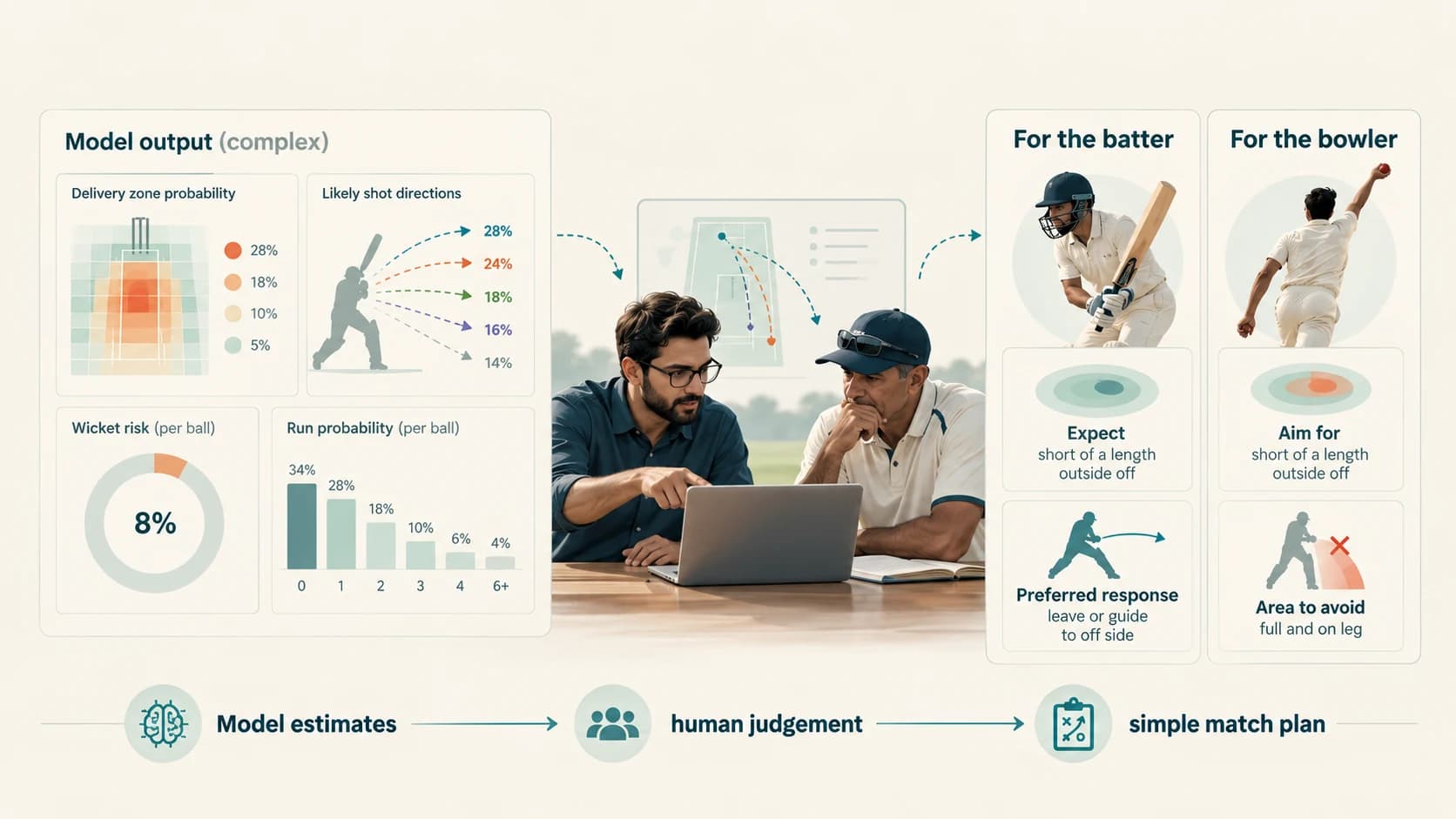
Imagine an analyst's model produces dozens of outputs before a death over:
- next-ball run probabilities,
- likely delivery zones,
- boundary risk,
- wicket probability,
- batter scoring preferences,
- bowler variation tendencies.
The player does not need to see all of that.
The useful message might be:
To the batter
Expect full and wide more often than usual. Keep the off-side option ready.
To the bowler
The batter attacks straight against full pace. Wider yorker gives the safer matchup.
To the captain
If this bowler continues, protect square leg and long-on.
A machine can calculate thousands of possibilities.
The human still has to turn them into cricket.
So, Can AI Predict the Next Ball?
Yes—within limits.
AI can already estimate things such as:
- likely run outcome,
- dismissal probability,
- likely shot areas,
- player-score projections,
- match outcome.
Research and technical systems also show how models can analyse sequences and estimate more specific batter and bowler tendencies.
But “predict” does not mean:
know exactly what will happen.
The correct mental model is:
AI finds patterns in the past
↓
combines them with the current situation
↓
assigns probabilities to possible futures
↓
updates when new information arrives
Cricket remains difficult to predict precisely because both sides are thinking.
The bowler tries to deceive the batter.
The batter reacts to the ball.
Both change plans.
Conditions change.
Pressure changes behaviour.
And sometimes a player simply does something no historical pattern suggested.
That is not a failure of cricket analytics.
It is why cricket is interesting.
The most useful AI will not remove uncertainty from the game.
It will help teams understand that uncertainty better—and make slightly better decisions before the next ball turns every prediction back into reality.