Why Does a New Cricket Ball Behave So Differently From an Old One?
Learn why a new cricket ball swings, seams and bounces differently from an old one, and how wear, shine, roughness and the seam change bowling strategy.
A Test match begins with a brand-new red cricket ball.
The fast bowlers are excited.
The slips come in.
The wicketkeeper stands ready for movement through the air and off the pitch.
Several hours later, the same ball may look completely different.
Its glossy finish has faded.
One side may still be carefully polished while the other is visibly scuffed.
The seam is no longer as sharp.
The ball may feel softer.
And the bowlers may have changed their entire plan.
Instead of trying to make the new ball swing conventionally, they may use:
- reverse swing,
- cutters,
- slower balls,
- cross-seam deliveries,
- spin.
The reason is simple:
a cricket ball changes physically while it is being used.
Every impact with the pitch, bat, boundary boards and outfield alters its surface. The ball that reaches the 50th over is not aerodynamically identical to the ball that began the innings.
That matters because cricket-ball movement depends heavily on three things:
the seam
the surface
the speed and orientation of the ball
Modern research into cricket-ball aerodynamics shows that swing is produced by differences in the airflow and pressure around the two sides of the ball. As the surface wears, those differences change.
So “new ball” and “old ball” are not just descriptions of age.
They describe two different aerodynamic and mechanical conditions.
First, What Is a Cricket Ball Actually Made Of?
A high-quality cricket ball is a surprisingly engineered object.
The MCC Laws specify that a new men's cricket ball must weigh between 155.9 g and 163 g and have a circumference between 22.4 cm and 22.9 cm.
Inside the leather cover is a dense core traditionally built from materials such as cork, rubber and tightly wound string.
The outside is made from shaped leather panels.
The main stitched seam around the circumference sits slightly above the surrounding surface.
That raised seam is crucial.
It gives the bowler:
- finger grip,
- control over seam position,
- a feature that can affect airflow,
- a ridge that can interact with the pitch after the ball lands.
A new match ball is also finished with a smooth polished or lacquered surface.
So at the beginning of an innings, the bowler is holding an object that is:
hard
smooth
glossy
round
equipped with a relatively prominent seam.
None of those characteristics remains perfectly unchanged.
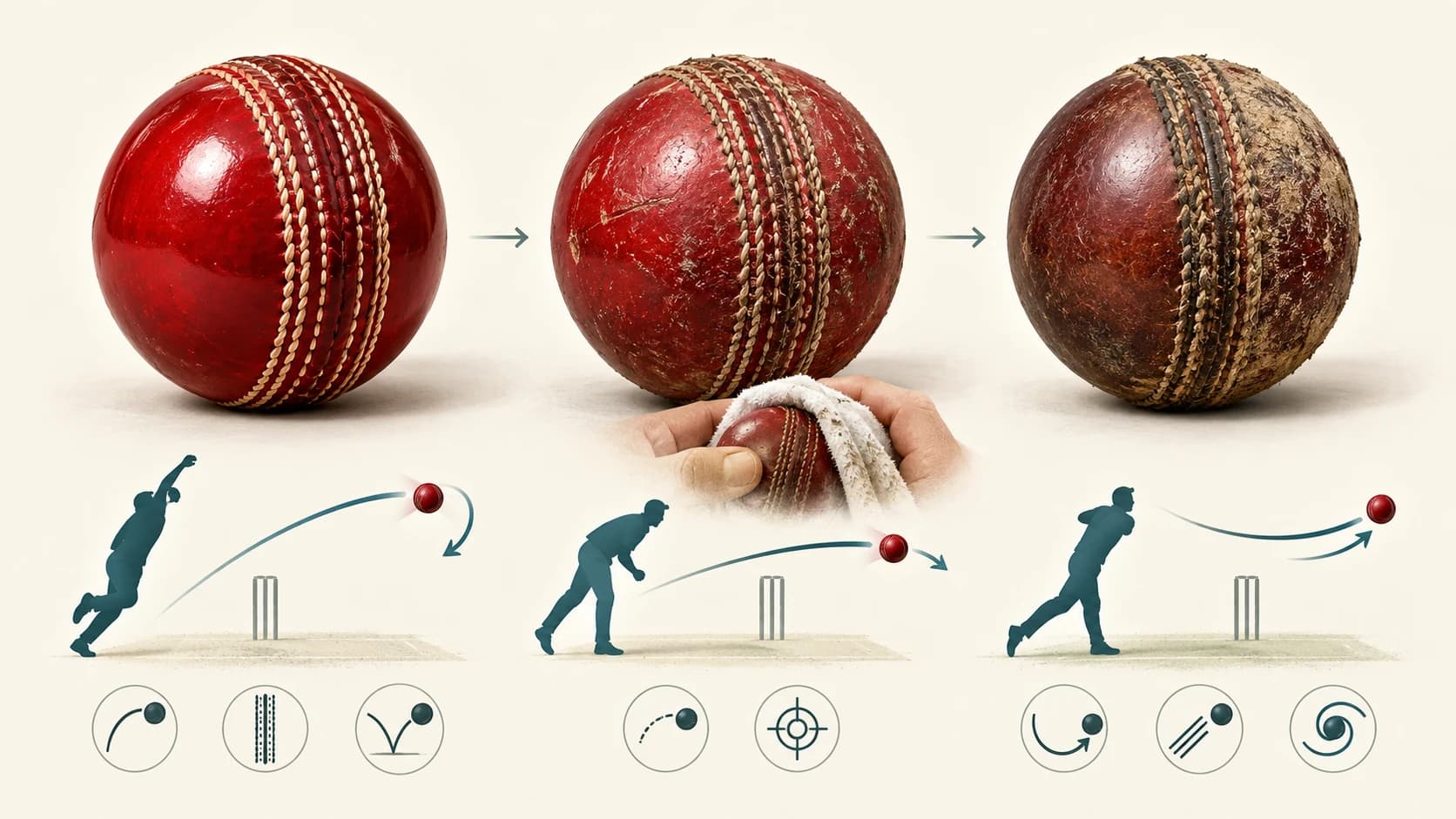
What Changes as the Ball Gets Older?
Imagine following one ball through 50 overs.
It repeatedly:
- strikes the pitch,
- lands on the outfield,
- hits the bat,
- is caught and thrown,
- is rubbed on players' clothing.
The leather gradually develops:
- scratches,
- scuffs,
- abrasions,
- small surface imperfections.
Research on balls worn under match conditions has shown that surface roughness increases substantially with use.
The seam also experiences repeated impacts and can become less prominent.
The ball may soften as its leather and internal structure absorb repeated impacts.
So the physical progression is roughly:
new
→ smooth, hard, pronounced seam
↓
used
→ less glossy, more scratched, seam wearing
↓
old
→ substantially rougher, less uniform surface, flatter seam, often softer.
The rate of change is not fixed.
A ball used on a hard abrasive outfield can age differently from one used on lush grass.
Weather, pitch hardness, ball construction and how often it hits rough surfaces all matter.
Why a New Ball Can Swing So Well
A cricket ball moving through air creates a thin layer of moving air close to its surface called the boundary layer.
The ball's seam and surface condition influence what happens to this airflow.
If the bowler holds the seam at an angle and keeps it stable during flight, the air can behave differently on the two sides of the ball.
That asymmetry creates a pressure difference.
The result is a sideways aerodynamic force:
swing.
Recent fluid-dynamics research has refined the traditional explanation of exactly how the seam affects the airflow. A 2024 Cambridge review concluded that the seam behaves more like a set of small vortex-generating features than the simple “trip wire” description often used in older explanations.
But the practical conclusion remains familiar:
seam orientation + ball speed + surface condition can create asymmetric airflow and sideways movement.
With a smooth new or well-preserved ball, this commonly produces conventional swing.
For conventional swing, the ball generally moves toward the side in which the seam is pointing, under the appropriate aerodynamic conditions.
Why Bowlers Try to Keep the Seam Upright
The seam can only influence the airflow consistently if it maintains a useful orientation.
A bowler therefore tries to release the ball with:
- the seam upright or deliberately angled,
- relatively little unwanted wobble,
- a controlled amount of backspin.
Research from the University of Bath notes that skilled swing bowlers use a small amount of backspin to help stabilize the seam through the air.
If the seam tumbles unpredictably, the airflow pattern also changes constantly.
The result may be less controlled swing.
That is why television close-ups often focus on a fast bowler's release.
The position of the fingers and seam can be the first clue to what the ball may do.
The New Ball Can Also Move Off the Pitch
Swing happens before the ball lands.
Seam movement happens after it hits the pitch.
A new ball's pronounced seam can make this second type of movement more dangerous.
If the ball lands on the seam, that raised ridge can interact with the surface and cause the ball to deviate sideways.
The amount depends heavily on the pitch.
A grassy or responsive surface may offer noticeable movement.
A flat surface may provide almost none.
But the new ball gives the fast bowler the best version of one useful tool:
a relatively sharp seam.
As that seam becomes worn and flattened, the same delivery may produce less pronounced deviation.
Why the New Ball Often Feels Faster
A new ball is generally harder and retains its shape well.
When it hits a firm pitch, it can rebound energetically.
That contributes to the impression of:
- pace,
- carry,
- steep bounce.
This is especially important for wicketkeepers and slip fielders.
A hard new ball can carry an edge comfortably to the slips.
Later, a softer older ball may not reach the same fielders as quickly.
That can influence field placement.
Early in an innings, a captain may use:
- three slips,
- four slips,
- gully.
Later, some of those catchers may disappear as the ball loses hardness, seam movement and carry.
Why Fielders Keep Polishing One Side
If every part of the ball becomes equally rough, the fielding side loses an important source of aerodynamic asymmetry.
So teams traditionally try to maintain one side in better condition than the other.
Under the MCC Laws, a fielder may polish the ball on clothing provided:
- no artificial substance is used,
- the only permitted natural substance is sweat,
- no time is wasted.
The use of saliva to polish the ball was made permanently prohibited in international cricket by the ICC in 2022.
The purpose of legal polishing is not merely cosmetic.
It helps preserve a contrast between the two sides.
One side may be maintained as relatively smooth.
The other accumulates more natural wear.
As the ball becomes older, that contrast can become aerodynamically important.
The New Ball's Conventional Swing Does Not Last Forever
A newly lacquered ball starts with a relatively smooth surface.
That condition gradually disappears.
The University of Bath found in wind-tunnel work using balls worn under match conditions that conventional swing was strongest with a new polished ball and generally reduced as wear accumulated.
This is why fast bowlers often talk about a new-ball spell as a special opportunity.
For perhaps the first part of the innings, the ball may combine:
- pronounced seam,
- hard surface,
- strong carry,
- useful conventional swing.
If the opening bowlers fail to take wickets, the game can change as those properties fade.
The same bowling plan may no longer be the best one.
Then Something Strange Can Happen: Reverse Swing
An old ball does not necessarily stop swinging.
Under the right conditions, it can begin moving in the opposite aerodynamic direction from conventional swing.
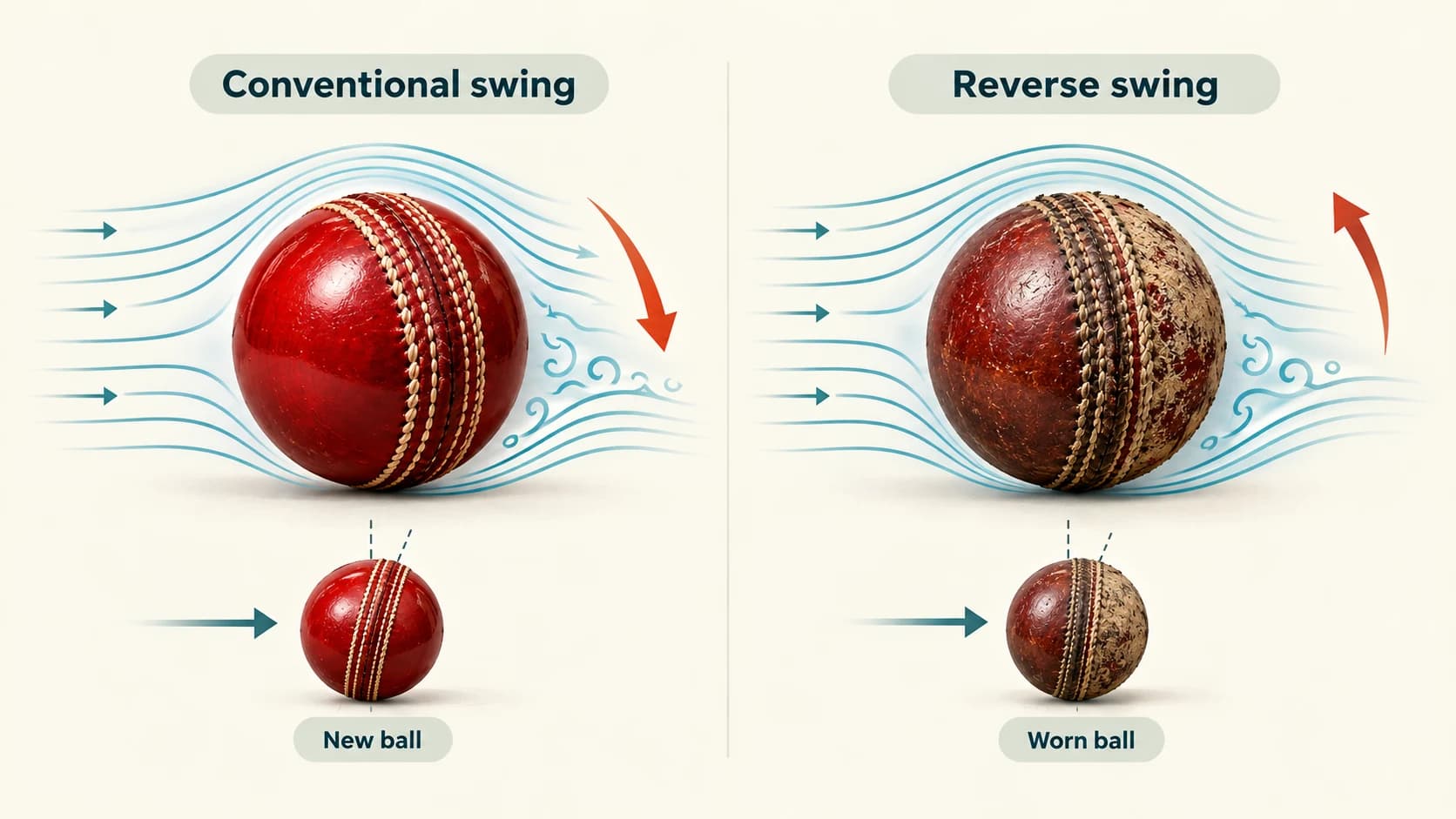
This is reverse swing.
In simplified terms:
Conventional swing
The ball moves in the direction associated with the angled seam.
Reverse swing
The lateral force reverses and the ball moves away from the seam direction.
Why?
Because wear changes the boundary-layer behaviour on the two sides.
One hemisphere may be substantially rougher while the other is kept comparatively smooth.
At suitable speeds and seam orientations, the points where the airflow separates from each side can switch relative to the conventional-swing case.
That reverses the pressure imbalance.
The important idea is not that an old ball has a magical new force.
The same aerodynamic system is operating.
The surface conditions have changed enough to change the airflow regime.
Reverse Swing Is More Complicated Than “One Side Shiny, One Side Rough”
That phrase is a useful introduction.
It is not a complete scientific explanation.
A 2024 Cambridge review of 70 years of cricket-ball research emphasized that swing behaviour depends on several interacting factors:
- seam geometry,
- surface roughness on both sides,
- ball speed,
- air properties,
- seam orientation.
The researchers also found that older simplified descriptions do not explain every behaviour observed in professional cricket.
So there is no universal rule such as:
A ball becomes 35 overs old and automatically starts reverse swinging.
A particular ball may reverse earlier.
Another may barely reverse at all.
The transition depends on the actual physical condition of that ball and how fast it is being bowled.
Why Fast Bowlers Become Dangerous Again With the Old Ball
When conventional swing fades, batters may begin to feel more comfortable.
Then reverse swing can change the contest.
The danger is partly psychological.
The batter has spent perhaps 30 overs seeing the ball behave one way.
Now it begins moving differently.
Reverse swing can be particularly threatening with:
- full deliveries,
- yorkers,
- balls attacking the stumps.
A late-moving old ball aimed at the base of the stumps gives the batter very little time to adjust.
This is why an old ball can sometimes become a weapon rather than simply a worn-out version of the new one.
Old-Ball Bowling Is Often About More Than Swing
Even when reverse swing is unavailable, bowlers can exploit an older ball differently.
Fast bowlers may use:
- cutters,
- cross-seam deliveries,
- slower balls,
- changes of pace.
A rougher surface can interact differently with the pitch.
The softer ball may also make raw pace less effective, encouraging bowlers to create uncertainty through variation instead.
Spinners may appreciate the extra grip offered by an older, less glossy surface.
But how much the ball turns after pitching still depends strongly on the pitch itself.
A worn ball cannot create large spin on a surface that offers almost no grip simply because it is old.
Why Batting Changes as the Ball Ages
Batters also change their strategy.
Against the new ball
The main threats may include:
- conventional swing,
- seam movement,
- bounce,
- carry.
The batter may:
- leave more deliveries,
- play later,
- use softer hands,
- avoid driving too far from the body.
Against the older ball
If conventional swing reduces, scoring can become easier.
But new threats appear:
- reverse swing,
- spin,
- cutters,
- uneven bounce on a deteriorating pitch.
So “survive the new ball and batting becomes easy” is not universally true.
The challenge often changes rather than disappears.
Why Captains Care So Much About the Second New Ball
Under MCC Law 4, in a match lasting more than one day, the fielding captain may demand another new ball once 80 overs have been bowled with the old one.
This creates a major tactical moment in Test cricket.
Imagine the score after 80 overs:
280/5
The old ball is reversing.
A fast bowler is threatening the stumps.
Should the captain immediately take the new ball?
The new ball offers:
- fresh seam,
- hardness,
- conventional swing potential,
- better carry.
But taking it means giving up the behaviour of the old one.
Sometimes captains delay.
They may wait because:
- reverse swing is working,
- a spinner is exploiting the old ball,
- the pitch is not helping the new ball,
- the next new-ball bowler needs rest.
The second new ball is therefore not automatically an upgrade.
It is a change of weapon.
Limited-Overs Cricket Creates a Different Ball-Age Problem
The age profile of the ball depends on the format.
T20I
Current ICC T20I conditions use one new ball at the start of each innings.
Because the innings lasts only 20 overs, the ball never reaches the extreme age seen in Test cricket.
ODI
Current ICC men's ODI conditions changed in July 2025.
Two new balls are used for the first 34 overs—one from each end—and then the fielding team chooses one of them to use for the final 16 overs.
The change was partly intended to allow a more naturally aged ball to become relevant later in the innings.
This matters because two balls used alternately remain younger than one ball used for all 50 overs.
Ball regulations can therefore influence what bowling skills are realistically available.
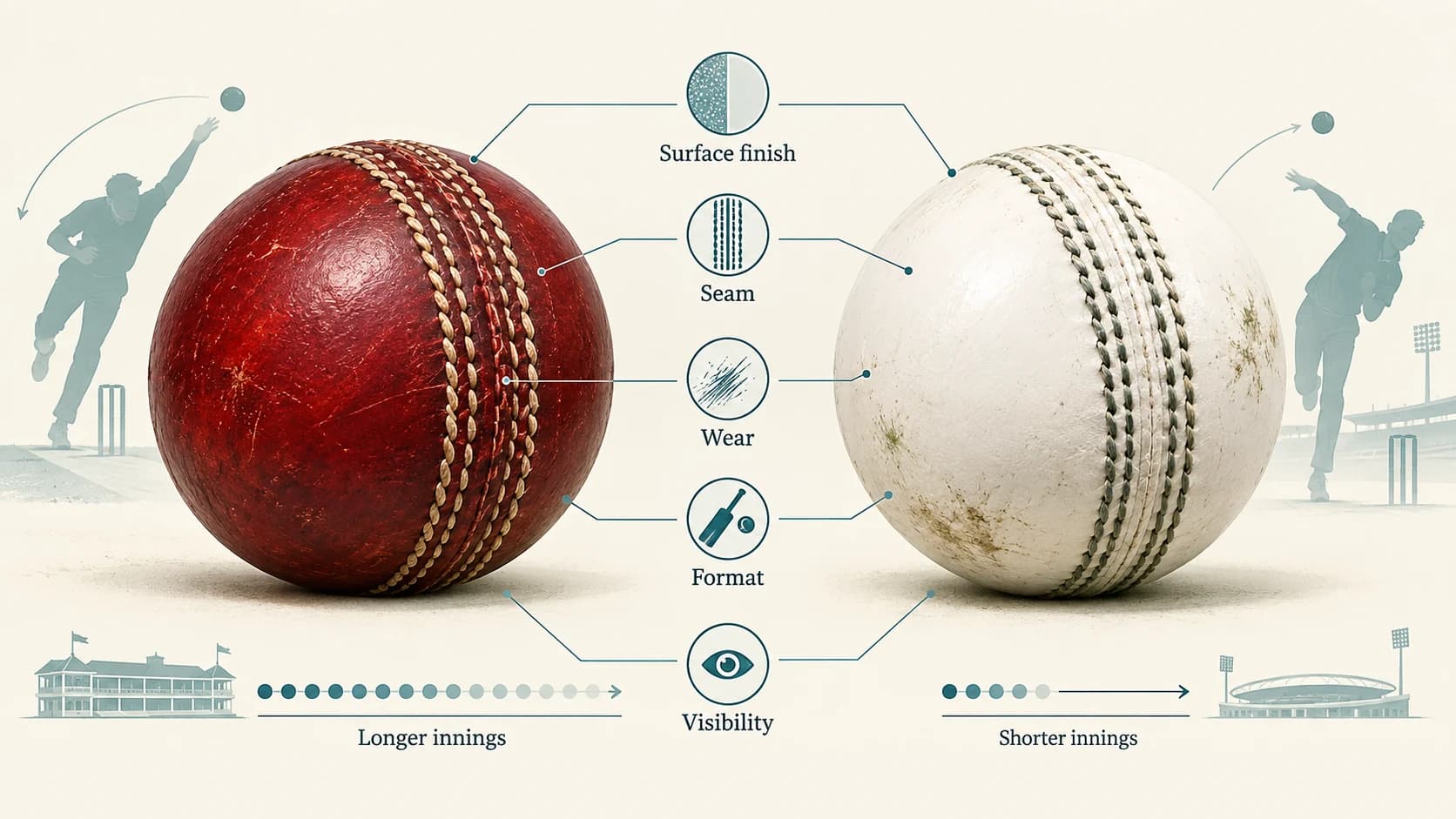
Why White Balls Can Age Differently From Red Balls
Colour is not the only difference between match balls.
Manufacturers can use different:
- leather treatments,
- lacquer,
- stitching,
- seam geometry.
The 2024 Cambridge review notes that Kookaburra, Dukes and SG balls are lacquered when new but can have different seam geometries and surface details.
Those differences can change:
- how long the shine lasts,
- how quickly the seam wears,
- when certain aerodynamic regimes appear.
That is why statements such as:
“The ball stops swinging after 15 overs”
should always be treated cautiously.
Which ball?
Which pitch?
Which outfield?
Which weather?
Which bowler?
There is no single ageing timetable.
What Happens If the Ball Becomes Damaged or Lost?
The fielding team does not automatically receive a brand-new replacement.
MCC Law 4 says that if a ball is lost or becomes unfit for play through normal use, the umpires replace it with one that has comparable wear to the previous ball.
That makes sense.
Replacing a 55-over-old ball with a brand-new one would fundamentally change the contest.
The aim is to restore a usable ball without giving either side an artificial new-ball advantage.
Why Ball Tampering Matters So Much
Once you understand how strongly surface condition affects movement, the seriousness of ball tampering becomes clearer.
Changing the surface deliberately outside the permitted methods can alter the aerodynamic properties of the ball.
That is why the Laws tightly control what fielders may do.
They may legally:
- polish using sweat and clothing,
- remove mud under umpire supervision,
- dry a wet ball using an approved cloth.
They may not deliberately damage the ball or use unauthorized substances to alter its condition.
The distinction exists because natural wear is part of cricket strategy; artificial alteration is not.
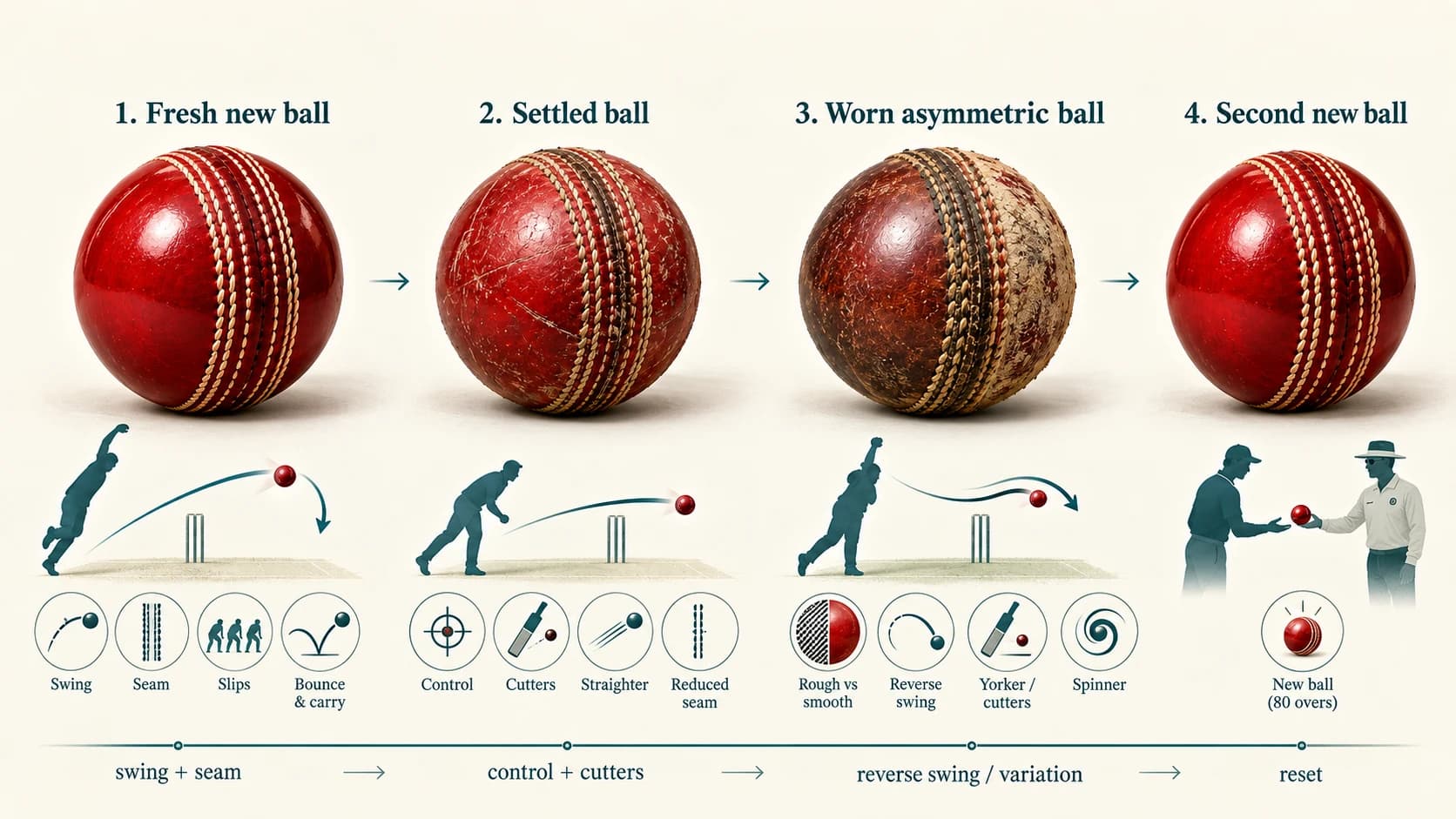
The Ball Is Constantly Moving Through Different “Lives”
A useful way to think about a long innings is not:
new ball → progressively worse ball.
It is:
Phase 1 — Fresh new ball
Useful for:
- conventional swing,
- seam,
- bounce,
- carry.
Phase 2 — Settled ball
The shine and seam begin fading.
Batting may become more comfortable.
Bowlers increasingly rely on control and changes of pace.
Phase 3 — Worn asymmetric ball
If maintained well and bowled under suitable conditions:
- reverse swing may appear,
- cutters can become useful,
- spinners may become more important.
Phase 4 — Second new ball
In multi-day cricket, the captain can eventually reset the cycle with a new ball.
That changing life cycle is one reason Test cricket can feel like several different games inside the same innings.
The Ball Changes, So the Strategy Changes
The deepest point is that a cricket ball is not passive equipment.
Its changing condition is part of the contest.
A new ball rewards one set of skills.
An old ball can reward another.
The fielding team tries to preserve useful characteristics legally.
The batter constantly reassesses what the ball is doing.
The captain decides when to change bowlers and, in long-form cricket, when to take the next new ball.
The same bowler may therefore have two completely different jobs.
With the new ball:
keep the seam stable and search for conventional swing.
With the old ball:
attack the rough-ball conditions, use cutters or search for reverse swing.
And the batter may move from:
survive the moving new ball
to:
watch for a reversing yorker.
That is why the age of the ball appears so often in cricket commentary.
“40 overs old” is not just a number.
It is shorthand for the changing physics of the object that every delivery depends on.