
Encryption, Hashing and Digital Signatures at Awareness Level
Encryption, Hashing and Digital Signatures at Awareness Level. Foundational Computer Awareness explanations, examples and explained practice questions for banking and recruitment exam preparation.
By Akhilesh Saini
Learning objectives
Distinguish encryption, hashing and digital signatures; recognize public-key versus symmetric-key ideas; and identify which mechanism mainly protects confidentiality, integrity or authenticity.
Three often-confused security operations
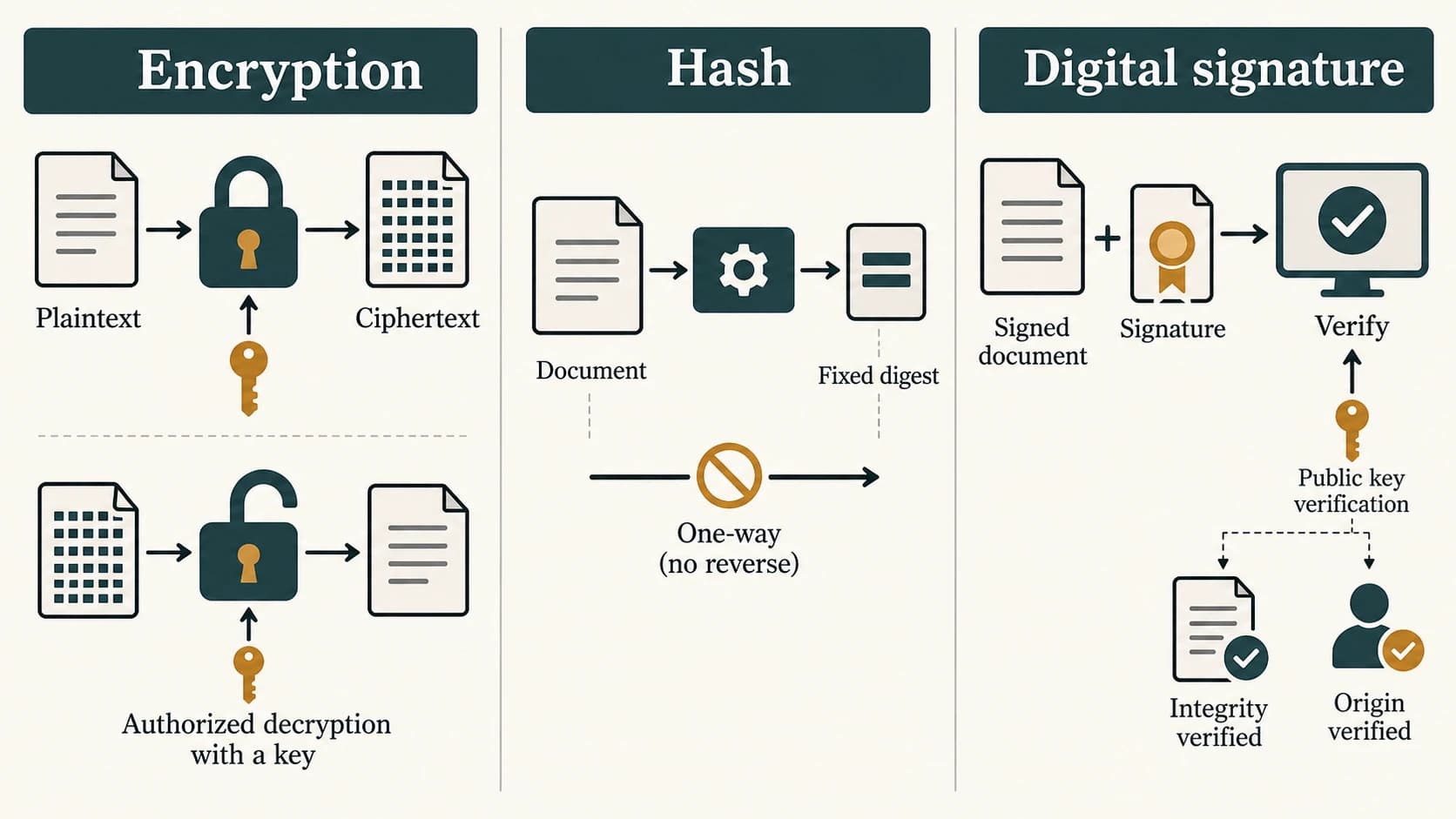
Encryption transforms readable information (plaintext) into an unreadable representation (ciphertext) using a cryptographic algorithm and appropriate key. Authorized parties with the correct key can decrypt it. Encryption helps provide confidentiality against parties who lack that key. It does not automatically prove that the sender is honest or that no malware exists on an unlocked device.
Hashing takes an input and computes a fixed-size output (a hash or message digest for a fixed algorithm). Cryptographic hashes are designed to make it computationally difficult to reconstruct an original arbitrary input from its digest or find differing inputs with the same digest. Hashing is not reversible encryption. A hash can help check whether data changed, but a plain hash transmitted alongside a file does not necessarily authenticate who supplied it.
A digital signature uses cryptography to demonstrate that a message was signed using a particular private signing key and that signed content has not been altered since signing. Someone checks a signature using a corresponding public verification key. Trust in the signer’s real-world identity also depends on how keys/certificates are verified and protected. Signatures mainly support authenticity and integrity, not confidentiality by themselves.
| Concept | Basic operation | Common security goal | Key exam caution |
|---|---|---|---|
| Encryption | Plaintext → ciphertext → authorized decryption | Confidentiality | Encrypted content can still be fraudulent |
| Hashing | Any data → digest | Integrity checking / secure constructions | Hash is not normally decrypted |
| Digital signature | Private key signs; public key verifies | Origin authenticity and integrity | A valid signature does not automatically prove content is true |
Symmetric and asymmetric encryption
With symmetric-key encryption, both ends use the same secret key (or closely related secret material) to encrypt and decrypt. It is widely used for efficient protection of stored or transmitted information. With asymmetric/public-key cryptography, operations involve a mathematically related public key and private key. Public-key schemes can support encryption, key establishment or digital signatures, but they do not all perform those jobs identically. It is inaccurate to say every public-key algorithm always encrypts data 'using the public key' in the same way.
In typical digital-signature teaching models, the signer uses a private key and the verifier uses the matching public key. Certificates help bind public keys to an identified subject through a trust process. A certificate is not proof that every claim on a website is honest.
Encryption in transit and at rest
Encryption in transit protects data while moving between endpoints, typically via protocols such as HTTPS using TLS. Encryption at rest protects stored data such as a device drive or cloud storage volume, subject to proper key and access management. Both are valuable; neither guarantees security if a user’s password, device or session is compromised.
An HTTPS lock indicator chiefly indicates a protected connection to the server identity presented by the connection; it is not an endorsement of a shop, investment scheme or message. A fraudulent site can also use HTTPS.
Worked examples
Example A — Confidential statement transfer: A customer views a banking statement through an HTTPS session. Encryption helps protect contents on the network, but the customer must still confirm the site/app is legitimate.
Example B — File verification: A published installer has a SHA-256 checksum on the vendor's independently authenticated page. A matching checksum may detect accidental or unauthorized modification relative to that trusted value; copying the digest from the same malicious source does not establish authenticity.
Example C — Signed document: A verifier confirms a digital signature against a trusted public key/certificate. This supports integrity and origin; it does not alone establish that the statements within the document are factually correct.
Exam facts
| Clue | Answer |
|---|---|
| Readable message before encryption | Plaintext |
| Encoded result of encryption | Ciphertext |
| Reverse encryption with key | Decryption |
| Same shared secret key | Symmetric encryption |
| Public/private key pair | Asymmetric cryptography |
| One-way fixed-length digest | Cryptographic hash |
| Sign with private, verify with public | Digital signature (common model) |
| HTTPS typically protects data via | TLS |
Common confusions and exam traps
- Hashing ≠ encryption: Hashes are not restored to original plaintext by a decryption key.
- Digital signature ≠ handwritten image of a signature: Cryptographic signatures are verified computationally.
- Signature ≠ secrecy: Signed contents can remain readable.
- Encrypted ≠ safe from every attack: Malware on an endpoint may access unlocked or decrypted information.
- HTTPS ≠ trustworthy business: Connection protection is separate from honesty.
Quick revision
- Encryption protects confidentiality through keys.
- Hashing produces a digest, not encrypted plaintext.
- Digital signatures provide evidence about origin/key possession and integrity.
- Symmetric uses shared secret material; asymmetric involves public/private keys.
- HTTPS/TLS protects connections, not the truthfulness of website content.
Practice questions — CA-09-05
1. Readable data before encryption is called:
A. Ciphertext
B. Plaintext
C. Salt
D. Checksum
2. The mainly intended result of encryption is:
A. Confidentiality against parties without the key
B. Guaranteed factual accuracy
C. Automatic malware removal
D. Internet bandwidth increase
3. Which statement describes a cryptographic hash?
A. It is always decrypted by the same key
B. It copies the whole document verbatim
C. It creates a digest rather than reversible ciphertext
D. It necessarily authenticates the author
4. In a typical digital signature, the signer uses the:
A. Receiver’s password
B. Public website URL
C. Firewall key
D. Private signing key
5. A typical digital signature is verified with:
A. The corresponding public key
B. A spreadsheet formula
C. An OTP shared publicly
D. A browser cookie
6. Which two goals are directly supported by a correctly verified digital signature?
A. Confidentiality and compression
B. Integrity and origin authenticity
C. Backup and restoration
D. Internet speed and privacy
7. Using one shared secret for encryption and decryption is:
A. Asymmetric only
B. Phishing
C. Symmetric encryption
D. File hashing
8. HTTPS protects web connections primarily using:
A. QR codes
B. Password files
C. ZIP archives
D. TLS
9. Which statement is correct about a padlock/HTTPS icon?
A. It does not by itself prove a website’s business claims are honest
B. It certifies guaranteed investments
C. It means the site is free of malware
D. It reveals the site’s private key
10. A digest downloaded from the same malicious source as an installer always proves authenticity. True?
A. Yes, always
B. No, the reference digest also needs a trustworthy source
C. Only for images
D. Only after restarting
11. Which is a good example of encryption at rest?
A. Using a search engine
B. Copying a link
C. Full-disk encryption on a laptop
D. Sorting a spreadsheet
12. Which claim is incorrect?
A. Hash functions can help detect alteration
B. Encrypted data requires key management
C. Signatures can be verified with public keys
D. Digital signatures automatically keep a document secret
Answers and explanations — CA-09-05
1. B — Plaintext. Plaintext is the readable input to an encryption process.
2. A — Confidentiality against parties without the key. Encryption conceals content from parties that cannot decrypt it.
3. C — It creates a digest rather than reversible ciphertext. A cryptographic hash maps input to a digest and is not reversible encryption.
4. D — Private signing key. The signer generates a signature using their own protected private key.
5. A — The corresponding public key. Public verification keys allow checking signatures made by corresponding private keys.
6. B — Integrity and origin authenticity. Digital signatures detect alterations and tie a message to signing-key possession, subject to key trust.
7. C — Symmetric encryption. Symmetric algorithms use shared secret key material for both encryption and decryption.
8. D — TLS. HTTPS commonly uses TLS to secure communication between browser and server.
9. A — It does not by itself prove a website’s business claims are honest. TLS protects the connection but does not establish the truthfulness of content.
10. B — No, the reference digest also needs a trustworthy source. An attacker may alter both the file and a displayed checksum; independent trust matters.
11. C — Full-disk encryption on a laptop. Full-disk encryption protects stored data when appropriately configured and locked.
12. D — Digital signatures automatically keep a document secret. Signatures do not inherently encrypt the message or conceal its contents.