How Can AI Generate an Image in Seconds?
Learn how AI turns a text prompt into an image using text encoding, latent representations, diffusion or flow models, GPUs and iterative generation.
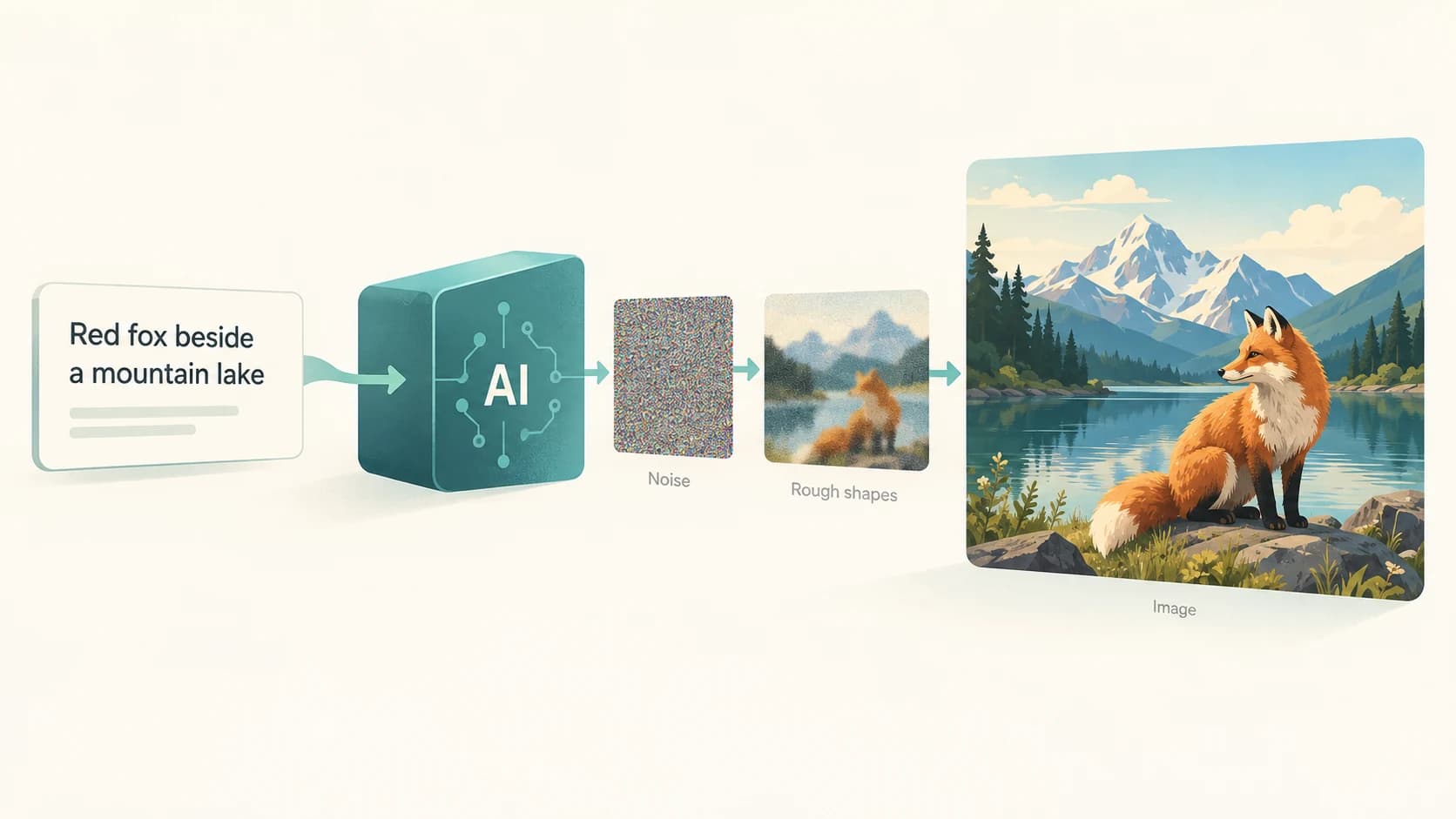
Type:
A small red fox sitting beside a mountain lake at sunrise, painted in watercolor.
Press Generate.
A few seconds later, a complete image appears: fox, mountains, reflections, clouds, lighting, colours and a convincing watercolor texture.
No artist painted it during those few seconds. The system did not need to photograph a fox, search the web for that exact scene or manually draw millions of pixels one at a time.
Instead, most modern AI image generators perform the expensive learning long before you enter your prompt.
During training, a model learns mathematical relationships between language and visual patterns. When you later request an image, it uses those learned parameters to construct a new visual result through a process called inference.
Many influential image generators have used diffusion: they begin with noise and progressively transform it into something resembling the prompt. Newer systems also use related approaches such as flow matching, diffusion transformers and other architectures, so there is no single pipeline shared by every AI image generator. NVIDIA's current documentation, for example, describes modern text-to-image systems using transformer-based diffusion models trained with flow matching, while classic diffusion models generate by repeatedly denoising a noisy starting point.
The surprising part is not merely that AI can create an image.
It is that billions of calculations can now be compressed into a short enough process that the result feels almost immediate.
The Hard Work Happened Before You Typed Anything
Suppose you ask for:
A yellow bicycle leaning against a brick wall on a rainy evening.
The image model already needs some understanding of relationships such as:
- what bicycles generally look like
- what "yellow" means visually
- the texture and structure of brick walls
- what rain does to surfaces
- what evening lighting looks like
- what "leaning against" implies spatially
It did not learn those concepts from your prompt.
They were learned during training.
Training exposes a model to large amounts of visual and textual information and adjusts enormous sets of numerical parameters so that the network becomes better at representing relationships between visual content and language.
Systems such as Google's Imagen demonstrated the importance of combining strong text understanding with image-generation models. Imagen used a large language encoder to transform prompts into text embeddings that could guide a diffusion model toward images matching the description.
Training can be extraordinarily computationally expensive.
Generating your individual image is different.
At that point, the model is not learning visual concepts from scratch. It is using what was learned previously.
That phase is inference.
It is similar to the difference between spending years learning to draw and then producing one drawing. The learning is expensive; using the learned skill is comparatively quick.
Step 1: The System Has to Understand Your Prompt
Before an image can be generated, your text has to become something a neural network can process mathematically.
Consider:
A black cat sleeping on a green velvet chair beside a window.
The generator needs to preserve several relationships:
- the animal is a cat
- the cat is black
- it is sleeping
- the chair is green
- the chair has a velvet-like appearance
- the cat is on the chair
- the chair is beside a window
A text encoder converts the language into numerical representations called embeddings.
An embedding does not look like the sentence.
It is a collection of numbers that captures information useful to the model about concepts and relationships in the prompt.
Research systems have taken different approaches. Imagen, for example, used a pretrained T5 language encoder, while image-text systems such as CLIP demonstrated that neural networks can learn strong connections between natural-language descriptions and visual concepts by learning from image-text pairs.
Modern commercial systems may use different encoders or multimodal architectures, and their full internal designs are not always public.
The important principle remains:
Your words have to become mathematical conditioning information that can influence image generation.
The AI Is Not Usually Searching for a Matching Picture
A common mental model goes like this:
You type "fox near a lake," and the AI searches its training collection for a fox photograph and a lake photograph, combines them, and returns the result.
That is not a good description of how a generative model normally works.
The trained model contains learned parameters, not simply a searchable folder containing every training image.
During generation, those learned parameters define how the model transforms a starting representation into an image that statistically fits the requested concepts.
Research on diffusion models shows that these models can generate novel samples rather than merely reproduce exact training images, although questions about memorization and training-data similarity remain important areas of research. Google's recent work, for example, studies why diffusion models can interpolate across learned visual structure to generate novel outputs.
So the model is better understood as having learned patterns of visual structure, not as performing ordinary image retrieval.
Step 2: Generation Needs a Starting Point
How do you create a picture that did not exist before?
In classic diffusion systems, the answer is wonderfully strange:
Start with noise.
Imagine a rectangle containing nothing but random coloured or grayscale static.
No cat.
No mountain.
No chair.
Just randomness.
During diffusion-model training, the system learns how images behave as progressively more noise is added to them.
It then learns approximately the reverse operation: given a noisy representation, what changes would move it toward something more like a real image?
The original Denoising Diffusion Probabilistic Models research formalized this family of generative models, and later work substantially improved their quality and efficiency.
During generation, the process is reversed.
Conceptually:
Random noise
↓
Slightly less random structure
↓
Rough shapes appear
↓
Objects become recognizable
↓
Textures and details improve
↓
Finished image
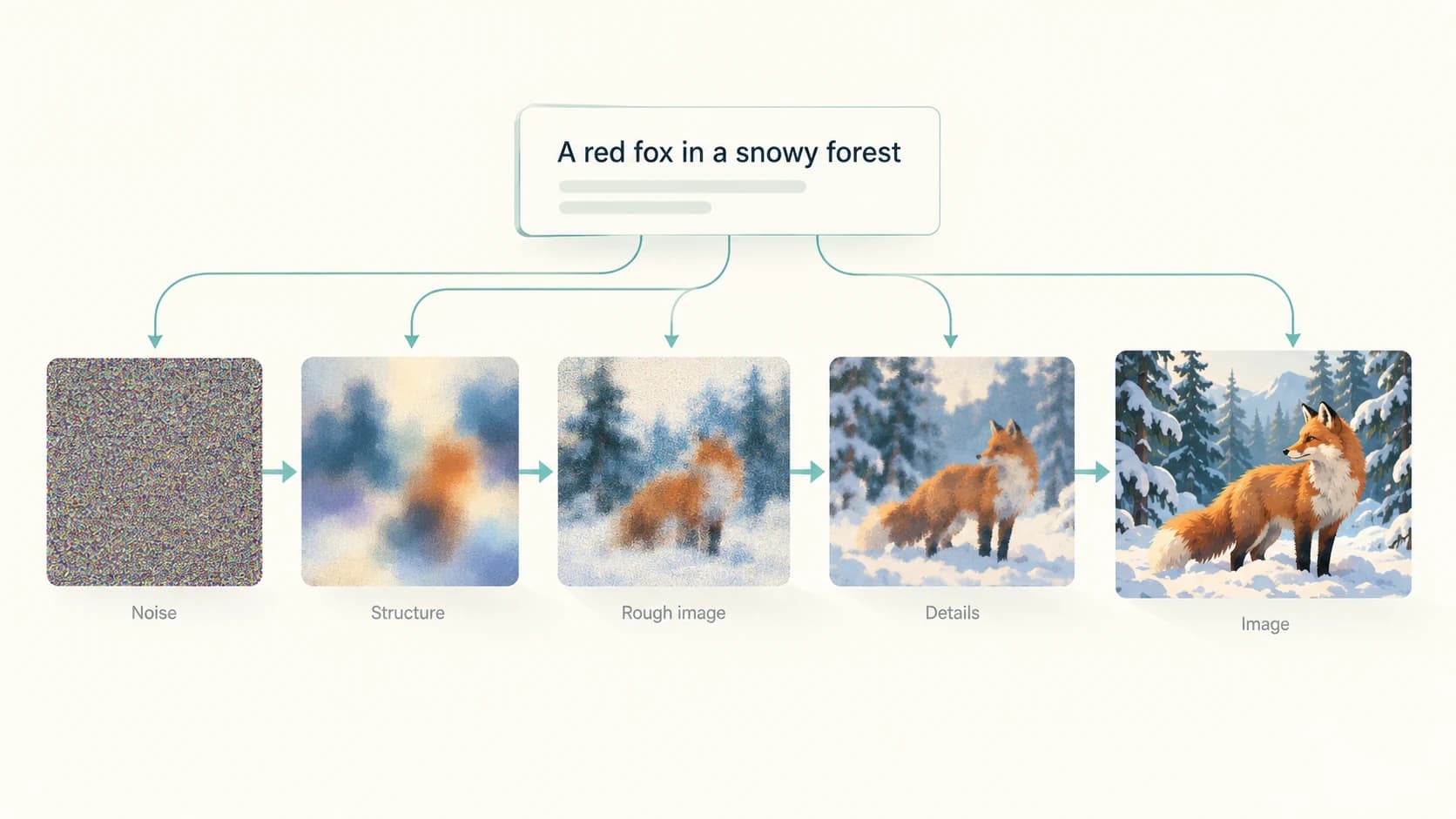
The prompt guides this transformation.
Without conditioning, the system might generate any plausible image.
With:
a black cat sleeping on a green velvet chair
the generation process is pushed toward visual structures consistent with that description.
It Does Not Necessarily Work Directly on Full-Resolution Pixels
Generating a 1024 × 1024 RGB image directly means dealing with more than three million colour values.
Doing all of the model's heavy computation directly on those pixels can be expensive.
A major breakthrough was latent diffusion.
Instead of performing the entire generation process in the full pixel image, a model can first represent images in a smaller, compressed numerical space called latent space.
A pretrained encoder learns how to compress an image into this representation.
Generation happens largely in the latent representation.
A decoder later transforms the finished latent representation back into pixels.
The 2021 Latent Diffusion Models paper showed that carrying out diffusion in this compressed space could significantly reduce computational requirements while retaining high-quality image synthesis.
A simplified pipeline becomes:
Prompt
↓
Text representation
↓
Random latent noise
↓
Iterative generation in compressed latent space
↓
Decode latent representation
↓
Final image
This is one of the reasons powerful image generation became practical on much more accessible hardware.
What Is Actually Happening During Denoising?
Calling the process "removing noise" can create another misconception.
The AI does not know that a finished fox image is secretly hidden inside the random static and simply clean it until the fox becomes visible.
There was no fox hidden there.
At each generation step, the trained neural network estimates how the current noisy representation should change to become more consistent with the distribution of images it learned during training—and, for text-to-image generation, more consistent with your prompt.
NVIDIA describes this intuitively as repeatedly applying a trained denoiser to random noise so that meaningful structure gradually emerges.
At early stages, the model may determine broad structure:
- where the subject is
- approximate composition
- large colour regions
- viewpoint
Later stages can refine:
- object boundaries
- facial details
- textures
- shadows
- reflections
- small visual features
The process is iterative.
But it no longer necessarily requires hundreds or thousands of slow steps.
Modern Image Generators Do Not All Use Classic Diffusion
The field is changing quickly.
One important development is the Diffusion Transformer, or DiT.
Earlier diffusion systems often relied heavily on convolutional architectures such as U-Nets.
The DiT research showed that transformers could instead operate over patches of latent image representations and scale effectively for diffusion-based generation.
Another development is flow matching.
Rather than describing generation solely as reversing a traditional diffusion process, flow-matching methods learn a vector field that transports samples from a simple starting distribution such as noise toward the data distribution.
The original Flow Matching research showed that these paths could provide efficient training and sampling, including paths that are not identical to conventional diffusion trajectories.
Current NVIDIA documentation lists modern text-to-image architectures such as FLUX and Qwen-Image using Diffusion Transformers with flow matching.
So the familiar explanation:
"AI image generators start with noise and remove it step by step"
is still useful.
But it should be treated as an intuitive explanation for an important family of systems, not as a universal description of every current or future image generator.
How Does the Prompt Keep Influencing the Picture?
If the system is transforming noise, what stops it from eventually producing a random dog instead of the fox you requested?
The text conditioning remains involved during generation.
The image-generating network can use attention mechanisms that connect visual representations with the encoded prompt.
For example, if the prompt contains:
red umbrella on a snowy street
the model has to coordinate concepts such as:
red
with:
umbrella
and:
snowy
with:
street
rather than randomly colouring everything red.
Latent Diffusion Models introduced cross-attention mechanisms that allowed diffusion generation to be conditioned flexibly on information such as text.
Other architectures implement conditioning differently, but the goal is similar:
keep the developing image aligned with the user's instructions.
Guidance methods can strengthen this connection further.
Classifier-free guidance, for example, became an influential technique for steering conditional diffusion generation and balancing prompt adherence against image diversity.
Why Do Two Generations From the Same Prompt Look Different?
Try the same image prompt twice and you may get two different results.
That is often intentional.
Generation typically contains a source of randomness.
In a diffusion-style system, different random starting noise—or a different seed—can lead to a different final image even when the text prompt is unchanged.
Think of the prompt as defining a region of possible answers rather than one exact picture.
A medieval castle on a cliff at sunset
does not specify:
- the exact shape of the castle
- number of towers
- direction of the cliff
- cloud positions
- exact camera angle
- precise texture of every stone
Many images satisfy the request.
Randomness lets the system explore those possibilities.
This is why AI image generation can produce variations without the user rewriting the prompt.
How Does the Rough Image Become High Resolution?
Different systems handle this in different ways.
Some models generate directly at their target resolution.
Others generate a lower-resolution or compressed representation and then increase detail.
Google's original Imagen architecture, for example, first generated a 64 × 64 image and then used additional text-conditioned super-resolution diffusion models to increase it to 256 × 256 and finally 1024 × 1024.
Latent-generation systems instead may produce a compressed representation that a decoder reconstructs at the final image resolution.
There can also be additional processing for:
- upscaling
- sharpening
- colour conversion
- transparency
- format encoding
- safety or provenance systems
Again, the exact pipeline depends on the product.
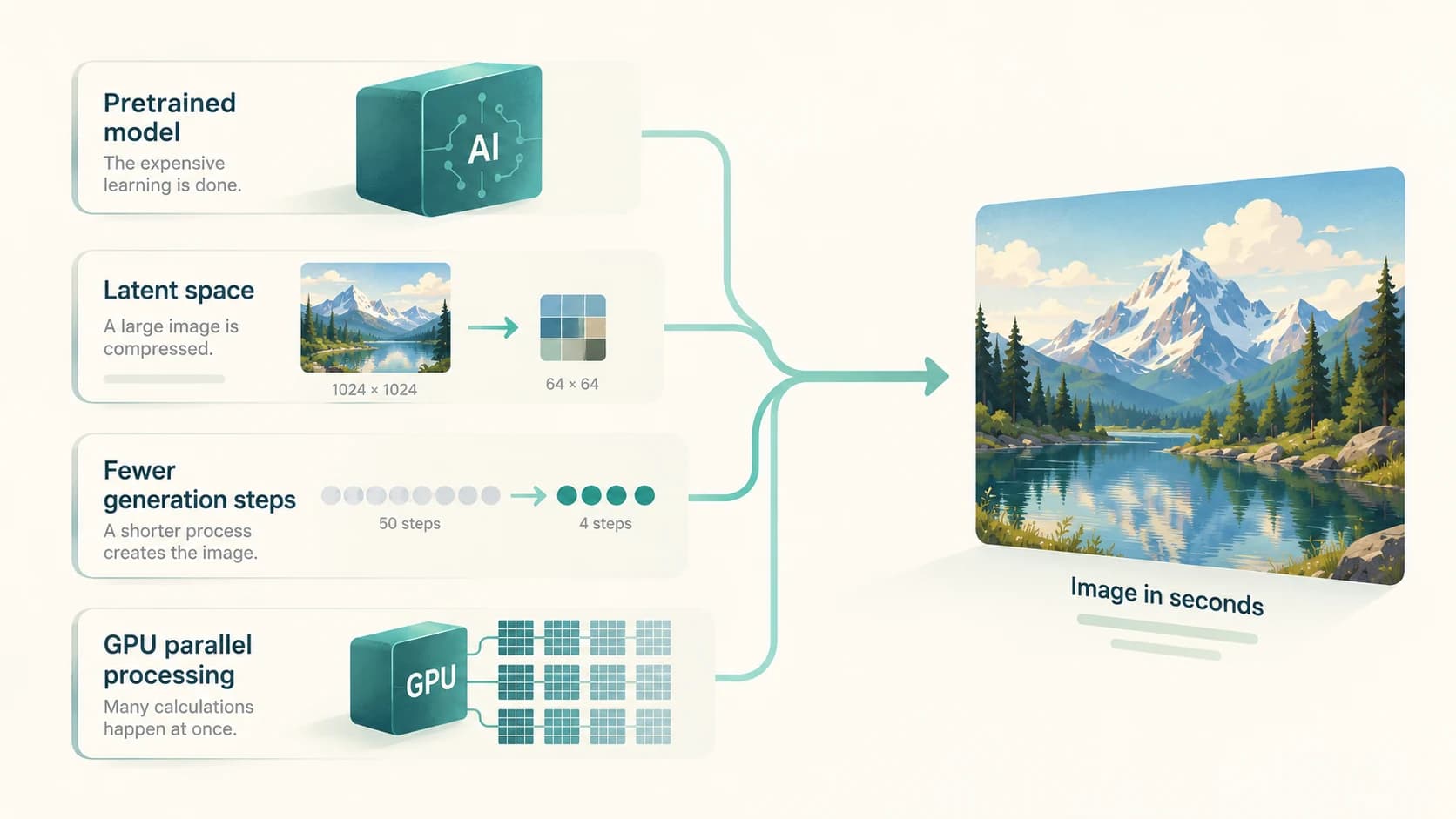
So How Can All of This Happen in Seconds?
At first glance, repeatedly running a huge neural network sounds slow.
Historically, it was.
Several developments changed that.
The model is already trained
The expensive learning stage has already happened.
You are performing inference, not training an image model from scratch.
Much of the computation can happen in latent space
Latent diffusion dramatically reduced the amount of information that needed to be processed compared with operating directly on every full-resolution pixel throughout generation.
Modern samplers require fewer model evaluations
Early diffusion approaches could need very large numbers of denoising evaluations.
Research subsequently reduced the number dramatically. OpenAI's Improved Diffusion work, for example, demonstrated sampling with roughly an order of magnitude fewer forward passes in its setting while preserving image quality. NVIDIA has also documented modern diffusion design improvements reducing sampling to tens rather than hundreds of model evaluations in some systems.
New architectures aim for straighter or shorter generation paths
Flow-matching and related methods can make sampling more computationally efficient, and researchers continue developing models capable of high-quality output with very few steps.
GPUs perform huge numbers of calculations in parallel
Neural networks rely heavily on matrix operations.
GPUs are designed for massive parallel computation and are well suited to AI inference. NVIDIA identifies parallel processing as one of the central reasons GPUs are effective for machine-learning workloads.
Inference software is heavily optimized
Techniques such as lower-precision computation, quantization, optimized kernels and specialized inference engines can reduce memory use and generation time.
For example, NVIDIA reported in 2025 that TensorRT optimizations and FP8 quantization could roughly double Stable Diffusion 3.5 performance in its tested configurations while reducing VRAM requirements. That is a product-specific benchmark rather than a universal figure, but it illustrates how much engineering occurs after the AI model itself has been designed.
Put all of those improvements together, and a process that once required impractical amounts of computation can become an interactive product.
Why Does Higher Quality Sometimes Take Longer?
Image generators often expose choices such as:
- fast
- standard
- high quality
- more inference steps
- larger resolution
Those settings involve trade-offs.
More computation can allow the model to refine a generation more carefully.
Higher resolution means more visual information must eventually be produced.
A larger model may understand instructions better but require more calculations.
Some providers therefore offer different models for different priorities. OpenAI's current image API, for example, distinguishes image-generation models optimized for speed from models optimized more strongly for quality and editing precision.
There is no universal rule that a slower generation must look better.
But quality, latency, memory use and computing cost are closely connected engineering decisions.
Why Does AI Sometimes Get Hands, Text or Objects Wrong?
An AI image generator does not explicitly build a physically perfect 3D world and then photograph it.
It generates visual structure that its learned model considers plausible.
This can fail in subtle ways.
A hand has many articulated parts that can appear from countless angles.
Written text requires exact symbol ordering.
A bicycle requires consistent geometry between wheels, frame, pedals and handlebars.
A reflection has to agree with the scene around it.
Small inconsistencies in the model's representation can therefore produce:
- extra fingers
- malformed objects
- inconsistent reflections
- impossible geometry
- incorrect text
- duplicated details
Modern models have improved significantly on many of these tasks, but image-generation research continues to document problems with artifacts, compositional errors and prompt alignment.
The image can look globally convincing while containing details that do not survive close inspection.
What Happens When You Edit an Existing Image With AI?
The process changes slightly when you provide an image rather than starting entirely from scratch.
The system now has an additional source of conditioning:
the existing image.
Depending on the architecture and task, the image can be encoded into an internal representation and partially transformed while the prompt specifies what should change.
For example:
Keep the person and room unchanged, but replace the blue sofa with a green leather sofa.
The generator has to preserve much of the existing visual structure while modifying a selected concept.
Diffusion-based image-to-image research has shown that the same general generative framework can support tasks such as inpainting, uncropping, restoration and other controlled transformations.
Current commercial systems increasingly combine generation and editing in the same conversational workflow. OpenAI's current image-generation API, for example, accepts both text prompts and image inputs for generation and editing.
The Whole Process in One View
A simplified modern text-to-image pipeline looks like this:
1. You enter a prompt
A glass greenhouse in a snowy forest at night.
↓
2. The prompt is encoded
Language becomes numerical representations that capture visual concepts and relationships.
↓
3. The generator receives a starting representation
Often noise or another simple latent starting point.
↓
4. The model progressively constructs visual structure
Diffusion, flow-based or related generative calculations transform the representation.
↓
5. The text keeps guiding generation
Attention and conditioning mechanisms encourage the image to match the prompt.
↓
6. A final visual representation emerges
Objects, composition, lighting and texture become increasingly defined.
↓
7. The latent representation is decoded or the image is otherwise rendered
The internal representation becomes normal pixels.
↓
8. Optional refinement occurs
Upscaling, editing, post-processing or safety systems may be applied.
↓
9. The finished image is returned
All of this can happen in seconds because the difficult learning happened beforehand and the generation pipeline is running on hardware designed to perform enormous amounts of neural-network computation in parallel.
The AI has not imagined the scene in quite the way a human artist would.
Nor has it simply copied one photograph.
It has transformed your language into mathematical guidance and used a learned model of visual patterns to construct one possible image consistent with those instructions.
What appears on your screen is therefore the end of a remarkable conversion:
words → numbers → visual representation → image.