What Actually Happens After You Send a Prompt to an AI Chatbot?
Follow an AI prompt from your screen through tokenization, context, transformer processing, tools, next-token prediction and streaming back to you.
You type:
Why is the sky blue?
and press Send.
A moment later, the chatbot begins producing a fluent explanation.
It can feel as though your question travelled into a giant digital brain, the AI "thought about it," found the answer somewhere inside itself and typed it back.
The real process is both less magical and more interesting.
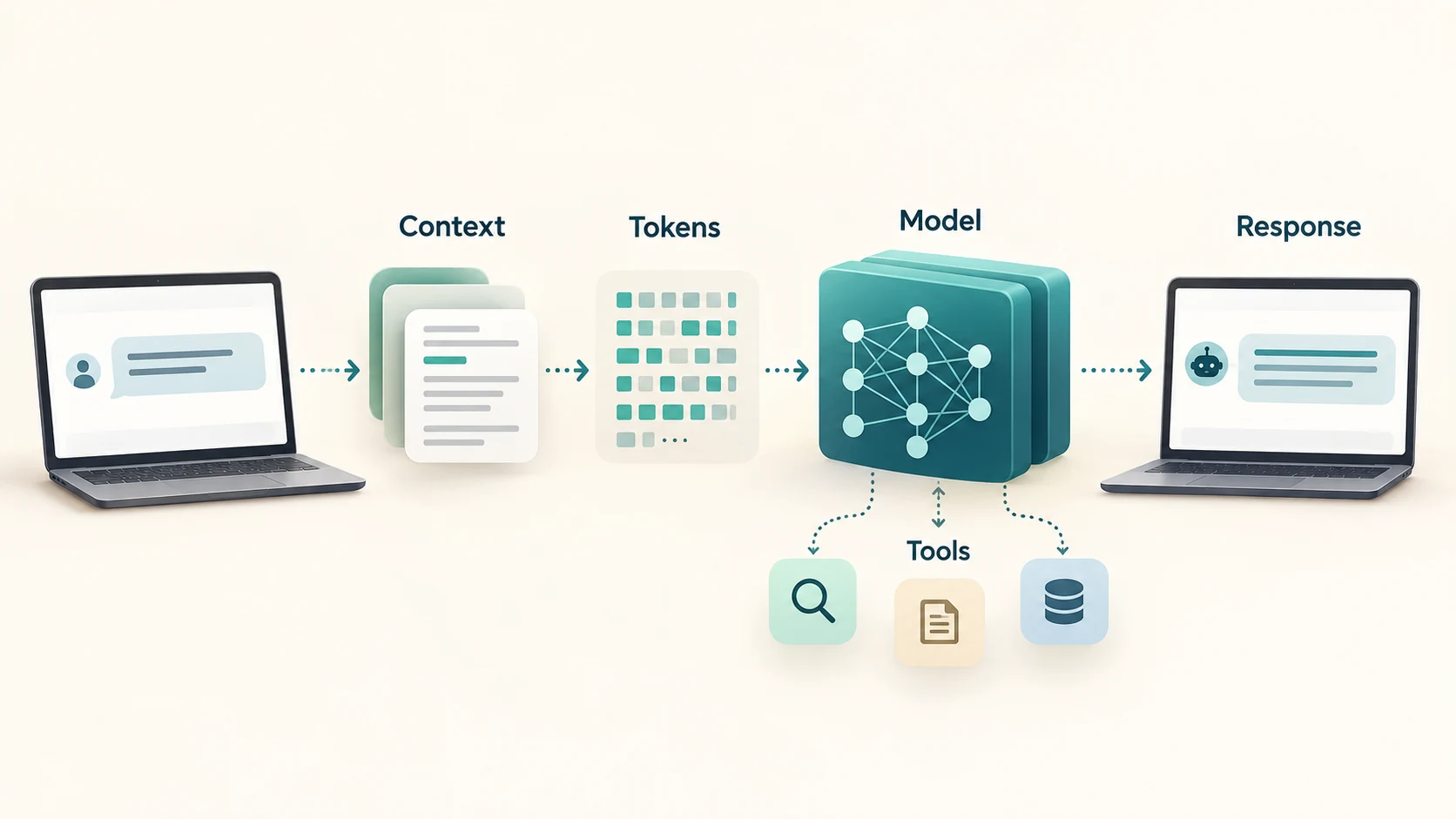
In a typical cloud-based AI chatbot, your message passes through several layers before you see a response. The application may combine your prompt with conversation history and hidden instructions, convert the text into numerical tokens, run those tokens through a large neural network, possibly use external tools such as web search or code execution, generate output token by token, apply product-level safeguards and stream the result back to your screen.
Modern chatbot products therefore consist of more than just a large language model.
The model is the component that predicts and generates.
The chatbot system around it decides what context the model receives, which tools it can access, how responses are filtered and how the final result reaches you.
Let's follow one prompt through that process.
Step 1: Your Message Leaves the Chat Interface
When you press Send in a cloud-based chatbot, the application creates a request containing your input.
That request may contain much more than the sentence you just typed.
Depending on the product, it can include:
- your current prompt
- earlier messages in the conversation
- instructions defining how the assistant should behave
- attached images or documents
- information returned by tools
- output-format requirements
- relevant saved or retrieved context
OpenAI's current API, for example, represents model input as items that can include user, assistant, developer and system messages, as well as images, files and tool outputs. Its documentation states that higher-priority developer or system instructions can be supplied alongside user messages.
Other AI systems organize this context somewhat differently, but the general idea is important:
The sentence you type is not necessarily the complete prompt the model eventually receives.
The chatbot application first builds the working context.
Your Previous Conversation Has to Fit Somewhere
If you ask:
What about the second option?
the model needs to know what "the second option" refers to.
That means the relevant earlier conversation has to be available somehow.
Modern models process information within a context window: the amount of input and output information the model can work with during a request.
Google describes a context window as the limited amount of information a generative model can receive and use while generating a response. Context size is measured in tokens rather than ordinary words.
For short chats, keeping the necessary context is straightforward.
For very long conversations, products may need strategies such as:
- dropping older material
- summarizing it
- retrieving only relevant earlier information
- caching repeated context
- using models with larger context windows
The details vary significantly between products.
Step 2: Your Words Become Tokens
The neural network does not directly receive your sentence as a sequence of English words.
First, the input is tokenized.
A token is a unit that the model processes.
It might represent:
- a whole word
- part of a word
- punctuation
- a single character
- another encoded unit
For example, a tokenizer might treat a familiar short word as one token while breaking a long or unusual word into several pieces.
OpenAI describes tokens as the units its models use to process text and notes that they can represent characters, word fragments, whole words or punctuation. Google gives a similar definition for generative models.
So your sentence:
Why is the sky blue?does not necessarily enter the model as:
Why | is | the | sky | blueIt becomes a model-specific sequence of token IDs.
Those IDs are numbers.
The language has now started turning into mathematics.
Step 3: Tokens Become Vectors
A token number alone does not contain enough useful information.
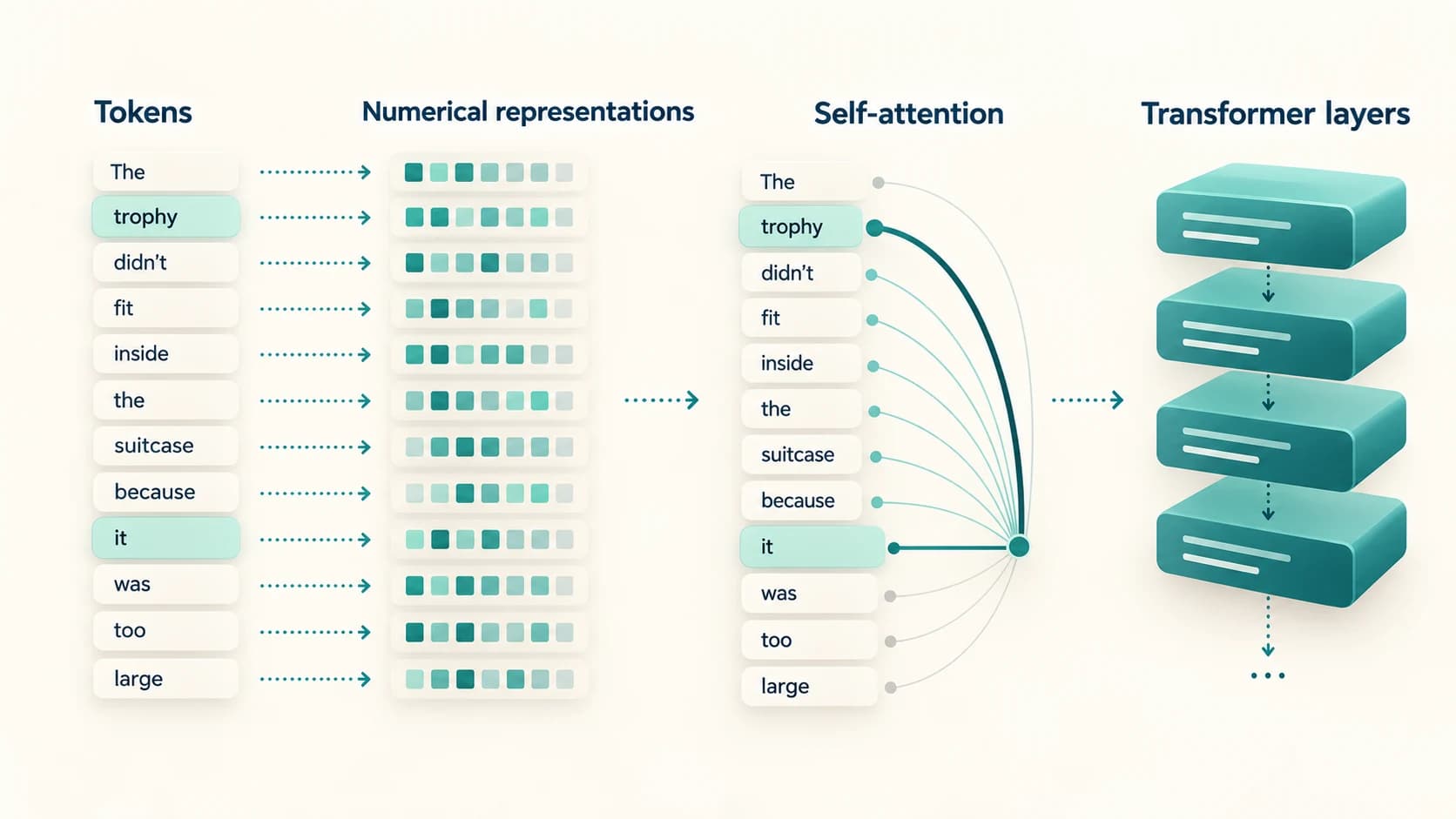
The model converts tokens into high-dimensional numerical representations commonly called embeddings.
An embedding is essentially a list of numbers representing a token in a mathematical space.
The model also needs information about where tokens appear in the sequence.
After all:
Dog bites manand:
Man bites dogcontain almost the same words but mean something very different.
Transformer models therefore combine token representations with positional information so that order can influence the computation. Google's machine-learning documentation describes transformer input as combining learned token embeddings with positional information before later layers process the sequence.
The chatbot is no longer dealing with a visible sentence.
It is processing large arrays of numbers.
Step 4: Attention Helps the Model Use Context
The architecture behind most modern large language models is based heavily on the Transformer, introduced in the 2017 paper Attention Is All You Need.
One of its most important mechanisms is self-attention.
Self-attention allows the model to calculate how strongly different tokens in the context relate to one another.
Consider:
The trophy didn't fit inside the suitcase because it was too large.
What does it refer to?
The trophy?
The suitcase?
Understanding the sentence requires considering relationships between words that may be separated from one another.
Google describes self-attention as a mechanism that allows each token to weigh the relevance of other tokens when constructing its contextual representation.
Modern models contain many attention heads and many processing layers.
As information passes through those layers, the numerical representation of each token becomes increasingly dependent on the surrounding context.
This is part of how the same word can be interpreted differently in different sentences.
The Model Does Not Search a Database for a Matching Answer
This is a common misconception.
A base language model generally is not storing a giant collection of ready-written answers such as:
Question 8,432,517:
Why is the sky blue?

Stored answer:
...
During training, the model's parameters were adjusted to capture statistical patterns and relationships in data.
At response time, those learned parameters are used to compute an output for the current context.
Google describes large language models as systems that estimate probabilities over tokens and generate sequences based on context and learned parameters.
So the model is generating a response, not normally locating one prewritten paragraph inside a database.
That distinction also helps explain why a model can sometimes produce information that sounds convincing but is incorrect.
Sending a Prompt Normally Does Not Retrain the Model
Another useful distinction is between training and inference.
Training is the expensive process in which model parameters are adjusted using large amounts of data.
Inference is what happens when an already-trained model receives input and computes an answer.
When you type a normal prompt, the prompt influences the model's current response through context.
It does not ordinarily rewrite billions of model parameters before answering you.
Google's machine-learning documentation describes prompt engineering as influencing an existing model through input without altering the model's parameters.
Whether a provider later retains conversations or uses eligible data to improve future models is a separate product and privacy-policy question.
It is not the same thing as the model learning your sentence in real time while answering it.
Step 5: The Model Predicts What Should Come Next
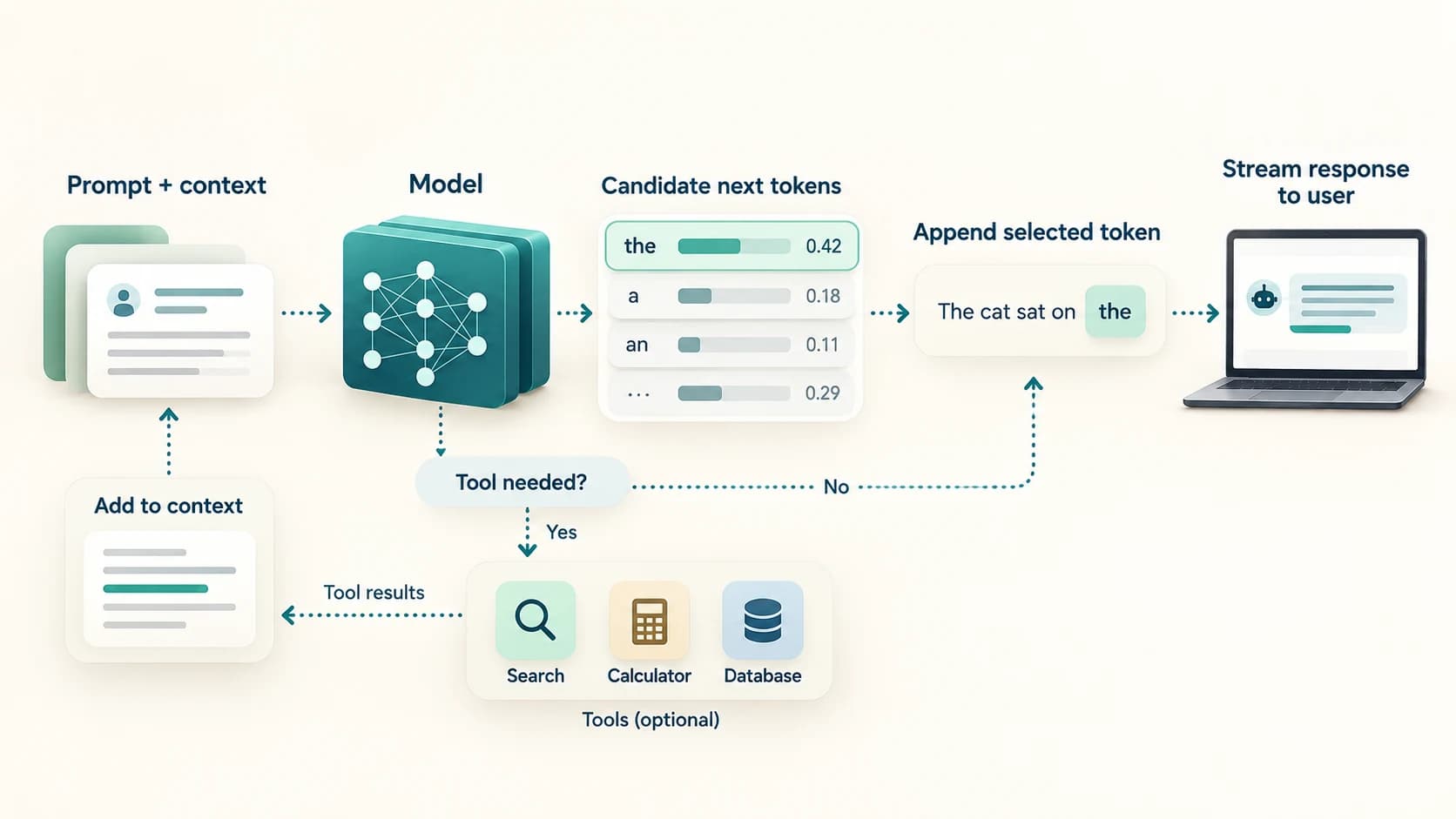
Eventually, the network produces scores for possible next tokens.
Suppose the context ends with:
The capital of France isThe model might assign high probability to a token corresponding to:
Parisand much lower probability to unrelated alternatives.
Once a token is selected, it becomes part of the context.
Then the model predicts the next token.
And the next.
And the next.
Conceptually:
Prompt
↓
Predict next token
↓
Add token to context
↓
Predict another token
↓
Add it
↓
Repeat
Google's developer documentation describes large language models as generating token sequences and explains that parameters such as temperature, top-k and top-p can influence how the next token is selected from the model's probability distribution.
That repeated prediction process can eventually produce:
- a sentence
- an essay
- computer code
- a summary
- a table
- structured data
This is why describing an LLM as "autocomplete" is not entirely wrong.
It is just an extraordinarily sophisticated form of sequence prediction operating over very large contexts with enormous learned models.
Why Doesn't the Model Always Choose the Most Likely Word?
If it always selected the single highest-probability token, responses could become overly rigid or repetitive.
Generation systems can instead sample among plausible candidates.
Parameters such as temperature, top-p and top-k can alter that process.
Google's current API documentation describes temperature as controlling randomness in token selection, while top-k and top-p restrict the candidate set from which the next token can be sampled.
This helps explain why the same prompt can sometimes produce different wording on separate attempts.
The underlying probability distribution may be similar while the exact sequence chosen differs.
But randomness is only part of the explanation.
Different model versions, instructions, conversation context, tool results and product settings can also change the answer.
Why the Answer Appears One Piece at a Time
When a chatbot's answer begins appearing before the entire paragraph has been completed, you are seeing streaming.
The server does not necessarily wait until the full response exists before sending it to your browser or app.
Generated output can be transmitted incrementally.
OpenAI's current Responses API, for example, supports server-sent streaming events containing successive text deltas while a response is being generated.
That creates the familiar effect:
The
The reason
The reason the sky
The reason the sky appears...
The interface may make it look as though the AI is typing.
Technically, the product is receiving and rendering generated pieces as they become available.
Sometimes the Model Needs Information It Does Not Have
Now consider a different prompt:
What happened in the stock market this morning?
A model relying only on knowledge learned during training may not know today's market events.
Modern AI chatbots can solve this by using tools.
A chatbot system may provide the model access to tools such as:
- web search
- databases
- file search
- calculators
- code execution
- maps
- calendars
- external APIs
Google's Gemini documentation, for example, describes built-in tools for Search, Maps, code execution, URL retrieval and file search. It also supports function calling, where the model requests that an external application execute a function and then uses the returned result.
So the process can become:
User prompt
↓
Model realizes external information is needed
↓
Tool request
↓
Search / database / calculation runs
↓
Tool result returns
↓
Result becomes additional context
↓
Model generates final answer
This architecture is extremely important.
The language model itself did not suddenly acquire access to today's internet during training.
The surrounding chatbot system gave it a way to retrieve fresh information.
Web Search Is Usually a Separate Operation
When an AI chatbot gives you a current answer based on the web, it may perform several additional steps.
Google's documentation for Search grounding describes a workflow in which the model analyzes a prompt, generates search queries when useful, processes search results and then creates a response grounded in those results.
That means:
model knowledge and retrieved knowledge are not the same thing.
A current sports score obtained from search did not have to be stored inside the model's parameters.
It can be fetched during the conversation.
The same principle applies to retrieval-augmented generation, commonly called RAG, where an application searches documents or a knowledge base and inserts relevant material into the model's context before the answer is generated.
Tool Use Can Require Several Model Passes
A complicated request may not require just one trip through the model.
Suppose you ask:
Find today's exchange rate and calculate what ₹75,000 is worth in euros.
An AI system might:
- interpret the request
- decide it needs current exchange-rate information
- use a search or financial-data tool
- receive the rate
- decide a calculation is needed
- use a calculator or code tool
- receive the result
- generate the final explanation
Google's tool documentation describes exactly this broader pattern: models can request external capabilities, receive results and then continue generating a final response.
So an answer that appears to come from "the AI" may actually be the product of several systems cooperating.
Where Do Safety Systems Fit?
There is no single universal safety pipeline used by every chatbot.
Different providers implement safeguards differently.
But modern AI products can include systems that examine:
- user prompts
- generated responses
- tool requests
- images
- suspected abuse patterns
Some may block a request.
Others may steer the model toward a safer response.
Others may filter or classify the output before it reaches the user.
OpenAI currently provides moderation systems that classify text and image inputs and can also return moderation signals for generated outputs. Its broader service-level safety systems use automated methods such as classifiers and reasoning models as part of detecting potentially policy-violating activity.
Google likewise documents built-in safety systems and configurable filtering for generated-model applications.
The exact placement of these safeguards can vary, so it would be misleading to draw one universal diagram and claim every AI chatbot follows it exactly.
Some Models Do Extra Internal Computation
Modern AI models are also increasingly capable of spending additional computation on difficult problems.
From the outside, you may simply see a longer delay before the answer appears.
Internally, some systems distinguish between visible output tokens and additional model computation used to improve the eventual answer.
OpenAI's token documentation, for example, distinguishes visible output tokens from internal reasoning tokens for models that support such processing.
Different providers implement reasoning systems differently.
The important point for a general reader is that the user-visible answer is not always the only computation taking place between the prompt and the final response.
Why Can the AI Still Hallucinate?
If the process is this sophisticated, why does an AI sometimes confidently invent something?
Because its fundamental job is to generate a plausible continuation based on the context and its learned model.
Plausibility is not automatically the same as truth.
Google's educational material explicitly lists hallucination—producing incorrect predictions or information—as a known problem of large language models.
Suppose the model has incomplete information about a rare historical event.
It still has to generate tokens.
The probability distribution may strongly favour a sentence that resembles correct historical writing even though a particular name or date is wrong.
External grounding, retrieval, tools and careful system design can reduce this problem.
They do not magically guarantee correctness.
Why Good Prompts Matter
Your prompt becomes part of the model's context.
That means instructions can change which continuation appears most appropriate.
Compare:
Explain quantum computing.with:
Explain quantum computing to a high-school student in 300 words.
Use one analogy, avoid equations, and explain what a qubit is.
The second prompt provides more constraints.
Those constraints change the context against which token probabilities are computed.
This does not mean the user is programming the model's weights.
It means the user is giving the model a better description of the response that should be generated.
That is essentially what prompt engineering does.
A Chatbot Is More Than an LLM
It is useful to picture an AI chatbot as several layers.
The interface
This is the website or app where you type.
The orchestration system
This assembles context, instructions, conversation state and available tools.
The model
This processes tokens and generates predictions.
External tools
These may provide search results, calculations, databases, files or actions.
Safety and policy systems
These may classify or constrain input and output.
The delivery layer
This streams the finished response back to your device.
The exact architecture varies, but the distinction explains why two products using similar underlying language models can behave very differently.
Their models may not be identical, of course.
But even when they are similar, everything wrapped around the model can change the user experience.
The Whole Journey of a Prompt
For a straightforward question that does not require tools, a simplified flow looks like this:
You type a prompt
        ↓
The chatbot assembles instructions and conversation context
        ↓
Text is split into tokens
        ↓
Tokens become numerical representations
        ↓
Transformer layers process relationships across the context
        ↓
The model calculates probabilities for the next token
        ↓
A token is selected
        ↓
The process repeats
        ↓
Generated text is streamed back to you
For a more complicated request, insert another loop:
Model decides it needs a tool
        ↓
Search / code / database / API runs
        ↓
Result comes back
        ↓
Model uses the new information
        ↓
Generation continues
Safety and product-level processing can happen around several parts of that pipeline.
And the whole sequence may complete in only a few seconds.
That is what is actually happening when an AI chatbot appears to answer you instantly.
Your sentence is transformed into numerical tokens, processed through billions of learned parameters, related to the surrounding context through attention mechanisms, sometimes augmented with fresh information from external systems, and then converted back into language one predicted token at a time.
The result feels like a conversation.
Underneath, it is an enormous amount of mathematics, computation and software infrastructure working together to decide one small thing repeatedly:
Given everything available so far, what should come next?