
How to Read Credit Card Terms: Fees, Interest, Rewards and Exclusions
Learn to read your Indian credit card's MITC, compare fees and interest, check cashback exclusions and calculate realistic savings before applying or renewing.
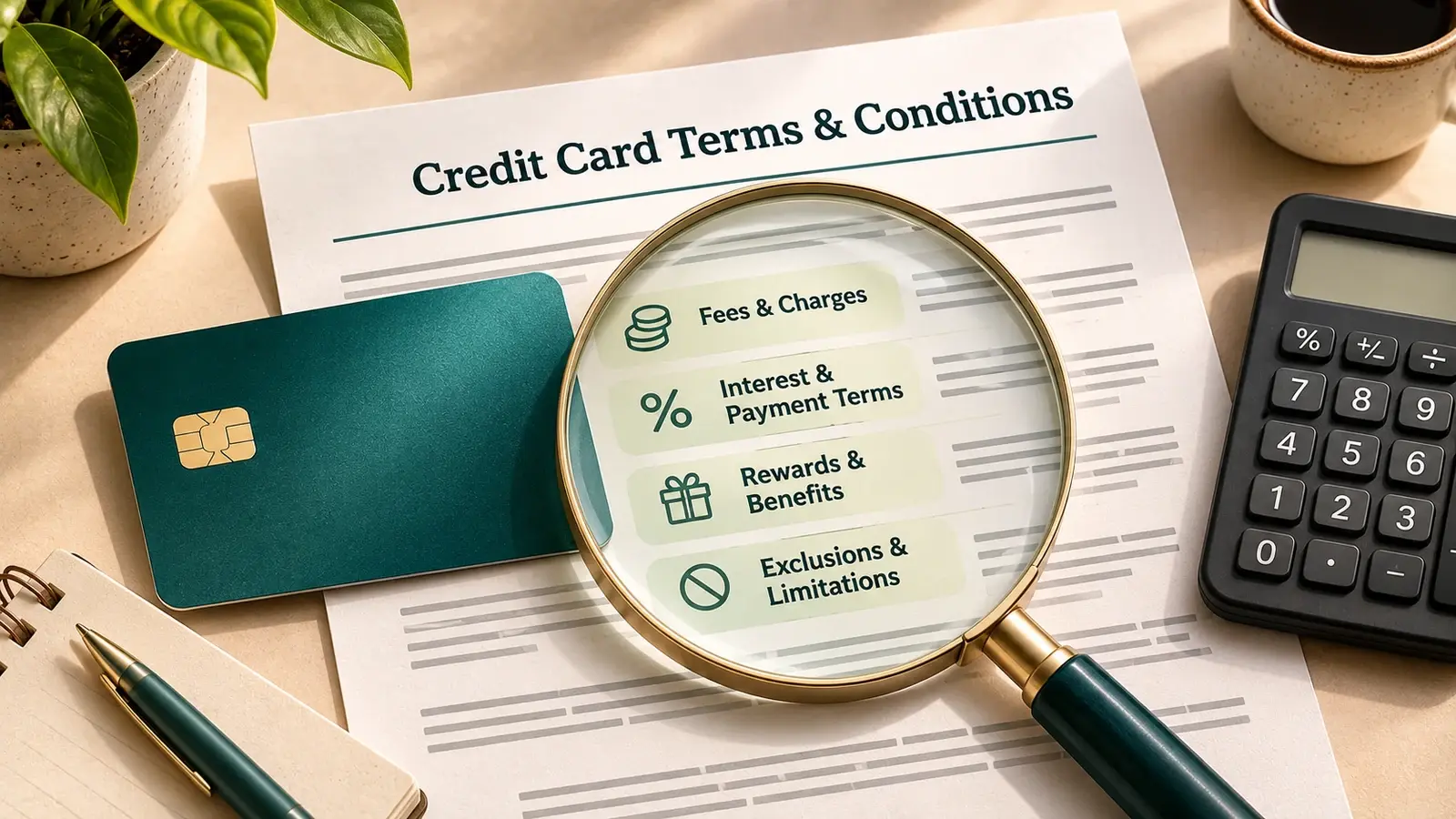
Quick Answer
Before applying for or renewing a credit card in India, check its Most Important Terms and Conditions (MITC) and separate rewards terms. Do not rely only on the advertised cashback rate or annual fee.
| Check first | What to find |
|---|---|
| Annual cost | Joining and renewal fees, taxes, waiver conditions |
| Borrowing cost | Monthly interest, annual percentage rate (APR), grace period |
| Repayment | Total amount due, minimum amount due, payment deadline |
| Rewards | Eligible spending, point value, caps and exclusions |
| Other charges | Cash withdrawals, overseas payments, EMI and transaction fees |
If you regularly carry unpaid balances, prioritise repayment costs over rewards. Pay the full statement balance by its due date whenever possible.
1. Find the right documents
On the issuer's official website or app, download the latest:
- MITC and schedule of charges for your card variant.
- Cardholder agreement and key fact statement, where provided.
- Rewards programme, benefit and fee-waiver terms.
- Customer notices announcing changes and their effective dates.
Check your welcome communication for any personalised fee offer. Save copies for future reference. For an example of how issuers organise these documents, see SBI Card's membership kits.
2. Check fees beyond the annual fee
| Charge | What to verify |
|---|---|
| Joining / renewal | Amount, applicable GST and whether each fee is waived |
| Annual fee waiver | Eligible spending threshold and calculation period |
| ATM cash advance | Withdrawal fee, cash limit and immediate interest |
| Foreign transactions | Currency markup, exchange rate and rupee-denominated international transaction charges |
| EMI | Interest, processing fee, early-closure fee and reward reversal |
| Specific transactions | Rent, utility, wallet, education or other category-based charges |
| Other fees | Late payment, reward redemption, over-limit and returned payments |
A lifetime-free card may have no membership fee but still charge interest and other disclosed transaction fees. A first-year-free offer does not necessarily waive renewal fees.
3. Understand interest and minimum payments
Total Amount Due (TAD) is the statement amount payable. Minimum Amount Due (MAD) is the smaller required payment to avoid the bill being treated as overdue; it is not an interest-free repayment option.
If you pay less than the total due, the interest-free facility can be lost. Finance charges may apply from purchase dates on outstanding amounts, adjusted as payments and refunds are credited. New retail purchases may also attract interest while the grace period is suspended. Cash advances generally attract interest immediately.
Look for both monthly interest and APR. For illustration, 3% monthly interest corresponds to a simple annualised interest rate of 36%, before additional charges or taxes. Actual APR and finance charges depend on the issuer's calculation method.
The RBI's current card directions for commercial banks and NBFC card issuers restrict late-payment penalties and past-due reporting to accounts remaining overdue for more than three days. This is not an extension of the payment deadline or interest-free period. Late fees are based on the remaining overdue amount, not the original total bill.
Read the issuer's worked finance-charge examples and check how payments are allocated. See SBI Card's MITC for an example.
4. Read rewards and exclusions separately
For every cashback or points offer, ask:
- Which merchants, spending categories and payment channels qualify?
- Is there a minimum transaction amount, rounding rule or monthly cap?
- What happens after the cap: reduced rewards or none?
- What is each point worth for the redemption option you will actually use?
- Do points expire, and are redemption fees or minimum thresholds applicable?
- Are refunds, cancellations and EMI conversions deducted from earned rewards?
Rent, fuel, utilities, insurance, education, wallet loads and government payments are common categories to check, not universal exclusions. Eligibility may depend on how the issuer classifies the transaction, including its merchant category code (MCC).
Check reward eligibility, fee-waiver eligibility and transaction fees independently. A payment may earn no rewards, fail to count towards a waiver and attract a fee. Examples appear in the CASHBACK SBI Card benefits and Axis Bank SELECT terms.
5. Calculate the actual annual value
Suppose a fictional card offers 5% cashback on eligible spending, capped at ₹500 per month, and charges ₹1,200 annually including taxes. You pay in full and spend ₹15,000 monthly, of which ₹12,000 qualifies.
| Calculation | Amount |
|---|---|
| Uncapped monthly cashback (5% × ₹12,000) | ₹600 |
| Cashback after monthly cap | ₹500 |
| Annual cashback | ₹6,000 |
| Less annual fee | ₹1,200 |
| Net annual benefit | ₹4,800 |
That is about 2.67% of total annual spending, not 5%. This illustrative calculation assumes no other rewards, fees or interest. Do not spend extra solely to reach a waiver or milestone.
6. Final checklist before applying or renewing
Confirm the due date, autopay setting, spending and cash limits, fee-waiver conditions, benefit expiry, dispute channels and card-closure procedure. If a charge is unclear, ask the issuer for written clarification before proceeding. Recheck notices before renewal because terms can change.
Ready to compare products? See our credit card buying guide for India. To understand the economics behind the benefits, read why banks offer credit-card rewards.
If you already have a statement, see total due, outstanding and minimum due explained.