Credit Card Statement Balance vs Total Outstanding vs Minimum Due: What Should You Pay?
Understand credit card statement balance, total outstanding and minimum due in India, how interest is charged, and how much to pay by the due date.
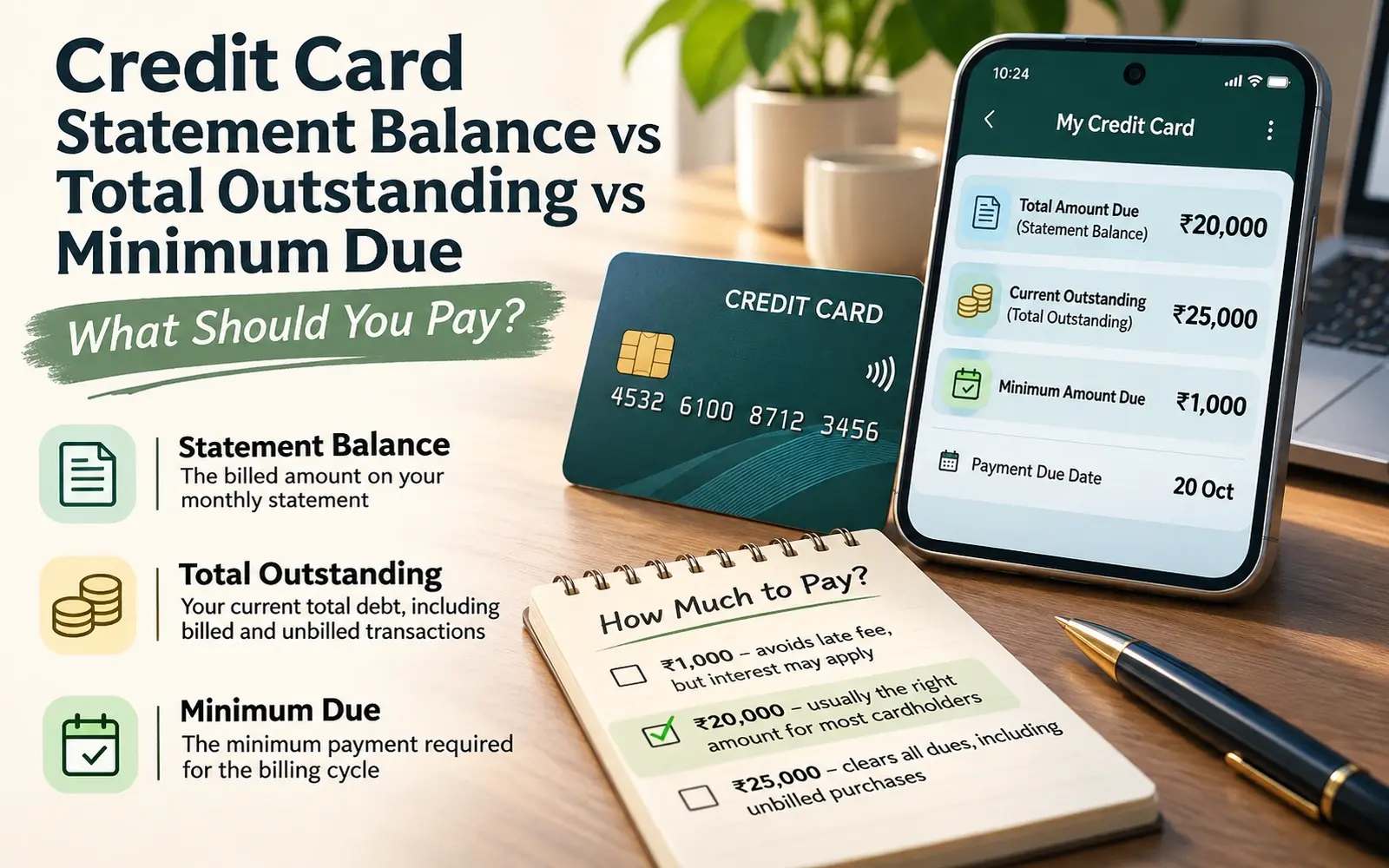
Your credit card app shows a total amount due of ₹20,000, a current outstanding balance of ₹25,000 and a minimum amount due of ₹1,000. All three numbers describe the same credit card account, yet paying each amount produces a different result.
Pay ₹1,000 and you may avoid a late-payment fee, but you could incur substantial interest. Pay ₹20,000 and you can ordinarily preserve your interest-free period on eligible purchases. Pay ₹25,000 and you may also clear purchases that have not even appeared on your monthly bill.
For most cardholders who pay their bills in full every month, the right amount to pay is the remaining total amount due by the payment due date. It is generally unnecessary to clear every unbilled purchase immediately. However, if you have carried debt from an earlier month or withdrawn cash using the card, the answer changes.
Understanding these differences helps you avoid unnecessary interest without paying money earlier than required.
What the three credit card balances actually mean
A credit card is a running account. Purchases increase the amount you owe, while repayments and eligible credits reduce it. Once a billing cycle closes, the issuer generates a statement that records the account position at that point.
The statement is a snapshot; the live account keeps changing.
| Term | What it means | When to pay |
|---|---|---|
| Statement balance / total amount due (TAD) | Net billed amount when the statement is generated | Clear the remaining billed due by the payment due date |
| Current or total outstanding | Current posted debt, typically including unpaid billed amounts and newer unbilled transactions | Pay early if useful; clear revolving or interest-bearing debt promptly |
| Minimum amount due (MAD) | Required minimum payment for the billing cycle | At least this much by the due date if full repayment is not possible |
The RBI formally defines TAD and MAD in its card-issuance directions. App labels for live outstanding and remaining dues are less uniform, however. One app may retain the original statement figure after repayment, while another may display an updated payable amount alongside it. Always check the actual payment status rather than relying on the label alone.
Statement balance is not a live transaction total
The statement can include retail purchases, outstanding debt from previous cycles, billed instalments, annual fees, interest and taxes, after accounting for credits received during that cycle. It is not necessarily just the sum of this month's shopping.
A payment made after the statement is generated normally reduces what remains payable, even though the original PDF still shows its historical closing balance.
Outstanding balance is not the same as used credit limit
The live outstanding amount generally reflects posted transactions and credits. Pending authorisations, blocked amounts and future EMI principal can also affect the available credit limit without being payable in the current statement. Issuers differ in how they display instalment balances and pending purchases.
For instance, a hotel may temporarily block part of your limit before the final transaction is posted. A card-based instalment purchase may also reserve more of the limit than the monthly instalment appearing on your bill. Do not assume that subtracting the available limit from the sanctioned limit always reveals the amount due this month.
A worked example: why your app shows different amounts
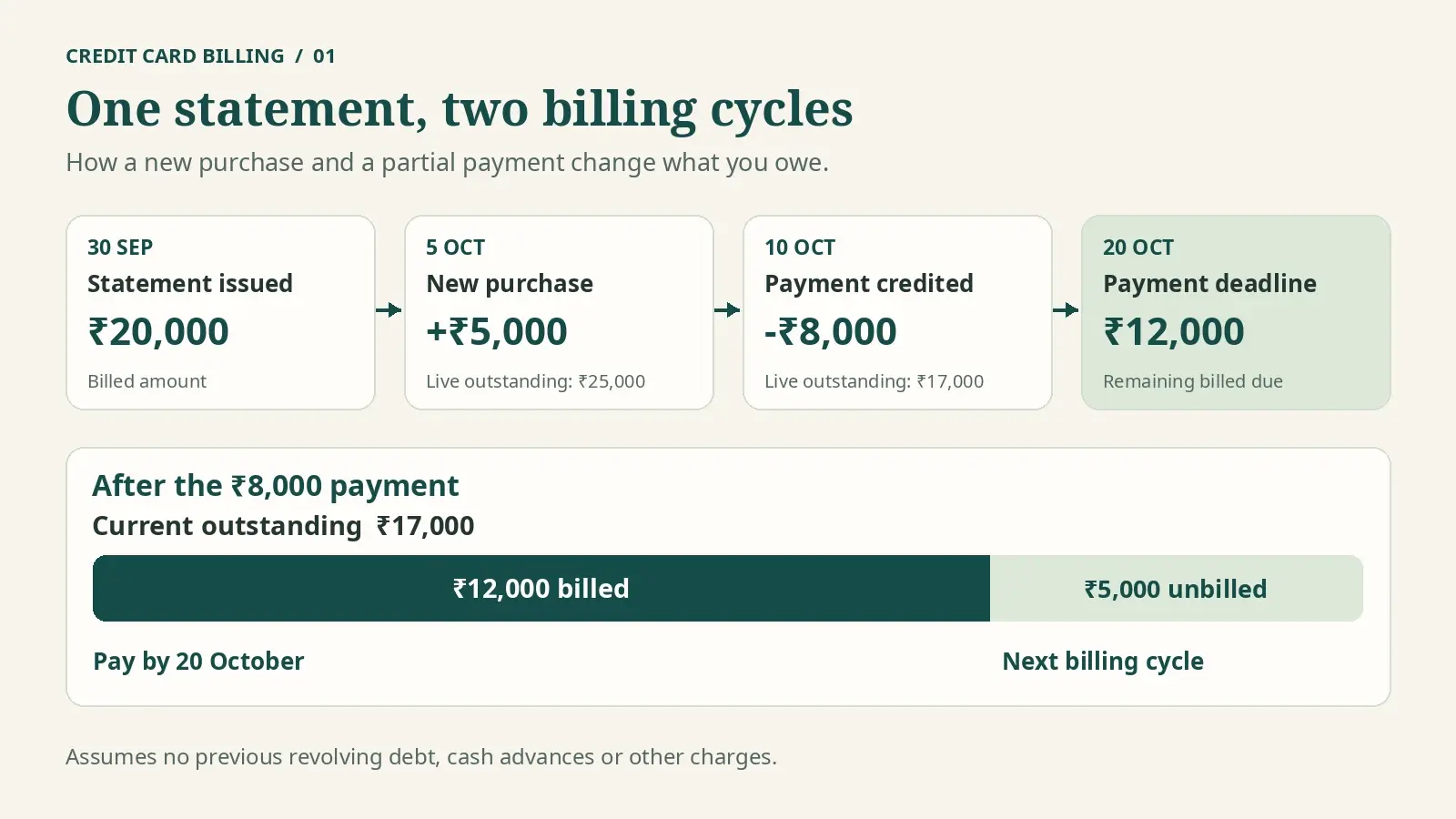
Suppose your billing cycle ends on 30 September and the payment is due on 20 October. Assume you have no previous revolving debt, cash advances or other charges, and your issuer gives eligible retail purchases an interest-free period.
| Date | Event | Amount |
|---|---|---|
| 30 September | Statement generated | ₹20,000 |
| 5 October | New posted purchase | ₹5,000 |
| 10 October | Payment credited | ₹8,000 |
| 20 October | Payment due date | — |
Immediately after the new purchase, your live outstanding is ₹25,000. After the ₹8,000 repayment, it falls to ₹17,000.
But the remaining billed amount is only ₹12,000: the original ₹20,000 minus the payment already credited. The other ₹5,000 belongs to the next billing cycle, assuming no unusual adjustments.
Paying ₹12,000 by 20 October clears the September bill. The ₹5,000 can normally be paid by the next statement's due date. Paying ₹17,000 instead would clear both amounts, but is not ordinarily necessary to avoid purchase interest in this example.
If the original statement lists a hypothetical MAD of ₹1,000, the ₹8,000 payment has already exceeded that minimum. This does not eliminate interest if you leave the remaining ₹12,000 unpaid after the due date.
The important question is therefore not simply what the statement originally said, but how much of that statement remains unpaid today.
How the minimum amount due is calculated
A common assumption is that MAD is always 5% of the credit card bill. That is not an RBI-mandated universal percentage.
Issuers set their own calculation methods within regulatory requirements. Under the RBI's directions, minimum-payment terms must be designed to prevent negative amortisation, and issuers cannot add unpaid taxes, levies or charges to the interest-bearing principal by capitalising them.
For example, SBI Card's published terms specify a minimum payment that includes applicable GST, billed EMIs, fees, finance charges and overlimit amounts in full, plus 2% of the remaining outstanding balance. The issuer's notices identify 15 July 2025 as the effective date of that calculation method. Other issuers and card products can apply different percentages, floors and additional components.
Consider an illustrative balance consisting of ₹20,000 in remaining retail principal, ₹600 in finance charges, ₹108 in associated GST and ₹1,500 in billed EMI. Under a method using those SBI Card components, the minimum would be ₹400 + ₹600 + ₹108 + ₹1,500 = ₹2,608, assuming no other applicable amounts or adjustments.
A payment of ₹2,608 would not reduce the retail purchase principal by ₹2,608. Under a charges-first allocation method, only ₹400 of that payment would reduce the retail balance in this simplified example. Part of the EMI may separately repay instalment principal.
This explains why minimum payments can consume a noticeable portion of your monthly budget while reducing revolving purchase debt very slowly. Consult your issuer's Most Important Terms and Conditions (MITC) for the actual calculation and allocation order.
What happens when you pay only the minimum?
Paying at least the required minimum on time generally avoids the account becoming overdue for that billing cycle. It is useful if you are temporarily short of money, but it is not a low-cost instalment plan.
The unpaid purchase balance becomes revolving credit. The interest-free treatment is normally suspended when a previous bill is not cleared, and fresh purchases can also attract interest from their transaction dates under the issuer's terms.
Interest may start before the payment due date
A particularly costly misunderstanding is that finance charges begin only on the day after the due date. The due date is the deadline for satisfying the payment conditions; it is not necessarily the starting date for calculating interest once those conditions have been breached.
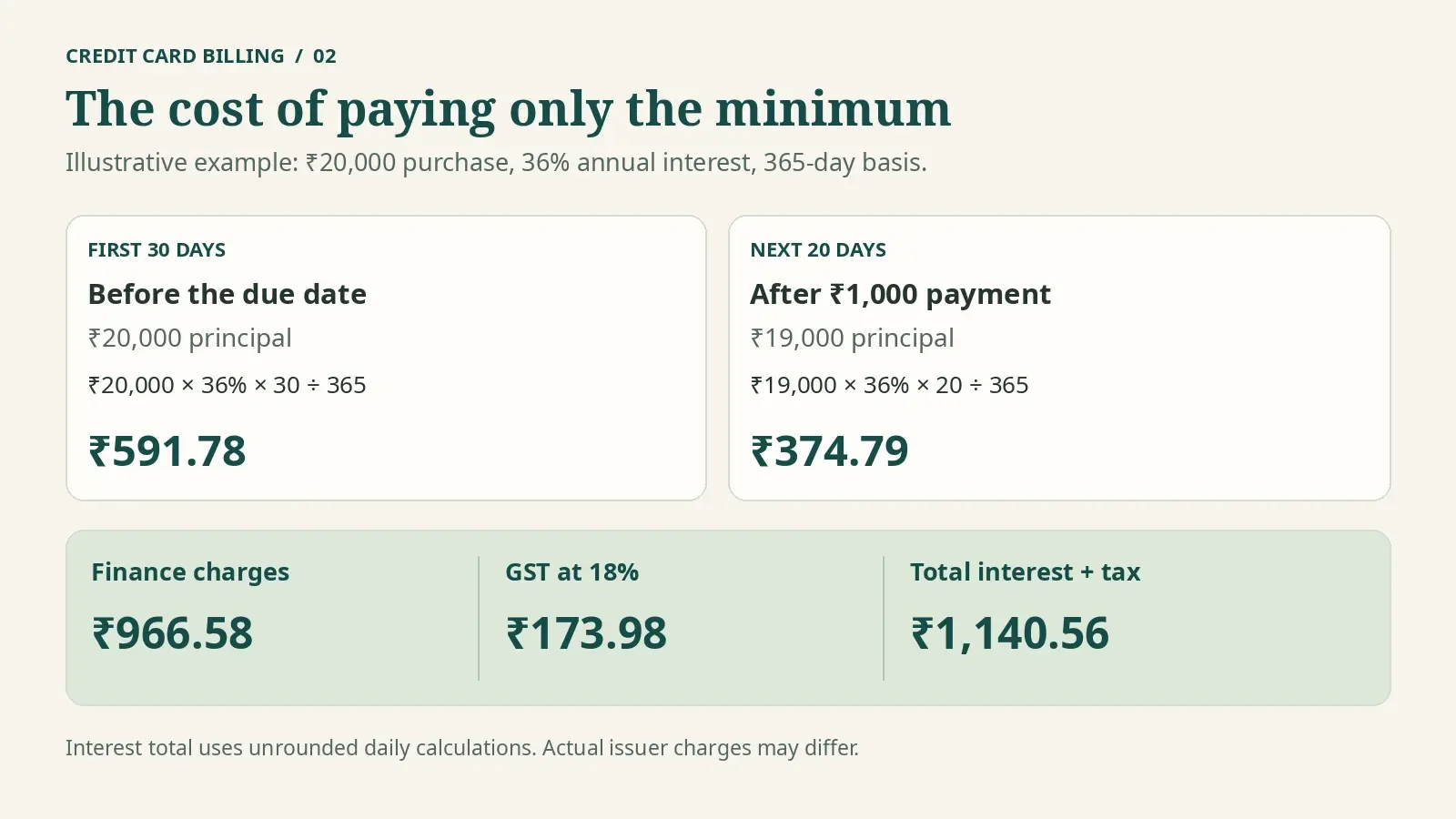
Assume you made a single eligible retail purchase of ₹20,000, had no earlier debt and later received a bill with a hypothetical ₹1,000 MAD. You pay only ₹1,000 on the due date, which is 30 days after the purchase. You clear the remaining ₹19,000 another 20 days later. Assume an illustrative annualised interest rate of 36%, a 365-day convention, no new transactions and no other charges. The entire first payment reduces principal because no charges have yet been posted in this example.
Using a simplified daily-interest calculation:
- First 30 days: ₹20,000 × 36% × 30 ÷ 365 = ₹591.78.
- Next 20 days: ₹19,000 × 36% × 20 ÷ 365 = ₹374.79.
- Total illustrative finance charge: approximately ₹966.58, calculated before rounding individual components.
If applicable GST is 18% on that finance charge, it adds approximately ₹173.98, bringing the illustrative interest and tax cost to ₹1,140.56. Paying the original bill in full on time would ordinarily have avoided this purchase-interest cost under the assumed conditions.
The example is not a quote for any specific card. Actual rates, day counts, statement timing, allocation of payments and applicable taxes affect the result. Issuers must disclose their annualised rates and calculation methods. SBI Card's published MITC, for instance, demonstrates finance-charge calculations based on the periods during which different balances remain unpaid.
Why interest can appear even after you clear the balance
Suppose you have already been revolving debt and pay the entire amount displayed in your app today. Interest accumulated since the last statement might not yet have been posted. It can appear on the following bill as residual or trailing interest.
If you want to stop revolving debt completely, ask the issuer for the payoff amount, including accrued finance charges where available. Check the next statement and pay any legitimate remaining charges. Confirm when your interest-free period will resume before relying on it for new purchases.
Cash advances are another exception: they commonly attract finance charges from the withdrawal date, even if the rest of the statement is cleared on time. Cash withdrawal fees may also apply. An apparently small ATM withdrawal can therefore behave very differently from an ordinary retail purchase.
What if you receive a refund or make an early payment?
Suppose your statement shows ₹20,000, but a merchant refund of ₹3,000 for a billed purchase is credited before the due date, while you have not yet paid the bill. The remaining amount payable should be ₹17,000, assuming there are no other changes.
The RBI's card directions expressly require eligible refunds and transaction reversals received before the payment deadline, where the relevant payment has not been made, to reduce the payment due. The issuer must inform the customer of the adjustment.
A refund promised by a merchant is not the same as a refund actually credited to the card. If it is still pending as the due date approaches, do not simply deduct it from your payment. Confirm the status with the issuer; if affordable, pay the undisputed amount that is actually due rather than risk a shortfall based on an expected credit.
If you have already paid for the refunded transaction, different rules apply. The RBI provides for consent requirements in certain cases where a refund is retained against the card limit, and allows customers to request transfer of an outstanding credit balance to their bank account. The prescribed period for such a request is three working days. A refund does not necessarily eliminate an outstanding loan instalment or resolve a merchant dispute by itself.
Does paying the minimum affect your CIBIL Score?
Paying MAD on time is not the same as missing a required payment. Nevertheless, carrying a large balance can keep your credit utilisation high and make future borrowing more difficult or expensive. TransUnion CIBIL identifies payment history and credit utilisation among the factors relevant to credit scores.
There is no requirement to carry interest-bearing debt to build a credit history. Regular use followed by timely repayment can demonstrate repayment behaviour without incurring avoidable purchase interest.
The RBI also limits when issuers can levy late-payment charges or report a credit card account as past due: the account must remain overdue for more than three days. Once applicable, the delay is measured from the original due date. Late charges are based on the unpaid balance after that date, rather than the original full bill. This is a regulatory safeguard, not an extra interest-free repayment window.
An April 2026 RBI amendment for commercial banks updates the prudential reference in this rule from 1 April 2027; it retains the three-day condition. Do not schedule your payment around that buffer. Payments can take time to reach the card issuer, and finance charges can still arise if the full bill was not cleared by the stated due date.
Which amount should you actually pay?
The best choice depends on your existing debt, not simply the largest number on the app.
| Your situation | Sensible payment approach |
|---|---|
| You always pay in full | Clear the remaining billed TAD by the due date. |
| You have unbilled purchases but no revolving debt | Paying early is optional for ordinary eligible purchases. |
| You have carried a balance or taken a cash advance | Pay down interest-bearing debt promptly; confirm accrued charges and the payoff amount. |
| You cannot afford the full bill | Pay at least the required MAD on time and as much extra as safely possible. |
If money is tight, stop adding discretionary purchases to the revolving balance. Consider whether a lower-cost instalment conversion or other repayment arrangement is available, comparing the full interest cost, fees, taxes, tenure and prepayment conditions before accepting. A lower monthly instalment does not necessarily mean a cheaper loan.
For routine payments, setting auto-debit to TAD rather than MAD can reduce the risk of accidentally revolving debt. Keep sufficient funds in the linked bank account, confirm that the mandate has actually been activated and verify the payment after the due date. If you pay manually before an automatic debit, check how the issuer adjusts the scheduled deduction to avoid an unexpected duplicate payment.
Finally, examine the statement every month. Check unfamiliar transactions, interest charges, refunds and payment credits. Raise any billing discrepancy through the issuer's official complaint channels and request a written explanation of the calculation. For suspected fraud, report it immediately and ask the issuer how to handle the undisputed portion of your bill.
The bottom line
The statement balance tells you what was billed, the total outstanding tells you what is currently owed, and the minimum due tells you the least you must pay to avoid an overdue bill under the applicable terms.
For ordinary card spending, aim to clear the remaining statement balance by its due date. Pay the live outstanding early when you need to reduce debt or free up credit, not simply because it is higher than the bill. Treat minimum payments as a temporary fallback, not a regular repayment strategy. The cheapest credit card debt is usually the purchase balance you never allow to start accruing interest.
Related reading: compare cards if you can pay the statement in full.
Sources and Further Reading
- RBI — Commercial Banks: Credit Cards and Debit Cards, Issuance and Conduct Directions, 2025, especially definitions and paragraphs 22–32.
- RBI — NBFCs: Credit Cards, Issuance and Conduct Directions, 2025.
- RBI — Commercial Banks credit and debit card Amendment Directions, 27 April 2026, effective 1 April 2027.
- SBI Card — Most Important Terms and Conditions, finance charges, minimum payment, allocation and taxes.
- SBI Card — Customer notices, minimum-due calculation and payment allocation changes.
- SBI Card — Balance outstanding, amount due and credit limit FAQs.
- HDFC Bank — Understanding the credit card summary.
- ICICI Bank — Outstanding amount on a credit card.
- TransUnion CIBIL — Consumer FAQs, payment history and credit utilisation.