Sent Money to the Wrong UPI ID or Bank Account? How to Recover It in India
Learn what to do after sending money to the wrong UPI ID or bank account in India, how to request a reversal, and when to approach the RBI Ombudsman.

You intend to send ₹15,000 to your landlord, select a familiar-looking name in your UPI app and approve the payment. A moment later, you realise that you selected the wrong person. The app shows that the transfer was successful and your bank balance has already decreased.
Can the bank simply cancel it? Will NPCI refund the amount? Should you call the cybercrime helpline?
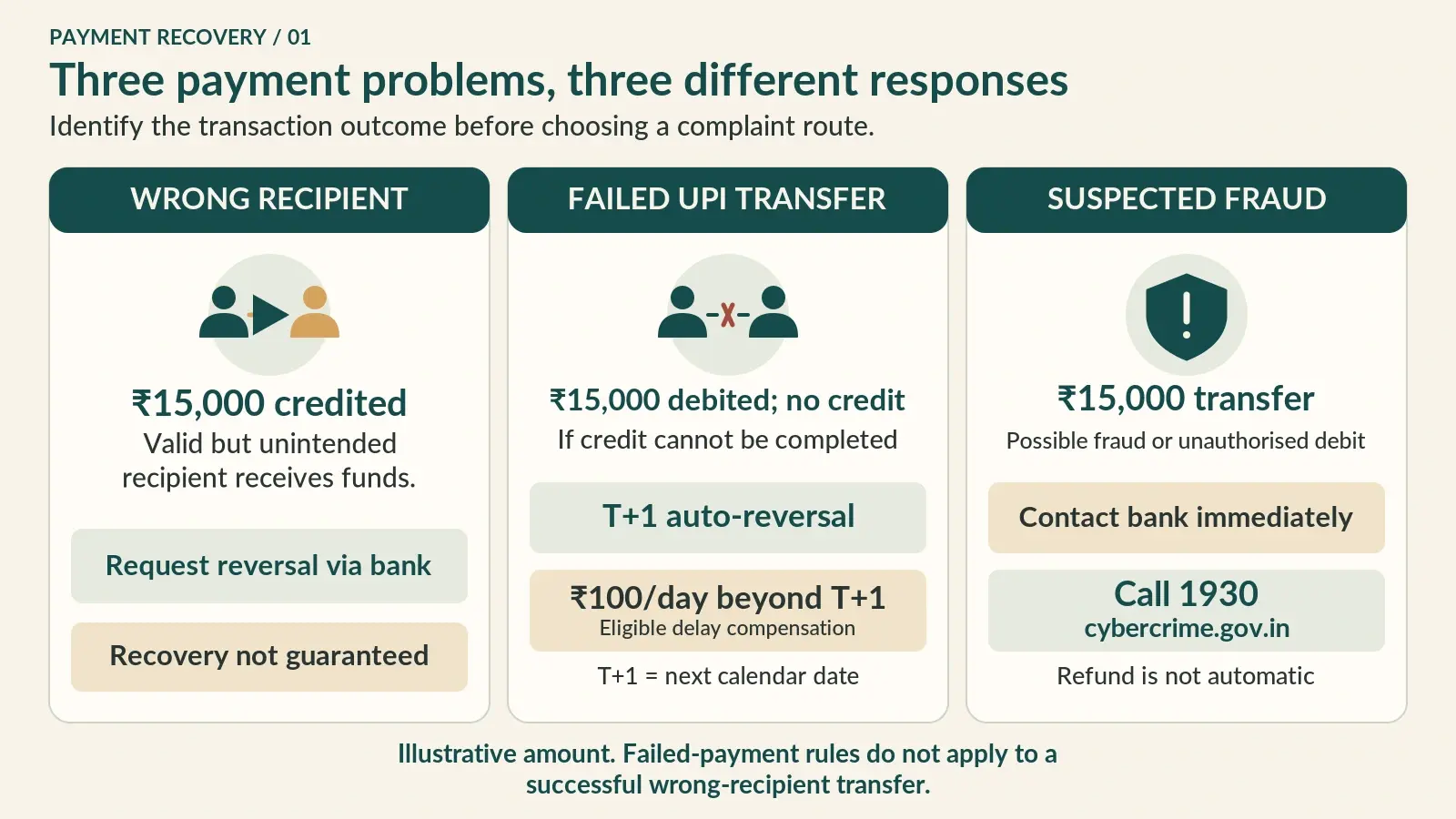
The answer depends on what actually happened to the payment. A successful transfer to an unintended recipient is not the same as a failed payment, an unauthorised debit or a fraudulent transaction. Each has a different recovery mechanism.
If you have sent money to the wrong account, contact your bank and payment app immediately, save the transaction reference and request recovery of the mistaken payment. There is a formal route for seeking its return, but no universal guarantee that the money will come back.
First identify what went wrong
The word "refund" is used for several different situations in digital banking. Choosing the correct complaint category matters because it determines what the bank or payment network will investigate.
| Situation | What happened | Appropriate first action |
|---|---|---|
| Successful wrong-recipient transfer | You authorised payment to an unintended recipient | Request a mistaken-payment reversal through your bank |
| Failed or pending transfer | Money may have been debited, but final credit is unsuccessful or uncertain | Ask the app or bank to trace the transaction |
| Unauthorised or fraudulent transfer | Someone took your money without permission or deceived you into paying | Report fraud immediately to the bank and cybercrime authorities |
| Merchant refund dispute | The correct merchant received payment, but a refund or service is disputed | Contact the merchant and raise the applicable payment dispute |
A payment marked successful is not necessarily proof that the intended person received it. It means the payment system recorded success for the destination specified in the transaction. Conversely, a pending screen does not establish that money has gone to the wrong account.
Check the receipt, beneficiary identifier, transaction status and bank statement before deciding which route to follow. If the status remains uncertain, ask your bank to confirm the final credit status rather than sending the same amount again.
Why successful transfers cannot simply be cancelled
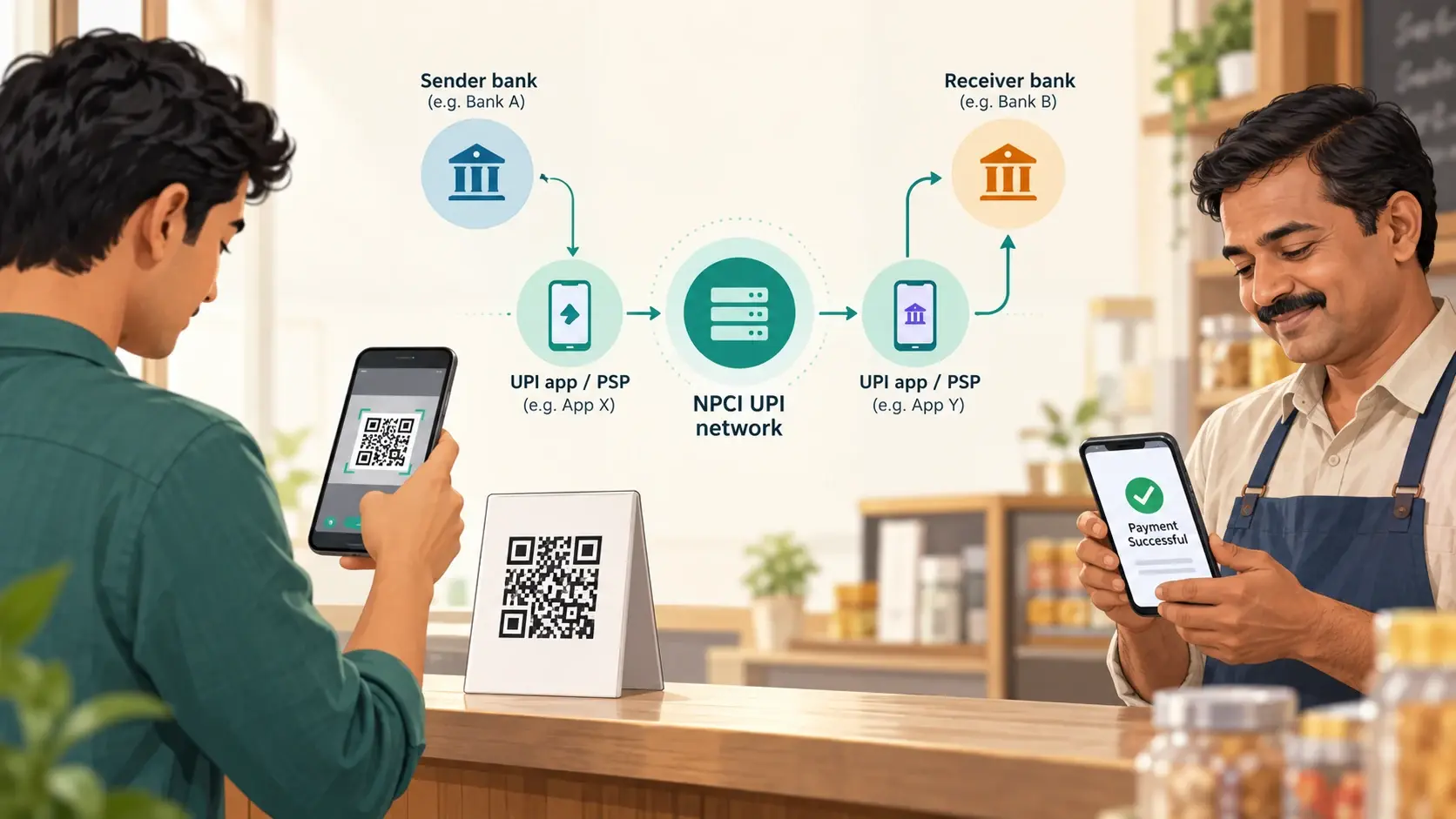
UPI normally moves money rapidly between bank accounts. The app provides the interface through which you initiate the payment; the participating banks and payment network process the transfer. Once a payment has been completed, deleting its receipt, removing the beneficiary or uninstalling the app does not undo the movement of money.
The same practical difficulty applies to completed IMPS, NEFT and RTGS transfers. Although these payment systems differ in their processing and settlement arrangements, a completed credit to a valid unintended account cannot ordinarily be cancelled at will by the sender.
The receiving account may belong to a person who has no relationship with you. The bank needs a proper basis for debiting that account. In an ordinary mistaken-transfer case, the recipient's consent is generally central to the voluntary reversal process. A correction of a bank's own posting error, a statutory direction or a court order may involve different authority.
PhonePe's official explanation describes this consent-based recovery process. Google Pay's help page likewise distinguishes requesting a refund from cancelling an already authorised payment.
Speed matters because money may be withdrawn or moved before recovery can be arranged. But an immediate complaint is not a promise that the bank can automatically freeze or return the amount.
What to do immediately after a wrong UPI transfer
1. Preserve the transaction details
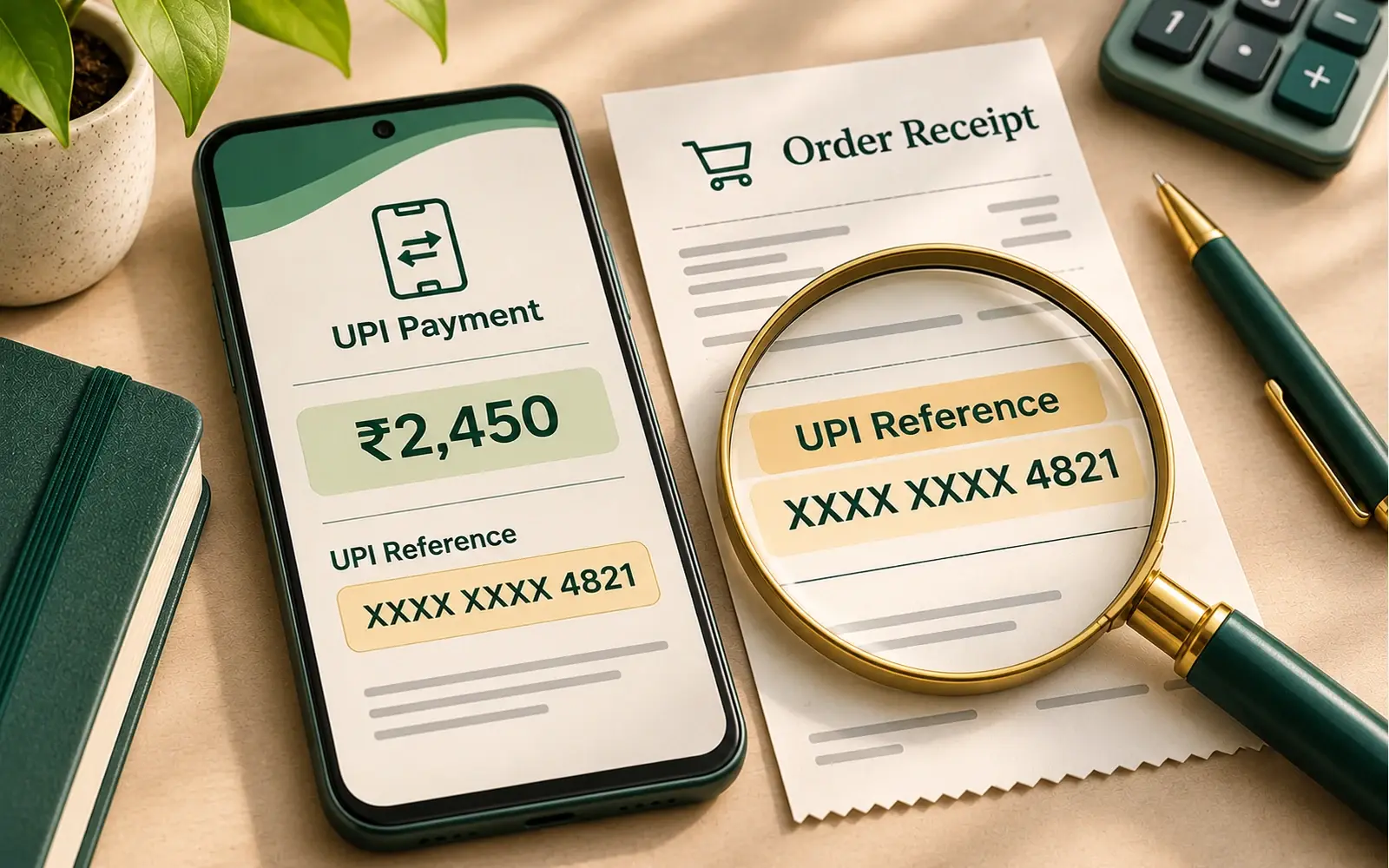
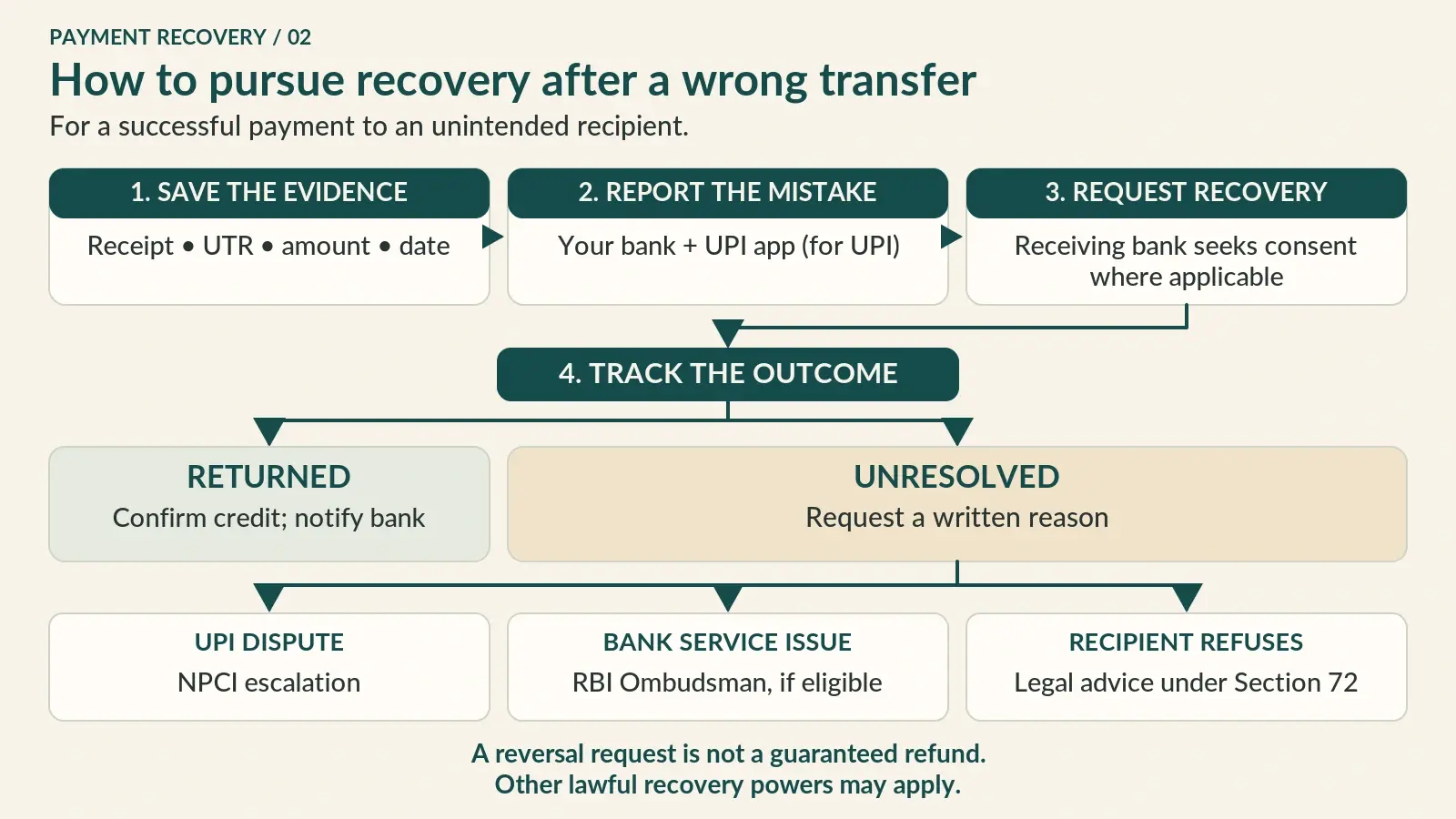
Open the payment history and save the transaction receipt. Keep the amount, date and time, transaction or UPI reference number (often called a UTR or RRN in different interfaces), displayed beneficiary name and UPI ID or account details, where visible. Save the debit entry from your bank statement as well.
Retain evidence of whom you actually intended to pay, such as an invoice or earlier communication. This helps distinguish a genuine mistake from a later disagreement about a payment that was originally intended.
2. Request a return from the recipient, if known
If you accidentally paid a friend, family member or known merchant, a voluntary refund may resolve the matter faster than a formal interbank dispute. Explain the mistake calmly, share only the necessary transaction details and ask for the money to be returned through a verified route.
If the recipient is a stranger, cannot be contacted safely or refuses to respond, work through your bank instead. Do not rely on unofficial services claiming to identify account holders. Banks are not generally free to disclose another customer's private details merely because you paid them.
3. Raise the correct complaint with the bank and app
Contact your account-holding bank using its official helpline, branch, online grievance channel or mobile banking service. In your UPI app, select the relevant payment in transaction history and use the available help or dispute option. Menu names vary by app and version.
State explicitly that you authorised the transaction but selected the wrong beneficiary, if that is what happened. Request a wrong-payment reversal, historically called a wrong credit chargeback in UPI dispute processing. Ask for a complaint acknowledgement and retain it.
The bank can use the transaction reference to identify the receiving bank and pursue recovery. If both accounts are held at the same institution, communication may be more direct; if not, interbank coordination is needed. Neither arrangement guarantees success.
4. Follow up and track the result
Ask whether the recovery request has been raised, whether the receiving bank has responded, and whether more evidence is required. If the request is rejected or closed, ask for the reason in writing, to the extent it can lawfully be shared.
If the app and bank do not resolve a UPI complaint, use NPCI's dispute redressal route. Google Pay's published help instructions advise escalating persistent mistaken transfers to NPCI within three days of the transaction. Treat this as a reason to act promptly, not as a universal statutory deadline for all payment systems or legal remedies.
What changed in NPCI's reversal process in November 2026?
NPCI's Operating Circular 240, dated 4 November 2026, standardises several UPI dispute-management rules. Its scheduled implementation date is 25 November 2026.
Among the changes is a clearer name for the existing wrong-credit dispute process: "Wrong Payment - Reversal Request". The circular also introduces rejection reasons for cases in which the recipient confirms the payment was correct or has already returned it separately, and specifies supporting evidence for certain rejection scenarios. It extends eligibility for specified dispute types to transactions treated as approved after a subsequent status update.
This is not a new consumer right to reverse any successful payment instantly. A request may still fail, for example, if the recipient cannot be contacted or disputes that the transfer was a mistake. The significance is that the payment network has defined a more explicit mechanism for handling and documenting these situations.
Customers do not need to know internal dispute codes to lodge a complaint. Describing the facts clearly, providing the reference number and retaining written acknowledgement are more important.
What if you entered the wrong bank account number or IFSC?
For NEFT, IMPS and RTGS transfers initiated with bank details, a typing error can have different consequences. An invalid account may result in the transfer being rejected or returned. But a valid account belonging to another person may receive the money successfully.
RBI's NEFT guidance updated in November 2026 explains that the account number supplied by the sender determines the account credited. Supplying the correct beneficiary details is the remitter's responsibility.
Contact your sending bank and provide the UTR, amount, date, account number and IFSC used, along with the intended recipient details. Ask it to trace the credit and initiate a recovery request with the destination bank where appropriate. Do not assume that every UPI-specific dispute rule also applies to NEFT or RTGS.
There is now an additional prevention mechanism. RBI's December 2024 beneficiary account-name lookup instruction required participating NEFT and RTGS banks to introduce the free name-checking facility by 1 April 2025. This retrieves the name associated with the supplied account details before payment. A mismatch is a reason to stop and verify, not to proceed simply because the account number looks familiar.
Failed transactions have different refund rules
Under RBI's failed-transaction turnaround-time framework, specific technical failures have prescribed resolution periods and delay compensation. These rules should not be confused with voluntary recovery of money successfully sent to the wrong person.
| Eligible failure scenario | Prescribed reversal period | Delay compensation |
|---|---|---|
| UPI fund transfer: sender debited, beneficiary not credited and credit cannot be completed | T+1 day | ₹100 per day beyond T+1 |
| IMPS fund transfer: same type of failed credit | T+1 day | ₹100 per day beyond T+1 |
| UPI merchant payment: debit occurs but merchant confirmation is not received | T+5 days | ₹100 per day beyond T+5 |
Here, T is the transaction's calendar date. Compensation under the applicable framework is meant to be paid without requiring a separate claim. NEFT has its own credit and return procedures, so ask the bank to apply the rules of the actual payment system.
For example, imagine you send ₹15,000 through UPI on 10 November and your bank confirms an eligible failed fund transfer that cannot be credited. The T+1 deadline is 11 November. If reversal occurs on 14 November, the delay is three calendar days, giving ₹300 in prescribed delay compensation in this hypothetical case.
If the same ₹15,000 was successfully credited to a stranger instead, the T+1 failed-payment rule does not create an entitlement to ₹300 or to an automatic refund. The problem is the destination, not a failure to deliver the payment.
When to report cybercrime instead
A genuine typing error is not automatically financial cybercrime. But if you paid a fraudster posing as a merchant, received a manipulated QR code, were tricked into approving a collect request, or discovered a debit you never authorised, treat it as a potential fraud incident.
Immediately contact your bank's official fraud-reporting channel, call 1930 and lodge a report at cybercrime.gov.in. Keep the acknowledgement and any relevant messages, call records or screenshots. Ask the bank to secure affected payment access if credentials may have been compromised.
RBI's customer-liability rules for unauthorised electronic banking transactions depend on circumstances, including the source of the breach and how promptly it was reported. They are not blanket insurance against an ordinary payment mistake. The applicable rules also depend on the transaction date and bank category; RBI has announced revised fraud-protection arrangements for implementation from 2027. Verify the applicable provisions before relying on a compensation entitlement.
Avoid people promising instant recovery for a fee or asking for your PIN, OTP, screen-sharing access or a fresh payment. You do not need to authorise an outgoing UPI payment to receive an ordinary refund.
Can you approach the RBI Ombudsman if the bank does not help?
Yes, where there is a maintainable complaint about deficient service by an RBI-regulated entity. For example, the bank might fail to register a complaint, neglect to process an applicable recovery request or fail to provide a proper response. Escalate first to the bank's designated grievance or nodal officer and preserve proof of your original complaint.
The Reserve Bank – Integrated Ombudsman Scheme, 2026, effective 1 July 2026, allows eligible complaints through RBI's Complaint Management System without a filing fee. Where no reply arrives, the applicable waiting period is the longer of 30 days and any relevant RBI, NPCI or card-network timeline. An unsatisfactory response may also permit escalation. The 2026 scheme generally requires filing within 90 days of the applicable timeline expiring or the last communication from the regulated entity, whichever is later, subject to its other conditions.
The Ombudsman examines the bank's service, not simply whether an unrelated private recipient owes you money. Even if recovery fails, that alone does not establish that the bank acted improperly. A complaint cannot guarantee a refund from the bank for the sender's own mistake.
What if the recipient refuses to return the money?
Section 72 of the Indian Contract Act, 1872 establishes a duty to restore money received by mistake or under coercion. That legal obligation is distinct from the bank's power to debit a customer's account.
For a substantial unresolved transfer, seek advice from a lawyer about a written demand and appropriate civil recovery proceedings. The evidence, applicable limitation period, jurisdiction, recovery costs and the recipient's circumstances all matter. If evidence of dishonest conduct or fraud emerges, discuss the appropriate criminal complaint as well; a mere accidental transfer does not establish a criminal offence.
Keep a complete record of what has already been returned. A voluntary refund followed by a separate bank reversal could create an unintended double recovery. Inform the bank promptly if the matter is settled outside its dispute process.
How to prevent the next wrong transfer
Verify the recipient's displayed bank name before confirming a UPI payment, especially when using a mobile number, saved contact or QR code. For account-based transfers, check both the account number and IFSC against a trusted source and use the available name lookup. For a large first-time payment, a small test transfer followed by confirmation from the intended recipient can be worthwhile.
Be particularly careful when someone sends revised payment details by message or email. Confirm them using an independently known contact channel. A matching name alone does not establish that a payment request is genuine, and a small successful test does not authenticate subsequent requests to change accounts.
The practical rule is simple: verify before paying, report immediately after a mistake, and follow the recovery route that matches the actual transaction. A completed wrong payment may be recoverable, but the outcome depends on the evidence, the receiving party's cooperation and any applicable legal authority—not on how quickly an app displays a complaint number.
Sources and further reading
- NPCI Operating Circular 240: Standardization of Dispute Management Rules in URCS (4 November 2026)
- NPCI: UPI frequently asked questions
- Google Pay: Incorrect transfers
- PhonePe: Wrong transfers and pending payments
- RBI: NEFT FAQs, November 2026
- RBI: Beneficiary name lookup for NEFT and RTGS
- RBI: Failed transaction turnaround times and compensation
- RBI: Integrated Ombudsman Scheme 2026 FAQs
- India Code: Indian Contract Act, 1872, Section 72
- National Cyber Crime Reporting Portal
- RBI: Commercial banks responsible business conduct directions
- RBI: Fraudulent electronic banking transaction amendments, June 2026