Is No-Cost EMI Really Free? Hidden Charges, GST and Discounts You Might Lose
Understand how no-cost EMI works in India, why GST and processing fees may apply, and how to compare the real cost with paying upfront.
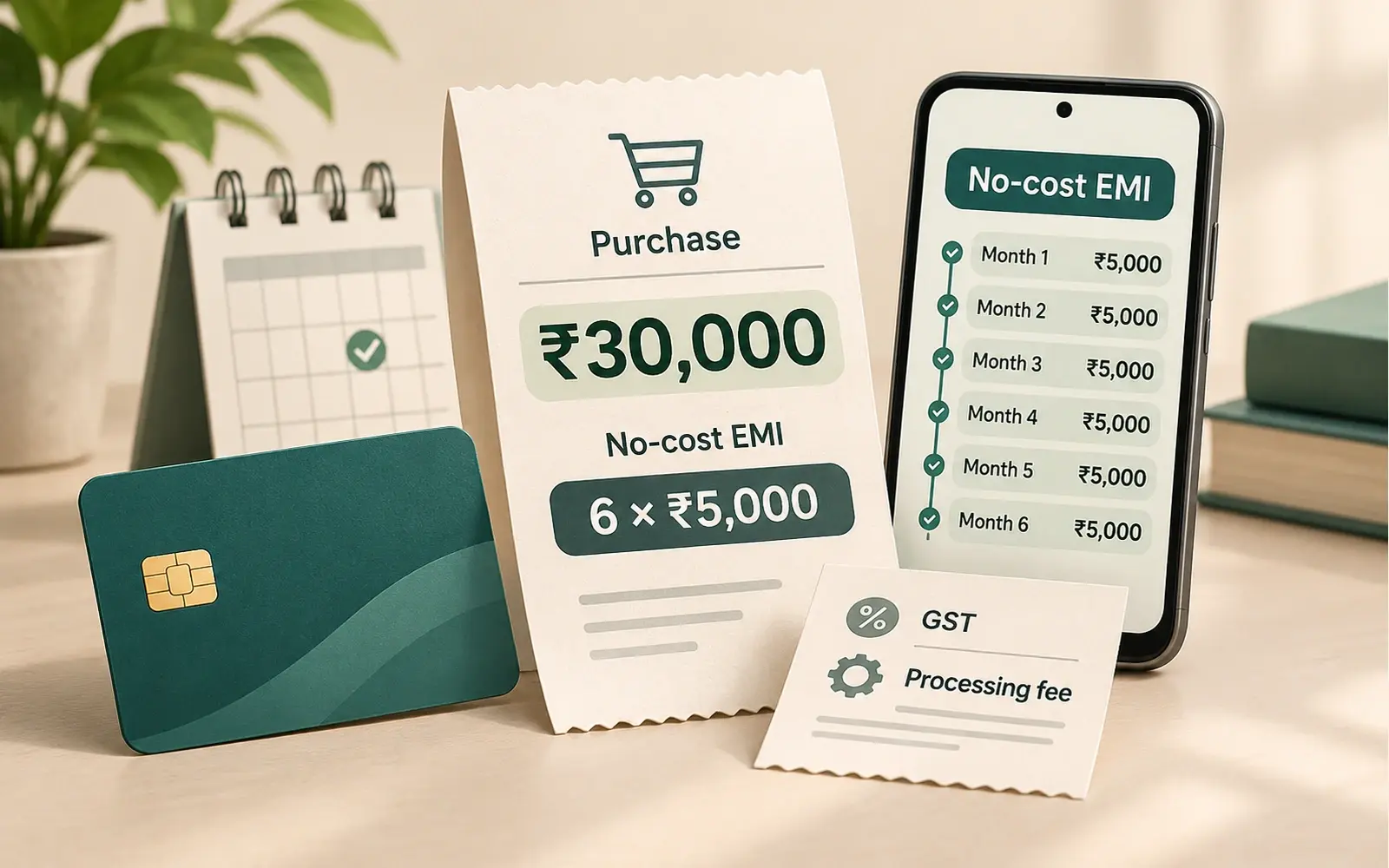
A smartphone costs ₹30,000. At checkout, the retailer offers six monthly instalments of ₹5,000 under a no-cost EMI scheme. The arithmetic seems straightforward: six payments add up to ₹30,000, so why pay everything today?
Then your credit card statement arrives. It contains an EMI interest component, GST and a processing fee. Meanwhile, someone buying the same phone without EMI received an additional ₹1,500 discount. Suddenly, the two payment options are not equivalent.
No-cost EMI can eliminate the net interest cost of financing a purchase, but it does not necessarily eliminate every cost of borrowing or guarantee the lowest purchase price. Some offers genuinely let you spread payments without spending more. Others become more expensive once you include taxes, fees and benefits you give up.
The way to tell them apart is to compare the complete amount payable under each payment method, rather than just the advertised monthly instalment.
How no-cost EMI actually works
EMI stands for Equated Monthly Instalment. In a conventional interest-bearing EMI arrangement, a lender finances a purchase and you repay the borrowed principal and interest over an agreed period. The instalment generally stays constant, although separately billed charges can make your actual monthly outflow vary.
In a common credit card no-cost EMI arrangement, the bank still earns interest. The merchant, manufacturer or participating card issuer provides a promotional benefit that offsets that interest, often by reducing the purchase amount financed. The interest subsidy is sometimes called merchant subvention or merchant payback.
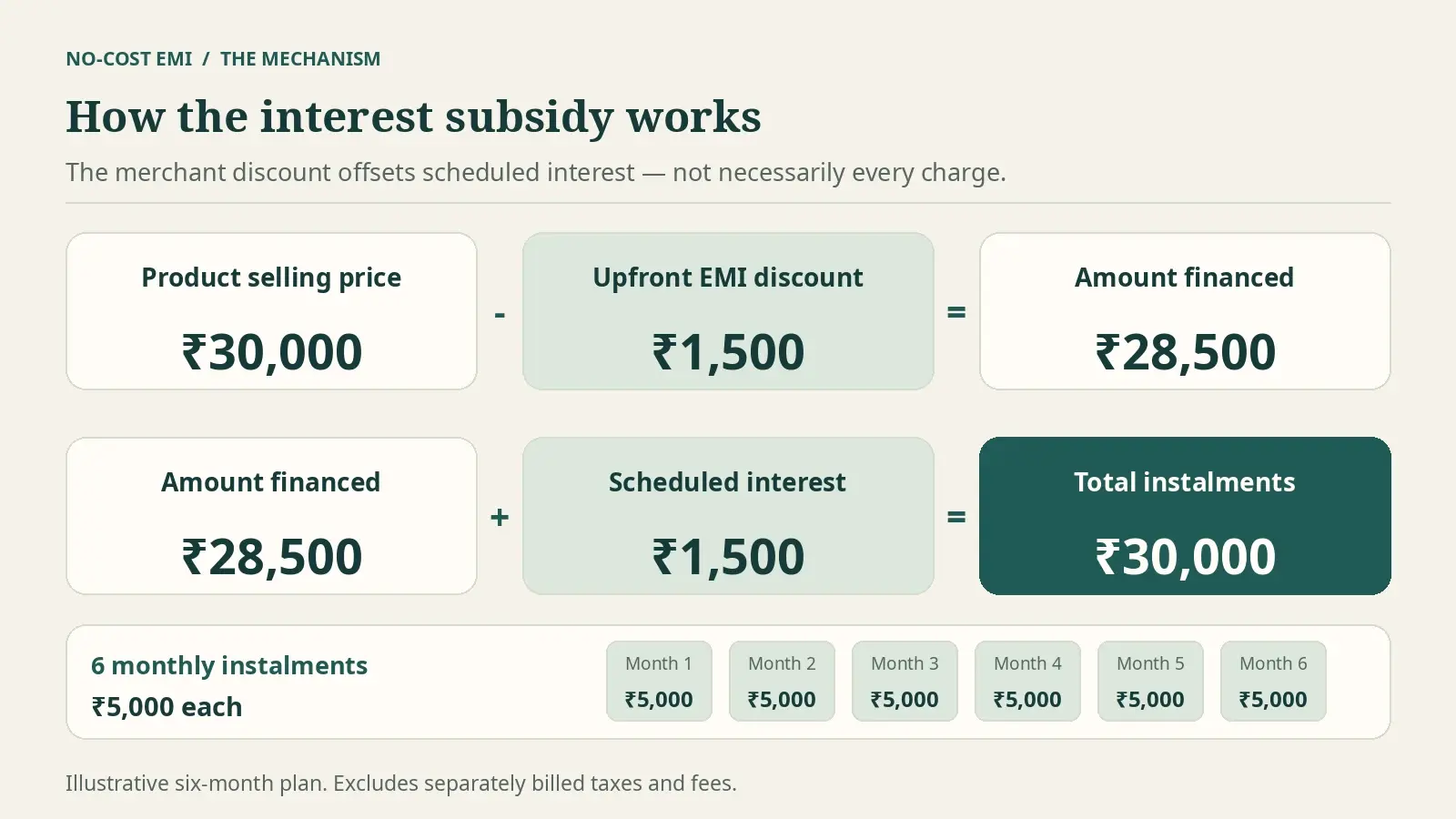
For example, suppose a product's selling price is ₹30,000 and the interest payable under a particular six-month plan is ₹1,500. The merchant gives an upfront EMI discount of ₹1,500, and the lender finances the remaining ₹28,500.
| Component | Amount |
|---|---|
| Product selling price | ₹30,000 |
| Upfront EMI discount | −₹1,500 |
| Amount financed (principal) | ₹28,500 |
| Total interest over six months | +₹1,500 |
| Total of six instalments, before separate charges | ₹30,000 |
The discount and interest cancel each other economically. The bank has not necessarily waived its interest, and the ₹1,500 discount is not an additional saving on top of the advertised ₹30,000 price. It is already being used to offset the borrowing cost.
These are illustrative figures for a hypothetical offer, not an interest-rate quotation. Actual interest is generally calculated on the financed principal according to the lender's repayment schedule, and the corresponding discount is determined for the eligible tenure.
Apple India's published financing terms describe this upfront-discount structure. HDFC Bank's EasyEMI terms also describe merchant-funded discounts or cashback while the bank continues to charge interest. Other arrangements may provide the subsidy later as cashback, or involve genuinely interest-free financing. Not every product marketed as no-cost EMI follows exactly the same accounting process.
Why interest and GST can still appear on your statement
When you select a subsidised credit card EMI, your lender may separately show principal and interest in each monthly statement. That is not, by itself, evidence that the offer has failed. Check whether the promised subsidy was actually received and whether it covers the total scheduled interest.
GST is a separate matter. Under India's GST framework, the general exemption for interest on loans and advances excludes interest involved in credit card services. Taxable financial services generally attract GST at 18%. Bank terms, including ICICI Bank's Instant EMI terms, expressly provide for GST on applicable interest and fees.
In the ₹30,000 example, the lender charges ₹1,500 in interest over the tenure. If the offer offsets only interest and not the tax on it, you pay an additional ₹270 in GST (₹1,500 × 18%). The instalments themselves may still total ₹30,000, but your aggregate payment becomes ₹30,270 before other charges.
The ₹270 is not a fresh tax on the entire product price. It relates to the interest charged for the credit card financing service. If the retail price already includes the product's GST, do not add that product tax again when comparing payment methods.
On a reducing-balance EMI, the interest portion generally falls as principal is repaid. Consequently, the GST on interest can also decline from month to month, even when the base instalment is fixed. Check whether the advertised instalment includes these taxes or whether your issuer adds them separately.
Does this apply to every type of EMI?
No. A credit card EMI is not necessarily the same lending product as a consumer durable loan, debit card-linked loan or other checkout finance facility. Interest on qualifying ordinary loans is generally GST-exempt, while taxable processing and service charges may still attract GST. A non-card loan can also have a different subsidy mechanism.
Identify the actual lender and credit product before applying the credit card example to a different type of financing. The label on the retailer's checkout page is not enough.
Five costs that can change the deal
1. Processing and convenience fees
A bank may levy a one-time fee for setting up the instalment plan. A merchant or payment provider may have a separate fee, depending on the arrangement. Such charges can be billed immediately or through your card statement.
HDFC Bank's published EasyEMI terms, for example, provide for processing charges that vary with the transaction. Apple India's financing terms distinguish its own facilitation of EMI from fees that the card issuer may impose. A retailer saying it does not charge a processing fee does not establish that the lender charges nothing.
A ₹200 taxable processing fee becomes ₹236 with 18% GST. On a small purchase, even a modest fixed charge can represent a meaningful percentage of the price.
2. The upfront discount you might lose
Consider a store that sells a laptop for ₹50,000 but offers a ₹3,000 discount only to customers paying in full. If the no-cost EMI option is based on the ₹50,000 price, its instalments may add up to ₹50,000 even before bank charges.
Your alternative is not necessarily the ₹50,000 sticker price. It is the ₹47,000 you could actually pay without financing. Giving up a discount is an economic cost, even though it never appears as an interest charge on a statement.
Do not assume all discounts are incompatible with EMI, however. Some promotions allow an interest subsidy alongside an additional bank discount or instant cashback. Apple India's terms explicitly contemplate combinations with eligible promotions, subject to their conditions. Compare the final checkout amounts for your own payment options rather than assuming either option always wins.
3. Cashback and reward points
A cashback promotion may be immediate, or it may arrive weeks or months later after certain repayment or eligibility conditions have been satisfied. If the interest subsidy itself is delivered through deferred cashback, you may have to fund the higher instalments until the benefit arrives.
Ordinary card spending can also earn rewards that an EMI transaction does not. For example, HDFC's EasyEMI and ICICI's Instant EMI terms contain reward exclusions, with eligibility governed by the relevant product rules. A full-payment purchase using an eligible rewards card might therefore be more attractive than it first appears.
Value rewards at what you can realistically redeem, not at the number of points shown in an advertisement. Treat conditional cashback as uncertain until you confirm eligibility and fulfil its conditions. Never deduct an instant discount twice if it is already reflected in the financed amount or checkout total.
4. Early repayment and cancellation charges
You might decide to clear the remaining loan after two months. Paying extra money into your credit card account does not necessarily close its EMI facility. A separate foreclosure request may be necessary.
Depending on the contract, foreclosure can involve a fee based on the unpaid principal, accrued interest, taxes and reversal of promotional benefits. Some fees may not be refunded. HDFC's EasyEMI terms, for example, describe preclosure charges and possible recovery of merchant benefits.
Returning the product creates another complication: a merchant refund and cancellation of the lender's EMI are not always the same event. Obtain confirmation of the loan's closure and verify the final statement rather than simply stopping payments after a return.
5. Late payments and revolving credit
The no-cost promotion concerns the agreed EMI financing arrangement. It does not protect you from charges that arise when you fail to meet your credit card repayment obligations.
If you pay only part of your overall card bill, you may incur ordinary credit card finance charges on eligible unpaid balances under the issuer's terms. Missed payments may also lead to late charges, credit reporting consequences or acceleration of the instalment debt.
Budget for the entire card bill, including each billed EMI, interest where separately shown, applicable taxes and fees, and your other purchases. Do not confuse the advertised instalment with the total amount due on your credit card.
A worked example: compare the real cost of no-cost EMI
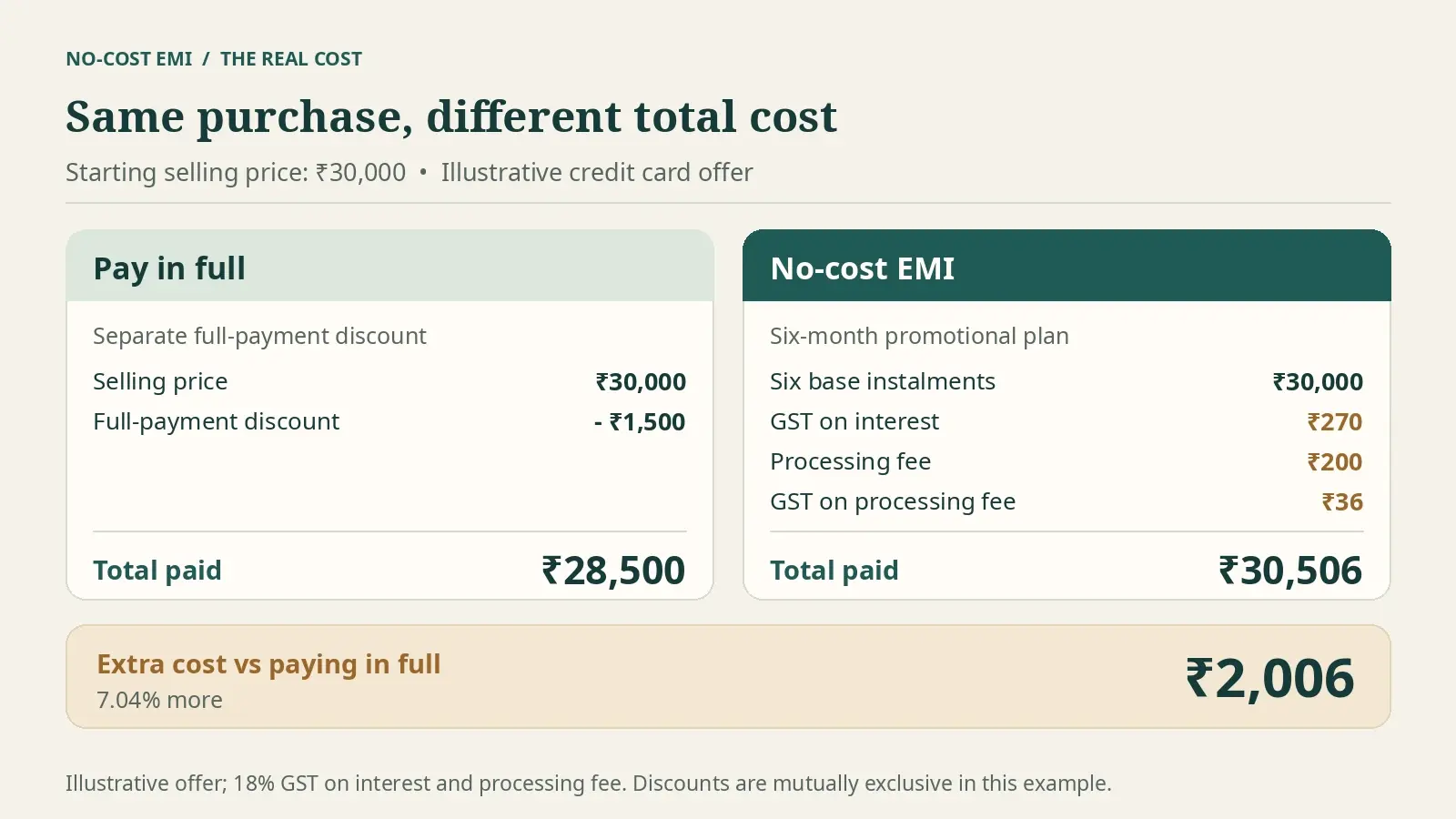
Return to the ₹30,000 smartphone. Assume you can buy it outright for ₹28,500 using a separate full-payment discount, but that discount cannot be combined with the six-month EMI promotion. The EMI discount of ₹1,500 offsets the lender's scheduled interest. A ₹200 processing fee also applies. Assume 18% GST on the card interest and processing fee, no additional cashback and no late payments.
| Cost component | Pay in full | No-cost EMI |
|---|---|---|
| Starting selling price | ₹30,000 | ₹30,000 |
| Applicable upfront discount | −₹1,500 | −₹1,500 |
| Purchase payment / loan principal | ₹28,500 | ₹28,500 |
| Scheduled interest | ₹0 | ₹1,500 |
| GST on interest | ₹0 | ₹270 |
| Processing fee | ₹0 | ₹200 |
| GST on processing fee | ₹0 | ₹36 |
| Total paid | ₹28,500 | ₹30,506 |
The advertised instalments total ₹30,000, but the real amount paid is ₹30,506. Compared with the full-payment price of ₹28,500, you spend an additional ₹2,006, or approximately 7.04% more.
That percentage measures the extra purchase cost relative to the alternative price. It is not an annualised borrowing rate. The actual cost of credit over time depends on the timing of the payments and charges.
Now change one assumption. Suppose no full-payment discount exists and both options start at ₹30,000. The same EMI costs just ₹506 more than paying upfront. If there is also an additional ₹1,000 cashback credited later, exclusive to EMI, with the same loan schedule and taxes, the net EMI cost falls to ₹29,506. It would then be ₹494 cheaper than full payment.
This is why the promotion must be evaluated as a complete transaction rather than judged solely by its name.
What RBI requires lenders to disclose
The Reserve Bank of India's 2025 card-issuance directions for commercial banks and NBFCs require clarity about the principal, interest and upfront promotional discount before credit card EMI conversion, with the components separately reflected in the card statement. Interest-bearing conversion must not be presented misleadingly as zero-interest or no-cost financing.
The distinction matters: a transparently disclosed subsidy can offset interest without making it disappear from the lender's books. The regulatory requirement is not a blanket promise that every promotional instalment comes with zero taxes, zero fees or every competing discount.
If the breakdown is missing, ask the lender to provide it before accepting. For a separate retail term loan, ask for the applicable Key Facts Statement and annual percentage rate (APR), which expresses annualised borrowing cost including relevant charges. RBI's standard KFS framework for retail and MSME term loans excludes credit card receivables, so do not assume that every credit card conversion must provide the same KFS document.
Keep the checkout offer, repayment schedule and lender communications. If the charges differ from the agreed terms, raise a written complaint with the relevant merchant or lender. Eligible unresolved complaints against regulated entities may be escalated through the RBI's Complaint Management System after the applicable complaint procedure.
How to decide whether no-cost EMI is worth taking
Use a simple comparison for each eligible payment method:
Net amount paid = total instalments + any down payment (or full upfront payment) + separately billed fees and taxes − additional benefits not already included in those amounts.
Compare that figure with the best available price for the same product, seller, warranty and delivery terms. Include any mandatory down payment for a financed purchase. For delayed cashback, calculate both the cost before the benefit arrives and the expected net cost after it is received.
Before you confirm the purchase, check the following:
- What is the lowest final price if you pay in full, and which offers are available with EMI?
- What principal is financed, how much interest will be billed, and how will that interest be offset?
- Are GST, processing fees, convenience fees and any upfront payment included in the displayed total?
- Which discounts, cashback and rewards can be combined, and when will they be credited?
- How much of your credit limit will be blocked, and what happens if you return the product or repay early?
- Can you comfortably pay the instalments alongside the rest of your monthly obligations?
A longer tenure may reduce each month's payment without improving the overall deal. Compare eligible tenures individually: interest subsidies, tax amounts, fees and discounts can differ. An EMI plan can also tie up more of your card limit than one month's instalment; HDFC's EasyEMI terms illustrate how a transaction can restrict available credit and release it as repayments are made.
No-cost EMI can make sense for a planned, affordable purchase when preserving cash for necessary expenses matters and the additional cost is small or zero. It may be particularly attractive when a genuine exclusive promotion makes the financed option cheaper. But it is a poor reason to upgrade to a more expensive product or accumulate several instalment commitments that strain your budget.
The bottom line
No-cost EMI is a financing promotion, not a guarantee of the cheapest deal. The interest may be fully offset while taxes and fees remain. Equally, some offers can be genuinely cost-free or even cheaper than paying upfront.
Compare the complete cost after eligible discounts and charges, verify the repayment and cancellation conditions, and choose an affordable option. The monthly instalment tells you how a purchase fits into one month's budget; the total net amount tells you what the purchase really costs.
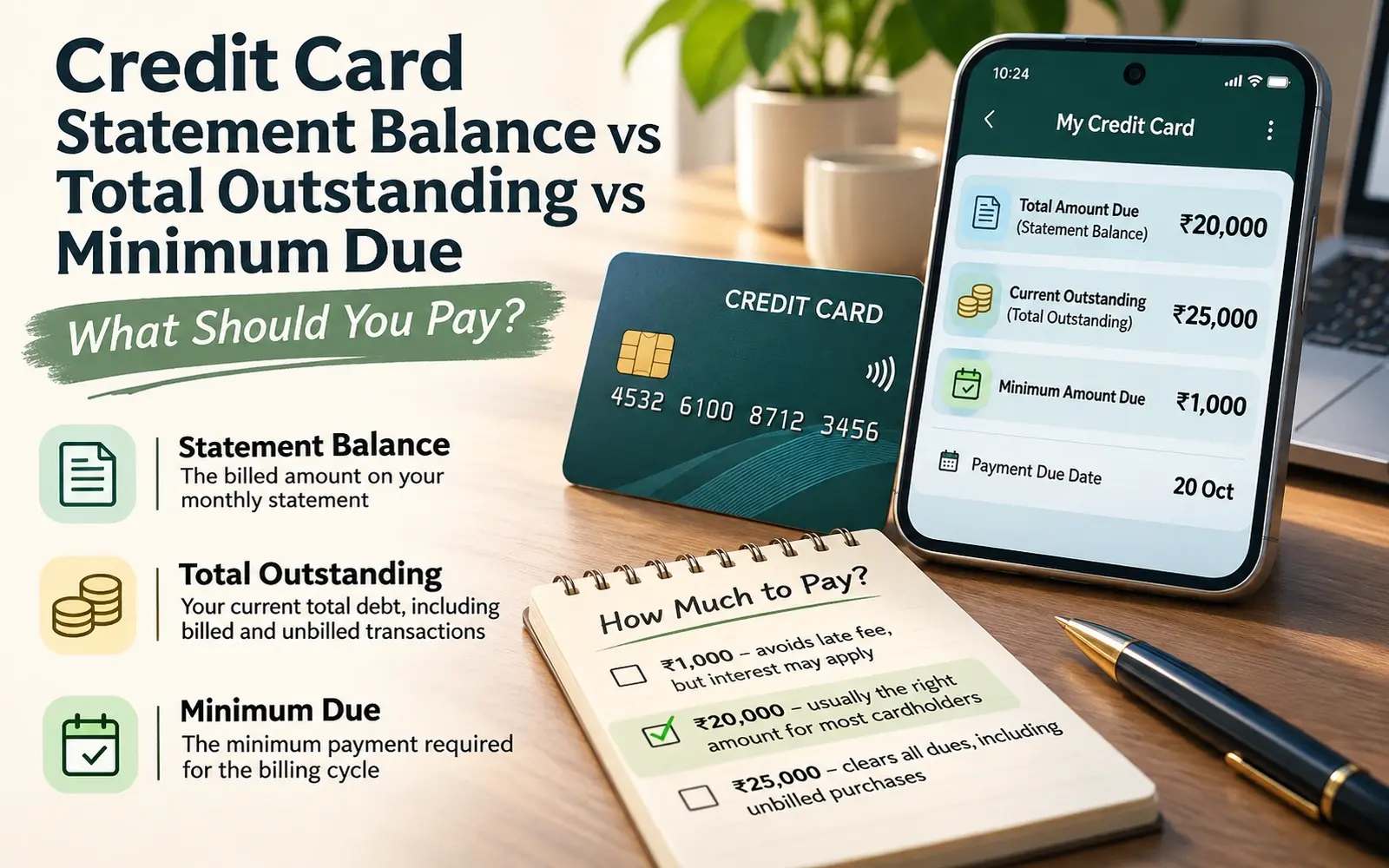
Related reading: understand what is actually due on a card statement.
Sources and Further Reading
- RBI — Commercial Banks: Credit Cards and Debit Cards, Issuance and Conduct Directions, 2025 — EMI transparency and billing requirements.
- RBI — NBFCs: Credit Cards, Issuance and Conduct Directions, 2025 — corresponding requirements for NBFC card issuers.
- CBIC — Sectoral FAQs — banking services, interest exemption and credit card interest, particularly questions 42 and 46.
- CBIC — GST Goods and Services Rates — financial and related services, Heading 9971.
- HDFC Bank — EasyEMI credit card terms — merchant payback, charges, credit limits, reward exclusions and preclosure.
- ICICI Bank — Instant EMI terms and conditions — interest calculation, GST, repayment, rewards and cancellation.
- Apple India — EMI, No Cost EMI and Instant Cashback Terms — upfront interest-offset discounts and promotion conditions.
- RBI — Key Facts Statement for Loans and Advances — APR disclosure and scope of the KFS framework.
- RBI — Complaint Management System — complaint escalation for eligible regulated entities.