
How to File a Car Insurance Claim After an Accident in India
Learn how to report a car accident, submit insurance claim documents, get repair approval, choose cashless or reimbursement settlement and dispute unfair deductions in India.
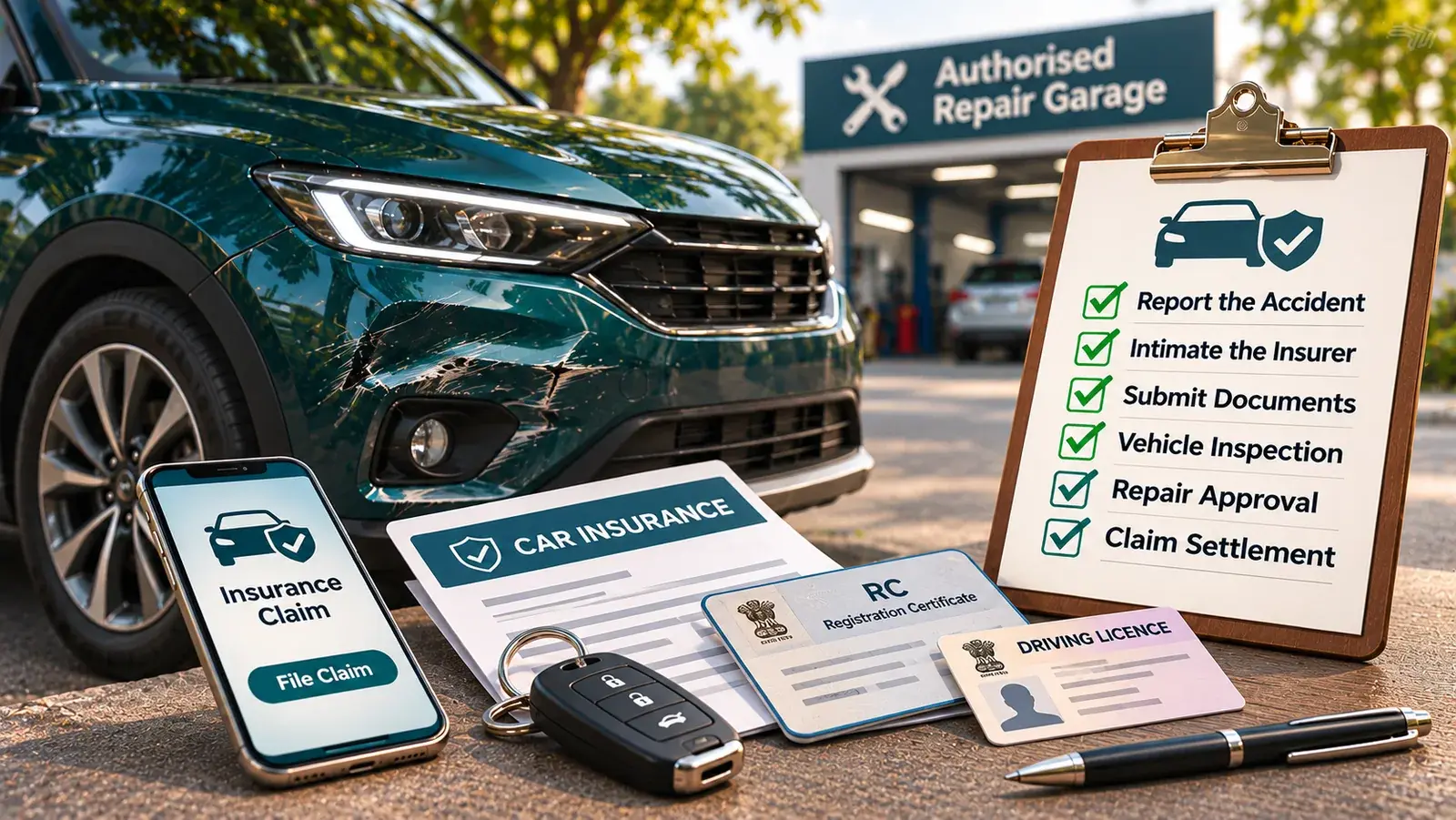
Quick Answer
After an accident, ensure everyone's safety, inform your insurer, document the damage and obtain repair clearance before work begins. Use an eligible cashless garage if you want to avoid paying the entire repair bill upfront.
| Situation | What to do |
|---|---|
| Someone is injured | Call 112 and arrange medical assistance |
| Another vehicle or property is damaged | Inform police and insurer |
| Your car is unsafe to drive | Arrange suitable towing |
| Only your car has minor damage | Report it and compare claim benefits with out-of-pocket repair |
Third-party-only insurance does not pay for damage to your own car. You need active own-damage cover for that, subject to your policy terms.
1. What to do immediately after the accident
- Stop safely, switch on hazard lights and move yourself away from traffic when safe.
- Help injured people and call 112 if emergency assistance is needed.
- Once safe, photograph the damage, vehicle positions, number plates and surroundings. Save dashcam footage and witness details.
- Exchange contact, registration and insurance details with the other driver. Provide accurate information; do not agree to a private liability settlement without consulting your insurer.
- Report the accident through your insurer's official app, website or helpline. Save the claim reference number.
Is an FIR necessary? Minor own-damage claims may not require an FIR. If someone is injured or third-party property is damaged, comply with Section 134 of the Motor Vehicles Act: provide information to police or, if no officer is present, report to the nearest police station promptly and within 24 hours. Obtain the applicable police record and follow the insurer's requirements. Do not delay medical care for paperwork.
2. Documents to keep ready
| Document | When needed |
|---|---|
| Policy number or copy, RC | To identify the insured vehicle and cover |
| Driving licence | Of the person driving at the time |
| Claim form and accident details | As requested by the insurer |
| Photos and repair estimate | To establish and assess the damage |
| FIR or police report | Where applicable |
| Repair invoice, payment receipt and bank details | For reimbursement |
The insurer may request additional relevant records depending on the accident. Share sensitive documents only through verified channels.
3. Cashless vs reimbursement claims
| Cashless | Reimbursement | |
|---|---|---|
| Garage | Insurer-approved arrangement | Garage accepted under policy terms |
| Payment | Insurer pays approved charges to garage | You pay first and claim eligible costs |
| Your share | Deductibles and uncovered costs | Same deductions from reimbursement |
Confirm garage eligibility before towing the car there. Cashless does not mean free repairs.
4. Inspection, approval and repairs
- Ask the garage for an itemised repair estimate and submit it to the insurer.
- Arrange the insurer's damage assessment, which may involve a registered surveyor or a digital inspection for eligible smaller losses.
- Wait for repair clearance. If additional damage is discovered during dismantling, ask the garage to obtain supplementary approval before proceeding.
- Confirm approved parts, labour and your estimated contribution. For a badly damaged car, ask whether it will be treated as a total loss instead of repaired; settlement depends on the insured declared value (IDV) and policy terms.
- On completion, inspect the repairs, check warning lights and obtain the final invoice and settlement breakdown. For reimbursement, submit the paid bills and required bank details.
Do not drive a damaged vehicle if it may be unsafe. Take necessary steps to prevent further damage, but avoid non-emergency repairs before inspection and clearance.
5. How much will insurance actually pay?
| Possible deduction | Meaning |
|---|---|
| Deductible (compulsory or voluntary) | Your agreed share of the claim |
| Depreciation | Reduction in eligible replacement-part cost |
| Consumables or excluded items | Costs not covered by your policy or add-ons |
| Unrelated damage | Old damage or work outside this accident |
Zero-depreciation cover may reduce eligible depreciation deductions, but other charges can still apply. For minor damage, compare the expected payout with your deductible and potential loss of the No Claim Bonus (NCB) on renewal.
6. Delayed or rejected claim? Know your rights
Under IRDAI's 2024 policyholder-protection master circular (Part C), where a surveyor is required, allocation should occur within 24 hours of reporting and the report is due within 15 days of allocation. These are claim-handling timelines, not guaranteed repair completion dates. Motor losses below ₹50,000 need not undergo a mandatory registered-surveyor assessment.
Report promptly, but a late report or missing paperwork alone is not grounds to reject or close a claim under the circular. Coverage exclusions and the circumstances of the loss still matter.
- Ask for written reasons, policy clauses and an itemised deduction statement.
- Complain to the insurer's grievance officer; track or escalate through IRDAI Bima Bharosa.
- If dissatisfied with the response, or if no response arrives within 30 days, check eligibility and filing limits for the free Insurance Ombudsman process.
Third-party injury, death and liability disputes follow a separate legal process, which may involve the Motor Accident Claims Tribunal (MACT). Forward any notices to your insurer and seek legal assistance where necessary.
Sources and useful links
Exact coverage and garage procedures depend on the policy.
- Ministry of Home Affairs — emergency response number 112
- Motor Vehicles Act, Section 134 — statutory accident duties (text reproduction)
- ICICI Lombard — accident claim procedure
- ACKO — claim process, FIR and deductions FAQs
- IRDAI master circular, 5 September 2024 — Part C, pp. 45–47 (hosted copy)
- Ministry of Finance — motor claim-settlement framework, 16 December 2025
- Insurance Ombudsman — complaint procedure
Related reading: Car Accessories That Are Actually Useful in India, including dashcams for accident evidence.
For the effect of policy add-ons on your share of the bill, see zero-depreciation versus comprehensive car insurance.