Zero-Depreciation Car Insurance vs Comprehensive Insurance: Which Protection Is Worth Paying For?
Understand zero-depreciation car insurance in India, how repair claims differ from standard comprehensive cover, what is excluded and when the extra premium is worthwhile.

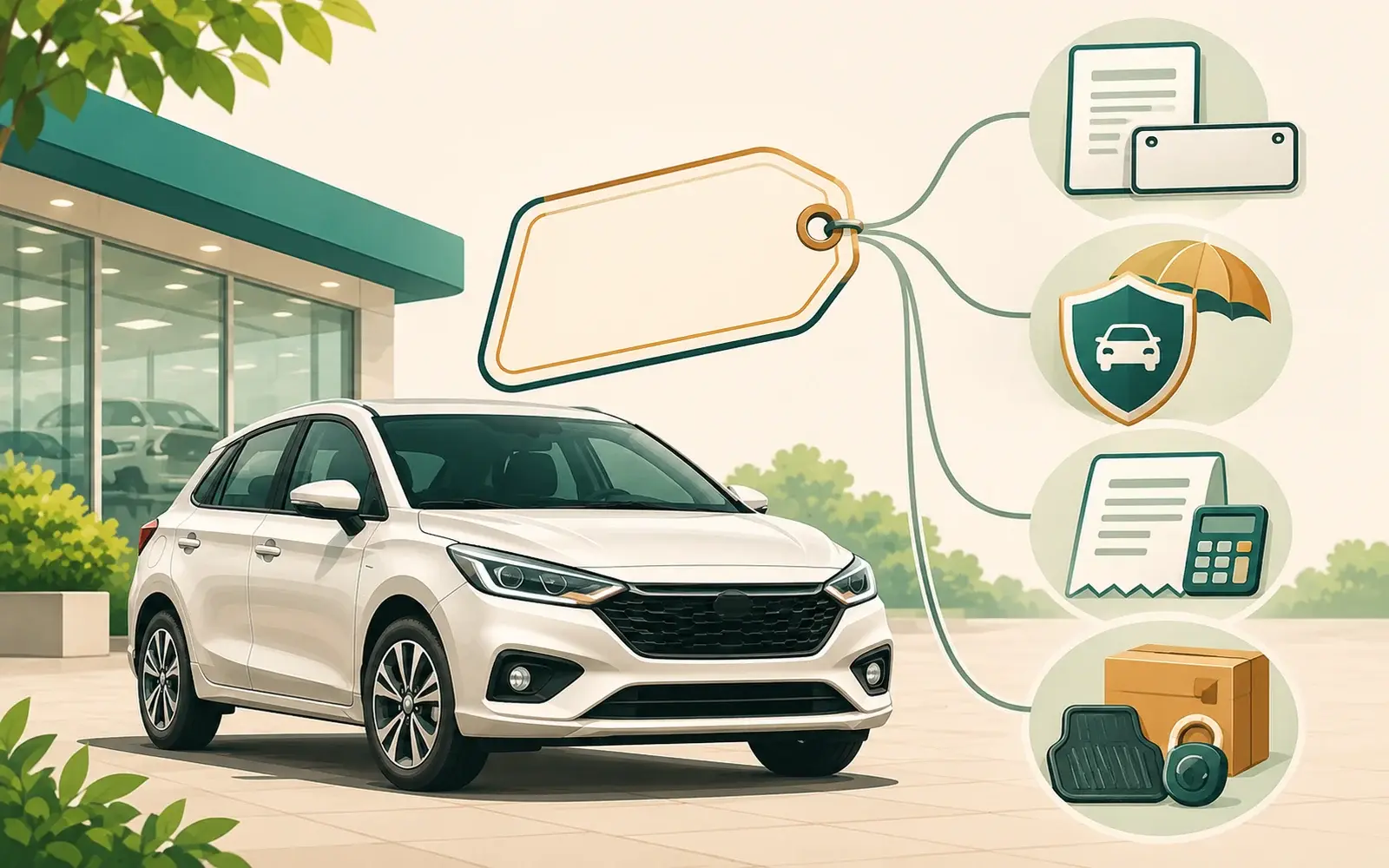
A car's bumper, headlamp and front fender need replacing after a collision. The workshop prepares a bill of ₹50,000, and the owner expects the comprehensive insurance policy to take care of it. Yet the approved insurance payment is considerably lower. Part of the difference comes from depreciation deductions on replacement parts, even though the workshop must install new ones.
This is the financial gap that zero-depreciation insurance is designed to reduce. But paying for it does not necessarily eliminate every expense after an accident, nor does it preserve the original purchase price of the car.
For Indian motorists, the sensible question is not whether zero depreciation is more comprehensive than comprehensive insurance. It is whether waiving certain deductions on eligible repair claims is worth the additional premium, given the car's age, repair costs, policy restrictions and the owner's ability to absorb a surprise bill.
Comprehensive insurance and zero depreciation are not competing policies
Third-party motor insurance protects against specified legal liabilities arising from the use of a vehicle. Under Section 146 of the Motor Vehicles Act, 1988, insurance against third-party risks is generally compulsory for using a motor vehicle in a public place. It does not, by itself, pay for repairs to your own car.
A conventional comprehensive or package policy combines third-party liability with own-damage (OD) insurance. Depending on the contract, OD cover protects the insured vehicle against events such as collisions, theft, fire and floods. A standalone OD policy can also be purchased separately where valid third-party cover already exists. This arrangement is particularly relevant to new-car buyers whose long-term third-party cover continues after their initial OD policy expires.
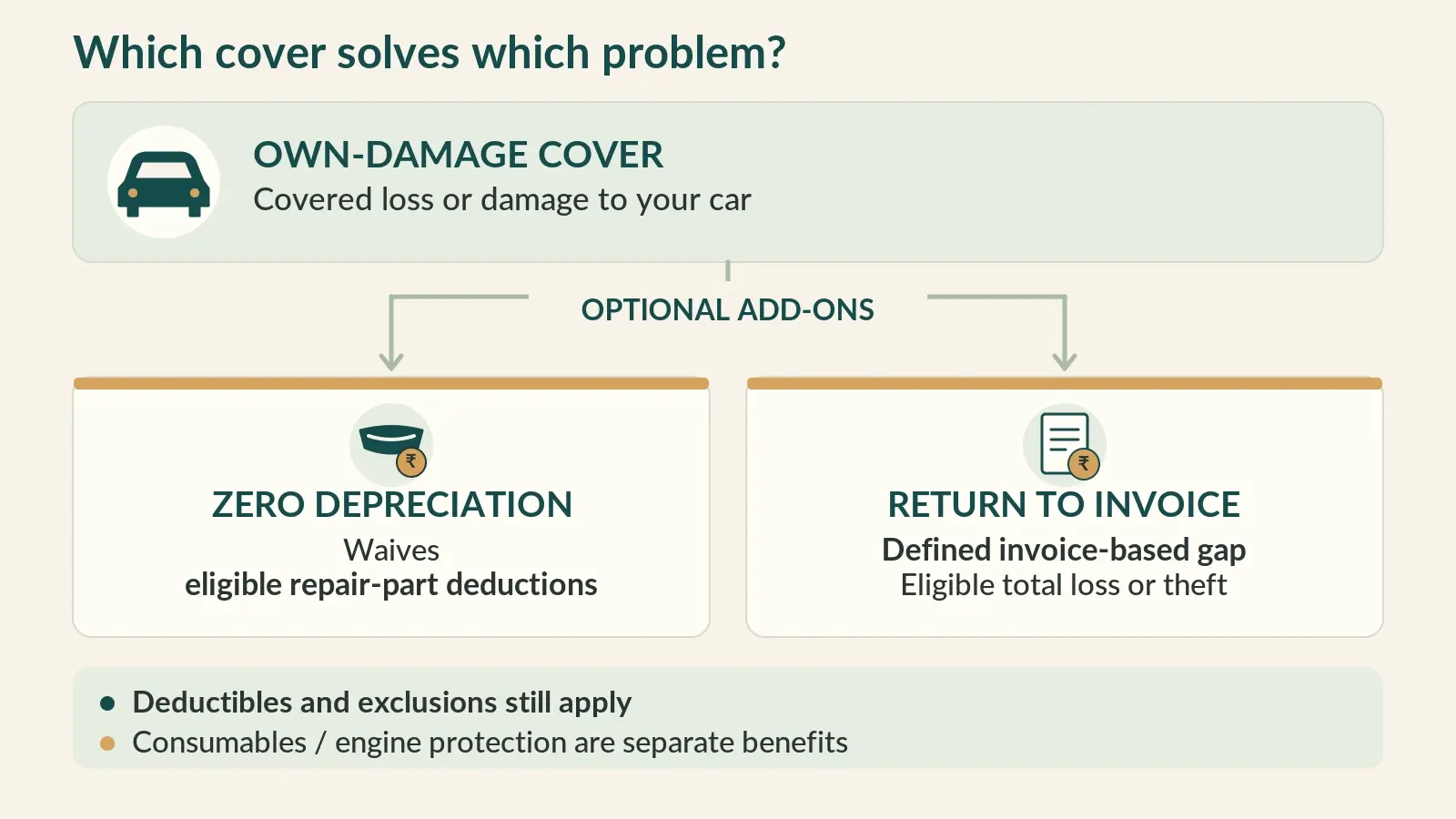
Zero depreciation, sometimes advertised as nil depreciation, zero dep or bumper-to-bumper cover, is an optional enhancement to eligible OD insurance. It changes the calculation of certain covered repair claims, rather than replacing the underlying protection.
| Feature | Standard comprehensive cover | Comprehensive cover with zero dep |
|---|---|---|
| Third-party liability | Included | Included through the base policy |
| Covered accidental damage to own car | Included | Included through the base policy |
| Depreciation on replaced parts | Applicable under policy terms | Waived for eligible parts and claims |
| Deductibles and exclusions | Apply | Generally still apply |
| Theft or total loss | Settled under applicable IDV terms | Generally unchanged by zero dep alone |
| Premium | Base policy premium | Base premium plus add-on charge |
A regulatory change is also approaching: IRDAI's circular dated 2 November 2026 (IRDAI/CIR/MOT/10/2026) schedules a four-section structure for private motor policies issued from 15 December 2026, distinguishing third-party liability, occupant liability, personal accident protection and OD cover. It requires an option form and customer information sheet. As of 24 November 2026 this is an announced future change, not yet effective. The central distinction in this article remains the same: depreciation protection modifies eligible OD settlements. Check the latest applicable policy documents when buying or renewing.
Why does an insurer deduct depreciation on a new replacement part?
Insurance ordinarily indemnifies an insured loss rather than automatically paying every rupee of a workshop invoice. A damaged component may have been in use for several years, but replacing it with a new component costs today's replacement price. Under traditional motor policy schedules, the insurer deducts a prescribed share from the approved replacement cost to account for depreciation.
For example, the published ICICI Lombard private car package policy uses the following schedule:
| Replacement component | Depreciation deduction under this example wording |
|---|---|
| Rubber, nylon and plastic parts; tyres, tubes, batteries and airbags | 50% |
| Fibreglass components | 30% |
| Glass parts | Nil |
| Other parts, including metal components | Age-dependent, nil to 50% |
For a metal component under this wording, the rate is nil during the first six months, 10% for a car over one year and up to two years old, and 15% for a car over two years and up to three years old. The schedule rises with vehicle age. Painting is treated separately: 50% depreciation applies to the material element; where paint labour and material are billed together, the wording assumes materials represent one-quarter of the consolidated painting charge.
These percentages illustrate a commonly encountered contractual schedule, not a guarantee that every policy sold today or in the future uses identical rates. Special exclusions and limits can also apply, notably to tyres.
The distinction is significant in modern cars. A plastic bumper can be expensive, and a plastic or composite assembly may house sophisticated electronics. The depreciation category and approved replacement cost must be established from the actual parts and policy, not merely their appearance. A headlamp assembly, for instance, should not automatically be treated as a glass part just because it contains a transparent lens.
Zero dep can waive the applicable depreciation on eligible replacements. It does not make ordinary maintenance or unrelated damage insurable.
A ₹50,000 repair claim: how much does zero dep actually save?
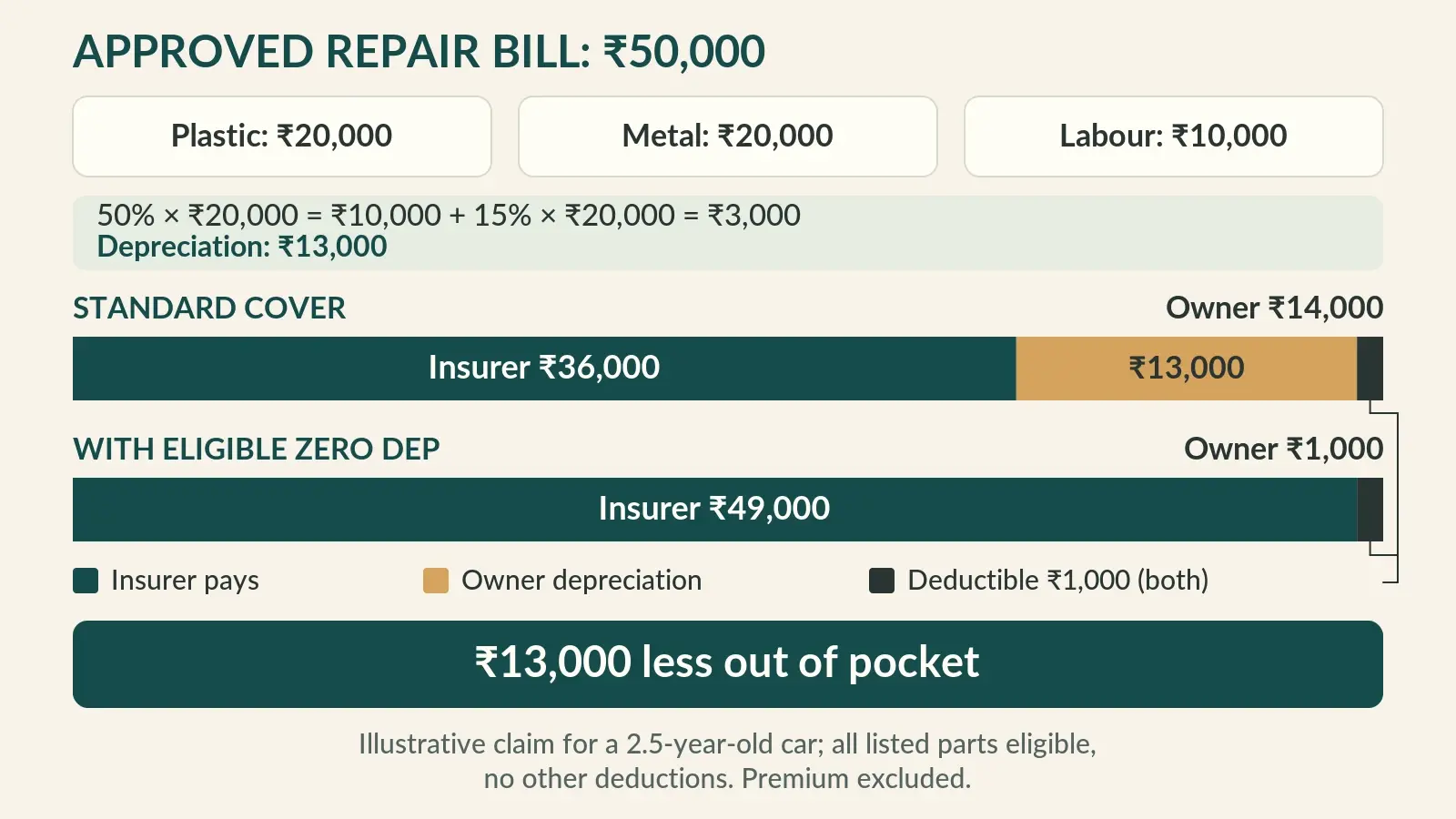
Suppose a two-and-a-half-year-old car suffers accidental damage. The insurer approves the following replacement and repair amounts. For simplicity, assume all listed parts qualify under the add-on, there is no paint-material deduction, and the only other deduction is a ₹1,000 policy excess (deductible).
| Approved work | Cost | Standard depreciation | Deduction |
|---|---|---|---|
| Plastic bumper and trim | ₹20,000 | 50% | ₹10,000 |
| Metal body panel | ₹20,000 | 15% | ₹3,000 |
| Approved labour | ₹10,000 | None in this example | ₹0 |
| Total | ₹50,000 | ₹13,000 |
Under standard comprehensive insurance, the illustrative settlement is ₹50,000 minus ₹13,000 depreciation and ₹1,000 deductible, leaving ₹36,000 paid by the insurer and ₹14,000 paid by the owner.
With eligible zero-depreciation cover, the ₹13,000 deduction is waived. The insurer pays ₹49,000, and the owner still pays the ₹1,000 deductible. The improvement in the claim settlement is ₹13,000.
This is not an actual claim quotation. It isolates the effect of the add-on; real claims may involve revised estimates, different parts classifications, taxes, exclusions, policy limits and additional deductibles. The additional premium for the cover is not included in either settlement figure.
A different accident might primarily require labour-intensive repairs rather than part replacement. In that case, the depreciation avoided could be small. The size of the workshop bill alone therefore does not tell you how valuable zero dep will be.
What zero-depreciation insurance still does not cover
The expression bumper-to-bumper can create an impression of unlimited protection. In practice, the base policy must first accept the claim, and the additional cover must apply to that particular loss.
Deductibles, consumables and workshop extras
A compulsory deductible is the amount the policy requires you to bear on a claim. A voluntary deductible may increase that contribution in exchange for a premium discount. Neither is automatically removed by zero depreciation. Some add-ons may impose a further deductible of their own.
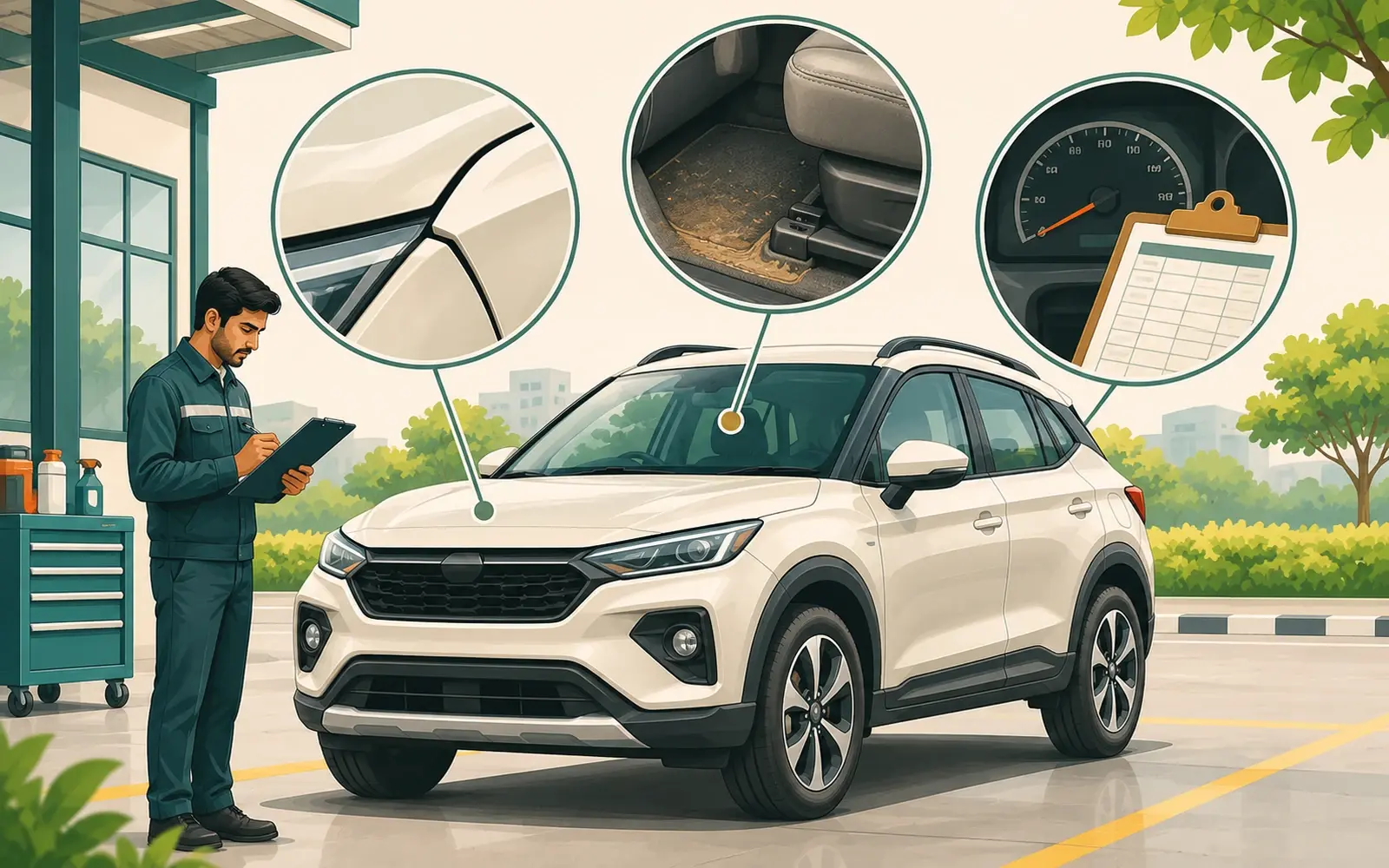
Consumables such as oils, grease, clips, fasteners and coolant can also remain payable by the owner unless the contract specifically covers them. An insurer may approve repairing a part rather than replacing it, or reject work unrelated to the insured accident. Even a cashless repair at a network garage can leave an amount to pay before collecting the vehicle.
Wear, mechanical failures and flood-related engine damage
Replacing worn tyres, a failing clutch or an ageing battery is generally maintenance, not an insured accident. Zero dep does not convert these costs into admissible claims. Damage caused by excluded conduct, such as intoxicated driving, is not made payable by adding depreciation protection.
Direct damage from flooding may qualify under OD cover, but consequential internal engine damage, for example after attempting to restart a waterlogged car, may be excluded. An engine protection add-on can address specified risks that ordinary OD insurance excludes, subject to its conditions. If the car stalls in floodwater, do not attempt to restart it; arrange safe recovery and contact the insurer.
Part exclusions and limited claims
Not all insurers waive depreciation on the same components. For example, an HDFC ERGO annual private-car zero-depreciation endorsement specifically excludes tyres. Digit's published product explanation identifies tyres and batteries as excluded from its depreciation benefit.
The ICICI Lombard package wording linked above illustrates another restriction: its zero-depreciation endorsement applies to the first two claims during the policy period. Later claims revert to the base depreciation treatment under that endorsement. Other products may have different limits or no numerical cap. These examples are product-specific, not company-wide promises for every available plan.
Zero depreciation does not prevent the car's insured value from falling
Insured Declared Value (IDV) is the insured vehicle value specified in the policy. It matters particularly in theft, total loss and constructive total loss settlements. It is not the same as the replacement-part depreciation used for repairable accident claims.
Imagine a car originally bought for ₹12 lakh has an agreed IDV of ₹8 lakh at renewal. If the vehicle is stolen and an eligible total-loss claim is accepted, adding zero dep does not normally convert the settlement basis from ₹8 lakh to ₹12 lakh. In traditional package wordings, a constructive total loss can arise when eligible retrieval and repair costs exceed 75% of IDV; the exact terms of the policy must be checked.
Return to Invoice (RTI) is a separate add-on that may pay a defined difference between the underlying total-loss settlement and an invoice-based value. It has its own eligibility, limits and exclusions. If the concern is the financial loss after theft rather than the cost of repairing a bumper, RTI is the more relevant cover to investigate.
Is the additional premium worth paying?
Zero dep is a way to transfer uncertainty about future repair costs to an insurer. Its value depends on the additional premium and the deductions it could save, not simply on whether you are buying a new car.
Suppose two otherwise identical annual quotes differ by ₹3,000 because one includes zero dep. If the ₹50,000 accident described earlier occurs and qualifies, the add-on increases the payout by ₹13,000. After considering the extra premium, the buyer is ₹10,000 better off in that scenario. If there is no claim, the extra ₹3,000 has purchased protection that was not used.
The simplified break-even probability for that single type of eligible claim is ₹3,000 divided by ₹13,000, or about 23%. This is a hypothetical financial threshold, not an estimate of your accident risk. Other claim sizes, multiple claims, coverage caps and the value of financial predictability change the decision.
When zero dep deserves serious consideration
It is often attractive for a new or relatively young car, particularly one with costly body parts, lighting assemblies or sensors, and for drivers who would struggle to absorb a substantial unexpected repair contribution. Frequent driving and regular parking in crowded places can increase exposure to damage, though neither predicts a claim with certainty.
Older cars may still benefit if eligible. Their age-related component deductions can be higher, but add-on premiums, restricted availability, inspection requirements and the vehicle's declining IDV may weaken the case. A blanket rule that all cars become ineligible after five years is not reliable. Obtain a quote for the exact vehicle.
When standard comprehensive cover may be sufficient
An owner with a modestly priced older car, a healthy repair fund and limited driving may reasonably decide against the extra protection. A high add-on premium with narrow exclusions or a restrictive claim limit may offer poor value. Compare actual alternatives rather than dropping OD cover entirely just to reduce the bill.
Remember the No Claim Bonus (NCB), a renewal discount generally applied to the OD premium. An OD claim can affect future NCB even when zero dep is used, unless a separate applicable protection preserves it. For minor damage, ask how claiming would affect your renewal before deciding whether to pay privately; still comply with reporting obligations and never delay necessary safety repairs.
How to compare quotes and handle a repair claim
When buying or renewing, ask for both versions of the quotation with the same IDV, deductibles, OD term and other benefits. The difference in total payable premium is the genuine price of the extra cover. Compare the following items in the policy schedule, customer information sheet and endorsement rather than relying on a sales agent's description:
- The vehicle's age eligibility, renewal conditions and exact add-on premium.
- How many depreciation-free claims are allowed and which parts or painting costs are excluded.
- Whether a particular garage network, prior approval or a special deductible applies.
- Whether consumables, engine protection, RTI and NCB protection are included separately or absent.
- The IDV, OD expiry date and validity of third-party insurance.
After an accident, prioritise safety, obtain emergency assistance when needed, notify the insurer promptly and follow its documentation and inspection process. Photograph damage where safe, preserve the repair estimate and obtain the necessary approval before non-emergency repairs. Ask for an itemised settlement showing the reason for every deduction, including which amounts were waived under zero dep.
If the insurer's explanation conflicts with the contract, raise a written grievance through its official grievance channel. Unresolved concerns can be registered through IRDAI's Bima Bharosa portal. The Council for Insurance Ombudsmen explains eligibility and procedures for escalating qualifying disputes.
The bottom line
Comprehensive insurance provides the foundation for protecting your car against covered losses. Zero depreciation improves that protection by reducing eligible part-replacement deductions, not by covering every accident expense or keeping the insured value of the car constant.
For newer cars and owners who prefer predictable repair costs, a reasonably priced, broad zero-dep endorsement is often worthwhile. For older or inexpensive cars, compare its price with realistic potential deductions and your ability to pay them. The strongest policy is the one whose actual terms cover the risks you cannot comfortably bear, not necessarily the one with the longest list of add-ons.
Sources and further reading
- Motor Vehicles Act, 1988 — India Code — statutory third-party insurance framework.
- Department of Consumer Affairs — Car Insurance consumer guidance — policy categories and basic consumer considerations.
- ICICI Lombard — Private Car Package Policy wording — parts depreciation, IDV and example zero-dep endorsement.
- HDFC ERGO — Annual private-car zero-depreciation endorsement — example of a tyre exclusion.
- Digit — Zero depreciation cover — product-specific limitations and standalone OD eligibility.
- SBI General — Zero depreciation cover — eligibility and premium considerations.
- IRDAI circular IRDAI/CIR/MOT/10/2026, 2 November 2026 (copy hosted by ricago) — announced four-layer structure effective 15 December 2026; see also Financial Express reporting.
- IRDAI — Bima Bharosa and Council for Insurance Ombudsmen — complaint procedure — grievance routes.