E20 Petrol and Your Car: How to Check Compatibility, Mileage Impact and Warranty Coverage
Is your car ready for E20 petrol? Learn how to verify compatibility in India, interpret mileage changes and understand what warranties actually cover.
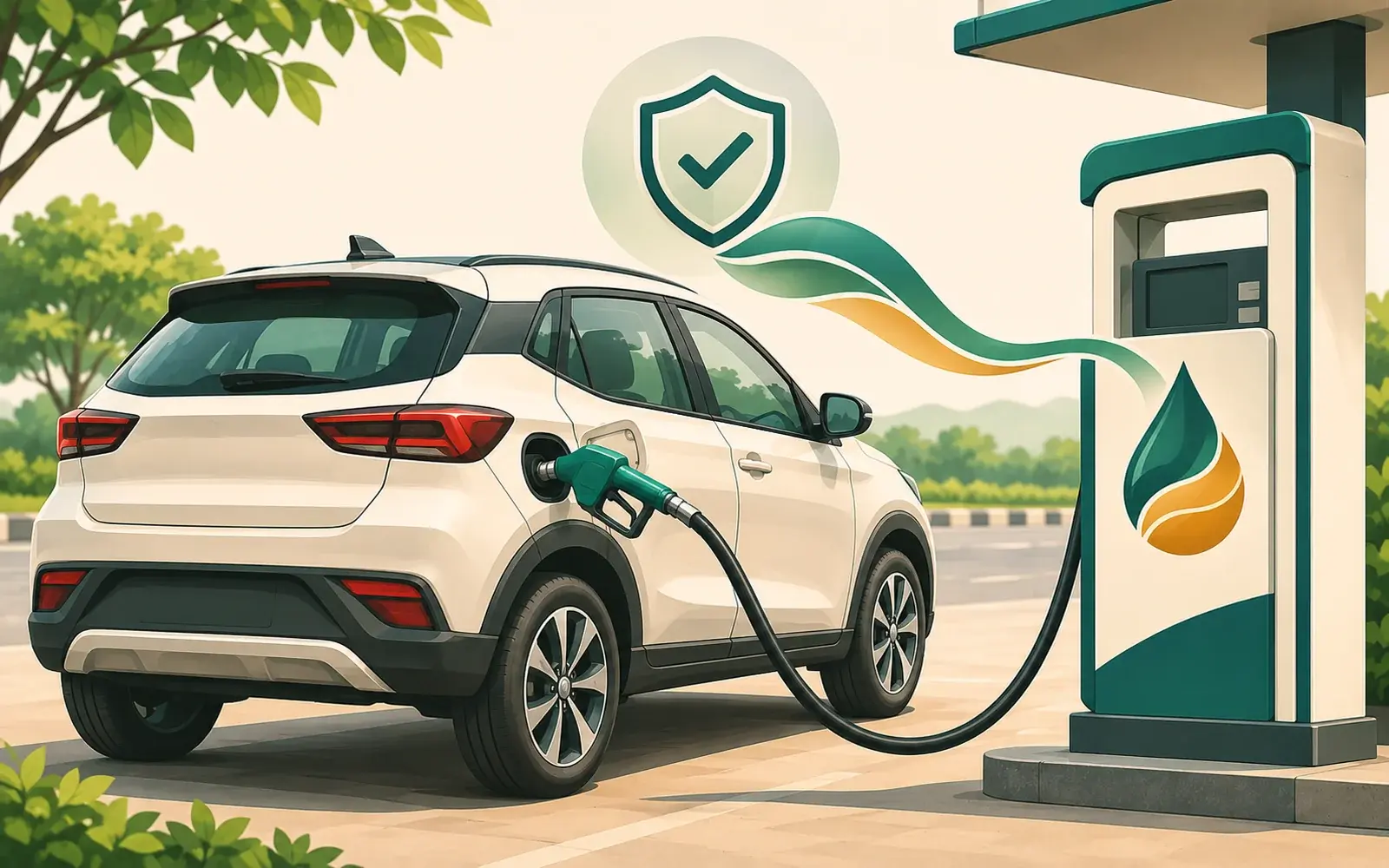
Your car's fuel flap says E10, but the petrol station sells E20. Should you fill up, expect worse mileage, or worry about your warranty?
The answer depends on the exact vehicle, not simply whether it was manufactured before or after a particular year. E20 compatibility, an engine tuned to use E20 efficiently, and warranty coverage are related questions—but they are not the same question.
For most owners, the practical approach is to check the manufacturer's guidance, understand what the mileage figures actually mean, and keep an appropriate service record. Here is how to do that without relying on rumours or blanket assurances.
What is E20 petrol, and what is India's current rule?
E20 means petrol blended with 20% ethanol and approximately 80% petrol, by volume. Ethanol is an alcohol that can be produced from agricultural feedstocks. It raises a blend's resistance to engine knocking, but contains less energy per litre than conventional petrol.
India has progressively expanded ethanol blending. A Ministry of Petroleum and Natural Gas notification dated 17 February 2026, effective 1 April 2026, directs oil companies to sell ethanol-blended motor spirit containing up to 20% ethanol, meeting Bureau of Indian Standards specifications and a minimum Research Octane Number (RON) of 95, subject to the stated exception for special circumstances.
The wording up to 20% matters: the notification does not mean that every individual litre has been independently measured at exactly 20%. In July 2026, the government reported approximately 20% average blending for November 2025–June 2026 and said it had taken no decision to raise the nationwide standard beyond 20%.
E20 is the mainstream petrol-blending programme, not a requirement to use E85 or other high-ethanol flex-fuels. Those require vehicles specifically designed and certified for them.
E20-compatible does not always mean E20-optimised
Three descriptions commonly get mixed together:
- Material-compatible: Fuel hoses, seals, gaskets, pumps and related components are suitable for exposure to the stated ethanol blend.
- E20-calibrated: The engine's fuel and ignition controls have been tuned to operate appropriately on E20, which can reduce the efficiency penalty.
- Tested or certified for a particular fuel: The vehicle has undergone the applicable test or approval process. The scope and date of that assessment matter.
A car may tolerate E20 without its engine delivering the same efficiency as a newer E20-calibrated version. Conversely, an older manual specifying E10 may reflect the fuel standard in force when the car was approved rather than a proven inability to tolerate E20.
This is why model, powertrain, manufacturing period and the manufacturer's latest clarification are better evidence than a generic social-media list of “safe” and “unsafe” cars.
How to check whether your own car can use E20
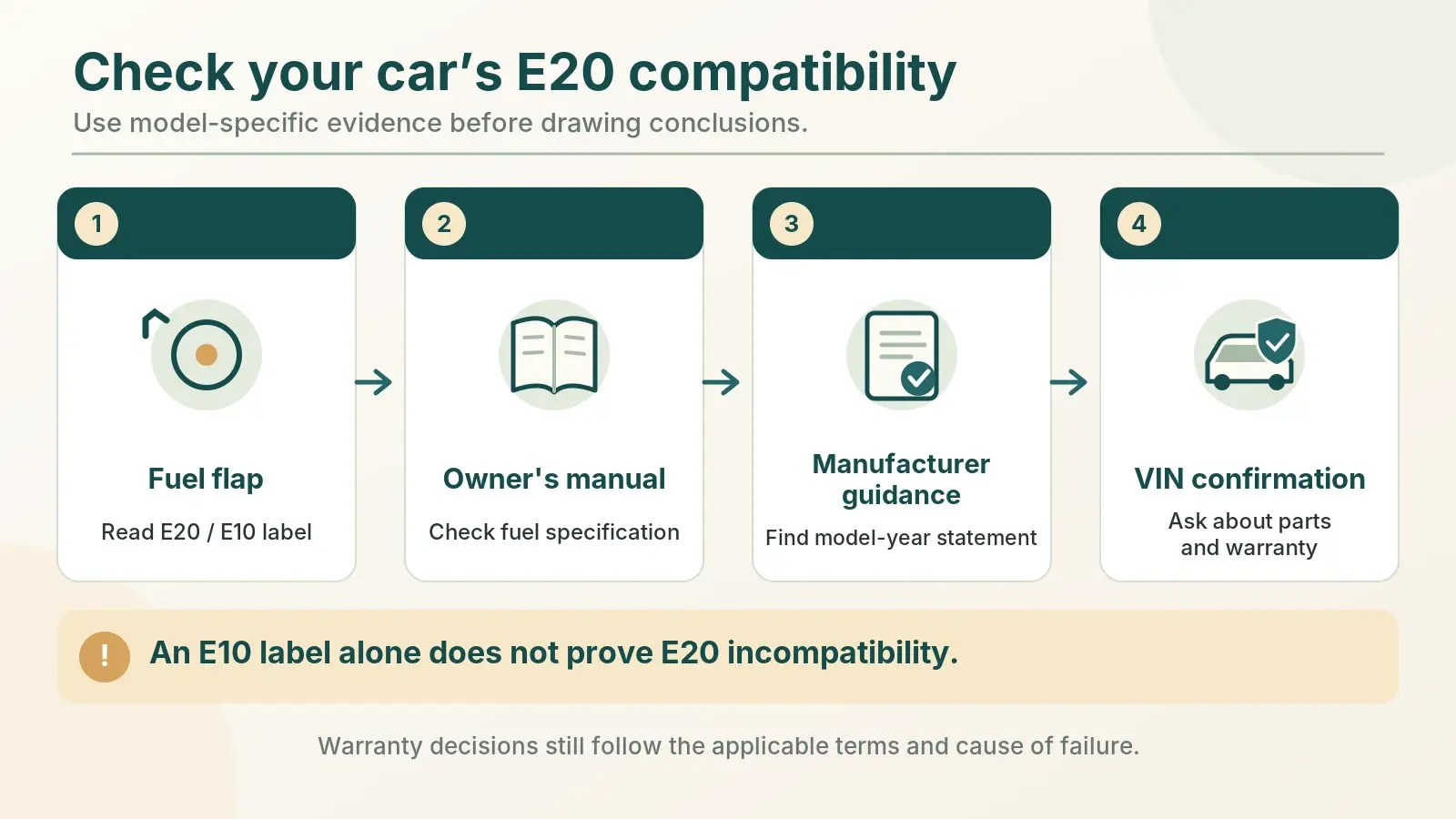
1. Look at the fuel flap and owner's manual
Check the petrol filler area for an E20, E10, E5 or equivalent fuel label. Then find the manual's Fuel requirements or Recommended fuel section. Keep a photo or copy of the relevant page.
An E20 marking is useful positive evidence. An older E10 marking is not a final negative verdict, because some manufacturers subsequently clarified compatibility for vehicles bearing those labels.
2. Check the manufacturer's India-specific guidance
Look for an official FAQ, product bulletin or service announcement rather than a dealer advertisement. Pay close attention to whether the company says material-compatible, calibrated or certified.
Manufacturer examples illustrate why a universal manufacture-year cutoff is misleading:
| Manufacturer | Published India-specific guidance | What it means for an owner |
|---|---|---|
| Honda Cars India | Says cars manufactured in India since 1 January 2009 are E20 material-compatible. | Check that your model and production history fit the statement. |
| Volkswagen India | Says petrol BS-VI cars sold after 1 April 2020 have E20-compatible components, even if the flap says E5/E10. | A sticker alone may be out of date; earlier cars were not evaluated to the same standard. |
| Toyota Kirloskar Motor | Says vehicles manufactured in India from 1 April 2023 are E20 material-compliant; vehicles sold after 1 April 2025 had fuel efficiency measured using E20 under applicable norms. | Material compatibility and the fuel used for efficiency certification are separate milestones. |
These examples are not an exhaustive list of compatible models or a guarantee for imported versions, modified engines or every older vehicle.
3. Ask using your VIN and engine details
If the documentation is unclear, contact the carmaker's customer-care team or an authorised service centre. Provide the vehicle identification number (VIN), model, engine, manufacturing year and any fuel-label photo. Ask:
- Is this specific vehicle approved or considered material-compatible for petrol containing up to 20% ethanol?
- Is the engine calibrated for E20, or should some mileage change be expected?
- Are any inspections or component replacements recommended for its age and condition?
- Does normal use of BIS-compliant E20 affect any remaining manufacturer or extended-warranty cover?
Request a written response where possible. It is more reliable than a verbal assurance that “all cars are fine.”
Will E20 reduce your car's mileage?
It can. Ethanol has lower energy content per litre than petrol, so increasing its share may reduce kilometres travelled per litre. But the size of the change depends on the engine, its calibration and the conditions of the comparison.
The 2021 NITI Aayog ethanol-blending roadmap estimated a fuel-efficiency reduction of 6–7% for older four-wheelers designed for E0 and calibrated for E10, versus 1–2% for four-wheelers designed for E10 and calibrated for E20. These were planning estimates for different vehicle configurations, not a prediction for every car sold today.
In July 2026, the government described the impact for certain E10-designed vehicles as generally around 3–5%. However, independent real-world comparisons by Autocar India in July 2026 found a wider spread across four tested cars: approximately 3.8% to 12.6% lower mileage on E20 than E10 in those specific tests. That small sample does not represent the entire national fleet, but it is a useful reminder that no single percentage applies universally.
What a 5% reduction looks like
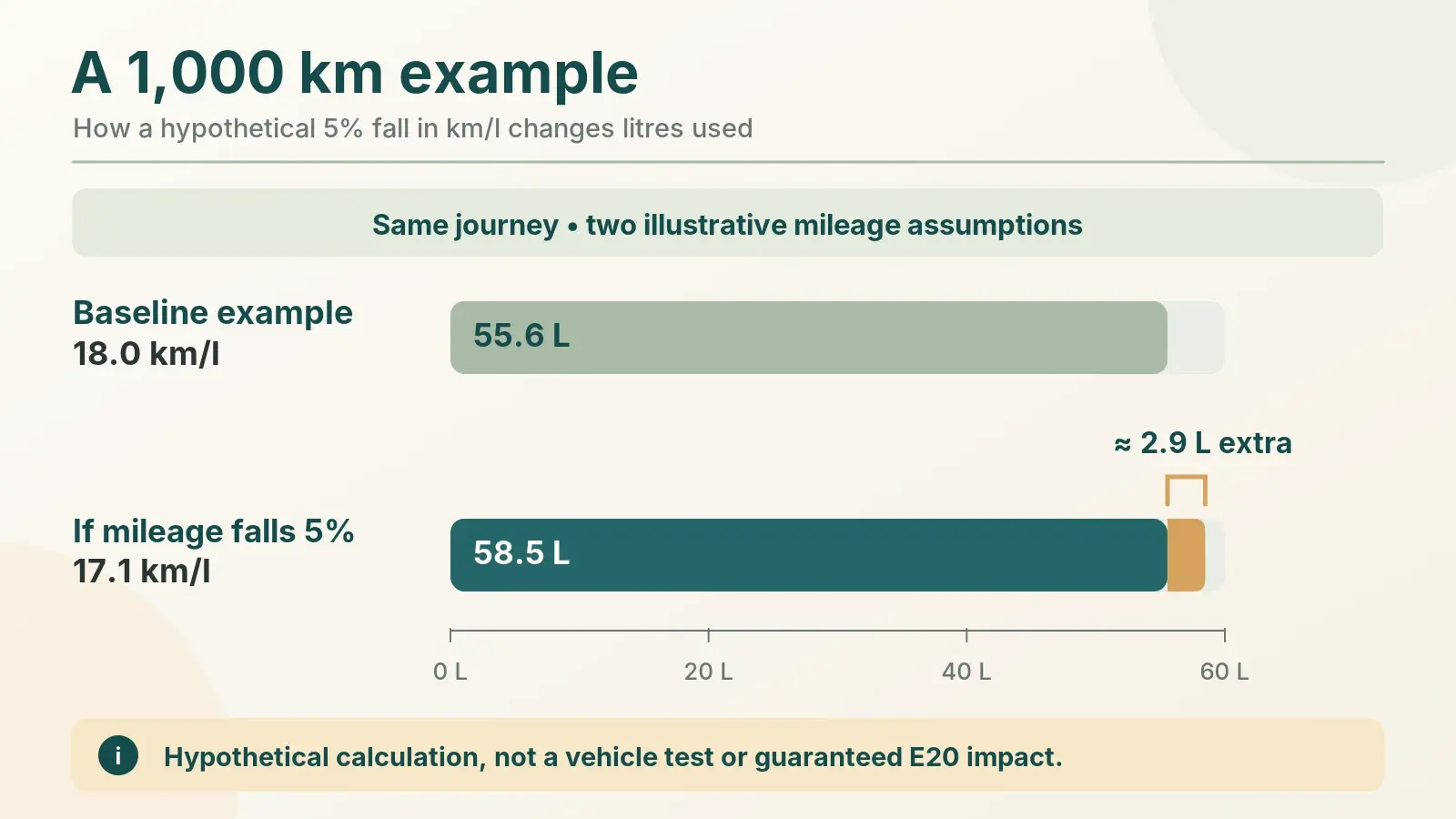
Suppose your car previously returned 18 km/litre under comparable conditions. A hypothetical 5% reduction in kilometres per litre gives:
- Earlier: 18.0 km/litre
- After a 5% reduction: 17.1 km/litre
- Fuel for 1,000 km at 18.0 km/litre: 55.6 litres
- Fuel for 1,000 km at 17.1 km/litre: 58.5 litres
That is about 2.9 extra litres per 1,000 km. It is an illustration of the arithmetic, not an E20 test result or a prediction of your running cost.
Do not compare one tank in free-flowing highway traffic with another in stop-start traffic and attribute the entire difference to ethanol. Tyre pressure, air-conditioning load, driving style, temperature, road gradient and fuel quality also change the result.
For a useful personal comparison, use several full-tank measurements, record distance and litres refilled, keep the driving mix reasonably similar, and note the fuel type if it is verifiably identified. Dashboard mileage displays are convenient but are not a substitute for a consistent measurement method.
Does the higher octane cancel the mileage reduction?
Not automatically. Octane measures knock resistance, not energy content. A vehicle engineered to exploit higher octane may gain performance or efficiency advantages, but a conventional engine does not acquire those benefits merely because its fuel has a higher RON. Do not treat E20's 95-RON specification as a promise of better mileage.
Can E20 damage an older petrol car?
The specific concern is usually long-term material compatibility, especially in older hoses, seals, O-rings, gaskets and some plastic fuel-system parts. Ethanol can affect certain material formulations; compatibility therefore needs validation, not assumption.
India's government and testing agencies report that their laboratory work and field experience have not established widespread engine damage caused by compliant E20. In a 2025 Ministry response, officials also acknowledged that some older vehicles may need certain rubber parts or gaskets replaced earlier. These statements can both be true: no evidence of a widespread failure pattern is not a guarantee that every ageing component in every car is unaffected.
If your car is older or its compatibility remains uncertain, sensible precautions are straightforward:
- Maintain the vehicle to schedule and ask the workshop to inspect the fuel system if there are signs of deterioration.
- Investigate persistent fuel smells, visible leaks, difficult starting or unusual running promptly; do not assume ethanol is the cause without diagnosis.
- Refuel at reputable, authorised outlets and retain the bill when investigating a suspected fuel-quality issue.
- Do not install unapproved conversion kits, fuel additives or substitute parts based solely on online claims.
Toyota reported in July 2026 that a widely circulated concern involving a Toyota Hycross was traced to fuel contamination, not to the compliant E20 blend itself. That example also illustrates why fuel quality and ethanol percentage should not be treated as interchangeable explanations.
Does E20 petrol void your warranty?
Using E20 does not automatically cancel every car warranty in India. Equally, a statement that a manufacturer will honour warranties does not mean that every fuel-system repair is free.
The relevant questions are whether the warranty is still active, what the contract covers, whether the fuel met applicable standards, and what caused the alleged failure.
There are useful manufacturer-specific clarifications:
- Honda Cars India says warranty applicability is unchanged for its India-manufactured, E20-material-compatible cars from 1 January 2009 when the fuel meets E20 standards and specifications.
- Volkswagen India says E20 use does not void the standard warranty for its covered post-April-2020 vehicles. For older, unevaluated vehicles, the company says an extended/parts warranty is not automatically void, but failures resulting from violation of manufacturer guidelines are not covered.
- Toyota Kirloskar Motor says it will continue honouring warranty claims according to the terms and conditions offered at sale.
That last phrase—according to the terms and conditions—is essential. Warranties usually distinguish manufacturing defects from damage caused by contaminated fuel, unauthorised modifications, misuse or neglected maintenance. A car that is already beyond its warranty period does not receive new coverage because E20 is now widespread.
The Ministry of Petroleum and Natural Gas has also stated that E20 use does not invalidate motor insurance in India. Insurance remains a separate contract with its own coverage and exclusions; this is not a promise that every mechanical breakdown is insured.
If a warranty claim is refused
Ask the authorised workshop for a written diagnosis identifying the failed component, test findings, and the exact warranty clause relied upon. Keep the job card, service history and fuel receipts. Escalate unresolved questions to the manufacturer's customer relations team and, where appropriate, India's National Consumer Helpline. Avoid accepting either “E20 always caused it” or “E20 could never cause it” without evidence from the specific vehicle.
What should you do when buying a new or used car?
For a new petrol car, verify the exact variant's E20 specification and ask whether the quoted fuel-efficiency figure was tested on E20. You can still compare mileage figures across models, but compare like with like rather than assuming the test fuel was identical for every older and newer brochure.
For a used petrol car, pay closer attention to the production period, fuel-system condition, maintenance records and any manufacturer clarification for that model. An E10-marked flap is a reason to check—not an automatic reason to reject a good car. Likewise, an E20 sticker does not replace a mechanical inspection.
Owners of cars with CNG conversions, aftermarket fuel-system modifications or unusual engine swaps should get vehicle-specific guidance. A blanket statement about the factory petrol version may not apply to the modified system.
The practical takeaway
E20 compatibility is not a yes-or-no judgment based only on the car's age. Confirm the manufacturer's position for your exact vehicle, separate material compatibility from engine calibration, and measure mileage instead of relying on a universal percentage.
For warranties, look for written, model-specific guidance and the original terms. Compliant E20 is not automatically a reason to cancel coverage, but ordinary exclusions and evidence of the actual fault still matter. A few careful checks are far more useful than either panic about E20 or a promise that every car will behave identically.
Sources and Further Reading
- Ministry of Petroleum and Natural Gas — Gazette notification S.O. 860(E), effective 1 April 2026 — legal requirements for ethanol blending and minimum RON.
- NITI Aayog and Ministry of Petroleum and Natural Gas — Roadmap for Ethanol Blending in India: 2020–2025 — original fuel-efficiency and material-readiness analysis.
- Press Information Bureau — Government highlights safety, performance and national benefits of ethanol-blended petrol, 23 July 2026 — current official interpretation and reported average blending.
- Press Information Bureau — Response to concerns on 20% ethanol blending, 12 August 2025 — durability, older rubber components and insurance clarification.
- Honda Cars India — E20 compliance announcement — Honda's material-compatibility statement.
- Volkswagen India — E20 Compatibility FAQ — year-specific compatibility and warranty guidance.
- Toyota Kirloskar Motor — Official announcements — Toyota's E20 compatibility and warranty statement.
- Autocar India — Worried about E20 fuel? We answer your burning questions, 22 July 2026 — independent contextual reporting and limited real-world mileage comparisons.