What Do Tyre Numbers Like 195/55 R16 Mean? A Guide to Choosing the Right Tyre Size
Decode 195/55 R16 tyre markings, load and speed ratings, compare wheel sizes, and learn how to choose safe replacement tyres for your car in India.
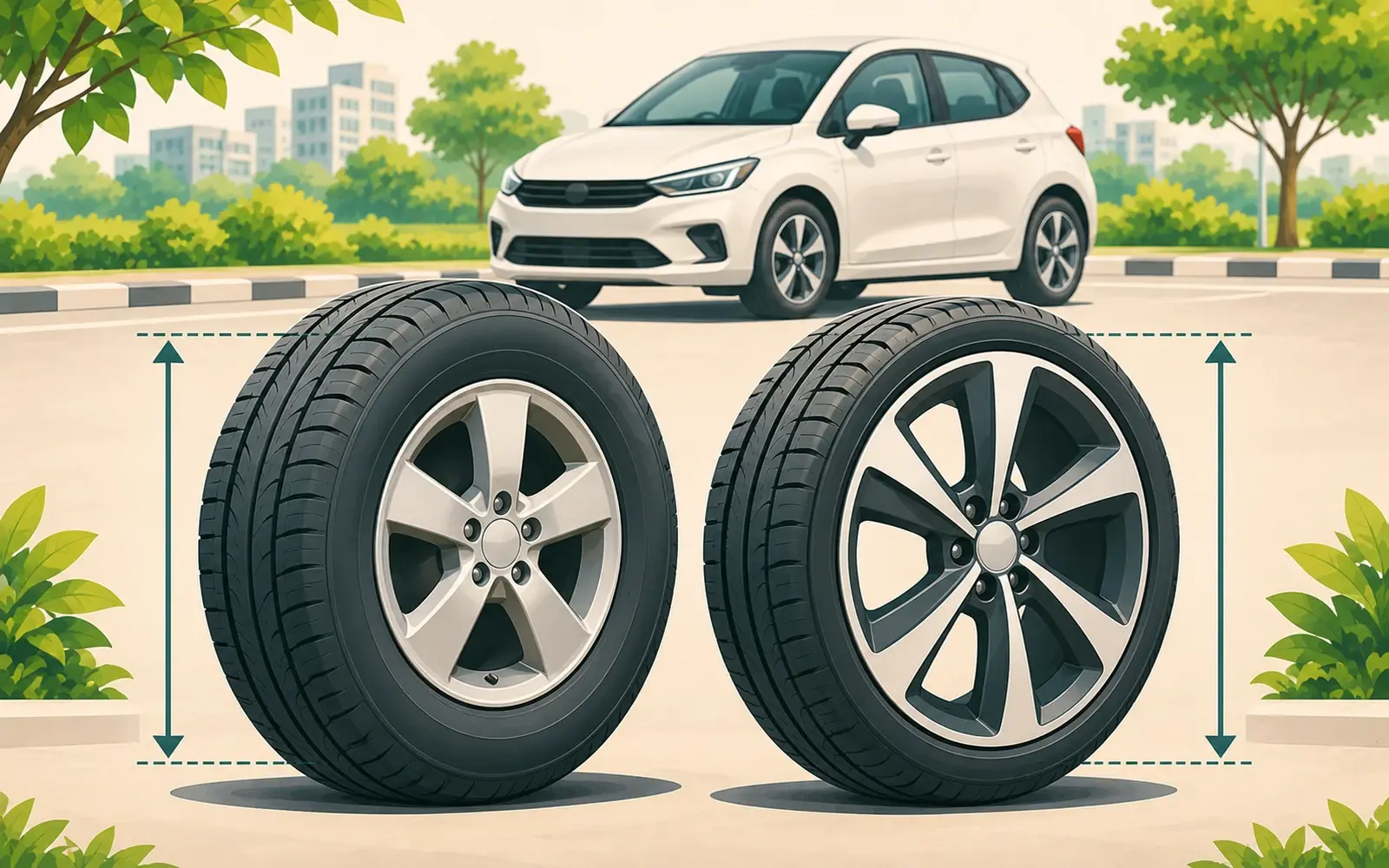
Walk into a tyre shop and ask for a 16-inch tyre. The shopkeeper may offer several options: 195/55 R16, 205/55 R16 or 215/60 R16. All fit nominally 16-inch rims of appropriate width, but they are not interchangeable simply because the last number matches.
The differences affect the tyre's width, the amount of rubber between the rim and the road, and the distance the car travels with each wheel revolution. Choosing incorrectly can change steering behaviour, cause rubbing inside the wheel arch or leave the tyre unable to support the vehicle's intended load.
Fortunately, the numbers are not difficult to understand. Once you can decode a tyre marking, you can compare replacements intelligently rather than relying entirely on the recommendation of a shopkeeper.
What does 195/55 R16 actually mean?
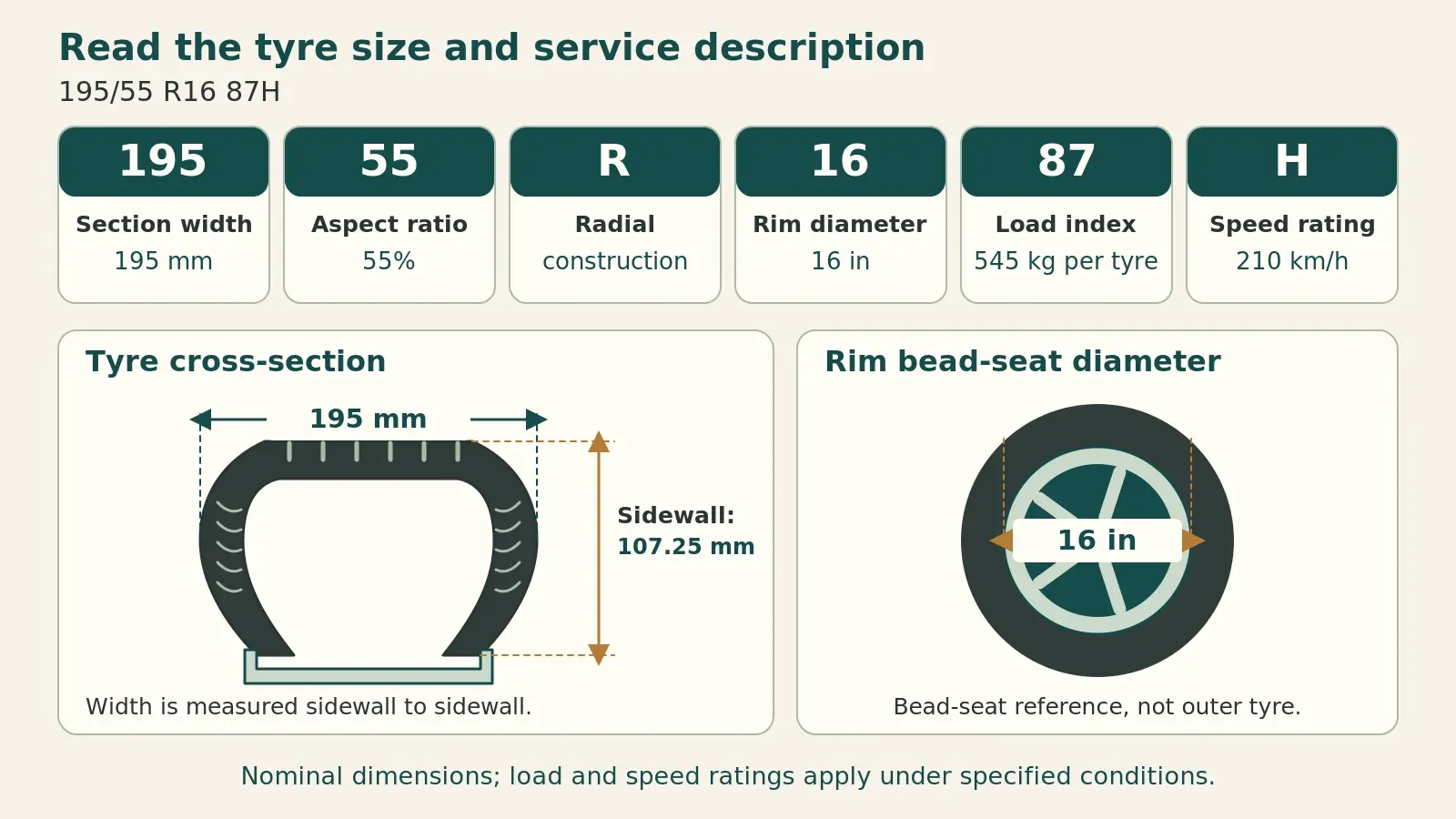
Consider a tyre marked 195/55 R16 87H. The first four elements describe its nominal size and construction. The final two form its service description, indicating its load and speed capabilities.
| Marking | Meaning | In this example |
|---|---|---|
| 195 | Nominal section width | 195 mm |
| 55 | Aspect ratio | Sidewall height is 55% of width |
| R | Construction | Radial |
| 16 | Nominal rim diameter | 16 inches |
| 87 | Load index | 545 kg per tyre under specified conditions |
| H | Speed symbol | 210 km/h rating under specified conditions |
These markings follow established tyre designation conventions, explained in Michelin India's sidewall guide. They identify important specifications, not the quality of a tyre or its suitability for every vehicle.
195: The width of the tyre
The first number is the nominal section width in millimetres, measured across the tyre from sidewall to sidewall under standard measuring conditions. It is not exactly the width of the tread that touches the road.
A 205-section tyre is nominally 10 mm wider than a 195-section tyre. However, actual dimensions can vary between models and with the width of the wheel on which the tyre is mounted. Two tyres carrying identical size markings may not have precisely identical physical measurements.
55: The aspect ratio, not the height in millimetres
The second number expresses sidewall height as a percentage of nominal section width. For our example:
Nominal sidewall height = 195 × 55 ÷ 100 = 107.25 mm
A 205/55 R16 tyre has the same aspect ratio but a nominal sidewall height of 112.75 mm because it is wider. This is why comparing the second number alone can be misleading.
A shorter sidewall generally flexes less and can provide more immediate steering response. A taller sidewall usually offers more cushioning and additional room for deformation over uneven surfaces. Actual ride quality also depends on inflation pressure, tyre construction and suspension tuning.
R: Radial construction
The letter R indicates that the tyre uses radial construction. Its carcass cords run approximately radially from bead to bead, with reinforcing belts beneath the tread. This is the common construction used in modern passenger-car tyres.
R does not mean radius, racing or rim size.
16: The wheel diameter
The last size number is the nominal diameter of the rim at the tyre's bead seating area, expressed in inches. A 16-inch rim corresponds to a nominal 406.4 mm diameter, using 25.4 mm per inch.
A tyre designed for a 16-inch wheel cannot be mounted on a 15-inch or 17-inch wheel. Even among 16-inch wheels, the rim width must be suitable for the particular tyre. The diameter of the rim is also different from the overall diameter of the complete wheel-and-tyre assembly.
Load index and speed rating are just as important
A replacement with the correct dimensions can still be unsuitable if its load index or speed symbol falls below the car manufacturer's requirements.
According to Michelin's load and speed rating tables, load index 87 corresponds to 545 kg per tyre and load index 91 corresponds to 615 kg. These are standard rated capacities under prescribed conditions, not a guarantee that the tyre can carry that load at any inflation pressure or in any condition.
Similarly, H corresponds to a speed category of 210 km/h, while V corresponds to 240 km/h. The speed symbol describes a tested operating capability under specified conditions. It is not permission to drive at that speed on public roads.
Do not calculate your car's permitted payload by multiplying 545 kg by four and subtracting its kerb weight. Weight is not distributed evenly across the four tyres, especially when braking, cornering or carrying passengers and luggage. The manufacturer's gross vehicle weight and axle limits remain controlling constraints.
As a general rule, choose a replacement that meets or exceeds the specified load and speed ratings, while also satisfying all other fitment requirements. A higher rating alone does not make a tyre better suited to your particular car.
Why a bigger rim does not always mean a bigger tyre
A common misconception is that upgrading from 15-inch wheels to 16-inch wheels necessarily increases the overall height of the tyre.
Car manufacturers often compensate for a larger rim by fitting a tyre with a shorter sidewall. This is sometimes called plus-sizing. The idea is to maintain similar overall dimensions while changing the proportions of wheel and rubber.
We can estimate the unloaded nominal overall diameter using this formula:
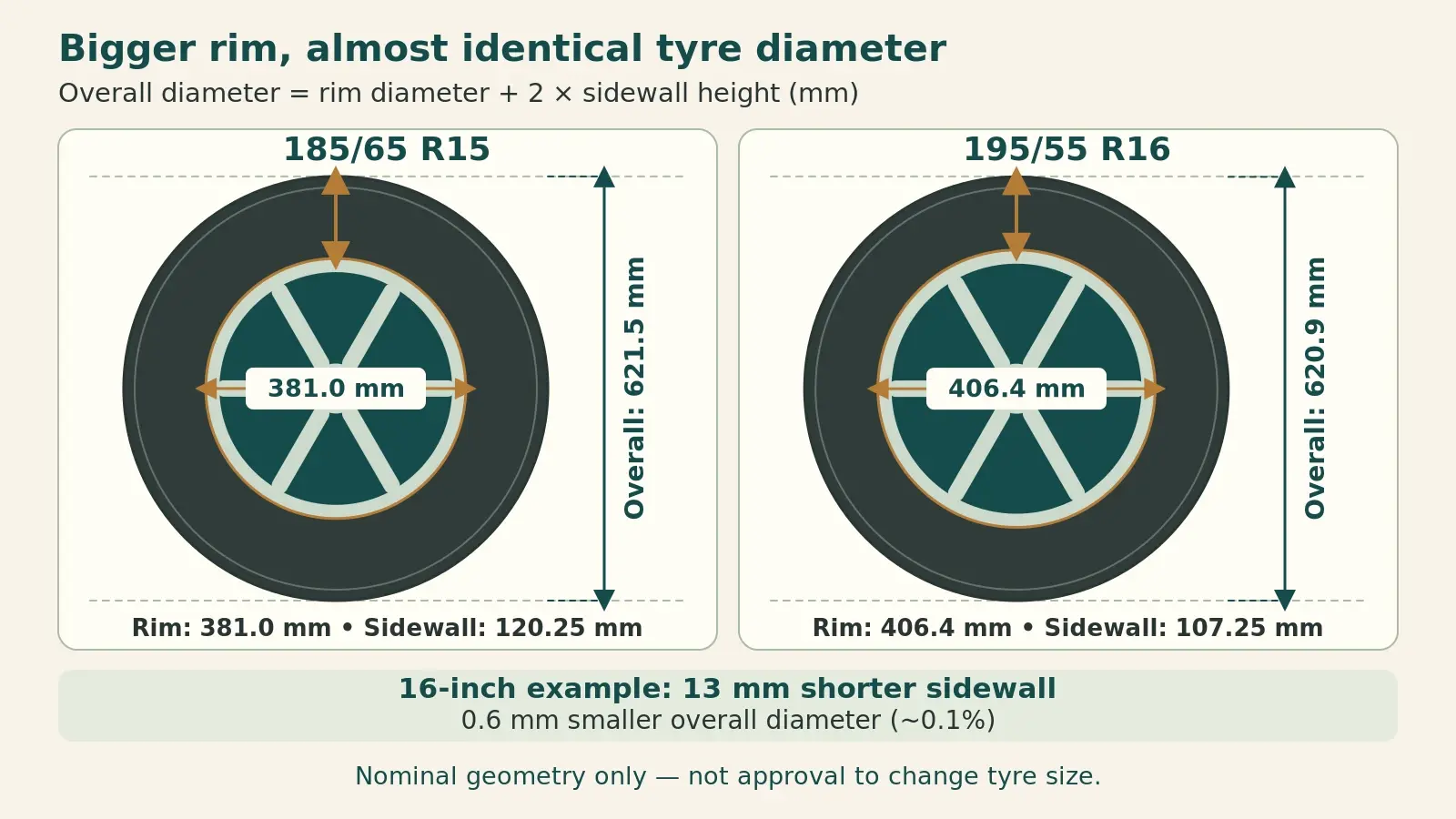
Overall diameter = (rim diameter in inches × 25.4) + (2 × nominal sidewall height)
For 195/55 R16, that gives:
- Rim diameter: 16 × 25.4 = 406.4 mm.
- Two sidewalls: 2 × 107.25 = 214.5 mm.
- Overall diameter: 406.4 + 214.5 = 620.9 mm.
Compare that with 185/65 R15, where the sidewall height is 185 × 0.65 = 120.25 mm.
| Nominal dimension | 185/65 R15 | 195/55 R16 |
|---|---|---|
| Section width | 185 mm | 195 mm |
| Sidewall height | 120.25 mm | 107.25 mm |
| Rim diameter | 381.0 mm | 406.4 mm |
| Overall diameter | 621.5 mm | 620.9 mm |
The 16-inch combination has 13 mm less nominal sidewall height on each side, but its overall diameter is only 0.6 mm smaller — a difference of approximately 0.1%.
This is not merely a theoretical pairing. Maruti Suzuki's Baleno specifications list 185/65 R15 steel wheels on certain variants and 195/55 R16 alloy wheels on others. Manufacturers can offer different combinations for the same vehicle family while preserving similar overall diameters.
These calculations are based on nominal sizes. Real unloaded dimensions, loaded radius and rolling circumference vary with tyre design, wear, pressure and load. The presence of both sizes in a model's brochure does not automatically approve either one for every variant or model year.
What happens if you change to a wider or larger tyre?
Suppose a shop suggests 205/55 R16 as a replacement for 195/55 R16 without changing the rims. Both have a 55 aspect ratio and 16-inch rim diameter, but the wider tyre has a taller sidewall as well.
Its nominal diameter is 406.4 + (2 × 112.75) = 631.9 mm. That is about 1.77% larger than the original 620.9 mm.
If wheel-based speed measurement were perfectly calibrated to the original nominal rolling circumference, an indicated 100 km/h would correspond to approximately 101.8 km/h after this change. This simplified estimate illustrates the direction of the effect; actual speedometers have their own calibration, and real rolling circumferences differ from geometric estimates. It is not a prediction of an actual dashboard reading.
A wider or taller tyre also needs sufficient space when the steering is turned fully and the suspension compresses under load. A wheel with the wrong width or offset can create clearance problems even if the tyre diameter is almost unchanged. Changes in rolling circumference can also affect systems that rely on wheel-speed information.
Online calculators and informal rules such as keeping the diameter within 2% or 3% are screening tools at best. They cannot establish whether a particular combination is approved, safe or suitable. Continental's tyre-size guidance recommends using the specified replacement size and consulting the vehicle manufacturer or a tyre specialist before changes.
Which tyre characteristics matter on Indian roads?
Ride comfort and pothole protection
For a daily commuter using broken city roads and rural stretches, sufficient sidewall height is useful. A low-profile tyre has less room to deform around a sharp pothole before the rim is exposed to impact. That does not mean a taller sidewall prevents all damage, but it can provide a more forgiving starting point.
If comfort and durability matter more than appearance, retaining an approved standard wheel size is often sensible. Do not sacrifice suitable tyre construction or correct inflation pressure simply to gain a larger sidewall.
Grip, monsoon driving and steering
Wider tyres can offer different handling characteristics, especially when paired with appropriate tread and compound. But width alone does not guarantee shorter braking distances or more grip. The rubber compound, tread design, water evacuation, vehicle load and road surface all influence performance.
In standing water, aquaplaning risk depends on speed, water depth, tread condition, pressure and tyre design. A wider tyre is not automatically safer in the monsoon. Prioritise a suitable wet-weather tyre and adequate tread depth over a cosmetic width upgrade.
Fuel economy and ownership costs
Some wider or larger wheel-and-tyre combinations increase mass, aerodynamic drag or rolling resistance. This can reduce efficiency and affect acceleration. Yet a well-designed wider tyre may have lower rolling resistance than another narrower model; size is not the only factor.
Larger rims can also make replacement tyres more expensive, but prices depend on brand, availability and model. Compare the actual cost of a complete set in approved sizes, including fitting, balancing and any required wheel changes, rather than assuming the cheapest individual tyre is the best option.
Other sidewall markings worth checking
Tyre size is only one part of the information moulded into the rubber. Look for these additional details when purchasing replacements:
- XL (Extra Load): Indicates a reinforced load-capacity category. Check the actual load index and required inflation; XL is not a puncture-proof designation.
- Tubeless or TL: Identifies a tyre designed to retain air without a separate inner tube when fitted to an appropriate wheel.
- Rotation arrow or Outside marking: Directional tyres must rotate in the indicated direction; asymmetric tyres must be installed with the designated outside face outward. Some tyres carry both types of fitting instructions.
- Manufacturing date code: A four-digit week/year date marking, when present in the standard format, is read as week followed by year. For example, 2426 indicates the 24th week of 2026. Ask the dealer to identify the date code if markings are unclear.
- Maximum pressure: A tyre's marked pressure limit is not the recommended everyday inflation pressure for your car.
Check new stock for damage, correct identification and the manufacturer's warranty terms. Age matters even when a tyre has plenty of tread left; storage conditions, heat and usage also affect deterioration. Michelin's tyre lifespan guidance recommends professional annual inspections after five years of use and precautionary replacement by ten years from manufacture, or sooner if required. Follow any stricter vehicle or tyre manufacturer guidance.
How to choose the correct replacement tyres
Begin with the owner's manual and the tyre-information label, typically found near the driver's door. The existing tyre is a useful reference but not definitive evidence: a previous owner may have changed the wheels or fitted an incorrect size.
Before placing an order:
- Identify the exact car variant, model year and approved tyre and wheel specifications.
- Match the nominal size, load index and speed symbol to the manufacturer's requirements, along with any special tyre specifications.
- Compare suitable tyre models for wet grip, ride comfort, expected usage and replacement cost.
- If changing size, obtain confirmation from the vehicle manufacturer or its authorised workshop and have a qualified specialist verify the complete wheel fitment, clearance and any applicable requirements.
- After fitting, ensure correct wheel balancing, installation orientation and cold tyre pressure. Investigate abnormal wear or steering pull and arrange alignment when necessary.
Keep matching tyres on each axle, and follow vehicle-specific rules for matching tread depths, especially on all-wheel-drive vehicles. If only two tyres are being replaced on a car with identical front and rear fitments, Michelin generally recommends putting the newer pair on the rear axle to improve stability, subject to vehicle-specific instructions. Do not casually mix sizes across axles unless the car is designed for that arrangement.
Check pressures when the tyres are cold, using the vehicle's specified pressure for the intended load. Regular pressure and tread inspections contribute more to everyday safety than an expensive wheel upgrade that is poorly matched or maintained.
The bottom line
195/55 R16 tells you that the tyre has a nominal 195 mm section width, a 55% aspect ratio, radial construction and a 16-inch rim fitment. Its load and speed markings complete the basic specification.
The best tyre size is not necessarily the widest or the one fitted to the most expensive variant. It is the approved size that meets your vehicle's requirements and suits your driving conditions. Understand the numbers first, then compare actual tyre quality and suitability. That is how you make a better purchase without turning an ordinary replacement into an unnecessary engineering experiment.
Sources and further reading
- Michelin India — Tyre markings explained
- Michelin India — Tyre load rating and speed rating
- Bridgestone Australia — Understanding tyre sizes and calculations
- Continental India — Tyre size and replacement compatibility
- Maruti Suzuki NEXA — Baleno specifications
- Michelin India — Changing tyre size
- Michelin India — Tyre lifespan and ageing
- Michelin India — Tyre rotation and replacement
- NHTSA — Tyre safety and cold inflation pressure (general safety guidance; not Indian law)