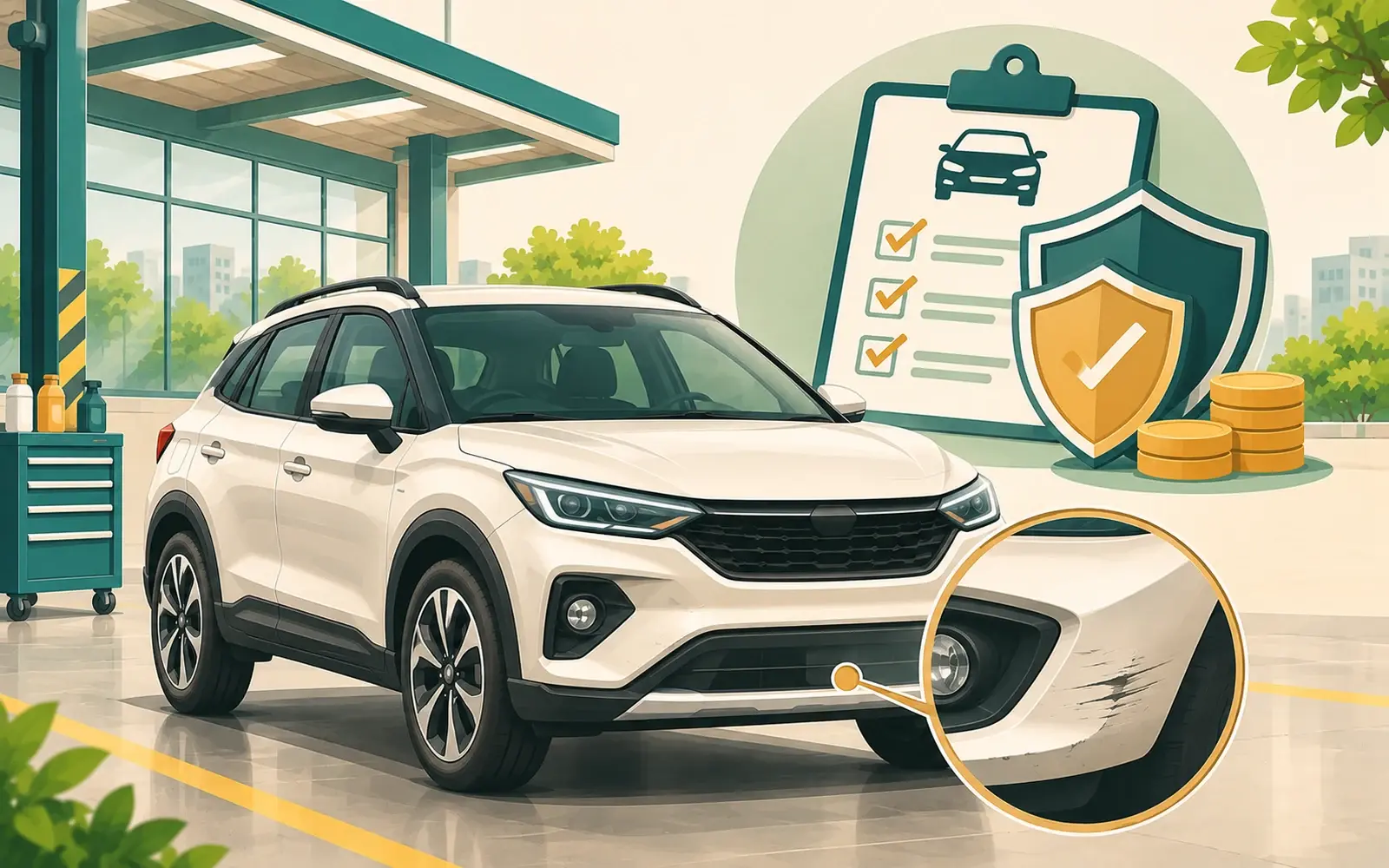
How to Inspect a Used Car for Accident Damage, Flood Damage and Odometer Tampering
Learn how to spot hidden accident repairs, flood damage and mileage tampering in used cars in India, verify records and arrange an independent inspection.
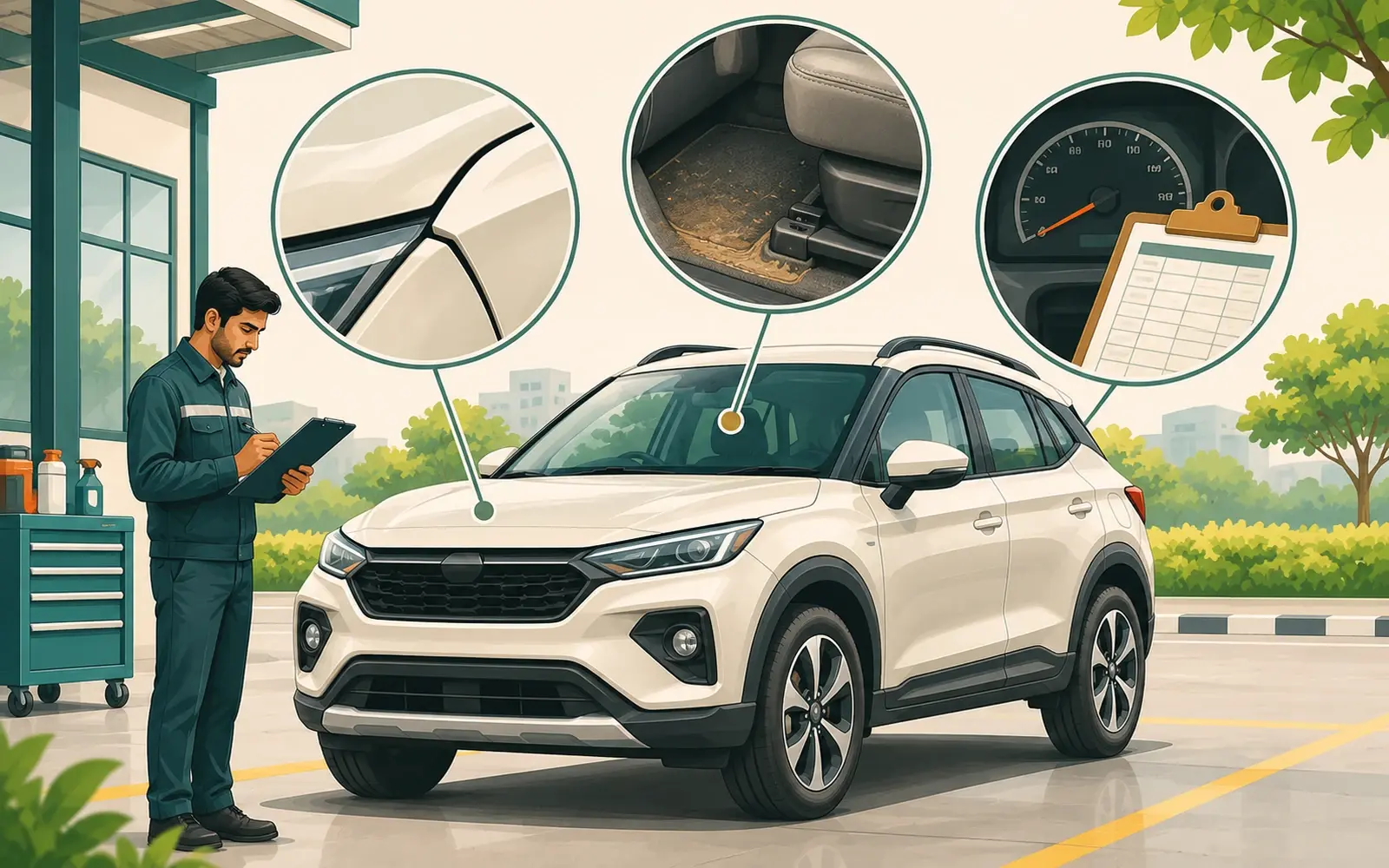
A five-year-old car with 35,000 km on the odometer, freshly polished paint and a tidy interior can look like an excellent purchase. But none of those things tells you whether its front structure was repaired after a collision, water once reached its wiring harness, or its actual mileage is much higher than the dashboard suggests.
These are not merely bargaining points. Poor structural repairs can compromise protection in a future collision, water damage can produce intermittent electrical failures months later, and false mileage can hide overdue maintenance. All three can undermine the value of an otherwise attractive used car.
The most useful inspection combines three kinds of evidence: the physical condition of the car, its documented history and an independent technical assessment. Here is how to approach each in India, what the warning signs mean, and when walking away is the better decision.
Start with the car's identity and history
Before travelling to inspect a car, request its registration number, exact variant, manufacturing year, displayed mileage and service history. Ask specifically whether it has suffered structural accident damage, significant water ingress, an insurance total-loss assessment or an instrument-cluster replacement. A vague claim such as "non-accidental" is less useful than a written answer to those questions.
At the viewing, compare the vehicle identification number (VIN or chassis number) on the car with its registration certificate (RC), available invoices and insurance documents. The stamped location varies by model; consult the owner's manual or ask an authorised workshop to identify it. Signs of alteration around the identification markings warrant professional and registration-authority verification before proceeding.
Use the official Parivahan vehicle services or mParivahan to cross-check accessible registration information. Confirm that the person selling the vehicle is the registered owner or has documented authority to sell it. Check for outstanding finance, registration restrictions and pending challans through the relevant official channels. A closed loan may still require removal of the hypothecation entry from the RC.
An RC lookup is not a complete accident or mileage history. Ask the owner to obtain dated workshop job cards, repair bills and available insurance claim records. An authorised service centre may verify records for that manufacturer's network with the owner's consent, but independent garage repairs and unreported accidents can remain invisible. Insurance renewal papers or a no-claim bonus are not proof of an accident-free past: repairs may have been paid for privately.
How to identify previous accident damage
A repainted bumper and a repaired chassis rail are not equivalent. The first may simply reflect a parking scrape. The second can affect how the body absorbs impact forces. Your inspection should establish not just whether work was done, but which parts were affected and how they were repaired.
Look at paint and panel alignment
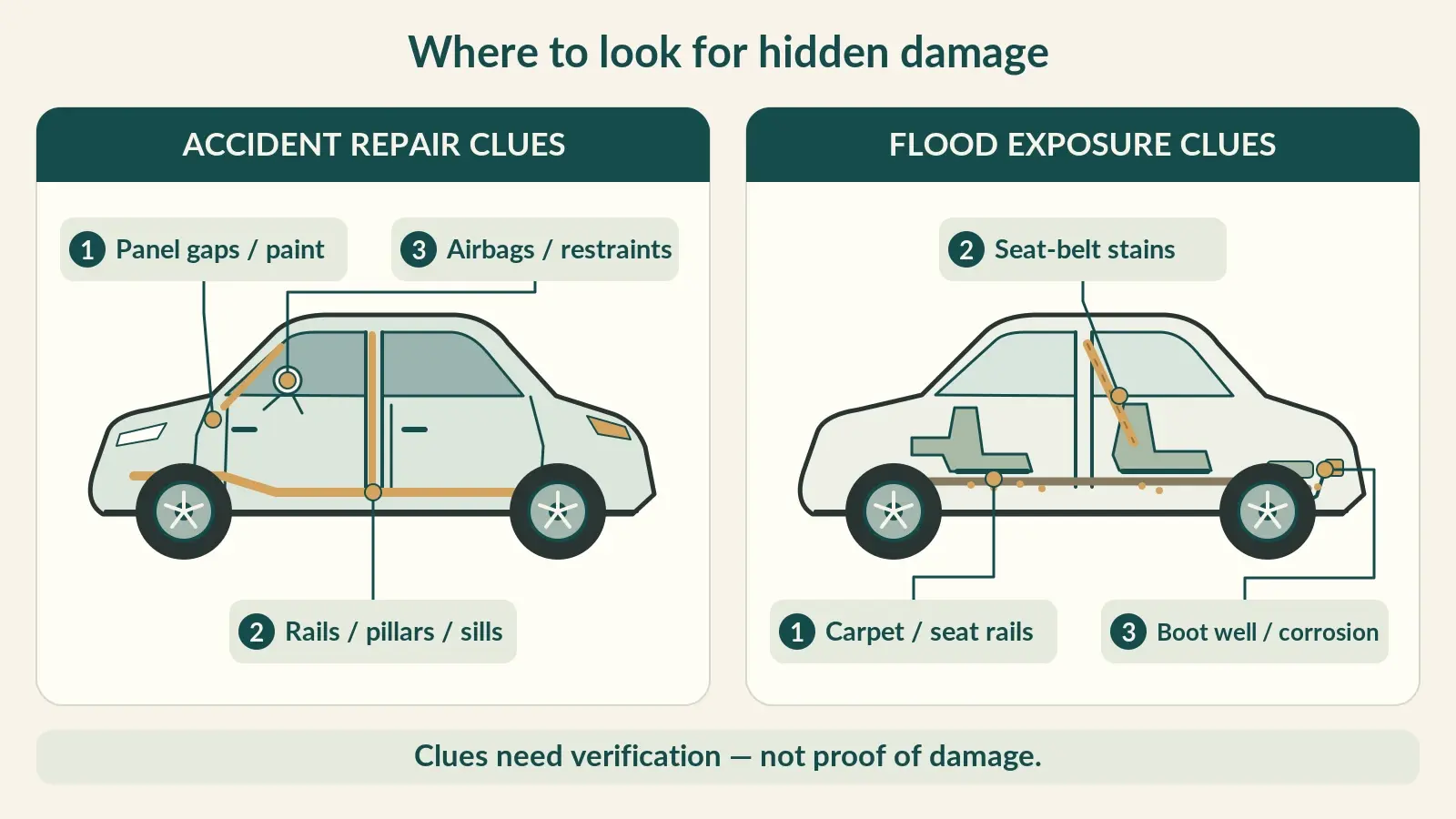
Inspect a clean, dry car outdoors in daylight. Stand back and compare the left and right sides. Look for unusual gaps between adjacent panels, a bonnet that sits higher on one side, doors that do not close smoothly, and differences in colour or surface finish. Examine the edges of panels and rubber seals for stray paint, masking lines or uneven finishing. Compare corresponding fasteners on bonnet and door hinges for tool marks or disturbed paint.
These observations can suggest removed, replaced or refinished panels. However, manufacturing tolerances vary, and a panel may have been removed during ordinary maintenance. A new windscreen or headlamp is also not proof of a major crash.
A paint-thickness gauge can strengthen the investigation. A technician can compare several readings across similar metal panels to locate unusually thick refinishing or filler. There is no universal micrometre value that proves an accident: factory finishes vary, some substrates require different measurement methods, and a replacement panel may have a normal-looking coating. Most ordinary gauges cannot measure painted plastic bumpers. Treat readings as a map of areas requiring closer examination, not a pass/fail certificate.
Examine the load-bearing structure
Many modern passenger cars use a unitised body, where the body shell itself carries structural loads. In these cars, the longitudinal rails, pillars, sills, floor and suspension attachment areas deserve more attention than bolt-on exterior panels. Body-on-frame vehicles require assessment of the separate frame as well.
With permission, inspect accessible areas under the bonnet, around door openings and beneath the removable boot floor cover. Look for distorted metal, unusual seams, poorly finished welds, cracked seam sealer or asymmetry. A bent front rail or a cut-and-joined pillar is a very different concern from a replaced plastic bumper.
Do not assume that every weld or sealant bead is abnormal. Factory construction techniques differ, and approved collision repairs may legitimately leave visible evidence. An experienced collision-repair specialist can compare the structure with model-specific repair procedures and dimensional specifications, preferably using a workshop lift and appropriate measurement equipment. Never crawl beneath a car supported only by a jack.
Check restraints and electronic safety systems
Airbags, seat-belt pretensioners and sensors may need replacement after a collision. Examine the steering wheel centre, passenger-side dashboard, seat seams and belt condition for suspicious repairs or mismatched trim. Observe the airbag/SRS and ABS warning lights during the model's normal ignition self-check. Lights that stay illuminated, or an expected warning light that never appears, need investigation.
A diagnostic scan covering the relevant safety modules is important, but it cannot certify that every airbag is physically installed and functional. If a car has advanced driver assistance systems (ADAS), ask for any required calibration evidence following windscreen, suspension or body repairs. I-CAR's collision-repair guidance distinguishes diagnostic scanning from calibration; clearing a fault code does not itself establish correct sensor alignment.
How to spot flood damage in a used car
The danger of flood damage is that drying and cleaning can improve appearances without undoing corrosion or contamination inside wiring connectors, control units and other components. A car can start and drive today while concealed damage continues to develop.
Look for a pattern of unusual findings in places that everyday cleaning or rain would not normally affect:
- Under the floor mats and accessible carpet edges: trapped moisture, discolouration or fine sediment. Replacement carpeting may warrant an explanation.
- Seat rails and cabin fasteners: corrosion in relatively sheltered locations, especially if similar marks appear at several heights or on both sides.
- Seat belts: pull the webbing out gently to inspect normally concealed sections for stains or dirt. Do not dismantle the retractors.
- Boot and spare-wheel well: sediment in seams, rusty tools or water marks beneath the luggage floor.
- Cabin and air-conditioning: a persistent damp smell, unexplained heavy fragrance or unusually musty airflow.
- Accessible electrical areas and lamps: unusual deposits, waterlines or corrosion; a technician should inspect connectors and modules without damaging them.
One wet mat could result from a leaking door seal, and lamp condensation can have causes unrelated to flooding. Conversely, a professionally cleaned flood car may show few obvious signs. The combination of sediment in multiple protected locations and widespread interior corrosion is more concerning than any single symptom.
If substantial immersion is suspected, do not start the car to see whether it runs. Arrange professional assessment first: water in an engine's intake or contaminated fluids can lead to further damage. For a hybrid or electric car, suspected flood exposure also creates high-voltage and battery hazards. Do not charge it, touch exposed high-voltage components or undertake your own electrical tests; contact a qualified manufacturer-approved service or recovery provider. The US National Highway Traffic Safety Administration (NHTSA) explicitly warns about shock and fire risks following flooding.
How to detect possible odometer tampering
An odometer measures accumulated distance travelled. Rolling it back misrepresents the car's usage, potentially hiding wear, reducing apparent maintenance needs and increasing its selling price. Digital instruments are not immune to manipulation.
The strongest practical check is to build a chronological mileage history using records independently verified against the car's VIN. Seek dated workshop job cards, inspection reports, previous sale documents and any reliable mileage entries in insurance paperwork. Look at the original documents or have the issuing workshop confirm them rather than relying only on screenshots supplied by a seller.
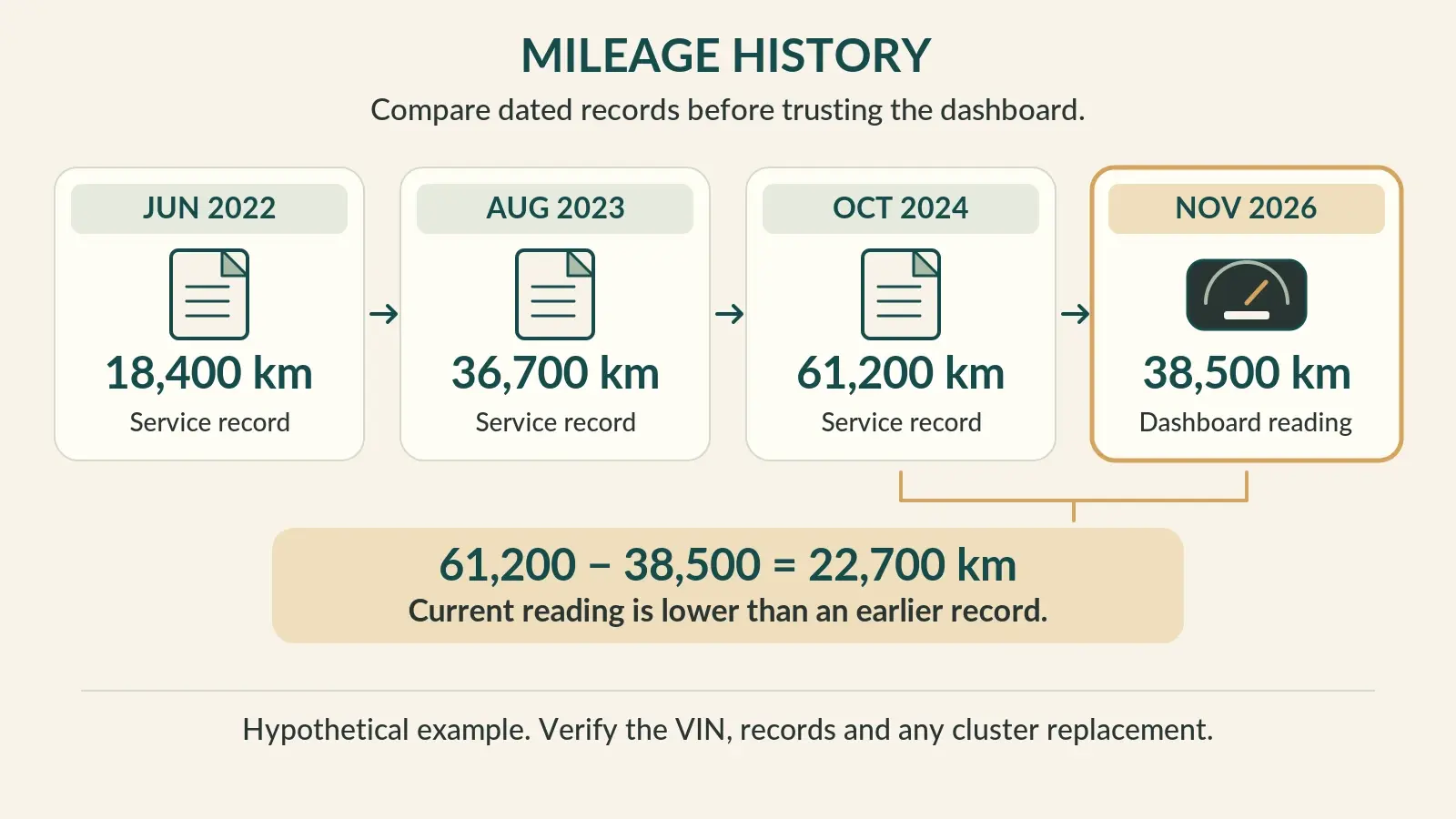
Consider this hypothetical example:
| Record | Recorded mileage |
|---|---|
| Authorised service, June 2022 | 18,400 km |
| Authorised service, August 2023 | 36,700 km |
| Workshop repair, October 2024 | 61,200 km |
| Dashboard at viewing, November 2026 | 38,500 km |
The current reading is 22,700 km below the earlier recorded reading. If the documents are genuine and refer to the same car, this requires an explanation. It does not prove deliberate fraud by itself: a clerical error or documented instrument-cluster replacement could account for a discrepancy. The actual total distance may also be considerably higher than the last reliable reading.
Compare the mileage story with wear on the driver's seat, steering wheel, pedals and switches. A heavily worn interior in a supposedly little-used car deserves attention, but wear depends on driving style, journey type, climate and materials. A low-mileage city taxi may have substantial seat and pedal wear; a high-mileage highway car can look surprisingly fresh. Replacement tyres or a newly upholstered steering wheel are clues, not verdicts.
Ask a technician whether the model stores mileage, operating hours or distance-related information in other electronic modules. Such data can sometimes corroborate service records, but access and interpretation vary by car. A basic OBD-II reader mainly intended for emissions diagnostics cannot universally recover an original mileage figure. Even a manufacturer-capable scan may not detect coordinated manipulation across modules. No scanner can promise a definitive answer for every vehicle.
What an independent pre-purchase inspection should include
If the initial checks are satisfactory, choose a workshop or inspection service independent of the seller. Ask for a written report with photographs, fault codes, safety concerns and repair estimates. For a car showing collision evidence, request a specialist body-structure assessment rather than relying solely on a mechanical inspection.
A useful inspection should cover the underbody and suspension, steering and brakes, tyres, leaks and fluid condition, powertrain operation, accessible structural repairs and relevant diagnostic modules. Where indicated, ask for checks of electrical corrosion, airbags and any required ADAS calibration. For an EV, request suitable battery and high-voltage assessments from a qualified facility.
Only after the car is judged safe to operate should you undertake a legal, insured test drive. Observe whether it tracks consistently, brakes predictably, shifts smoothly and produces unusual vibration or noises. A vehicle pulling to one side might have poor wheel alignment or unequal tyre pressure rather than structural damage; a professional must establish the cause. A short successful drive cannot rule out latent water-related or safety-system problems.
A dealer's own inspection report or limited used-car warranty can provide useful information, but check its exclusions and do not substitute it for independent assessment. If the seller will not allow reasonable inspection or independent verification, there is little reason to accept the uncertainty.
Which findings are negotiable, and when should you walk away?
Not every imperfection justifies rejecting a used car. What matters is whether the underlying risk can be identified, verified and priced reasonably.
| Finding | Sensible response |
|---|---|
| Documented cosmetic repaint, no structural issue found | Consider the condition and negotiate accordingly. |
| Previous collision, professionally documented repair | Require independent assessment of structure and safety systems before deciding. |
| Unexplained structural distortion or questionable airbag repairs | Do not purchase unless independently resolved and verified safe. |
| Evidence of significant immersion | Generally walk away; latent faults are difficult to price. |
| Mileage lower than authenticated historical records | Pause until the discrepancy is independently explained and documented. |
| VIN discrepancy or refusal of inspection | Stop the transaction pending resolution, or choose another car. |
A discount is not a substitute for safety. Even an apparently cheap vehicle can become costly if faults emerge after purchase or if its history reduces resale value. Conversely, a transparently disclosed and properly repaired minor collision need not automatically eliminate a good car from consideration.
Before paying: protect the transaction in India
Record the agreed purchase price, VIN, displayed mileage, disclosed damage history, warranty promises and any conditions of the sale in writing. Retain copies of the listing, messages, inspection report and payment receipts. Do not pay a substantial non-refundable advance before verification, and use a traceable payment method.
Complete the applicable ownership-transfer process through the RTO or VAHAN. Parivahan identifies Forms 29 and 30 for ordinary sales, with additional documents and interstate requirements where applicable. Confirm finance clearance, insurance transfer or replacement coverage, and valid pollution certification where required. Check model recall campaigns on the SIAM vehicle recall portal, and ask the manufacturer to verify completion for the actual VIN. A recall listing is not itself a repair history.
If a business seller materially misrepresents a vehicle, preserve the evidence and seek help through India's National Consumer Helpline (1915), where appropriate. Consumer remedies depend on the nature of the seller and transaction; a private sale is not necessarily treated the same as a dealer sale. Suspected deliberate fraud may warrant a police complaint or legal advice.
The bottom line
A used car is not safe simply because it looks good, and it is not necessarily unsafe simply because it has been repaired. The difference is the quality of the evidence behind its condition.
Verify identity and documents first. Inspect for accident and flood clues, reconcile the mileage history, and have the vehicle independently assessed before committing money. If an important safety concern or unexplained history discrepancy remains unresolved, choose another car rather than betting on a seller's assurance.
Sources and further reading
- Ministry of Road Transport and Highways, mParivahan: Transfer of ownership and hypothecation termination.
- NHTSA (United States): Odometer fraud and flood-damaged vehicles. Technical and inspection guidance, not Indian legal rules.
- US Federal Trade Commission: Buying a used car from a dealer and avoiding flood-damaged used cars. General inspection guidance.
- I-CAR: The differences between scanning and calibration and ADAS damage analysis and calibration requirements.
- National Insurance Crime Bureau (United States): Buying a used vehicle. Physical flood-damage clues; US title and database procedures do not apply to India.
- Autocar India: Buying a used car: eight things to know and identifying flood-damaged cars.
- Car and Bike: Detecting structural chassis repair.
- SIAM: Voluntary vehicle recall data.
- Department of Consumer Affairs, Government of India: National Consumer Helpline.