Real-World EV Range vs Claimed Range: How Far Can an Electric Car Actually Travel?
Understand why electric-car range differs from certified figures in India, what affects highway range, and how to plan charging stops realistically.
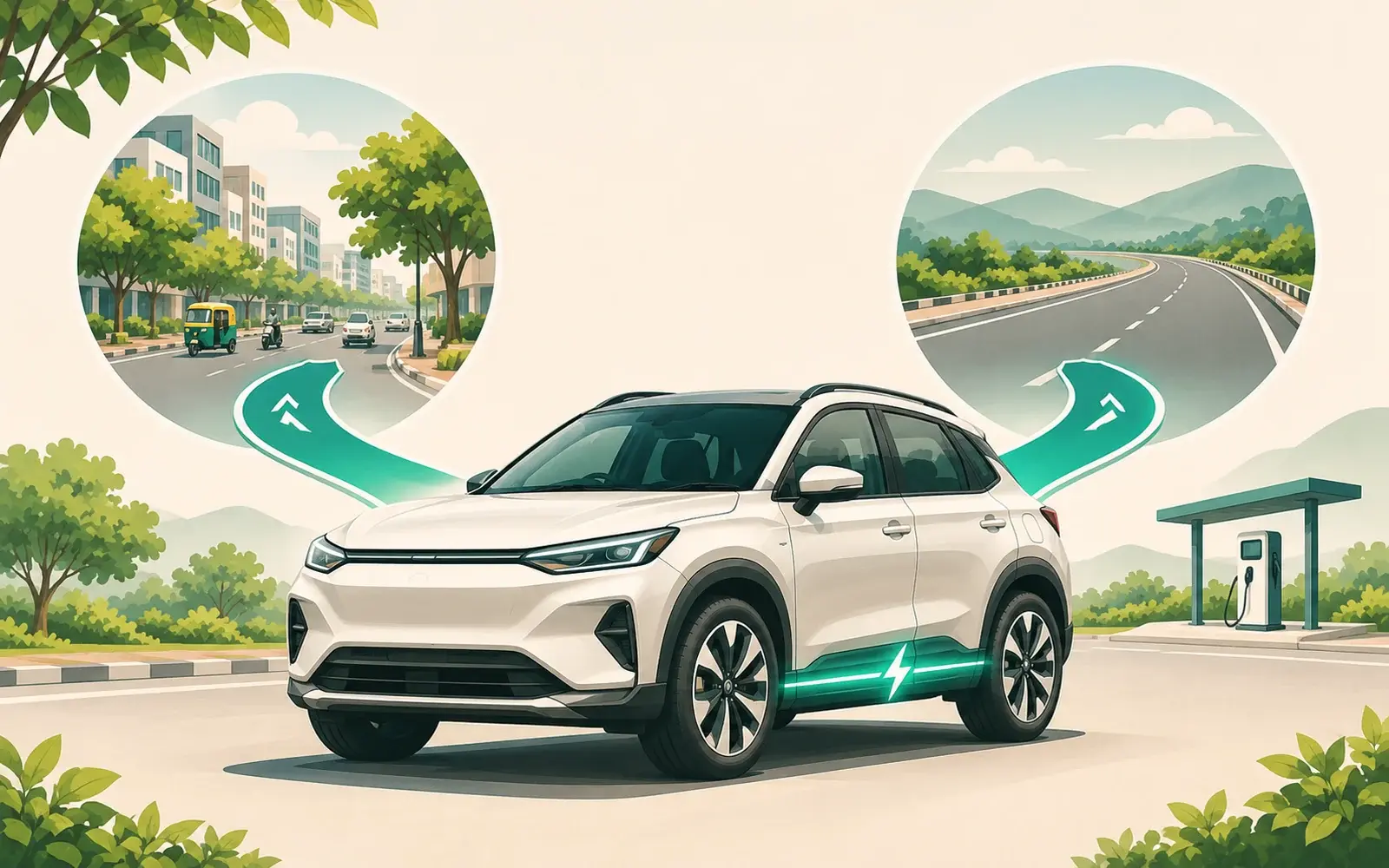
An electric car advertises 500 km of range. Does that mean you can leave home, drive 500 km on an Indian highway with the air conditioning on, and arrive with the battery almost empty? Not necessarily.
The advertised figure is usually the result of a defined test procedure. The distance you achieve depends on the battery energy available, how efficiently the car uses it, and the conditions of your journey. A car may travel farther in relaxed city driving than at sustained expressway speeds. Two owners of the same variant can also obtain different results without either vehicle being faulty.
The useful question is not simply “What is its claimed range?” It is “How much range can I confidently use in my normal conditions, and where will I recharge on longer trips?”
What does an EV's claimed range actually mean?
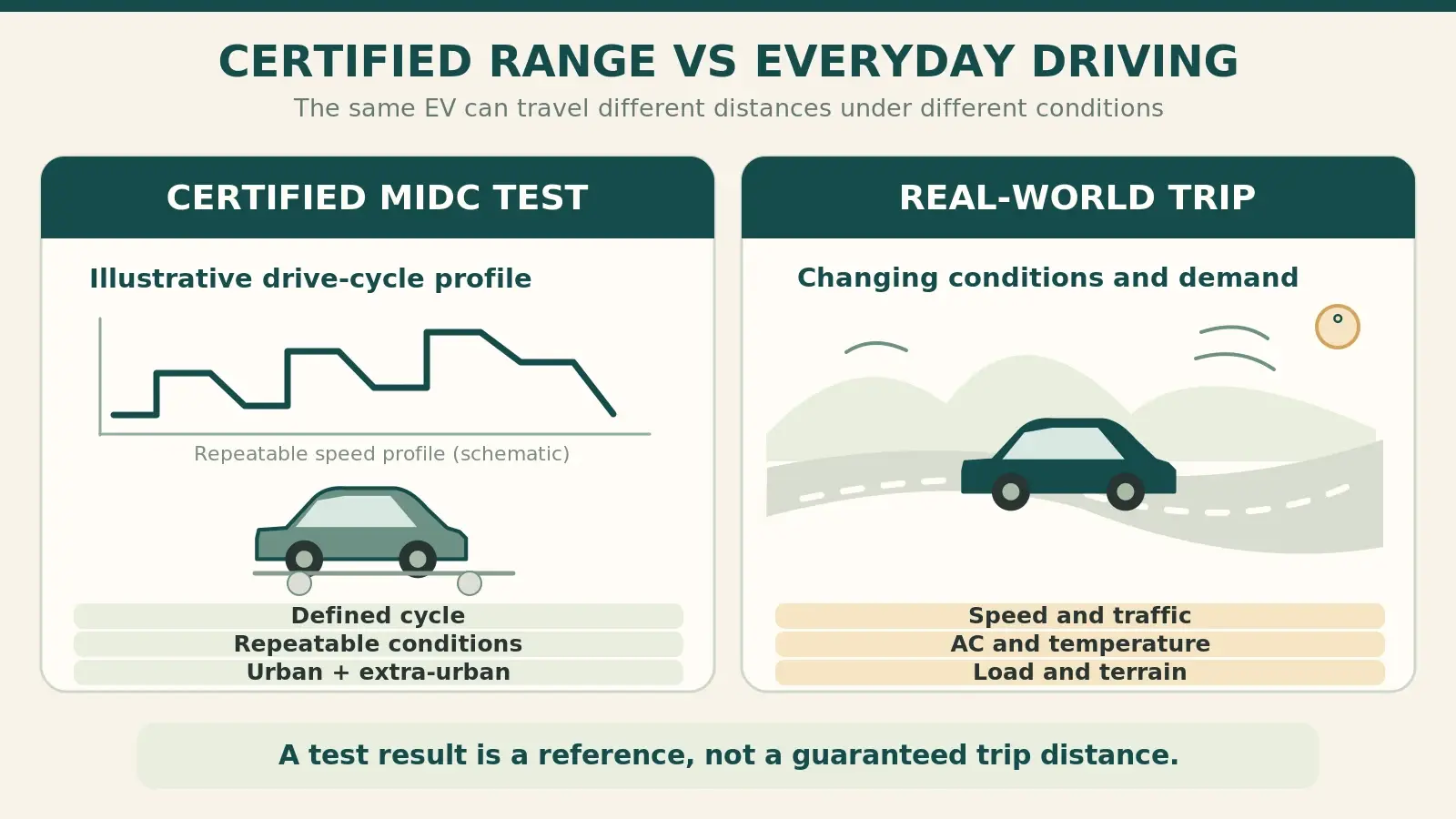
A certified range makes different vehicles testable under a repeatable procedure. It does not describe the maximum distance every driver will achieve or guarantee a particular trip outcome.
ARAI and MIDC range in India
Indian electric-car specifications commonly quote range measured under the Modified Indian Driving Cycle (MIDC). The underlying vehicle range measurement standard is AIS-040 (Rev. 1), with amendments covering the driving-cycle procedure. The MIDC has an urban component (Part 1) and an extra-urban component (Part 2). These simulate defined driving patterns; neither recreates every traffic jam, summer afternoon, hill climb or high-speed expressway run.
In September 2024, Tata.ev announced that it would report its certified figures using MIDC Part 1 + Part 2 (P1+P2), reflecting a requirement to include urban and extra-urban testing. This matters because older brochures and newer variants may display different range figures or test-cycle labels. When comparing cars, check whether the numbers follow the same test procedure, not merely whether they both say “ARAI range.”
The purpose of certification is comparability under specified conditions. It is neither a deception by itself nor a forecast tailored to your driving habits.
Manufacturer-estimated and independently tested range
Some manufacturers publish another figure intended to resemble everyday use. For example, Tata.ev's C75 is the company's own estimate of the near-real-world range it says 75% of its customers can expect based on its historical usage data. C75 is not the same as an independent road test or the official MIDC certification.
For context, Tata's published information for a 2026 Punch.ev 40 kWh variant lists a 468 km MIDC P1+P2 range and approximately 335–355 km C75 range. Both are manufacturer-published figures with different methodologies, not two measurements made on your particular route. Model specifications and disclosures can change, so confirm the exact variant before buying.
Independent road tests provide a third reference point. In an earlier, model-specific Autocar India test, a Curvv.ev 55 kWh with a stated 502 km MIDC figure delivered an extrapolated 365 km combined city-and-highway range under the publication's test method. This does not establish a universal percentage shortfall—or predict the result for newer versions of that car. It shows why test conditions must accompany any quoted number.
Why can actual driving range be lower—or sometimes higher?
Highway speed and aerodynamic drag
At higher speeds, the motor must continuously overcome greater air resistance. Aerodynamic drag force rises approximately with the square of speed, and the power needed to overcome it rises approximately with the cube, assuming other factors stay constant. This does not mean a car's total energy consumption follows a simple cubic rule: rolling resistance, drivetrain losses and auxiliary loads also matter.
The practical consequence is clear: maintaining 110–120 km/h on an open expressway can consume noticeably more energy per kilometre than travelling at a moderate pace. A short burst of speed is different from sustaining it for hours.
City driving and regenerative braking
Electric cars can recover some kinetic energy through regenerative braking. Frequent slowing and stopping therefore create opportunities to recover energy that a conventional friction brake would lose as heat. At moderate city speeds, lower aerodynamic drag can also help.
However, heavy traffic is not automatically efficient. A long crawl with the air conditioner running still consumes electricity while covering little distance. Regeneration cannot recover all energy, and harsh acceleration wastes some of the advantage. The actual city result depends on the pattern of movement, not merely the word “city.”
Air conditioning, weather and terrain
India's summer heat makes cabin cooling relevant. Air conditioning, battery cooling and other equipment draw energy from the pack. Cold weather can also reduce available performance and increase climate-control demand. The impact varies with cabin temperature, trip length, vehicle thermal management and ambient conditions; there is no reliable universal “AC costs 10% range” rule.
Climbing hills consumes additional gravitational energy. Descending can return part of it through regeneration, but not all. Strong headwinds, wet roads, underinflated tyres, roof carriers and heavy luggage can further increase consumption. Correct tyre pressure helps both range and safety.
Finally, different battery conditions and ageing can affect how much energy the car can use. These influences are usually gradual rather than a fixed loss on every journey.
The more useful numbers: kWh and km/kWh
A useful EV comparison starts with battery energy and efficiency rather than a range badge alone.
- kWh (kilowatt-hours) measures energy stored in or delivered from the battery, not motor power. Battery capacity is commonly advertised in kWh.
- Usable battery capacity is the portion the vehicle allows you to access. It may differ from its nominal or gross pack capacity; use the usable figure when it is officially available.
- km/kWh measures distance travelled per unit of battery energy. Higher is better for range under otherwise comparable conditions.
- kWh/100 km expresses consumption: lower is better. At 5 km/kWh, consumption is 20 kWh/100 km.
The basic estimate is:
Full-charge range (km) ≈ usable battery capacity (kWh) × driving efficiency (km/kWh).
Imagine a hypothetical electric car with 60 kWh usable battery energy. It might produce these illustrative results:
| Driving efficiency | Estimated full-charge range |
|---|---|
| 7 km/kWh — efficient use | 420 km |
| 6 km/kWh — mixed use | 360 km |
| 5 km/kWh — demanding highway use | 300 km |
These are arithmetic scenarios, not benchmarks for any specific model. They show why a car with the same physical battery can travel very different distances. Range cannot be inferred from battery size alone because vehicle mass, aerodynamics, motors, tyres and thermal systems vary.
Also distinguish energy taken from the charging station from energy used by the vehicle while driving. Charging has losses. If you purchase 50 kWh from a charger, that does not necessarily mean 50 kWh was stored in the battery. For range calculation, onboard driving efficiency is the more relevant measure.
How far can you actually travel between charging stops?
A claimed 400 km or an estimated 300 km full-charge range is not always the practical distance between two highway charging stops. Drivers often arrive at a charger with some battery remaining rather than intentionally running the vehicle to zero. They may also depart with less than 100% charge because DC fast charging tends to slow as the battery approaches full.
Continue the hypothetical example above:
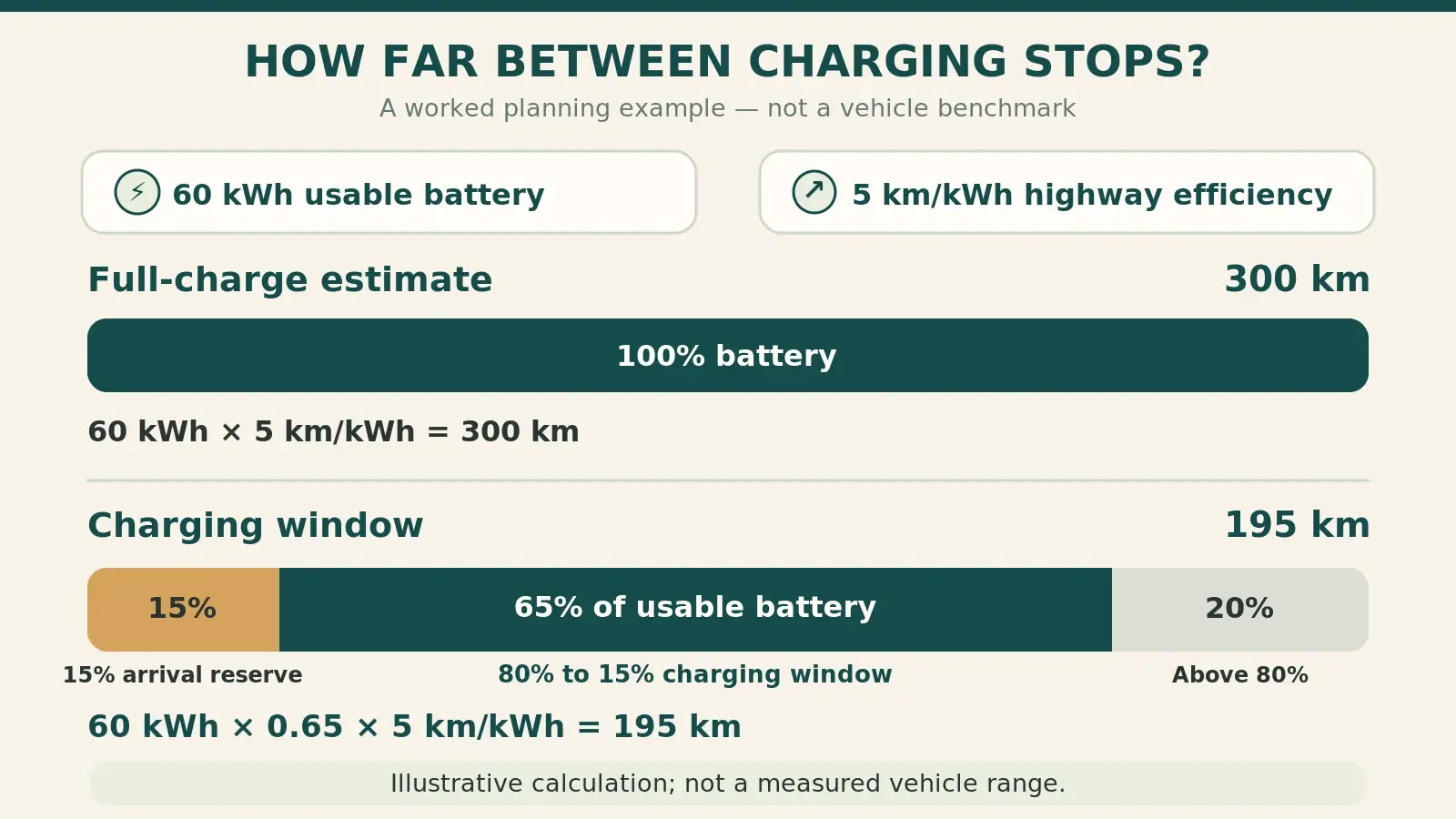
- Usable battery: 60 kWh.
- Observed highway efficiency: 5 km/kWh.
- Full-charge theoretical range in those conditions: 60 × 5 = 300 km.
- Example charging window: depart at 80% state of charge and plan to arrive at 15%.
- Energy budget: 60 × (0.80 − 0.15) = 39 kWh.
- Planned driving distance: 39 × 5 = 195 km.
This means the same car might offer roughly 300 km from a full usable charge under the assumed driving conditions but only 195 km between stops when the driver chooses an 80%-to-15% charging window. Neither number is its certified range.
The 80% departure and 15% arrival figures are illustrative planning choices, not instructions for every EV. The appropriate charging target depends on the vehicle's guidance, charger reliability, available routes, weather, traffic and how much reserve you want. For a remote hill route or an unreliable charging corridor, build in a larger buffer. Charging to 100% before a long trip can be appropriate if the manufacturer permits it; follow the owner's manual rather than a blanket internet rule.
Planning a 350 km highway journey
Suppose you need to cover 350 km in that hypothetical car and expect 5 km/kWh. The journey demands about 70 kWh of battery energy (350 ÷ 5), before any added margin. A 60 kWh usable battery therefore cannot complete it without recharging at least once under those assumptions.
Starting at 100% would give an estimated 300 km to empty, but planning to stop comfortably earlier is safer. Choose a working charging station along the route, verify its connector and power compatibility, check its recent operational status where available, and identify a backup. Charging-stop planning is a route and infrastructure decision—not simply a multiplication of the brochure's range figure.
Can the dashboard's “distance to empty” be trusted?
The remaining-range number shown in an EV is an estimate, not a second battery meter. The battery percentage indicates state of charge; the kilometre figure generally uses recent efficiency, battery conditions and sometimes navigation information to predict distance. Hyundai's owner documentation explicitly notes that displayed distance-to-empty can vary with speed, weather, terrain and driving history.
After several slow city journeys, the display may look optimistic for a fast highway trip. After a demanding uphill drive, the estimate may fall even if there is no battery fault. Watch battery percentage, recent km/kWh and distance to the next reliable charger together, rather than trusting a single number.
A simple reality check is to note battery percentage and distance travelled across a reasonably representative route. For example, covering 60 km while using approximately 20 percentage points suggests a rough 300 km full-scale projection (60 ÷ 0.20). This is only a quick estimate: percentage readings, usable energy and efficiency are not perfectly linear, and one short run may not reflect the conditions of your next journey.
How to evaluate EV range before buying in India
Start with your actual driving, not the highest range figure in a brochure. For a 30–50 km daily commute with dependable home charging, even a modest-range EV may meet your needs comfortably. If you frequently travel 300–500 km between cities, reliable highway range and charging speed become more important.
Before ordering, take these steps:
- Identify the exact variant and test cycle. Ask for the current MIDC P1+P2 figure, battery capacity, and any separately disclosed manufacturer-estimated range. Do not combine values from different battery packs or model years.
- Look for independent road tests. Prefer tests that disclose city/highway mix, speeds, climate control, tyres and calculation method. A single review is informative, not a universal guarantee.
- Ask about usable capacity and real efficiency. If usable kWh is unavailable, avoid pretending gross kWh gives a precise range calculation.
- Test your driving pattern. On a demonstrator, check efficiency with AC running and a realistic mix of roads. A brief test drive cannot establish full-charge range, but it can reveal the vehicle's consumption display and behaviour.
- Investigate charging, not just driving. Check compatible public DC charging, realistic charge-time curves, home charging feasibility and backup options on your regular routes.
Compare whole-trip convenience rather than only maximum distance per charge. A car with a somewhat shorter range but reliable, faster charging may suit some highway users better than a longer-range model with slower charging or fewer compatible options.
Does EV range fall permanently as a battery ages?
Battery ageing can gradually reduce usable capacity, which may reduce full-charge driving range. Its pace varies by chemistry, thermal management, climate, use and maintenance. But an unexpected drop in the dashboard's predicted distance is not proof of degradation: recent faster driving, changing temperatures or AC use may be the cause.
If considering a used EV, examine battery health or state-of-health information where available, service records, remaining battery warranty and actual measured efficiency. Do not infer battery condition from the displayed “range remaining” alone.
The practical answer
There is no fixed percentage that converts every claimed EV range into real-world range. Certified tests provide a common reference; manufacturer estimates and independent tests add context; your own speed, climate, route and energy use determine the result.
For everyday driving, focus on the kilometres you use between home charges. For long journeys, estimate efficiency in relevant conditions, calculate the distance you can cover within a sensible battery window, and plan reliable charging stops with a reserve. That is far more useful than expecting the brochure's maximum range on every trip.
Related reading: compare electric cars by budget.
Sources and Further Reading
- ARAI — AIS-040 (Rev. 1), Electric Power Train Vehicles: Method of Measuring the Range, including amendments.
- Tata.ev — Driving range declaration and MIDC P1+P2 explanation (September 2024).
- Tata.ev — Punch.ev model specifications and disclosed MIDC/C75 range.
- U.S. Department of Energy — All-Electric Vehicles: Driving Range.
- U.S. Department of Energy — Where the Energy Goes: Electric Cars.
- Hyundai Owner's Manual — Checking Electric Vehicle Driving Information.
- U.S. Department of Energy — Winterizing Your Electric Vehicle (charging and trip planning).
- Autocar India — Tata Curvv EV real-world range tested.