Mild Hybrid vs Strong Hybrid vs Plug-in Hybrid: Which Technology Actually Saves More Fuel?
Understand how mild, strong and plug-in hybrids save fuel, where each works best on Indian roads, and when the extra purchase price makes sense.
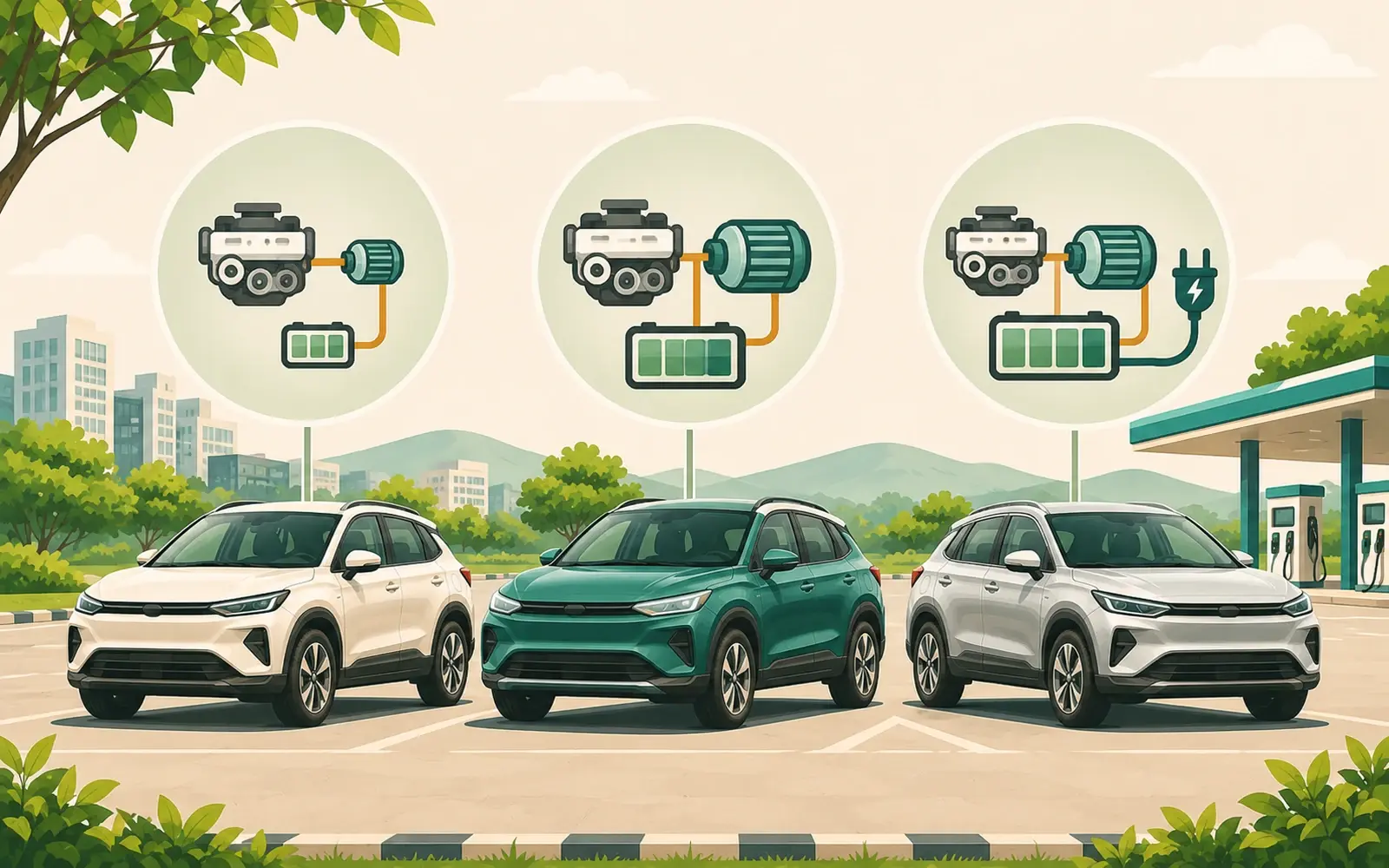
Two cars can carry a hybrid badge and use electricity in completely different ways. One switches off its petrol engine at traffic lights. Another can move through slow traffic without running its engine at all. A third can cover a daily commute on electricity from a charging socket—provided its owner actually plugs it in.
Those differences matter more than the badge. In Indian driving, a strong hybrid is often the most straightforward choice for substantial petrol savings without charging, while a plug-in hybrid can burn the least petrol on short, regularly charged journeys. A mild hybrid offers a smaller efficiency improvement with fewer changes to everyday ownership. None is automatically the cheapest car to own.
Mild, strong and plug-in hybrids at a glance
| Question | Mild hybrid (MHEV) | Strong/full hybrid (HEV) | Plug-in hybrid (PHEV) |
|---|---|---|---|
| Can it drive on electricity alone? | Generally no | Yes, for limited periods or distances | Yes, often for meaningful everyday trips |
| Does it need external charging? | No | No | Yes, to gain the full fuel-saving benefit |
| Typical battery role | Engine assistance, restarting, energy recovery | Propulsion plus substantial engine assistance | Extended electric driving plus hybrid operation |
| Biggest practical advantage | Modest savings with familiar petrol-car use | Strong city efficiency without charging | Very low petrol use when charged frequently |
| Main limitation | Limited fuel-saving capability | Higher upfront cost than a comparable non-hybrid | Cost, complexity and dependence on charging habits |
These are technology-level tendencies, not guaranteed fuel economy rankings. Engine size, vehicle weight, gearing, driving style and the particular hybrid system can change the result.
How each hybrid actually works
Mild hybrid: the petrol engine still does the driving
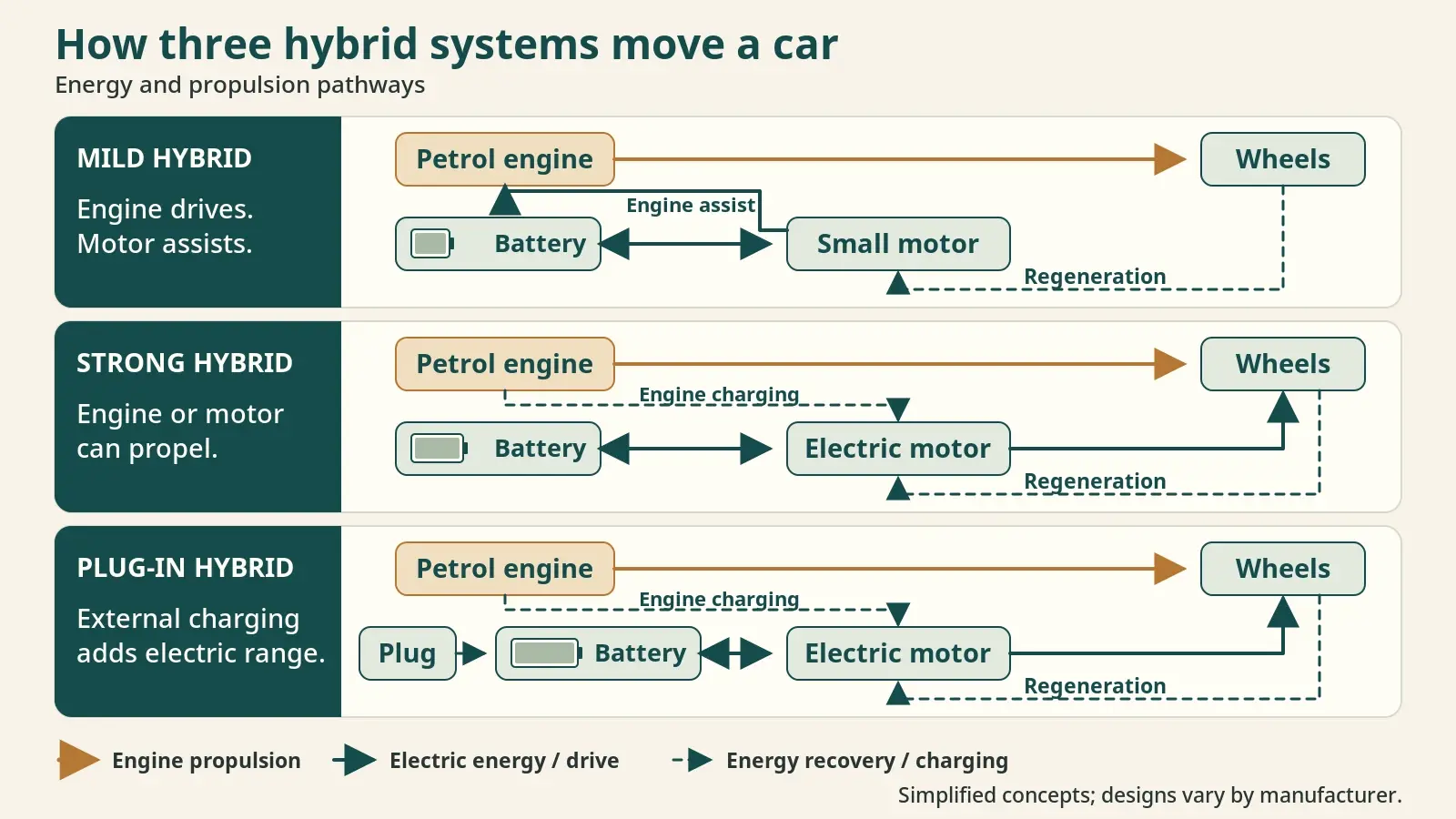
A mild hybrid usually uses an integrated starter-generator or related motor-generator, a small battery and electronic controls alongside the combustion engine. It can restart the engine smoothly after a stop, recover some energy during deceleration and provide electrical assistance when accelerating.
Maruti Suzuki describes three functions of its Smart Hybrid system: idle start-stop, brake-energy regeneration and torque assist. These reduce engine workload or fuel wasted at a standstill; they do not turn a mild-hybrid car into a battery-electric car. The petrol engine remains central to propulsion.
The saving is real but often modest. A car advertised as a mild hybrid may still feel and behave much like its conventional petrol equivalent. Some implementations are more capable than others, so compare the actual mileage and equipment of the variant rather than assuming all mild hybrids are alike.
Strong hybrid: the electric motor can propel the car
A strong or full hybrid uses a more capable electric motor and traction battery. Depending on speed, load and battery charge, it can move using the motor, the engine or both. Its control system decides how to blend these sources. The battery receives energy from regenerative braking and, when necessary, from the petrol engine.
This is especially useful during repeated slowing, stopping and restarting. The motor can handle some low-speed propulsion, while regenerative braking captures part of the energy that would otherwise become heat in the brakes. The engine can switch off more often, saving petrol in congested traffic.
A strong hybrid does not need to be plugged in. Marketing sometimes calls this self-charging, but that does not mean energy is free or produced from nothing. The energy ultimately comes from petrol and recovered vehicle motion. It simply manages that energy more efficiently.
Not every strong hybrid drives exactly the same way. Some use power-split systems, others use different series or parallel arrangements. The ability to drive electrically, how long it can do so and the petrol consumption all depend on the design.
Plug-in hybrid: an electric commute with a petrol backup
A plug-in hybrid has an internal-combustion engine, an electric drive system and a larger battery that can be charged from an external power supply. With sufficient charge and favourable operating conditions, many PHEVs can cover a significant share of a normal commute without burning petrol. On longer journeys, they can switch to or blend petrol-engine operation.
That gives them two distinct operating conditions. Charge-depleting driving uses externally supplied battery energy. Charge-sustaining driving occurs after the usable plug-in charge has been spent, with the vehicle operating more like a conventional hybrid. The resulting petrol economy can be very different.
Some PHEVs start the engine during hard acceleration, high speeds, low temperatures, cabin heating or other circumstances even when the battery shows charge. Electric range and the ability to remain in electric mode are model-specific. Also, PHEVs are not necessarily compatible with DC fast charging; check the charging hardware of the exact model.
Where hybrids save the most fuel on Indian roads
Stop-and-go city traffic
Urban congestion is where strong hybrids generally show their most obvious advantage. An engine idling at signals, crawling through a market road and repeatedly accelerating wastes fuel. A full hybrid can shut down the engine for some of this driving, recover braking energy and deliver electric torque at low speed.
A mild hybrid can reduce idling and offer some assistance, but it normally cannot sustain motor-only propulsion. It therefore has less opportunity to avoid petrol use altogether.
A PHEV with enough charge can be particularly efficient in petrol terms during a short urban commute. But the electricity it consumes must be counted when calculating running costs. If it spends most days without being charged, its theoretical advantage can shrink dramatically.
Open highways and longer trips
At steady highway speeds there is less braking energy to recover and fewer periods when the engine can remain off. Aerodynamic drag also grows with speed. Strong hybrids can still be efficient because of engine and transmission design, but the gap over an efficient petrol car or mild hybrid may narrow.
A PHEV may consume little petrol at the start of a trip while its plug-in charge lasts. After that, the engine must supply much more of the journey's energy. A larger battery and extra hardware also add weight, which can affect consumption. Its highway petrol economy should therefore be judged in charge-sustaining mode, not only from a spectacular combined claim.
Hills, heat and heavy loads
Climbs require extra energy; long descents can allow useful regeneration if the battery can accept it. Air conditioning, traffic, passengers, luggage, tyre pressure and temperature also affect all three types. Hybrid efficiency is not a fixed property of an engine badge. Two owners of the same car can get materially different results.
What Indian certified mileage figures really show
The Toyota Urban Cruiser Hyryder provides a useful India-market example because the same nameplate offers a Neo Drive variant with an integrated starter-generator and a separate strong-hybrid powertrain.
Toyota's published certified figures include 20.58 km/l for the Neo Drive 2WD six-speed automatic and 27.97 km/l for the strong hybrid. These numbers demonstrate how differently the two variants perform in their respective certification tests. They are not a controlled measurement of the hybrid system alone: the engines, transmissions, powertrain designs and variants differ. Nor should a buyer expect exactly those figures in daily traffic.
For a fair buying comparison, check the precise model, fuel type, transmission and test cycle. A certified claim is useful for comparison under standardised conditions, but real-world tank-to-tank results may vary substantially.
The usual km/l label also becomes difficult to interpret for PHEVs. If a vehicle covers part of a test on electricity and part on petrol, quoting only litres burned ignores the electricity taken from the grid. Look for the electric consumption in kWh/100 km, electric range and petrol consumption after battery depletion, not just one headline combined figure.
Why charging habits can make or break a PHEV
Imagine two drivers purchasing the same plug-in hybrid. One has dependable overnight charging and drives 30–40 km most weekdays. The other parks on the street and can only plug in occasionally. Their petrol purchases will not be similar, even though their cars are identical.
Research by the International Council on Clean Transportation using European real-world vehicle data found that plug-in hybrids often consumed substantially more petrol than suggested by official assumptions about electric driving. This is European fleet evidence, not an India-specific mileage figure. Its relevant lesson is that charging frequency and actual electric-drive share are decisive.
A PHEV is not a conventional hybrid with a decorative charging port: plugging in is the main way to realise its extra electric-driving benefit. Before buying, confirm where it will charge, the cost per kWh, the charging time and whether its realistic electric range covers your normal day.
A simple example: 40 km of city driving
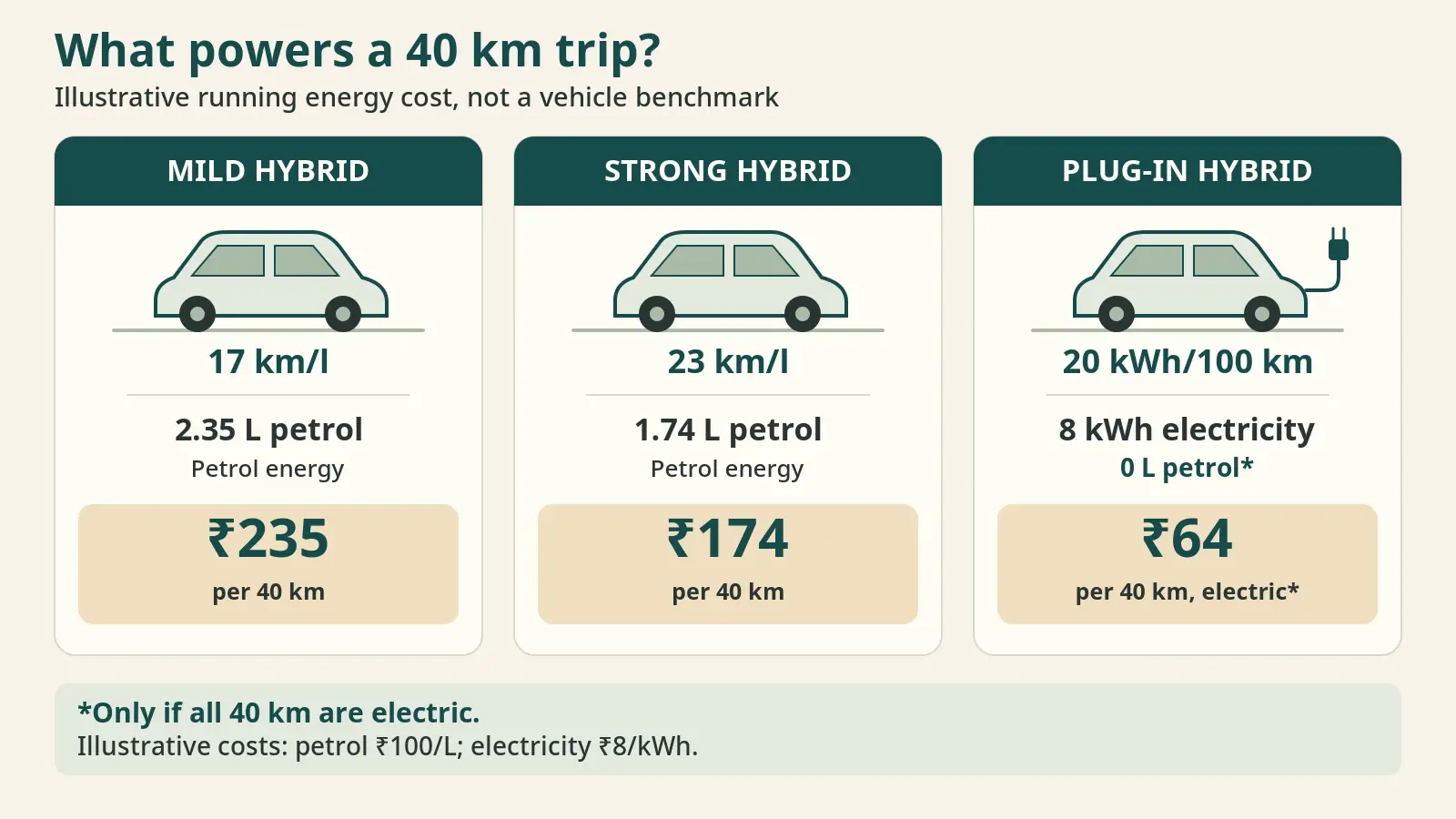
Consider three hypothetical vehicles making the same 40 km journey. The values below are deliberately illustrative, not official ratings or tests of comparable models.
| Assumption | Energy used for 40 km | Cost at assumed tariff |
|---|---|---|
| Mild hybrid at 17 km/l | 2.35 litres petrol | ₹235 |
| Strong hybrid at 23 km/l | 1.74 litres petrol | ₹174 |
| Plug-in hybrid in all-electric operation at 20 kWh/100 km from the wall | 8 kWh electricity; zero petrol | ₹64 |
Assumed prices: ₹100/litre of petrol and ₹8/kWh of delivered electricity. The electricity-consumption figure includes assumed charging losses by measuring from the wall. The PHEV row assumes the entire 40 km can be driven electrically, with no petrol engine intervention.
The arithmetic is straightforward: distance divided by km/l gives litres consumed; electric distance multiplied by kWh per km gives electricity consumed. In this example, the regularly charged PHEV buys the least petrol and has the lowest energy cost for this one trip.
That does not establish that it is the cheapest vehicle overall. The PHEV may cost more to buy, may consume petrol outside its electric range and may face different insurance, maintenance or charging costs. Charging from an expensive public point rather than an economical home tariff would also change the result.
Does a strong hybrid's fuel saving recover its higher price?
A more economical car is not automatically better value. Suppose a mild-hybrid option costs ₹1.5 lakh less than a strong-hybrid alternative. You expect 12,000 km a year and, for illustration only, achieve 17 km/l in the first and 23 km/l in the second, with petrol at ₹100/litre.
At that usage, the mild hybrid consumes approximately 706 litres a year; the strong hybrid uses about 522 litres. The difference is roughly 184 litres, or ₹18,400 annually. Dividing the hypothetical ₹1.5 lakh premium by that annual petrol saving produces a simple payback of approximately 8.1 years.
This is not a forecast for any real pair of cars. It excludes changes in fuel prices, interest, insurance, service costs, depreciation, resale value and replacement parts. It also assumes the efficiency difference persists. If you drive twice as far under similar conditions, the fuel component of payback improves; if you mostly drive short annual distances, it worsens.
For a PHEV, the calculation needs one extra step: separate the kilometres driven on external electricity from those driven on petrol, price both forms of energy and account for the purchase-price premium. An unusually low advertised petrol-consumption number alone cannot justify the extra cost.
Ownership trade-offs beyond mileage
Purchase price and availability. Mild-hybrid variants can be relatively accessible, whereas strong hybrids carry more electrified hardware. PHEV offerings and pricing differ considerably by market; do not assume a foreign model or quoted price is available in India. Compare actual on-road quotations, not technology categories in isolation.
Maintenance and reliability. A mild hybrid is not automatically maintenance-free, and a strong hybrid is not automatically expensive to repair. Strong hybrids and PHEVs add high-voltage components and batteries, but regenerative braking may reduce friction-brake use. Verify the precise battery and hybrid-system warranty, service-network capability, exclusions and costs after warranty expiry.
Space and weight. Battery packaging can affect boot space, weight or the spare-wheel arrangement. Check the actual variant rather than relying on a generic assumption about hybrids.
Charging practicality. Strong and mild hybrids work like familiar petrol cars at fuel stations. A PHEV can also use petrol, but its strongest advantage depends on convenient charging and regular access to a suitable power supply.
Which hybrid should you choose?
Choose a mild hybrid when the purchase-price difference matters most, your mileage is moderate and you want a conventional petrol-car ownership routine with some efficiency support. Compare it with an ordinary petrol alternative too: the badge alone does not establish good mileage.
Choose a strong hybrid if you cover meaningful annual kilometres, spend a lot of time in city traffic and cannot—or do not want to—charge a car. It is often the most practical way to obtain substantial petrol savings without changing your fuelling routine. Still calculate whether the actual price premium makes sense for your usage.
Consider a plug-in hybrid when you can charge frequently, your usual trips fit within its realistic electric range and you occasionally need the flexibility of a petrol engine for longer journeys. If you cannot charge reliably, compare the model's depleted-battery fuel economy with a strong hybrid before paying extra.
The bottom line
There is no universal winner: mild hybrids usually offer limited but convenient savings; strong hybrids are well suited to repeated urban driving without plugging in; and PHEVs can minimise petrol use when owners charge regularly. The smarter purchase comes from matching the technology to your actual daily distance, road conditions, charging access and total ownership budget—not choosing the biggest hybrid badge.
Related reading: compare electric, hybrid and petrol ownership.
Sources and Further Reading
- U.S. Department of Energy / EPA — Hybrid and other advanced technologies
- U.S. Department of Energy — Hybrid electric vehicles
- U.S. Department of Energy / EPA — Plug-in hybrids
- U.S. Department of Energy / EPA — Tips for hybrids and plug-in hybrids
- Maruti Suzuki — Smart Hybrid technology
- Toyota India — Urban Cruiser Hyryder official specifications and claimed fuel efficiency
- NITI Aayog e-AMRIT — Types of electric vehicles
- ICCT (September 2026) — Real-world plug-in hybrid electric-driving and fuel-use study