AMT vs CVT vs DCT vs Torque Converter: Which Automatic Transmission Is Best for Indian Roads?
Compare AMT, CVT, DCT and torque-converter automatics for Indian traffic, hills, highways, fuel economy and long-term ownership.
Two cars can have the same engine size, similar prices and an “automatic” badge, yet behave very differently in traffic. One pauses between shifts, another accelerates without obvious gear changes, and a third responds sharply on the highway but feels less happy inching uphill.
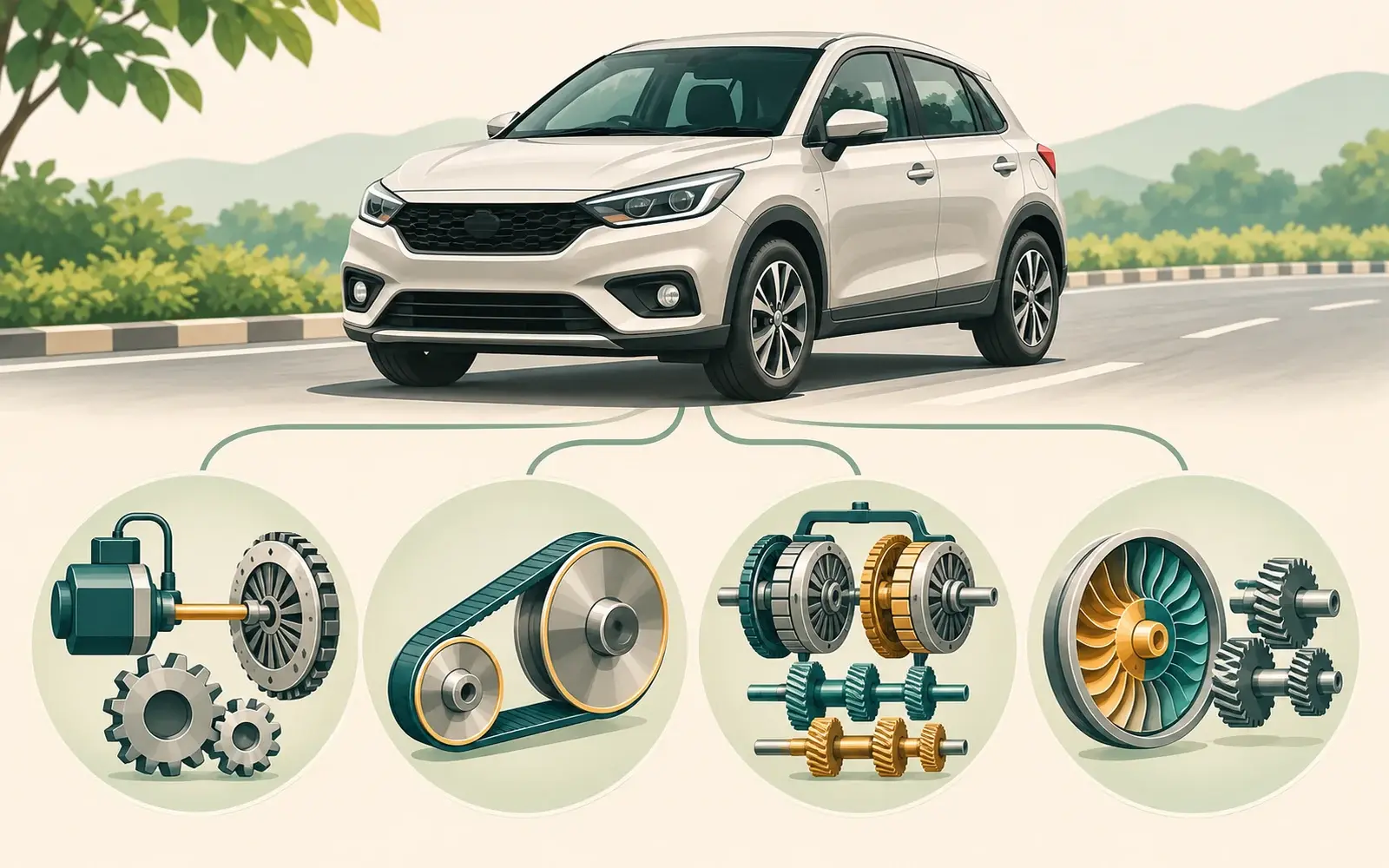
The difference is often the transmission. Indian buyers commonly encounter AMT, CVT, DCT and torque-converter automatics. Each removes the need for a clutch pedal, but they use different mechanisms to transfer engine power to the wheels.
There is no winner for every driver. AMT generally makes sense when price matters most; CVT suits relaxed city driving; DCT rewards responsive driving; and a well-calibrated torque-converter automatic is often the most versatile compromise. The exact car, engine and transmission tuning still matter more than the abbreviation alone.
The four automatic transmissions at a glance
| Transmission | How it changes drive ratio | Typical strength | Main trade-off |
|---|---|---|---|
| AMT (automated manual) | Actuators operate a conventional clutch and stepped gears | Affordable two-pedal driving | Noticeable pause or head-nod during shifts |
| CVT (continuously variable) | Usually varies the effective diameter of pulleys linked by a belt or chain | Smooth progress in traffic | Engine revs can feel disconnected from acceleration |
| DCT (dual-clutch) | Two clutches operate alternating sets of stepped gears | Quick, direct shifts, especially while moving | Low-speed clutch slip and thermal management need attention |
| Torque-converter AT | Fluid coupling at launch, with automatic stepped gearsets | Smooth take-off and broad usability | Size, weight, price and economy vary by design |
These are typical characteristics, not universal rankings. Software, gear ratios, engine output, clutch type, vehicle weight and maintenance can change the result substantially.
How each gearbox works—and what you feel
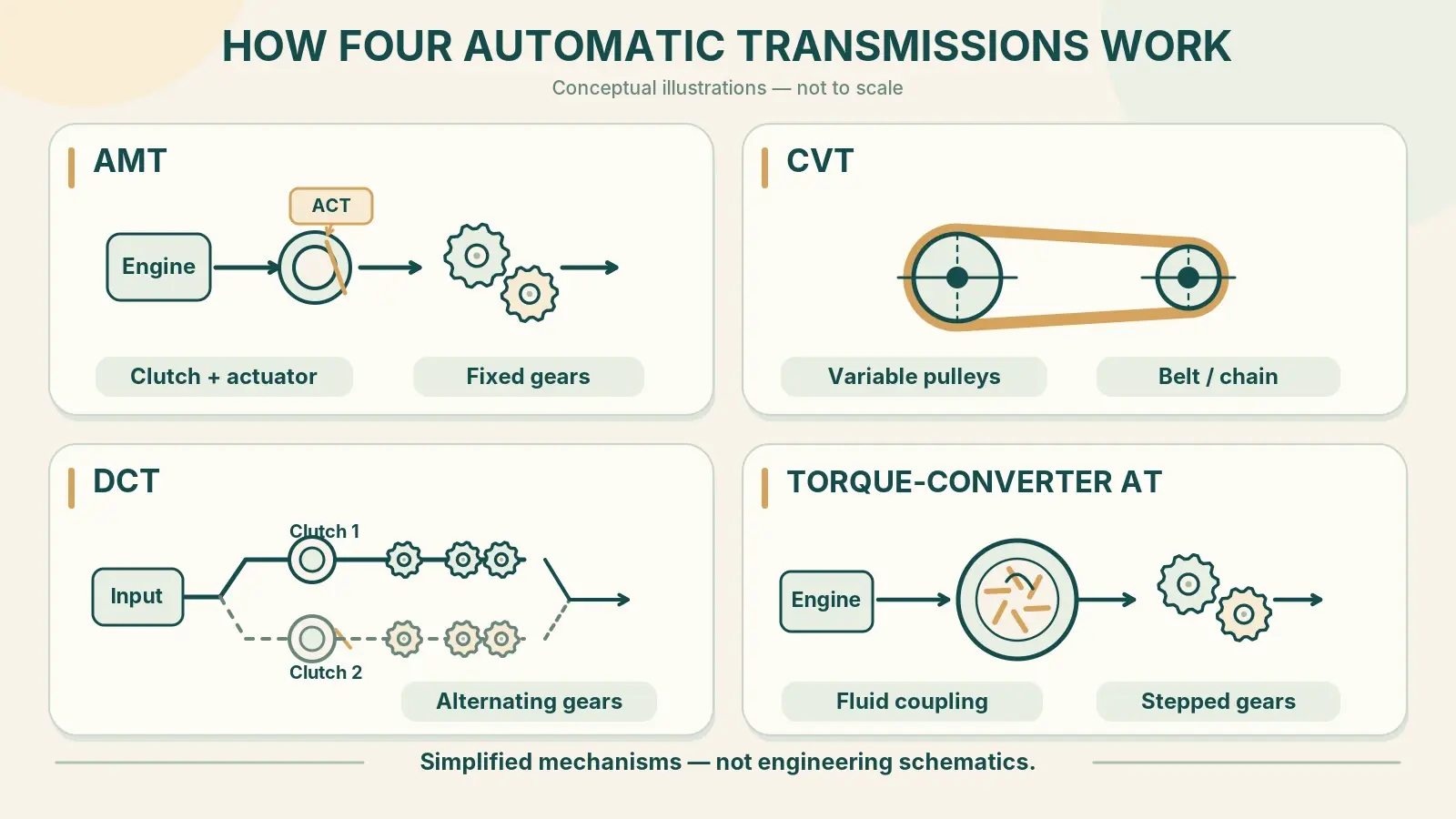
AMT: a manual gearbox that shifts itself
An automated manual transmission starts with much of the hardware of a manual gearbox. Instead of your left foot operating the clutch and your hand selecting gears, actuators do both. Maruti Suzuki calls its version Auto Gear Shift (AGS) and describes an electronic controller coordinating clutch and shift operation.
You get two pedals and automatic shifting, often without paying as much as for a more elaborate automatic. There is still a real clutch disengagement and re-engagement during many changes, however. When the car briefly interrupts engine power, passengers may feel a pause or a slight forward-backward movement. Gentle accelerator inputs can reduce that sensation, but cannot make every AMT behave like a CVT.
Some AMTs include a programmed creep function for slow traffic; this is a vehicle feature rather than proof that the gearbox uses a fluid torque converter. For an affordable small car used mostly for commuting, AMT may be entirely adequate—provided you are comfortable with its shifts on a test drive.
CVT: changing ratios without conventional shifts
A conventional CVT usually has two variable-width pulleys connected by a metal belt or chain. Changing the pulleys' effective diameters changes the drive ratio continuously. Honda's technical explanation shows why this can keep the engine operating near an efficient speed and avoid the interruption associated with stepping between fixed ratios.
In urban traffic, a well-tuned CVT feels progressive: release the brake, accelerate, and speed builds without the familiar sequence of upshifts. During hard acceleration, the engine can rise to a relatively high RPM while the vehicle catches up. Drivers call this a rubber-band feeling. Manufacturers can lessen it with programming, simulated shifts and other changes, so not all CVTs feel alike.
Hyundai's IVT (Intelligent Variable Transmission) is a branded continuously variable system. CVT-style smoothness is appealing for daily traffic, although response, noise and engine character should be assessed together.
DCT: two clutches, rapid gear changes
A dual-clutch transmission has two sets of gears and two clutches. One side can handle one group of ratios and the other the alternating group; the controller can prepare the next likely gear before transferring drive between the clutches. The result can be quick shifts and a connected, engaging feel once the vehicle is moving.
But a DCT is not simply a conventional automatic with faster software. At crawling speeds, its clutches may need to slip as the car moves slowly. Sustained slipping generates heat. Some DCTs use dry clutches; others use wet clutches with oil cooling. Their behaviour and service needs differ.
This matters in India because bumper-to-bumper queues, basement ramps and uphill traffic can require repeated low-speed starts. Kia's Indian owner's manual warns against holding a DCT vehicle on an incline with accelerator input and describes temperature warnings after stressful stop-and-go operation. Such guidance is a reason to drive correctly, not evidence that all DCT cars will fail.
Torque-converter automatic: fluid coupling plus gears
A conventional torque-converter automatic uses a hydraulic coupling between the engine and the transmission, allowing the engine to run while the vehicle is stopped and enabling comparatively smooth take-off. Inside the transmission, selected gearsets provide distinct ratios.
The traditional criticism is that fluid coupling wastes fuel. That is too simplistic for modern units: a lock-up clutch can connect the drivetrain more directly under suitable conditions, reducing slip. Transmission supplier ZF documents this technology as a way to improve efficiency and comfort.
A good torque-converter automatic can combine relaxed traffic behaviour, predictable hill starts and confident highway use. Nevertheless, a sluggish four-speed design and a modern, well-tuned six- or eight-speed unit should not be treated as interchangeable. Engine pairing and shift calibration remain crucial.
Which feels best on Indian roads?
Bumper-to-bumper traffic and crawling speeds
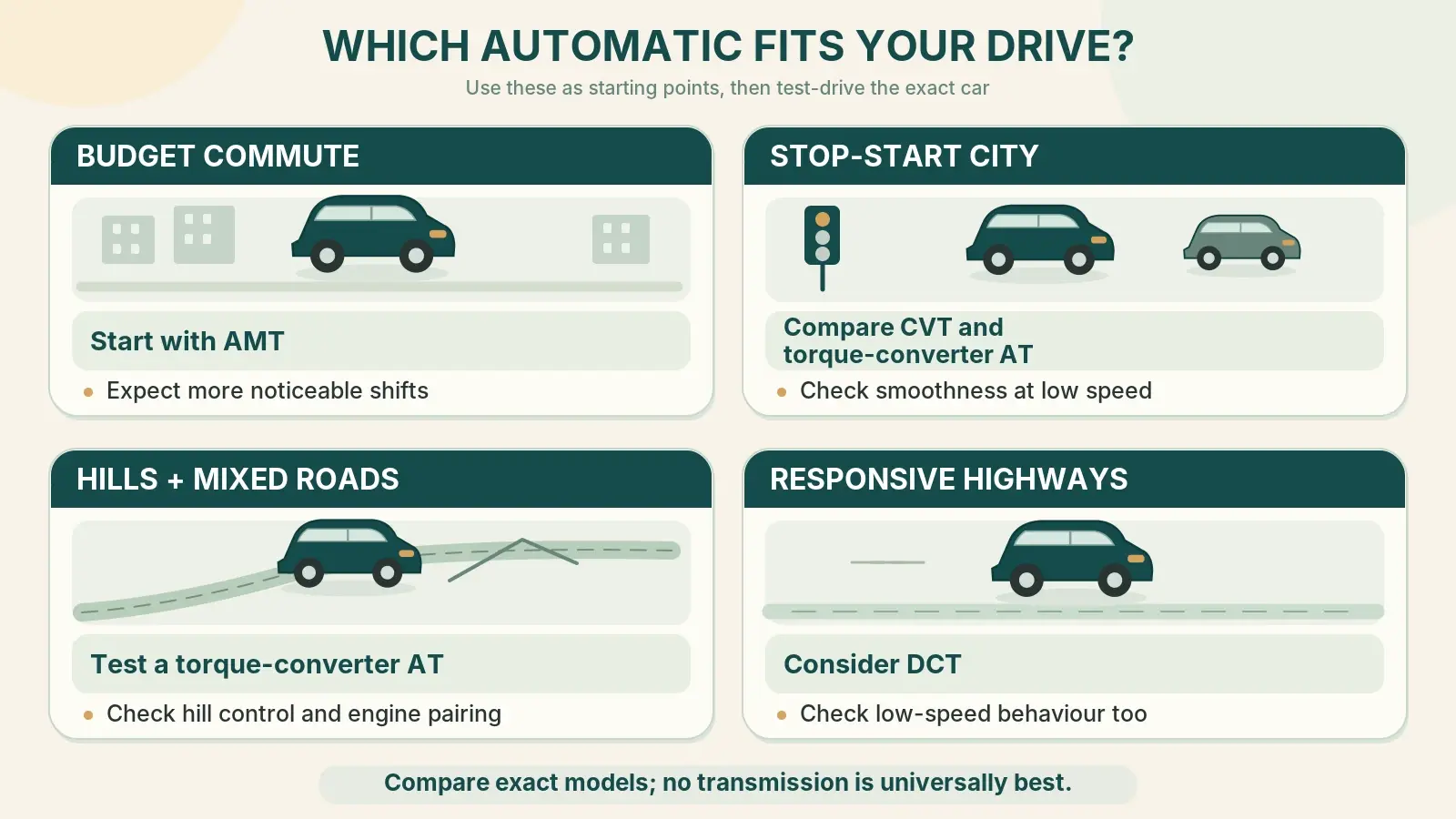
For a daily commute involving frequent stops, CVT and torque-converter automatics are usually the easiest to live with. They tend to move away smoothly and do not have the same conventional clutch-engagement pause as an AMT.
An AMT still eliminates the tiring clutch pedal, making it worthwhile for many budget buyers. Its disadvantage is comfort during repeated first-to-second-gear changes. A DCT may be excellent while traffic flows, but repeated inching at very low speed can be less satisfying, particularly if its clutches remain partly engaged. Exact behaviour depends on its design and controls.
Steep ramps, hill stations and loaded cars
On a hill, look beyond whether the selector says D. Evaluate low-speed torque delivery, hill-hold assistance, brake response and how the car behaves with passengers and luggage. A well-matched torque-converter automatic is often a reassuring all-round choice for frequent climbs; CVTs and AMTs can also perform well when designed for the vehicle.
With a DCT, hold the car using the foot brake or parking brake—not accelerator pressure. Leaving a sensible gap before moving in a steep queue may prevent unnecessary repeated clutch slipping. Follow the particular vehicle's manual, especially if temperature warnings appear.
Do not assume the gearbox automatically prevents rollback. Hill-start assist is a separate feature, and its availability and holding duration vary.
Highway overtaking and faster driving
A responsive DCT can feel particularly rewarding when accelerating and changing gears quickly. A modern torque-converter automatic can also deliver prompt kick-downs and smooth overtaking, especially when paired with a suitable engine. CVTs may hold engine revs high during an overtake, while AMTs can pause before choosing a lower gear.
But overtaking safety is not determined by the gearbox label. Engine power, vehicle load, throttle calibration, available road space and driver judgement matter more. Judge the complete car rather than extrapolating from DCT, CVT or AT alone.
Fuel efficiency: don't choose by acronym
It is tempting to rank the four by mileage, but there is no dependable universal order.
AMTs can approach the efficiency of their manual counterparts because much of the mechanical layout is similar. CVTs may keep the engine near an efficient operating range. DCTs can transmit power efficiently through engaged clutches, and modern torque-converter automatics use lock-up control to reduce hydraulic losses. Every one of these advantages can be offset by gearing, weight, engine tuning and driving conditions.
For a real purchase, compare official fuel-consumption figures for the exact engine, variant and transmission, then examine owner or independent real-world observations under similar routes. Do not compare one manufacturer's city mileage with another car's highway figure. Heavy congestion, air-conditioning, hills and driving style can outweigh modest laboratory differences.
Reliability and repair costs: what actually matters
No design is guaranteed to be trouble-free, and blanket claims such as “DCTs always fail” or “torque converters never break” are misleading.
- AMT: Mechanical clutch wear remains relevant. Actuators, sensors and calibration can also need attention, so a low purchase price does not guarantee a cheap major repair.
- CVT: Correct transmission-fluid specification and scheduled service, where prescribed, matter. Internal repairs can be specialised; do not substitute ordinary automatic fluid without checking the manual.
- DCT: Clutch packs, mechatronics, cooling provisions and software differ between wet- and dry-clutch systems. Extended creeping and repeated hill launches can add thermal stress in some models.
- Torque-converter AT: Often has mature applications, but internal clutches, hydraulic controls, solenoids and the converter can still require expensive work. Fluid requirements are model-specific.
A vehicle's service network, warranty, parts availability and actual failure history are more useful than a generic transmission reputation. When buying used, look for jerks beyond normal characteristics, delayed engagement, slipping, warning lights, fluid leaks and documented service history; ask a qualified workshop to inspect concerns rather than diagnosing by feel alone.
What about e-CVT and iMT?
Names on brochures sometimes make comparisons harder. A hybrid e-CVT is not necessarily the belt-and-pulley CVT described above. Many Toyota-style full hybrids use an electromechanical power-split arrangement with planetary gears and motor-generators. Its smooth driving behaviour may resemble a CVT, but the underlying hardware and maintenance questions are different.
An iMT, offered in some Indian vehicles, is another distinct arrangement: the clutch operation is automated, but the driver still changes gears using the lever. That is not the same fully automatic driving experience as an AMT, CVT, DCT or torque-converter AT.
Similarly, an advertisement saying “AT” may not identify every technical detail. Confirm the exact transmission in the manufacturer brochure for your chosen engine and trim.
How to test-drive an automatic properly
A short lap around a dealership rarely reveals how an automatic behaves during ownership. Where permitted and safe, try these situations in the actual engine-transmission combination you intend to buy:
- Start and crawl: Move gently from rest, then experience repeated low-speed acceleration and braking. Notice pauses, clutch shudder or unnatural hesitation.
- Drive a normal city stretch: Observe how smoothly the car gains speed and responds when you need to slow down suddenly.
- Try a safe incline: Assess hill-hold behaviour and controlled movement without holding the vehicle on the accelerator.
- Accelerate for an appropriate overtake: On a legal, clear road, check whether the transmission responds predictably when you request more power.
- Reverse and park: Test low-speed precision on a level surface, then evaluate parking convenience without excessive throttle input.
- Consider longer-term ownership: Read the manual's fluid schedule, DCT warnings if applicable, warranty exclusions and local service provisions.
Do not intentionally provoke overheating or perform unsafe tests. If a transmission feels unpleasant after a proper demonstration, that matters more than someone else's claim that it is technically superior.
So which automatic should you buy?
| Your priority | Strong starting point | What to check before deciding |
|---|---|---|
| Lowest-cost automatic for everyday errands | AMT | Can you comfortably accept shift pauses and occasional head-nod? |
| Relaxed stop-start commuting | CVT or torque-converter AT | Test smoothness, engine noise, launch response and price. |
| Mixed city, highways and frequent hills | Well-tuned torque-converter AT | Check exact gear count, engine pairing, hill behaviour and running costs. |
| Quick responses and enthusiastic driving | DCT | Check low-speed comfort, wet/dry design, cooling and service support. |
These are shortlisting suggestions, not fixed winners. A poorly calibrated torque-converter car can feel worse than a good AMT; a well-engineered DCT may be excellent for its owner's commute. Vehicle-specific execution overrides category stereotypes.
For most buyers who can afford the options, a smooth CVT or well-tuned torque-converter automatic is an easy place to start for Indian urban use. Choose AMT when affordability outweighs shift refinement, and choose DCT when you value its driving character and understand its low-speed operating requirements.
The best automatic is the one that makes your actual route easier—not the one with the most impressive initials on its badge.
Sources and further reading
- Maruti Suzuki — Auto Gear Shift (AGS) technology — automated clutch/gear operation and creep function.
- Honda Global — Continuously Variable Transmission — pulley mechanism, response characteristics and efficiency.
- Kia India — DCT operation and characteristics — dual-clutch operating guidance.
- Kia India — DCT temperature and hill warnings — low-speed slip and overheating cautions for the covered model.
- ZF — Passenger-car torque converters — hydraulic coupling and lock-up technology.
- AISIN — Automatic and CVT product technology — modern stepped automatics and CVT designs.
- Hyundai India — CVT and IVT explained — India-market terminology.
- Autocar India — Different automatic gearboxes explained — independent consumer context.