Ex-Showroom Price vs On-Road Price: Where Does the Extra Money Actually Go?
Understand India's ex-showroom and on-road car prices, including road tax, registration, insurance, TCS and dealer add-ons, with a clear ₹12 lakh example.
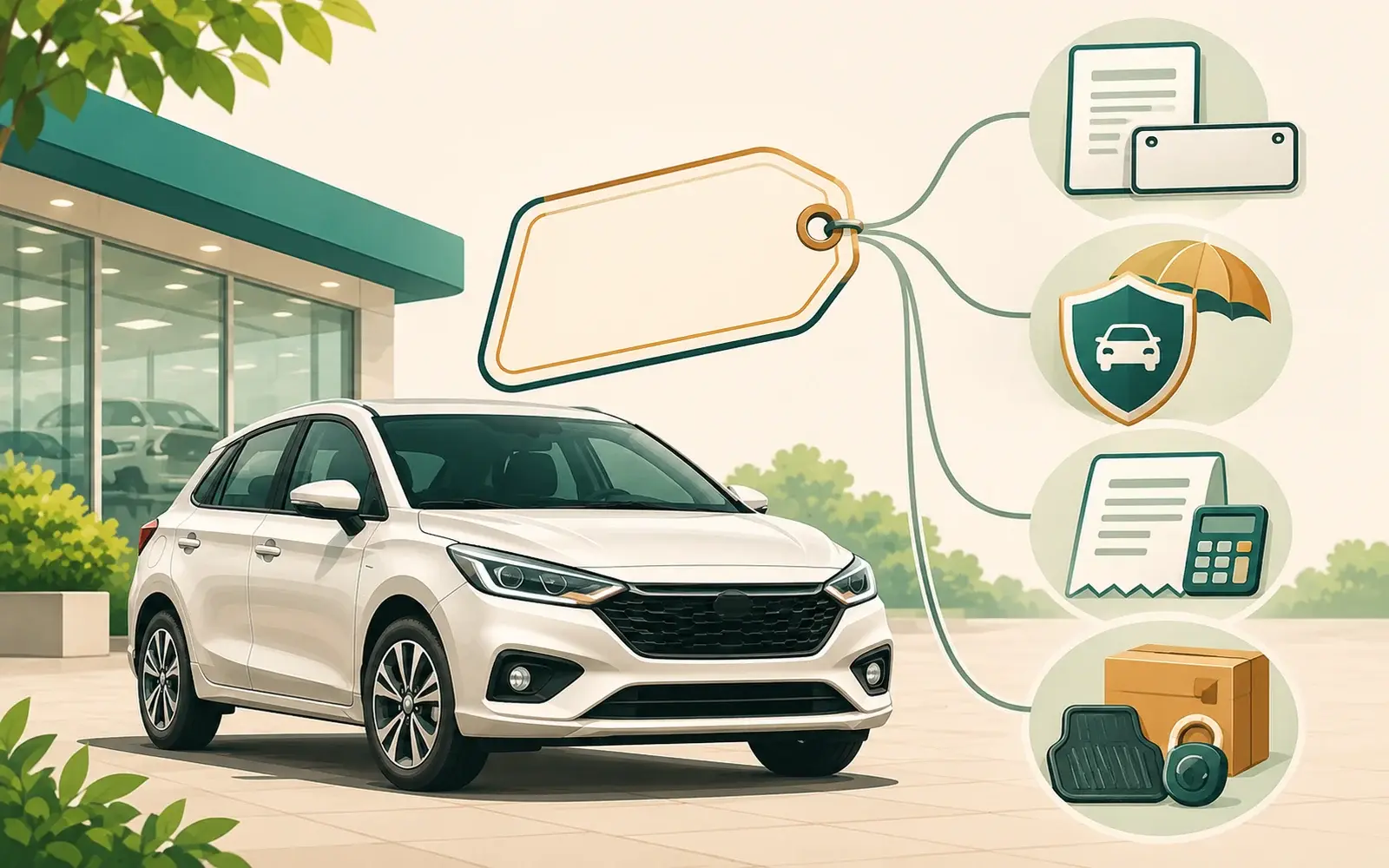
A car advertised for ₹12 lakh can arrive with a quotation substantially higher than ₹12 lakh. That does not automatically mean the dealer is overcharging you. It may include road tax, registration, insurance and tax collected at source (TCS). But it may also include accessories, protection plans or fees that deserve a closer look.
The useful question is not simply “Why is the on-road price higher?” It is “Which parts are statutory, which buy useful protection, and which are dealer-added choices?” Once you separate those categories, comparing offers from two dealerships becomes much easier.
Ex-showroom price and on-road price: the basic difference
Ex-showroom price is the price of the vehicle before costs such as its registration, state road tax and insurance are added. It typically includes the manufacturer's vehicle cost, dealer margin and applicable Goods and Services Tax (GST). It is not a pre-GST price.
On-road price is the amount quoted to get the car registered, insured and ready for delivery, plus any extras included in that quotation. Unlike ex-showroom price, it is not a single uniform national figure.
A useful way to read the quotation is:
On-road quotation = ex-showroom price + applicable road tax and registration costs + insurance + other applicable charges + any selected extras.
TCS may appear as another upfront line when the vehicle sale consideration exceeds the statutory threshold. Buyers should distinguish that tax credit from a non-refundable dealer fee.
| Price component | Where it belongs | Can the amount vary? |
|---|---|---|
| Vehicle price, including applicable GST | Ex-showroom | By variant, date, offers and seller |
| State road/motor-vehicle tax | Added on-road | Yes—registration jurisdiction and vehicle category matter |
| Registration and prescribed documents/plates | Added on-road | Under applicable government rules |
| Motor insurance | Added on-road | By coverage, vehicle and insurer |
| TCS, when applicable | Collected separately upfront | Set by tax rules and sale consideration |
| Accessories, coatings, plans and other extras | Sometimes added to dealer quote | Usually selectable or negotiable |
Do not assume that everything printed under the heading RTO charges is government tax. Ask for the calculation and official receipt.
What is already included in the ex-showroom price?
The most common misunderstanding is that a dealer charges GST again after adding the advertised ex-showroom price. Applicable vehicle GST is normally already built into that ex-showroom figure. A separate road tax is not a second GST charge; it is imposed under motor-vehicle taxation rules.
India's car GST structure changed on 22 September 2025. Government guidance describes 18% GST for qualifying small cars—including petrol/LPG/CNG models up to 1,200 cc and 4,000 mm, and diesel models up to 1,500 cc and 4,000 mm—and 40% for the specified larger car classes without the former compensation cess. Other categories, including electric vehicles, have their own treatment. These rules matter to the underlying vehicle price, but the buyer should not add the applicable percentage to the already GST-inclusive ex-showroom figure. Source: Press Information Bureau, 56th GST Council FAQs.
Ex-showroom quotations can still vary due to a manufacturer's revision, a dealer discount or a different vehicle variant. Compare the same model, powertrain, transmission, trim and model year, with discounts shown separately, before deciding that one seller is cheaper.
Where the additional money goes
1. Road tax: usually the largest government addition
Motor-vehicle tax is collected under the rules of the state or union territory where the vehicle is registered. The assessment can depend on factors such as vehicle price, fuel type, classification, registration category and local concessions. Do not rely on a universal percentage advertised in a buying guide.
This explains why the same car can have different on-road prices in different Indian cities. Special cases matter, too: eligible BH-series registrations follow a different recurring-tax framework from an ordinary state-registered private car. Ask for the correct rate for your intended registration, rather than assuming you qualify for the lowest figure available somewhere else. Official transport portals, including Delhi's vehicle-registration guidance, describe the requirement for applicable road tax.
2. Registration, number plates and documentation
Registering the vehicle involves prescribed registration fees and, as applicable, charges for registration-certificate issuance, high-security registration plates, hypothecation endorsement on financed cars and related services. These are different from the percentage-based road tax.
A dealer may combine them under “RTO,” but a single unexplained ₹15,000 line tells you very little. Request a breakdown separating road tax, registration fee, plates, hypothecation and any claimed service charge. Where available, match official amounts and payment receipts with the VAHAN/Parivahan registration system.
Government fee schedules can change. An old blog post's registration-fee figure is not enough to verify a new quotation.
3. Insurance: necessary cover versus an expensive package
Third-party motor insurance is compulsory for using a car on public roads. For new private cars, the standard upfront structure has generally included three years of third-party liability cover; an own-damage component may be purchased separately, often initially for one year. Compare the actual policy schedule rather than assuming the dealer's entire three-year quoted amount is comprehensive cover for three years. IRDAI's listed private-car policy products distinguish long-term third-party and bundled products.
Own-damage insurance protects your own car against covered risks; third-party insurance by itself does not pay for your car's collision damage. Comprehensive or bundled cover may be sensible, especially for a new car, but its premium and features are not interchangeable with the legal minimum.
When comparing dealer and independent insurance quotations, match the insured declared value (IDV), own-damage term, third-party term, deductibles, no-claim bonus if applicable, cashless repair network and chosen add-ons. A lower premium with a much lower IDV or missing coverage is not necessarily a better deal.
4. TCS on higher-value vehicle purchases
Under Section 394 of the Income-tax Act, 2025, a seller collects 1% TCS on the sale consideration of a motor vehicle exceeding ₹10 lakh, subject to statutory exceptions. The provision replaced the older Section 206C(1F) framework from the previous Income-tax Act. Source: Income-tax Department, Section 394.
TCS increases the cash paid at purchase, but it is tax collected against the buyer's tax account—not a dealer's service income. Check that it is reported against your correct PAN and reflected in the applicable tax statement, and claim the appropriate credit when filing or reconciling taxes. It should not be confused with GST or road tax.
Importantly, the law refers to vehicle sale consideration, not the total on-road bill after separately billed registration and insurance. Ask the dealer to show the exact basis if the calculation is unclear.
5. FASTag and smaller delivery items
FASTag issuance and its initial balance or security deposit can appear on the invoice. Check the issuer, the amount loaded, and whether the tag is activated for your vehicle. A small legitimate cost does not justify an unexplained package labelled “mandatory FASTag + accessories.”
The same scrutiny applies to number-plate frames, emergency kits and other handover items. Their presence on a quotation does not automatically make them statutory government charges.
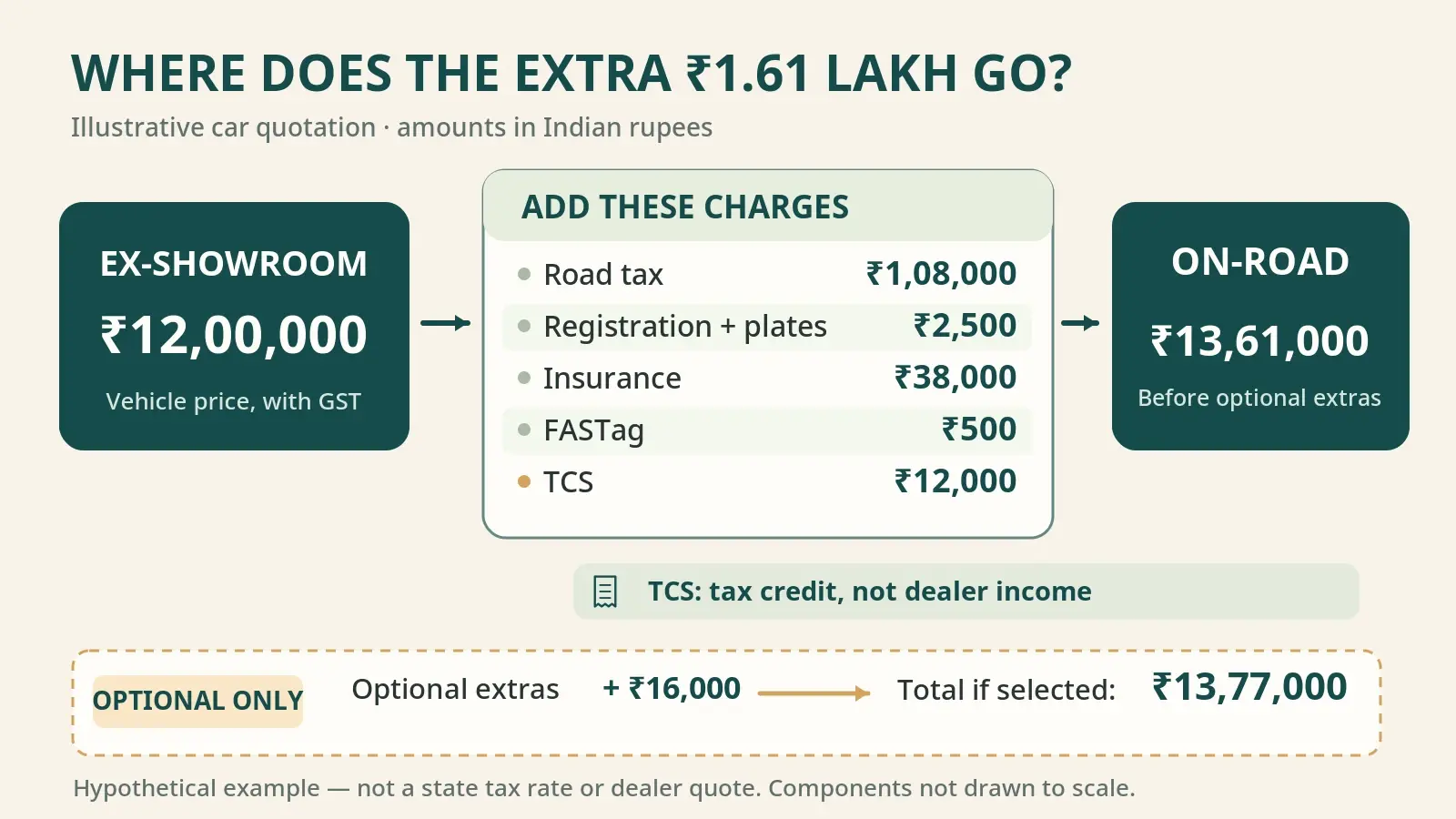
Example: how a ₹12 lakh car becomes ₹13.61 lakh on-road
Consider a hypothetical car with a ₹12,00,000 ex-showroom price and a registration location for which the example uses a 9% road-tax calculation. These are teaching figures—not verified prices, tax rates or an insurance quote for any particular state or model.
| Item | Illustrative amount |
|---|---|
| Ex-showroom price (GST already included) | ₹12,00,000 |
| Road tax, assumed at 9% | ₹1,08,000 |
| Registration, plates and related official costs | ₹2,500 |
| Insurance package | ₹38,000 |
| FASTag issuance / initial amount | ₹500 |
| TCS, illustrated at 1% of ₹12,00,000 sale consideration | ₹12,000 |
| Total upfront quotation | ₹13,61,000 |
That is ₹1,61,000 above ex-showroom, or approximately 13.4% more. Of the ₹1.61 lakh difference, ₹1.08 lakh comes from the assumed road tax. Other portions buy insurance or cover administrative costs, while the ₹12,000 TCS is potentially creditable against income tax.
Now imagine the dealer also adds a ₹12,000 accessories package and a ₹4,000 paint-protection service. The displayed total rises to ₹13,77,000, even though those two products were not part of the statutory calculation. Removing them saves ₹16,000 without changing the car's registration status.
The lesson: the total alone cannot tell you whether an offer is fair. Its components can.
Which dealer charges deserve a closer look?
Dealership quotations may include accessories, coatings, roadside assistance, extended warranties, maintenance packages, documentation fees, loan-processing charges and “handling,” “logistics” or “stockyard” fees.
Some products are useful; others may offer poor value. Their inclusion does not make them compulsory. Ask whether a service is required by law, required by your chosen finance or insurance contract, or simply recommended by the salesperson. Those are three different claims.
Handling or logistics fees are particularly worth challenging. A dealer should explain the precise service and legal basis rather than presenting a second transportation or delivery charge as an RTO levy. Industry guidance has long identified this as a disputed charge; do not automatically conclude that every differently labelled fee is illegal without checking the actual terms and jurisdiction. Autocar India's price breakdown discusses the issue.
Also check whether the dealer has bundled an “essential kit” with mats, mud flaps or perfume. You can generally ask for a quote without optional accessories and decide later whether to buy them. Do not agree to anything merely because a quotation labels it standard.
If the dealership says its insurance is mandatory, ask for the legal or contractual reason in writing. Buyers should be able to compare suitable insurance policies; the requirement to carry valid cover should not be confused with a requirement to purchase every add-on sold through the showroom.
How to compare quotations from two dealerships
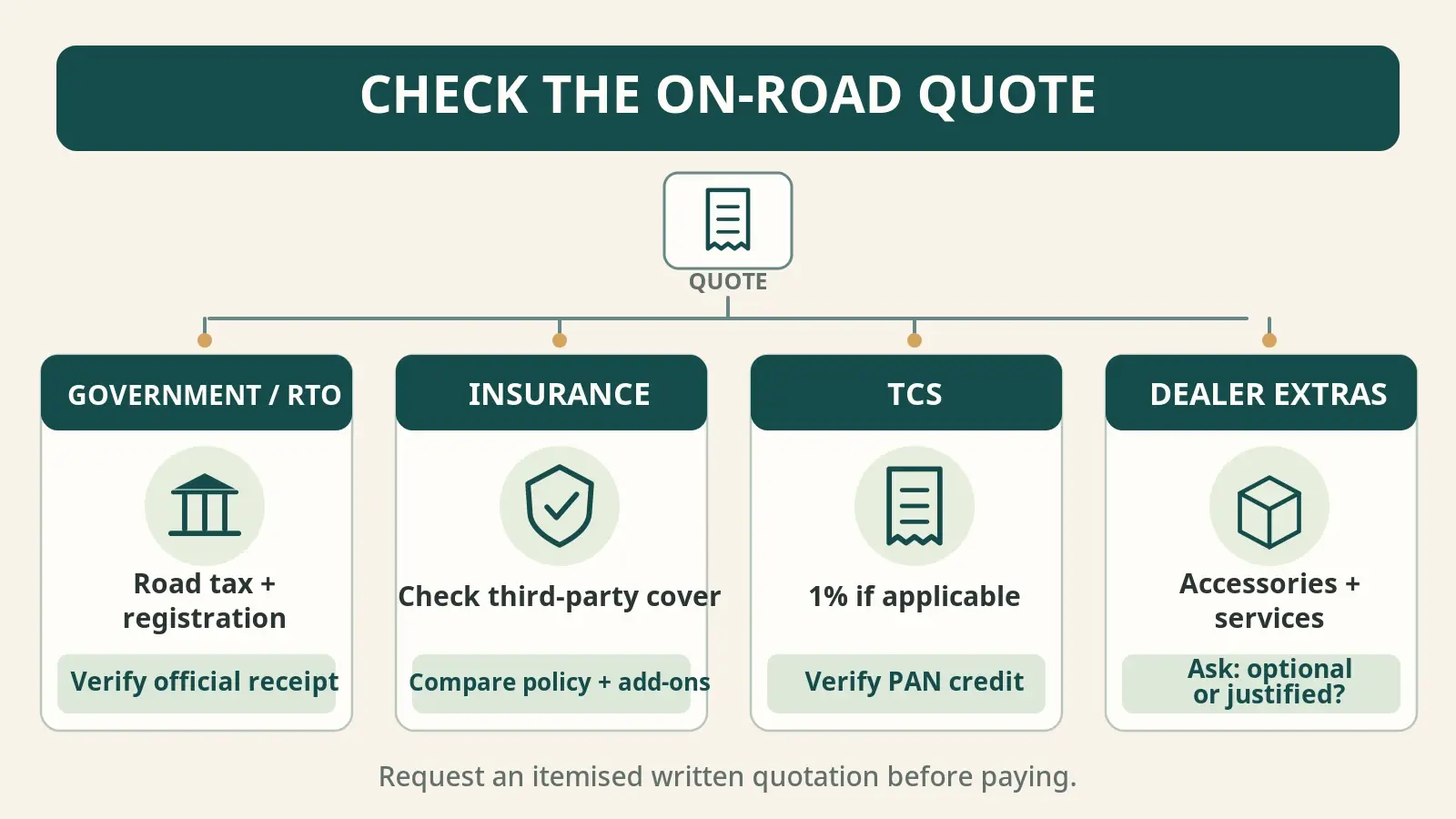
Start with written, itemised quotes for the same variant and the same registration jurisdiction. Then make three separate comparisons:
- Vehicle deal: ex-showroom price, manufacturer offers, dealer discount, exchange bonus, corporate eligibility and timing. Check whether discounts are conditional on exchanging a car, financing through a partner or buying a package.
- Mandatory and applicable charges: road tax, registration, actual insurance coverage and TCS. These should be independently explainable, even if two dealers estimate them differently.
- Optional expenditure: accessories, coating, warranty extension, roadside assistance, service packages, handling fees and other bundles. Ask for a version of the quote with these removed or separately selected.
A dealer offering a ₹30,000 “discount” may not be cheaper if it simultaneously adds ₹25,000 of unwanted products. Compare the net vehicle discount and final payable amount, not the headline discount.
Financing adds another wrinkle. A salesperson may emphasise a lower monthly EMI rather than a lower purchase price. Loan interest, processing fees and the term of the loan affect total ownership cost; they are not necessarily part of the on-road vehicle quotation. Compare the financed and cash versions of the deal separately.
Before you pay the booking amount or take delivery
Ask the dealership for the signed quotation, including what happens if the manufacturer changes its ex-showroom price before invoicing. Keep any promises about discounts, delivery date, accessories, insurance and refund terms in writing.
Before final payment, verify:
- The exact model, trim, colour, fuel type and registration address.
- The vehicle invoice price and the applied discounts.
- A separate road-tax calculation and official registration-related charges.
- The insurer, policy period, IDV, deductibles and add-ons actually chosen.
- Whether TCS applies and the PAN against which it will be reported.
- Whether FASTag has been issued and its initial amount credited.
- A clear list of optional items, with consent and receipts.
At delivery, check the vehicle identification number (VIN), registration records, insurance policy and key invoice details for consistency. The dealer's final receipt should reconcile with what you agreed to pay.
If you discover an unexplained or unwanted charge, first request a written correction from the dealer and escalation to the manufacturer's customer-support team. Preserve quotations, payment proofs and messages. India's National Consumer Helpline accepts grievances, including via 1915; it is a complaint-resolution channel, not a guarantee of a particular outcome.
The bottom line
Ex-showroom is the vehicle's selling price; on-road is the wider transaction cost. The legitimate difference can be substantial because registration, road tax, insurance and sometimes TCS sit outside the advertised figure. But dealer-added products can make the total larger still.
For a confident purchase, ask for the itemised final payable quotation before negotiating. Verify official charges, compare equivalent insurance cover and remove optional items you do not want. The best offer is not always the lowest ex-showroom figure—it is the clearest, fairly priced deal for the exact car you intend to register.
Sources and further reading
- Press Information Bureau — 56th GST Council FAQs on revised vehicle taxation
- Income-tax Department — Section 394, Income-tax Act, 2025 (TCS)
- Ministry of Road Transport and Highways — mParivahan
- Delhi Transport Department — vehicle registration guidance
- IRDAI — listed long-term and bundled private-car insurance products
- National Consumer Helpline — official grievance portal
- Autocar India — breakdown of ex-showroom and on-road prices