EV vs Hybrid vs Petrol Cars: Understanding the Difference
Understand how electric, hybrid and petrol cars work, how they differ in efficiency, running costs, maintenance, range and everyday use.
A petrol car stops at a fuel station. An electric car connects to a charger. A hybrid does something in between.
That sounds simple until you start shopping for one.
Terms such as EV, HEV, mild hybrid, strong hybrid, plug-in hybrid, regenerative braking, battery capacity and electric range quickly turn what seems like a basic comparison into an alphabet soup of technologies.
The easiest way to understand the difference is to ignore the marketing labels for a moment and ask one question:
What actually turns the wheels?
In a petrol car, an internal combustion engine does the work.
In a battery-electric vehicle, one or more electric motors do it using electricity stored in a large battery.
A hybrid carries both an engine and an electric motor and uses them together in different ways.
That basic difference changes almost everything else: how the car is refuelled, how efficiently it uses energy, what it feels like to drive, what maintenance it needs and what happens when you slow down.
How a Petrol Car Works
A petrol car uses a spark-ignition internal combustion engine, or ICE.
Petrol is stored in a fuel tank and delivered to the engine, where it is mixed with air. A spark plug ignites that mixture inside the engine's cylinders.
The expanding gases created by combustion push the pistons. The engine converts that movement into rotational force, which passes through the drivetrain to the wheels.
The exact layout varies, but a conventional petrol car normally needs systems such as:
- fuel tank and fuel pump
- fuel injection
- engine cylinders and pistons
- spark plugs
- engine oil and cooling systems
- exhaust system
- emissions-control equipment
- transmission
The U.S. Department of Energy's Alternative Fuels Data Center describes the same basic process: petrol, called gasoline in the United States, is mixed with air and ignited by a spark in a spark-ignition internal combustion engine.
This technology has been refined for well over a century. Modern petrol engines can be smooth, powerful and relatively efficient compared with older designs.
But there is a fundamental limitation: combustion produces a great deal of heat, and not all of the chemical energy in the fuel reaches the wheels.
That becomes one of the biggest differences between petrol and electric propulsion.
How an Electric Car Works
A battery-electric vehicle, usually called a BEV or simply an EV, removes the petrol engine entirely.
Instead, it has a large traction battery that stores electrical energy.
That electricity is sent through power electronics to one or more electric motors, which turn the wheels.
The main components typically include:
- high-voltage battery pack
- electric traction motor
- power electronics
- onboard charger
- charge port
- thermal-management system
- DC/DC converter
- a relatively simple reduction gear or electric transmission
There is no conventional petrol tank, spark-ignition engine or exhaust system.
The battery is recharged by connecting the vehicle to an external electricity source. Energy can also be returned to the battery during deceleration through regenerative braking.
The U.S. Department of Energy defines a battery EV in essentially these terms: it uses a traction battery to power an electric motor and must connect to an external electricity source to recharge.
How a Hybrid Car Works
A hybrid combines the two systems.
A conventional hybrid-electric vehicle, or HEV, has:
- a petrol engine
- one or more electric motors
- a battery
- power electronics
- a fuel tank
Unlike a full battery EV, however, a conventional hybrid normally does not need to be plugged in.
Its battery is relatively small and is charged mainly by the engine and by recovering energy during braking.
The computer controlling the drivetrain decides when to use the petrol engine, the electric motor or both.
Depending on the design and driving situation, a full hybrid may:
- move using the electric motor alone for short periods
- use the engine alone
- combine engine and electric-motor power
- turn the engine off when stopped
- recover energy while slowing down
This allows the petrol engine to operate less often or under more favourable conditions.
The result is generally lower fuel consumption than an otherwise comparable conventional petrol vehicle, particularly in stop-and-go driving. The U.S. Department of Energy describes conventional HEVs as combining an internal combustion engine with electric propulsion while charging their batteries through regenerative braking and the engine rather than an external plug.
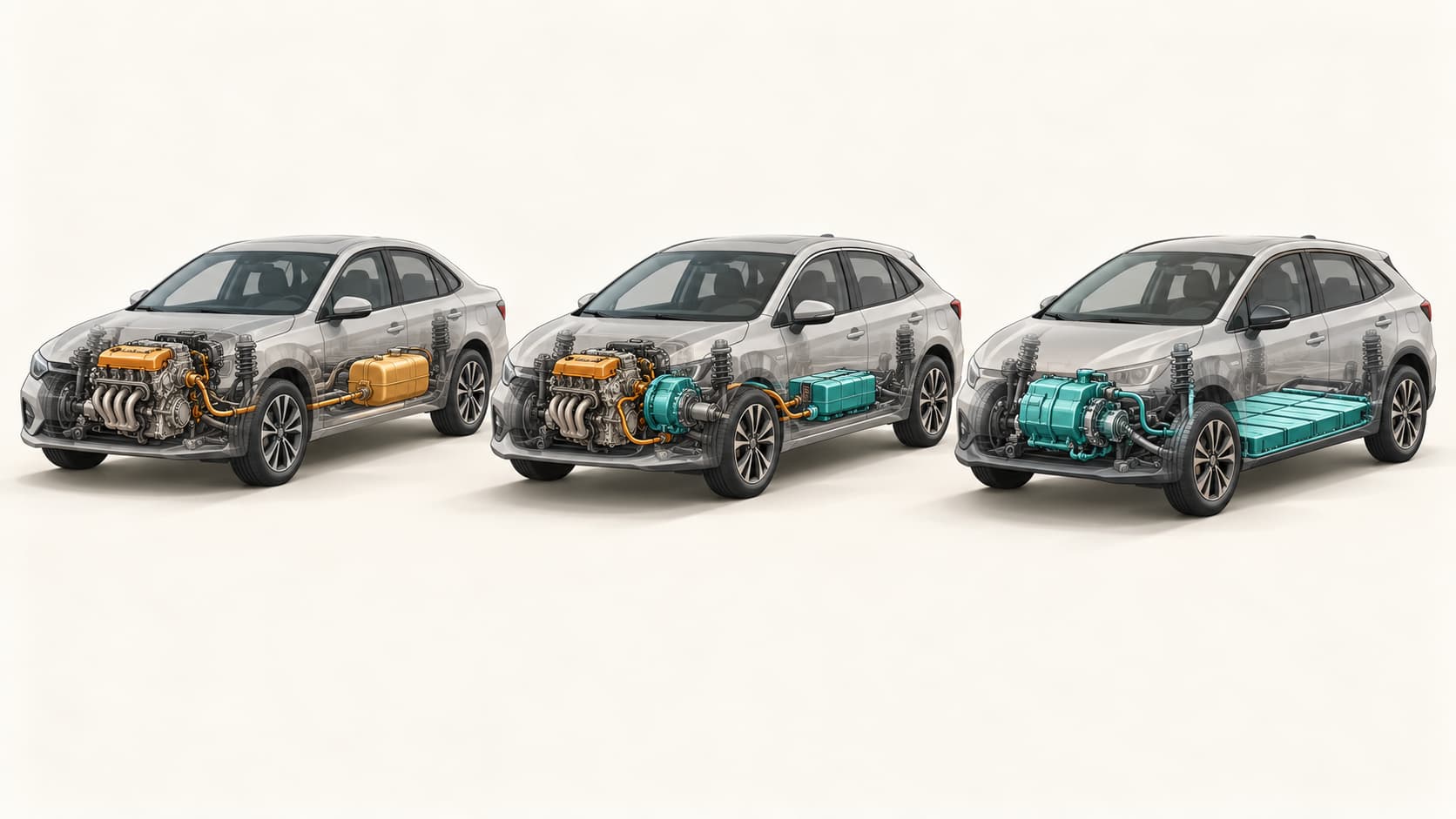
EV vs Hybrid vs Petrol: The Basic Layout
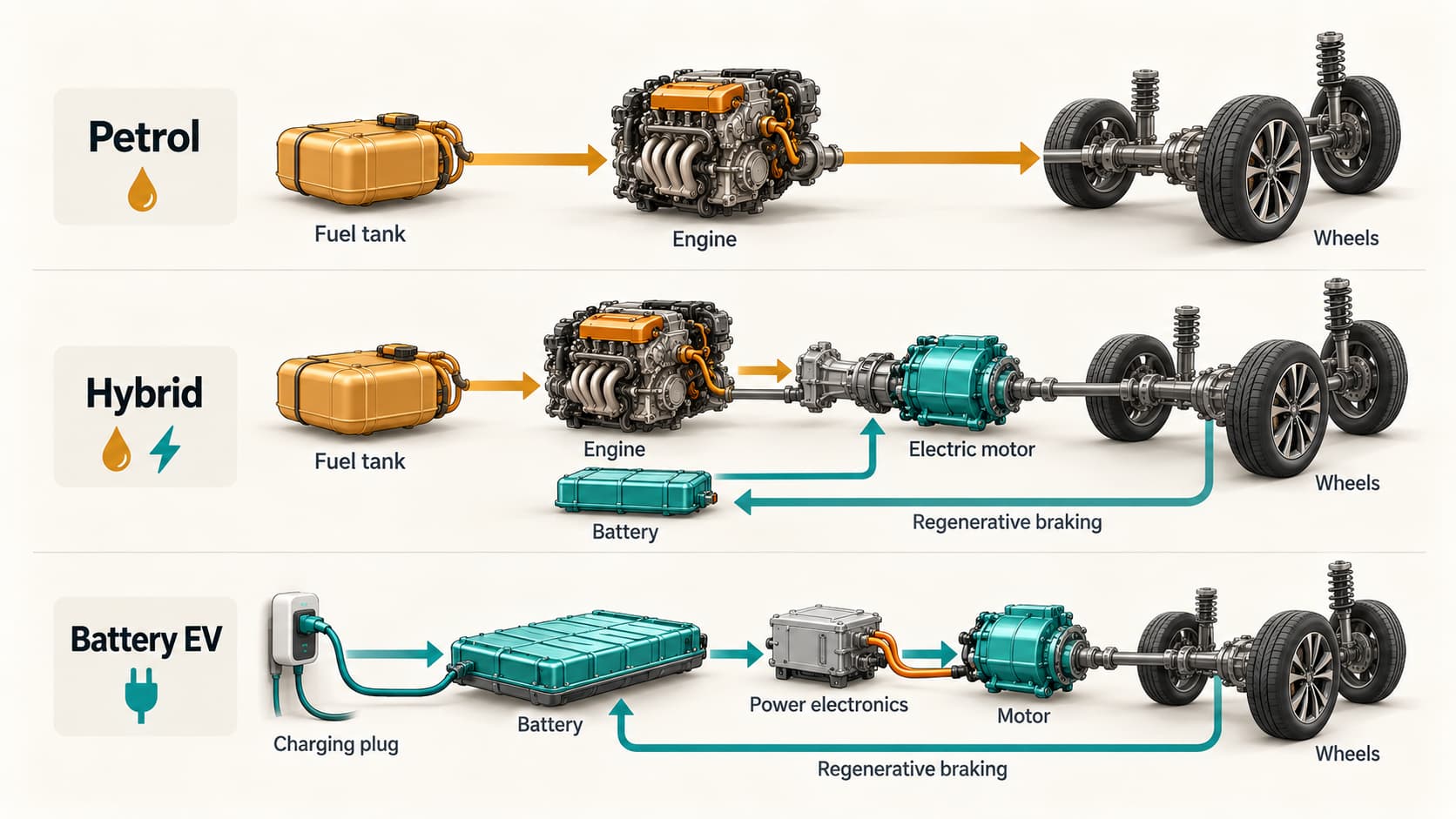
The three systems become much easier to understand when placed side by side.
| Feature | Petrol car | Hybrid car | Battery EV |
|---|---|---|---|
| Petrol engine | Yes | Yes | No |
| Electric traction motor | Usually no | Yes | Yes |
| Large traction battery | No | Smaller than BEV | Yes |
| Fuel tank | Yes | Yes | No |
| External charging required | No | No for conventional HEV | Yes |
| Regenerative braking | Usually no | Yes | Yes |
| Tailpipe exhaust | Yes | Yes when engine runs | None |
| Main energy source | Petrol | Petrol + recovered electrical energy | Electricity |
| Can drive without petrol | No | Sometimes briefly, depending on hybrid type | Yes |
The important distinction is that a conventional hybrid is still fundamentally fuelled with petrol.
You don't charge it overnight like an EV.
What Does Regenerative Braking Actually Do?
Regenerative braking is one of the most important differences between electrified cars and conventional petrol cars.
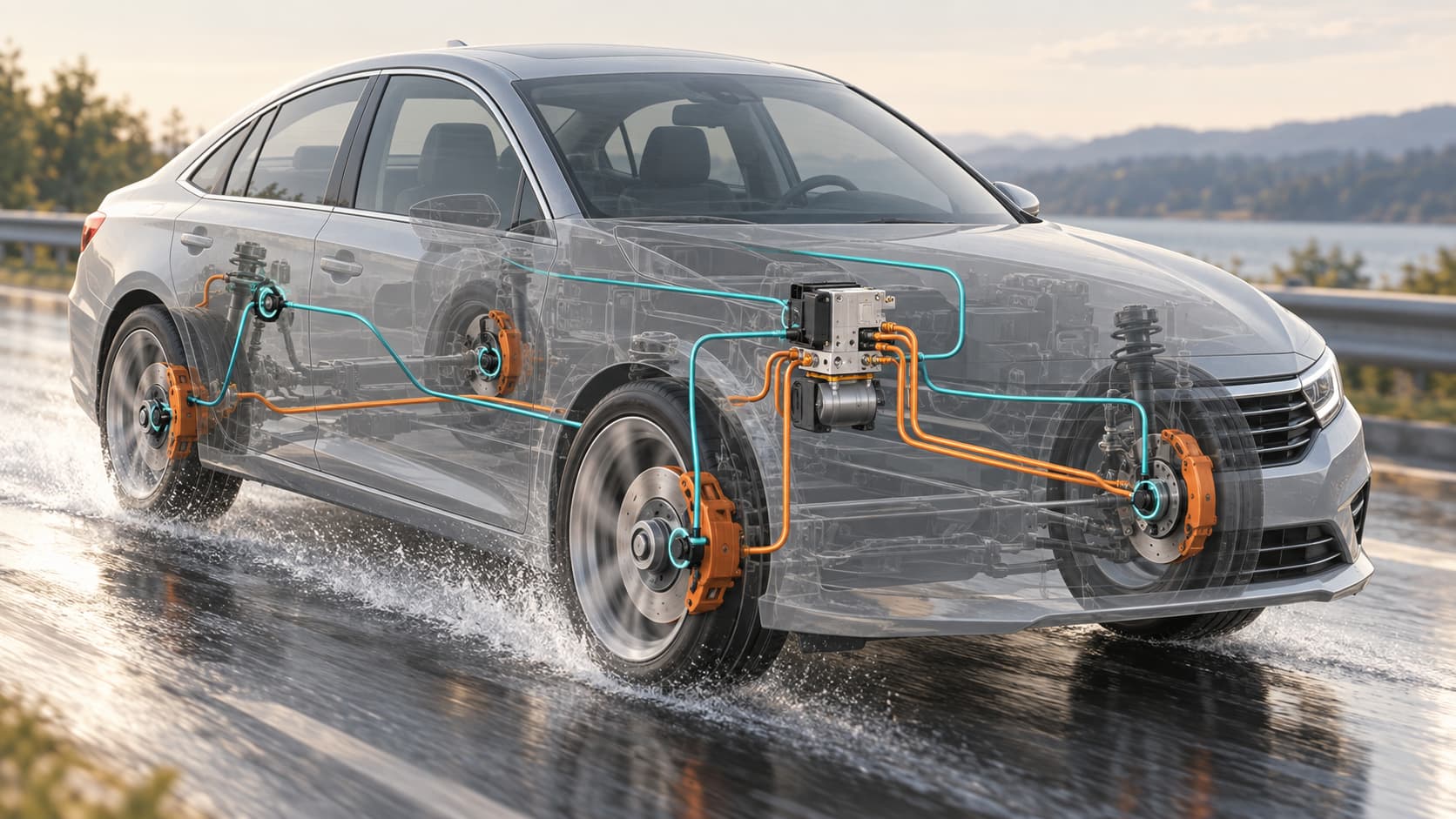
In a normal car, when you press the brake pedal, the brake pads create friction against discs or drums.
The car's kinetic energy is largely converted into heat and released into the surroundings.
An electric motor can work in reverse.
When an EV or hybrid slows down, the wheels can turn the electric motor, making it act as a generator. Some of the car's kinetic energy is then converted back into electrical energy and stored in the battery.
That energy can later help move the car again.
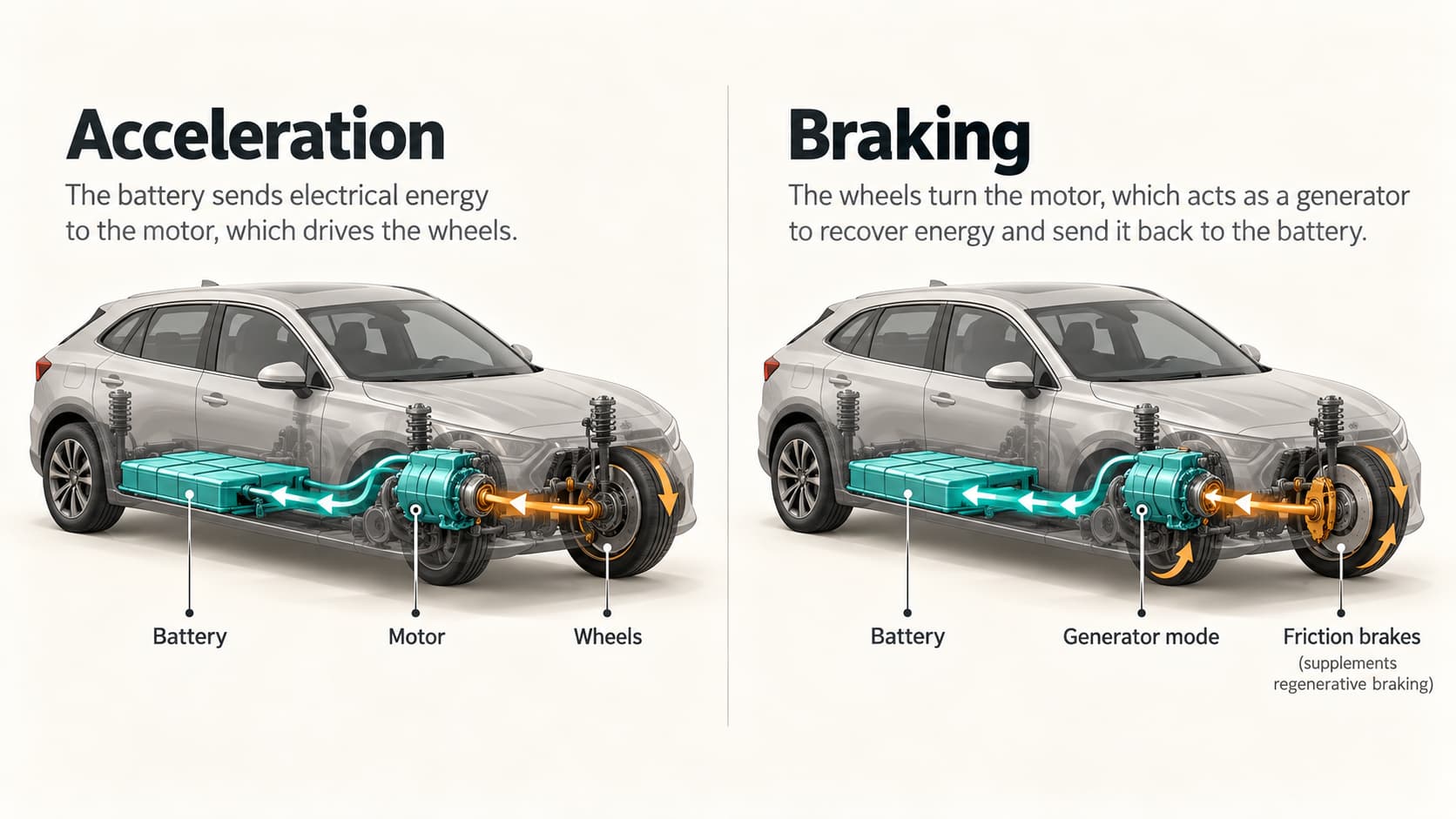
This is particularly useful in city driving, where vehicles accelerate and brake frequently.
The Department of Energy notes that hybrid vehicles use regenerative braking to capture energy that would otherwise be lost during braking and store it in their batteries.
Regeneration does not recover all of the vehicle's energy. There are conversion losses, and conventional friction brakes are still required for harder stops, low-speed braking and other conditions.
But recovering even part of that energy helps improve efficiency.
Why EVs Use Energy More Efficiently
The biggest mechanical advantage of an EV is that converting electricity into movement is much more direct than producing movement through combustion.
A petrol engine must repeatedly:
- bring fuel and air into the cylinders,
- compress them,
- burn the mixture,
- convert expanding gas into piston movement,
- turn that reciprocating motion into rotation,
- send that rotation through the drivetrain.
A significant amount of energy becomes heat rather than vehicle motion.
An electric drivetrain has fewer conversion stages.
Electricity from the battery passes through power electronics to an electric motor, which produces rotation directly.
U.S. Department of Energy analysis based on EPA drive-cycle data estimates that a typical EV converts a much larger share of its onboard energy into movement than a conventional petrol vehicle, particularly when regenerative braking is included. The exact efficiency depends on the vehicle and test conditions, so such figures should be treated as comparative engineering measurements rather than universal values for every car.
This efficiency is one reason EVs can travel substantial distances using what seems like a relatively small amount of electrical energy.
Why an EV Feels Different to Drive
Electric motors have another useful characteristic: they can deliver high torque from very low motor speeds.
That means an EV can respond immediately when you press the accelerator.
There is no need for an engine to build revs in quite the same way as a combustion engine.
Many EVs therefore feel unusually quick and smooth when pulling away from a traffic signal, even when they aren't designed as performance cars.
They also tend to be quiet at low speeds because there is no combustion engine operating.
The absence of conventional gear changes in many EV drivetrains can make acceleration feel particularly continuous.
This does not automatically mean every EV is faster than every petrol car. Motor power, vehicle weight, gearing, traction and software still matter.
Why Hybrids Are Especially Effective in Cities
City traffic is a difficult environment for a conventional petrol engine.
You accelerate.
Then brake.
Then idle.
Then accelerate again.
A hybrid can exploit this pattern.
When the car slows, regenerative braking captures some energy.
When the car stops, the engine can switch off.
At low speeds, some full hybrids can move for short periods using the electric motor.
When more power is required, the engine can restart automatically.
This repeated switching happens largely without the driver needing to think about it.
That is why the benefits of hybridisation can be particularly noticeable in urban and stop-start driving.
Mild Hybrid vs Full Hybrid: They Are Not the Same
The word hybrid can describe considerably different systems.
Mild hybrid
A mild-hybrid system uses a small electric motor-generator and battery to assist the petrol engine.
It can support functions such as:
- smoother engine restart
- electrical assistance during acceleration
- regenerative braking
- shutting the engine off when appropriate
But a mild hybrid generally cannot drive the vehicle using electric power alone.
Full or strong hybrid
A full hybrid has a more capable motor and larger battery.
Depending on the vehicle, it can move under electric power alone for limited distances or at lower speeds.
The Department of Energy makes the same distinction: mild hybrids use electric assistance but cannot normally propel the vehicle on electricity alone, while full hybrids use larger batteries and motors that can provide electric-only propulsion in some situations.
So simply seeing the word "hybrid" is not enough.
You need to know what kind of hybrid system the car actually uses.
Where Do Plug-In Hybrids Fit?
There is another category called a plug-in hybrid electric vehicle, or PHEV.
A PHEV sits between a conventional hybrid and a battery EV.
Like a hybrid, it has both:
- an internal combustion engine
- an electric motor
But it also has a larger battery and a charging port.
You can therefore plug it into an external charger.
With sufficient battery charge, a PHEV can travel for a meaningful distance using electricity before the petrol engine becomes necessary.
When the battery's usable electric charge is depleted, the vehicle can continue operating using its combustion engine and hybrid system.
The Department of Energy describes PHEVs as vehicles whose batteries can be charged externally, through regenerative braking or by the engine, and which can operate electrically before transitioning to engine-supported operation.
A PHEV can therefore be very different from an ordinary non-plug-in hybrid.
Range: Petrol Still Has a Practical Advantage in Refuelling Speed
A petrol car carries a large amount of energy in liquid fuel.
When the tank becomes empty, refuelling generally takes only a few minutes.
A conventional hybrid works in much the same way. You refuel it with petrol and continue driving.
An EV has to recharge its battery.
How inconvenient that is depends heavily on where the car is used and where it can charge.
If you can charge at home overnight, daily EV ownership can be remarkably simple: plug the car in when you park and start the next day with a replenished battery.
Long-distance travel requires more planning because charging stops generally take longer than filling a petrol tank.
Charging speed itself also varies with:
- charger power
- battery state of charge
- battery temperature
- vehicle charging capability
- battery-management strategy
EV range varies with temperature, speed, driving style, gradients and vehicle load. The Department of Energy specifically notes that extreme temperatures, aggressive driving, heavy loads and high-speed driving can reduce EV range.
This is why a single advertised range number should not be treated as a guaranteed distance under every condition.
Maintenance Is Different Too
A petrol car has an engine containing many moving parts and fluids.
Routine servicing can involve items such as:
- engine oil
- oil filters
- spark plugs
- engine coolant
- belts
- transmission-related fluids
- exhaust components
A hybrid retains its petrol engine, so many conventional maintenance requirements remain.
It also has an electrical propulsion system, although those components generally require relatively little routine maintenance.
A battery EV removes the combustion engine entirely.
That means no engine oil changes, spark plugs, fuel injectors or conventional exhaust system.
Regenerative braking can also reduce use of the friction brakes in normal driving.
The Department of Energy notes that all-electric vehicles typically require less routine maintenance because they contain fewer moving parts and fluids, while hybrids and plug-in hybrids retain maintenance requirements associated with their combustion engines.
That does not mean an EV is maintenance-free.
It still has:
- tyres
- suspension
- air conditioning
- cooling systems
- brake fluid
- bearings
- electronics
- cabin filters
- a low-voltage battery
- high-voltage battery and thermal-management components
Tyre wear can also be significant on heavy, powerful vehicles regardless of powertrain.
What About Battery Life?
EV and hybrid batteries are designed as automotive components rather than disposable consumer batteries.
Their battery-management systems monitor factors such as temperature, charging and discharge.
But batteries do age.
Over years of use, their maximum usable capacity can gradually decline.
How quickly this happens depends on battery chemistry, thermal management, charging behaviour, climate and vehicle design.
A battery does not normally switch suddenly from "perfect" to "dead" after a fixed number of years.
Instead, gradual capacity degradation generally means that an EV may eventually have less driving range than it did when new.
Battery warranties and replacement policies vary by manufacturer and market, so those should be checked for the specific vehicle rather than assumed from the powertrain type.
What About Emissions?
This comparison requires an important distinction between tailpipe emissions and total lifecycle emissions.
A petrol car burns fuel inside the vehicle and therefore produces carbon dioxide and other exhaust emissions while driving.
A hybrid also burns petrol, although its improved fuel efficiency can reduce fuel use and associated emissions compared with a similar conventional vehicle.
A battery EV has no combustion-engine tailpipe, so it produces no direct exhaust emissions while driving.
But that does not mean the entire vehicle has zero environmental impact.
Electricity has to be generated.
The battery and vehicle have to be manufactured.
Raw materials have to be extracted and processed.
Fuel production for petrol vehicles also creates upstream emissions before the fuel ever reaches the car.
The U.S. Environmental Protection Agency therefore compares vehicle emissions using both tailpipe and upstream energy-related emissions rather than assuming electricity has no environmental footprint.
So the environmental comparison depends partly on factors such as the electricity mix, vehicle efficiency, manufacturing and how far the vehicle is driven.
Running Cost: There Is No Universal Winner Everywhere
It is tempting to say that EVs are always cheapest to run.
Often, electricity can cost less per kilometre than petrol, and EVs can benefit from lower routine maintenance.
But the actual calculation depends heavily on local conditions.
Relevant factors include:
- petrol price
- home electricity tariff
- public charging price
- vehicle efficiency
- annual distance travelled
- purchase price
- financing cost
- maintenance
- insurance
- depreciation
- taxes and incentives
Charging an EV mainly at home can produce a very different cost profile from relying heavily on expensive public fast chargers.
Similarly, a hybrid driven primarily in dense city traffic may deliver a bigger fuel-saving advantage than one used almost exclusively at steady highway speeds.
The most useful comparison therefore isn't simply the sticker price or one year's fuel bill.
It is the total cost of owning the specific cars you are considering under your actual driving pattern.
Which Type Makes Sense for Different Driving Patterns?
There is no powertrain that is automatically ideal for every driver.
Petrol cars make practical sense when
You want quick refuelling, frequently travel long distances through areas where charging is limited, have relatively low annual mileage, or can purchase an appropriate petrol model for significantly less than an equivalent electrified vehicle.
Conventional hybrids make practical sense when
You want lower petrol consumption without needing to charge the car, particularly if much of your driving involves cities and stop-start traffic.
They can provide some of the efficiency benefits of electric propulsion while keeping the familiar petrol refuelling model.
EVs make practical sense when
You have convenient access to charging, especially at home or work, and your typical routes comfortably fit within the vehicle's real-world range.
They also suit drivers who value quiet operation, strong low-speed response, high drivetrain efficiency and reduced combustion-engine maintenance.
Plug-in hybrids are a special case
A PHEV can work particularly well when its owner actually charges it regularly.
If short everyday journeys can be completed electrically while the engine remains available for occasional longer journeys, the combination can be useful.
If the vehicle is rarely plugged in, however, much of the reason for carrying its larger battery and charging hardware is lost.
The Difference Is Really About How Energy Moves Through the Car
The easiest way to remember all of this is to follow the energy.
In a petrol car:
Petrol → engine → drivetrain → wheels
In a conventional hybrid:
Petrol + recovered braking energy → engine/electric motor → wheels
In an EV:
Electricity → battery → electric motor → wheels
Each approach solves the same problem: moving a car.
They simply do it in fundamentally different ways.
The petrol car relies entirely on combustion.
The hybrid uses electricity to make combustion more efficient.
The EV replaces combustion with an electric drivetrain altogether.
And that single engineering difference explains most of what a driver notices later: fuel stops versus charging, engine noise versus near-silent propulsion, wasted braking energy versus regeneration, oil changes versus simpler powertrain maintenance, and petrol range versus battery range.
When comparing actual cars, the badge on the boot matters less than understanding which powertrain you are buying and whether it fits the way you really drive.