How Does Adaptive Cruise Control Follow the Car Ahead?
Learn how adaptive cruise control uses radar, cameras and automatic braking to measure traffic ahead and maintain a selected following gap.
You set the cruise control to 100 km/h.
A few moments later, you catch up with a car travelling at 85 km/h.
With ordinary cruise control, your car would continue trying to maintain 100 km/h until you intervene.
With adaptive cruise control, something different happens.
Your car detects the slower vehicle, gradually reduces speed and begins following it. If that vehicle accelerates, your car accelerates too. If it changes lanes and the road ahead becomes clear, your car can return toward your original 100 km/h setting.
It can feel surprisingly human.
But the car is not watching the driver's brake lights and thinking, that car is slowing down, so I should slow down too.
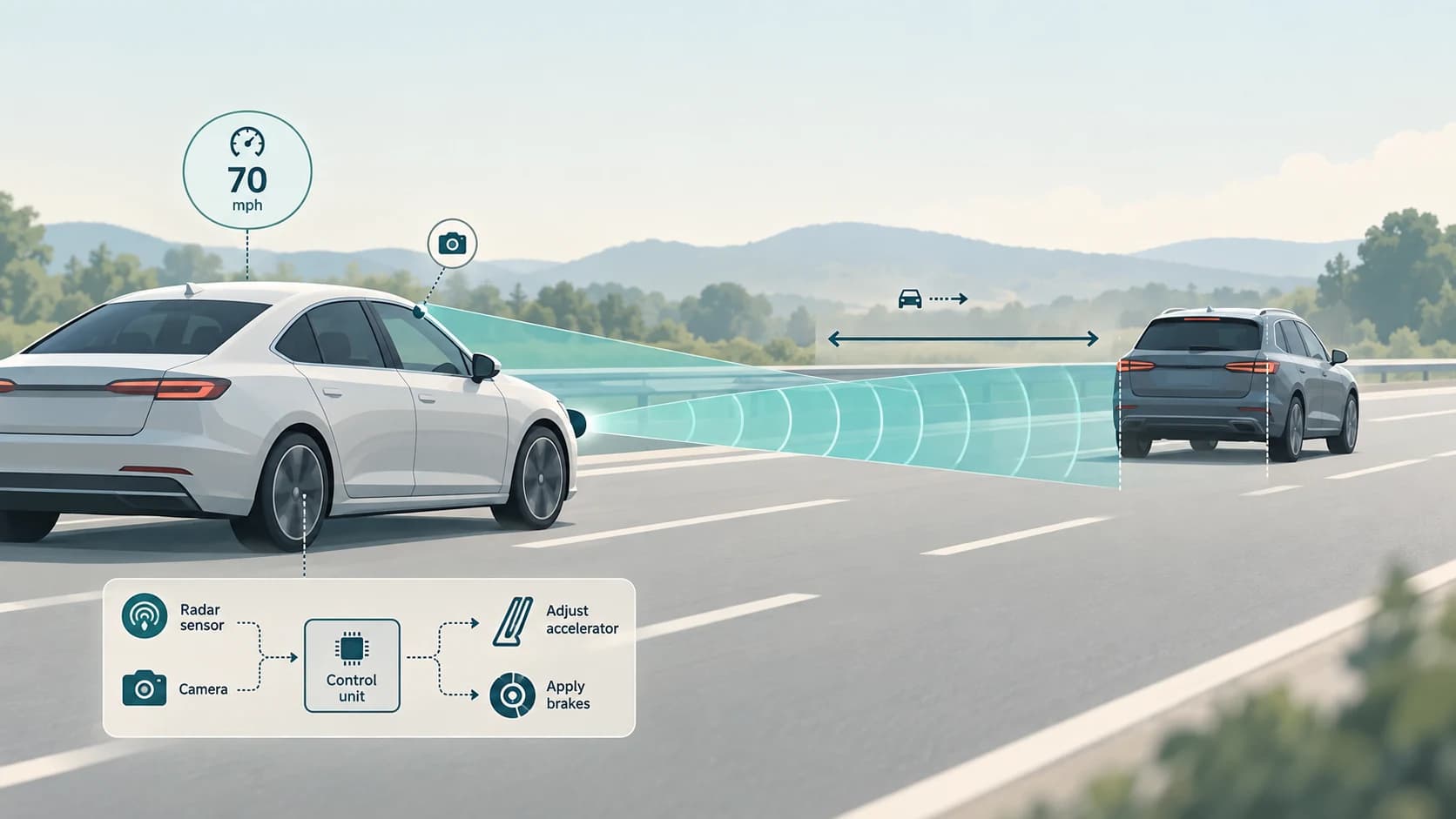
Instead, sensors continuously measure what is happening ahead. Software determines which vehicle your car should follow, calculates its distance and relative motion, compares the result with the following gap you selected, and then asks the powertrain or brakes to make small corrections.
Bosch describes radar as the core sensor in many adaptive cruise control systems, with cameras often added to improve scene understanding. NHTSA defines adaptive cruise control as a driver-assistance feature that automatically changes vehicle speed to maintain a preset distance from a vehicle ahead.
What looks like simple “following” is actually a continuously repeating measurement-and-control problem.
Ordinary Cruise Control Has Only One Main Goal
Traditional cruise control is relatively straightforward.
You choose a speed:
100 km/h
The car tries to maintain it.
If you drive uphill, the system requests more power.
If you go downhill, it may reduce power or, depending on the vehicle, use braking or other control strategies.
The system's main question is:
Am I travelling at the speed the driver requested?
Adaptive cruise control, usually abbreviated ACC, adds a second question:
Is there another vehicle ahead that requires me to travel more slowly?
That gives ACC two competing targets:
- Do not exceed the driver's selected cruising speed.
- Maintain the selected following gap when another vehicle is ahead.
When the road is empty, the first target dominates.
When a slower vehicle appears in your lane, the second one takes priority.
Radar Is Usually Watching the Road Ahead
The key sensor in many ACC systems is automotive radar.
A radar unit is normally mounted somewhere near the front of the vehicle, although its exact location varies by model.
It sends radio waves toward the road ahead.
When those waves hit an object such as another car, some energy reflects back toward the sensor.
From the returning signal, modern automotive radar can estimate information including:
- distance to the object
- relative speed
- position
- direction of motion
Bosch says its front radar systems can determine object position, relative speed and direction of travel and are used for functions including adaptive cruise control.
The important phrase is relative speed.
Suppose your car is travelling at:
100 km/h
and the car ahead is travelling at:
90 km/h.
You are closing the gap at approximately:
10 km/h relative to that vehicle.
The ACC system does not need to wait until you become dangerously close.
It can see that the distance is shrinking and begin responding earlier.
Distance Alone Is Not Enough
Imagine two situations.
Situation A
The vehicle ahead is 40 metres away and moving at the same speed as you.
The distance is stable.
Situation B
The vehicle ahead is also 40 metres away, but you are rapidly gaining on it.
The distance is shrinking.
The number 40 metres is identical.
The traffic situations are not.
That is why ACC needs both:
How far away is the vehicle?
and
How quickly is that distance changing?
This is one of radar's major strengths.
It can track the movement of objects rather than simply telling the car that something exists ahead.
Why Does the Car Also Need a Camera?
Radar is excellent at measuring longitudinal distance and motion.
But the car also has to answer a harder question:
Which detected object is actually relevant to my lane?
Imagine a motorway with three lanes.
Radar may detect:
- a car directly ahead
- a truck in the next lane
- a motorcycle farther ahead
- a vehicle entering from an on-ramp
Not every object should determine your speed.
A forward-facing camera can provide useful additional information about:
- lane position
- road geometry
- object classification
- lateral movement
Bosch describes radar as particularly strong at measuring longitudinal distances and speeds, while a forward camera provides high lateral accuracy. Combining the two through sensor fusion can improve the system's understanding of the traffic scene.
This becomes particularly useful when another vehicle starts moving into your lane.
The camera can help the system recognise the lateral movement earlier, while radar supplies precise distance and relative-speed information. Bosch specifically notes that camera-and-radar fusion can help ACC respond more dynamically to vehicles entering the lane.
The System Has to Choose a “Target Vehicle”
Detecting ten objects ahead does not mean ACC follows all ten.
The software identifies the vehicle most relevant to your path.
That vehicle becomes the lead vehicle or target vehicle for distance control.
Conceptually:
Radar and camera detect objects
↓
Software estimates where each object is moving
↓
System determines which object occupies your path
↓
Relevant vehicle becomes the ACC target
↓
Following distance is controlled relative to that target
This target can change constantly.
If the lead vehicle exits your lane, ACC may select the next vehicle ahead.
If a car cuts in between you and the existing target, the new car may become the relevant target instead.
This is one reason adaptive cruise control involves much more than a simple distance sensor attached to the throttle.
What Does the Following-Distance Setting Actually Mean?
Many cars let you choose something that looks like:
one bar
two bars
three bars
or perhaps several car-shaped distance levels.
That setting does not usually mean:
Always remain exactly 30 metres behind the next car.
A fixed distance would make little sense across all speeds.
Thirty metres might feel generous at 30 km/h but much less generous at motorway speed.
ACC systems commonly work with a following interval or time gap rather than one universal physical distance.
Volvo, for example, describes its ACC as maintaining a preset time interval to the vehicle ahead.
The basic idea is:
higher speed → larger physical gap for the same time interval
Suppose, only as an illustration, the system were targeting a two-second interval.
At 50 km/h, two seconds represents a much shorter physical distance than it does at 100 km/h.
The exact settings, minimum gaps and control logic vary by vehicle, so the bars on one manufacturer's dashboard should not be assumed to equal those on another.
How the Car Decides to Accelerate or Brake
Once a target vehicle has been identified, ACC behaves like a continuous feedback loop.
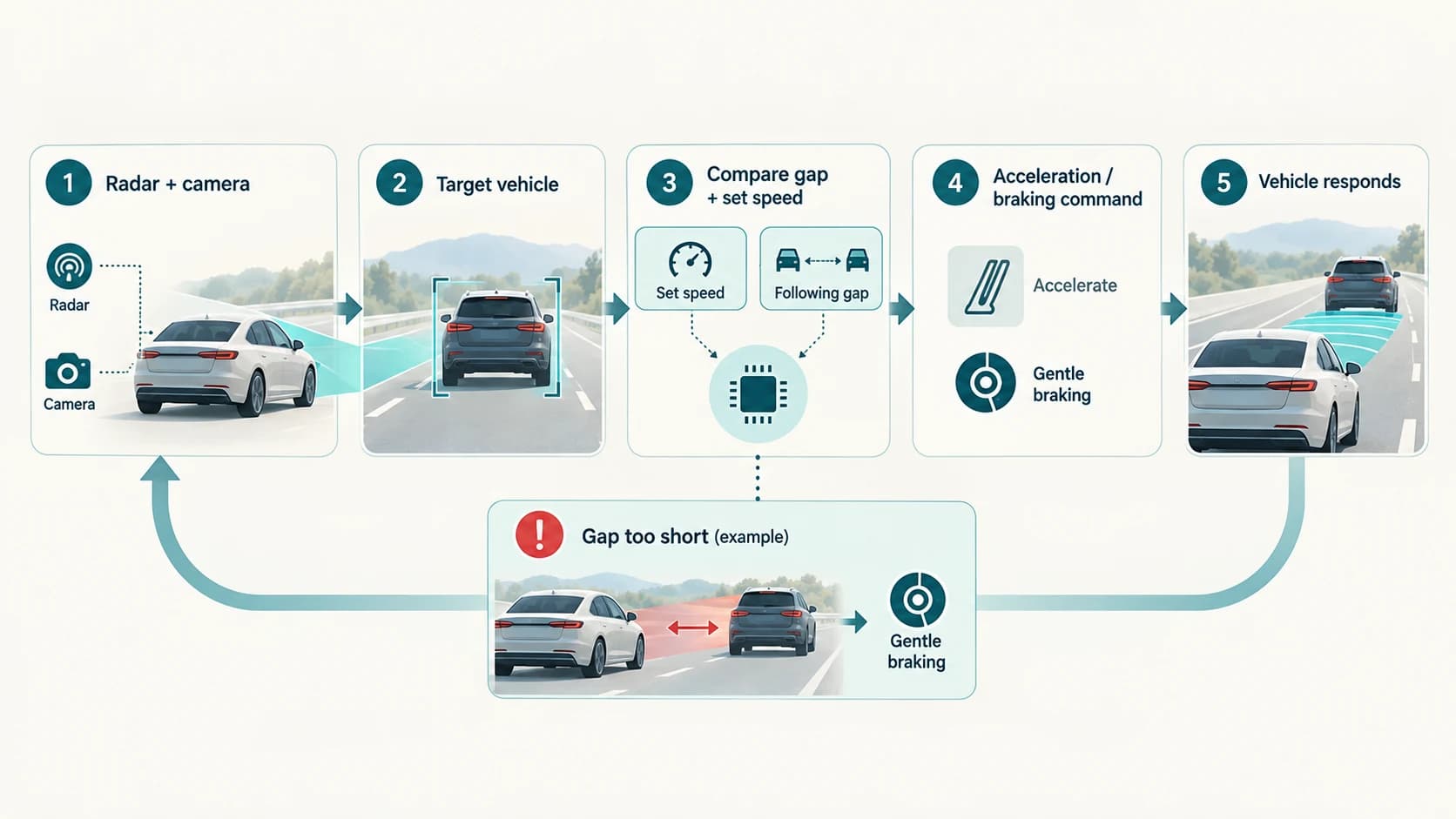
A simplified version looks like this:
1. Measure
The sensors estimate:
- lead-vehicle distance
- relative velocity
- relevant lane position
2. Compare
The controller compares the current situation with:
- the driver's selected speed
- the driver's selected following gap
3. Calculate
The system determines whether it should:
- maintain speed
- reduce acceleration
- coast
- brake
- accelerate
4. Act
The controller sends commands to the vehicle's:
- powertrain
- throttle/torque control
- braking system
5. Measure again
A fraction of a second later, new sensor data arrives.
The process repeats.
The car does not calculate the correct speed once and then hold it indefinitely.
It is continuously correcting itself as traffic changes.
What Happens When You Approach a Slower Car?
Suppose:
Your set speed: 100 km/h
Vehicle ahead: 80 km/h
At first, the vehicle may be far enough away that nothing needs to happen.
As the gap decreases, ACC recognizes that continuing at 100 km/h would eventually violate the selected following distance.
The system can begin by reducing drive torque.
If more deceleration is needed, it can apply the brakes.
Eventually your car may settle near:
80 km/h
while maintaining the selected gap.
Bosch describes the same basic sequence: when ACC detects a slower vehicle ahead, it reduces speed; if the vehicle ahead later accelerates or leaves the lane, ACC can accelerate again toward the driver's original set speed.
Why Doesn't the Car Copy Every Tiny Speed Change?
Imagine the lead driver repeatedly moves between:
79 km/h
and
81 km/h.
If ACC reacted aggressively to every tiny change, your car would constantly surge and brake.
That would be uncomfortable and inefficient.
So ACC control logic is generally designed to produce smooth responses within defined acceleration and braking limits.
Bosch explicitly describes ACC as a comfort and convenience system whose acceleration and braking interventions operate within defined limits.
The controller therefore has to balance several things:
- reaching the desired gap
- avoiding abrupt acceleration
- avoiding unnecessary braking
- responding quickly enough to meaningful changes
In control-engineering terms, the system is trying to reduce the difference between the desired and actual traffic state without constantly overcorrecting.
What Happens When a Car Cuts In Front?
This is one of the more difficult ACC situations.
Imagine you are following a vehicle comfortably.
Another car suddenly changes lanes into the gap between you and your target.
Now:
- the original lead vehicle may no longer matter
- the new vehicle is much closer
- the acceptable following gap may suddenly be violated
The system must quickly decide that the new car is now the relevant target.
Radar detects its range and movement.
Camera information can help determine that it has entered your lane.
The system may then reduce acceleration or brake to rebuild the desired following gap.
Sensor fusion is useful here because radar and camera have complementary strengths. Bosch notes that a camera's lateral accuracy can help ACC recognise vehicles entering its lane earlier.
But a sudden cut-in is also a good example of why ACC cannot guarantee perfect human-like behaviour.
The vehicle can enter the sensing path with very little margin available.
The driver still has to supervise what happens.
Can ACC Follow Traffic All the Way to a Stop?
Some modern systems offer full-speed-range or stop-and-go adaptive cruise control.
These can reduce speed as traffic slows and may bring the vehicle to a complete stop.
Depending on the model and how long the vehicle remains stopped, it may:
- resume automatically
- require the driver to press a button
- require a tap of the accelerator
Other ACC systems operate only above particular speeds.
Toyota, for example, identifies current systems on some vehicles as Dynamic Radar Cruise Control with Full-Speed Range, illustrating that low-speed operation is a specific capability rather than something that should be assumed for every ACC system.
Always check the behaviour of the particular vehicle rather than assuming all systems operate identically.
Why ACC Sometimes Brakes When You Don't Expect It To
Drivers occasionally experience a car reducing speed even when the situation appears harmless.
That can happen because the system has to interpret an imperfect sensor picture.
Possible situations include:
- a vehicle entering your lane
- a vehicle travelling near the edge of your lane
- a sharp bend
- a vehicle on an adjacent lane that briefly appears relevant
- sensor uncertainty
Older IIHS road and track testing documented examples of unnecessary or overly cautious ACC braking, as well as difficulty in some systems when approaching already-stopped vehicles. The specific vehicles tested were older models, but the findings illustrate a fundamental point: driver-assistance systems can interpret real-world traffic differently from a human driver.
This does not mean modern ACC is unreliable.
It means its perception has limits.
Curves Make Following More Difficult
On a straight road, determining which vehicle is directly ahead is relatively easy.
A curve complicates the geometry.
A vehicle that appears almost directly ahead from the sensor's point of view might actually be in:
- the neighbouring lane
- an exit lane
- another part of the curve
Conversely, the vehicle you truly need to follow may temporarily move away from the sensor's straight-ahead centre line.
Manufacturer documentation therefore warns that ACC performance can be more difficult on curves.
Volvo, for example, states that radar may lose the target vehicle or detect the wrong vehicle in some curved-road situations.
Modern cameras, better radar angular resolution and sensor fusion can improve this problem, but they do not make the road geometrically simple.
Why Stationary Vehicles Can Be Difficult
A driver may think:
If radar can see cars, why would a stopped car be difficult?
Because traffic sensing is not merely a question of whether an object reflects radar.
Roads contain many stationary objects:
- signs
- barriers
- bridges
- parked cars
- guardrails
- roadside structures
An ACC system designed primarily to follow moving traffic has to determine which stationary objects are relevant without constantly braking for harmless roadside infrastructure.
How well modern systems handle stopped traffic varies significantly by vehicle and generation.
IIHS has warned that some ACC systems may fail to react appropriately to already-stopped vehicles in certain situations, and manufacturer manuals often contain model-specific restrictions.
This is one reason automatic emergency braking exists as a separate safety function.
ACC Is Not the Same as Automatic Emergency Braking
These systems can share sensors, but they have different purposes.
Adaptive cruise control
ACC is primarily a continuous driving-assistance and convenience feature.
Its job is to:
- maintain a set speed
- follow traffic at a selected gap
- accelerate and decelerate smoothly
Automatic emergency braking
AEB is an emergency collision-mitigation feature.
Its job is to intervene when the system determines that a collision is imminent and the driver has not reacted sufficiently.
NHTSA treats adaptive cruise control and automatic emergency braking as separate driver-assistance technologies.
So you should not assume:
ACC will always perform maximum braking if anything appears ahead.
The comfort-oriented ACC controller normally operates within defined limits.
An emergency situation may require a different safety system—or the driver—to take over.
ACC Does Not Steer the Car
Adaptive cruise control controls longitudinal movement:
speeding up and slowing down.
It does not inherently keep the car centered in a lane.
That is the job of a separate system such as:
- lane centering
- lane tracing
- active lane keeping
Some cars combine ACC and lane centering, creating a more capable driver-assistance package.
NHTSA classifies ACC by itself as an example of Level 1 driver assistance, because it continuously assists with acceleration and braking while the driver remains responsible for steering and monitoring. A system that combines sustained speed control and sustained steering assistance may fall into Level 2, but the driver still remains responsible for supervision.
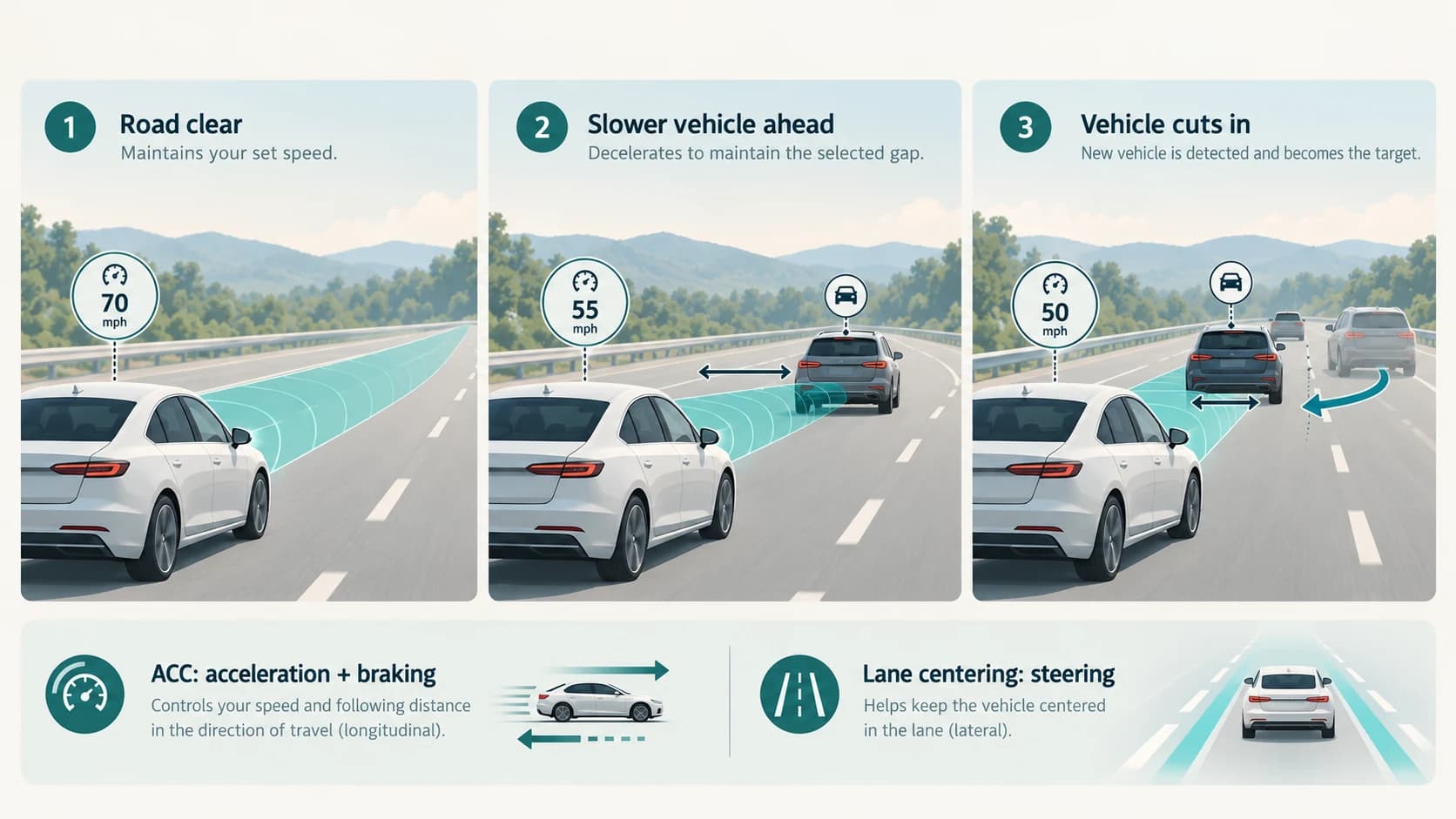
This distinction matters because the presence of ACC does not mean the car is self-driving.
What Can Interfere With the Sensors?
The exact limitations depend on the vehicle, but sensors can be affected by conditions such as:
- heavy rain or snow
- fog or poor visibility
- dirt or ice covering the radar area
- a blocked camera
- winding roads
- unusual vehicle positioning
- sensor misalignment
Toyota's current owner documentation, for example, warns that Dynamic Radar Cruise Control can become unavailable if the front camera has poor visibility or the radar sensor is blocked or outside its operating conditions.
Radar has useful advantages in darkness and poor visibility compared with an optical camera, but no sensor should be thought of as infallible.
This is another reason manufacturers increasingly combine several sensing technologies.
Why Doesn't ACC Eliminate the Need to Pay Attention?
Because the system is solving a constrained problem.
It is good at tasks such as:
detect lead vehicle
↓
measure gap
↓
measure relative speed
↓
adjust longitudinal speed
A human driver is responsible for a much larger problem:
- traffic lights
- pedestrians
- unusual road hazards
- emergency vehicles
- construction zones
- reckless drivers
- intersections
- complex merges
- road rules
- deciding when the assistance itself is wrong
IIHS describes ACC as continuous speed and following-distance assistance while emphasizing that the driver still controls the vehicle and must be ready to brake or accelerate if the system responds inappropriately.
So ACC should reduce workload.
It should not reduce attention.
What Happens Behind the Scenes in One Simple Traffic Situation?
Imagine you set:
Cruise speed: 100 km/h
and choose your preferred following-gap setting.
A car ahead is travelling at 90 km/h.
The sequence might look conceptually like this:
Radar detects an object
The system measures the vehicle's range and relative motion.
Camera helps establish lane relevance
The software determines that this vehicle is travelling in your path.
The vehicle becomes the target
ACC now controls your speed relative to it.
The controller predicts the shrinking gap
Your car is travelling faster, so the distance will continue decreasing.
Drive torque is reduced
The car begins slowing smoothly.
Brakes are added if necessary
The system continues adjusting until the desired following interval is reached.
Both vehicles settle at similar speed
Your car now follows at approximately 90 km/h.
The lead vehicle changes lanes
The original target disappears from your path.
The road ahead becomes clear
ACC gradually accelerates back toward:
100 km/h
The entire process then begins again with every new sensor update.
Following Another Car Is Really a Continuous Prediction Problem
Adaptive cruise control feels simple because the interface is simple.
You select a speed.
You select a gap.
The car follows traffic.
Behind those controls, however, the vehicle is constantly asking:
What objects are ahead?
Which one is in my lane?
How far away is it?
Are we getting closer or farther apart?
How quickly is that changing?
What acceleration or braking will restore the desired gap smoothly?
Has another vehicle just become the new target?
Radar provides much of the precise motion information.
Cameras help interpret where vehicles are relative to the road.
Software combines those measurements.
The powertrain and brakes turn the calculations into movement.
That is how a car “follows” another car without understanding traffic the way a human does.
It does not watch the driver ahead.
It continuously measures the physics between the two vehicles—and keeps adjusting its own speed so that the relationship stays within the limits you selected.