How Does a 360-Degree Car Camera Create a Top-Down View?
Learn how four wide-angle car cameras are corrected, reprojected and stitched together to create the bird’s-eye 360-degree view used while parking.
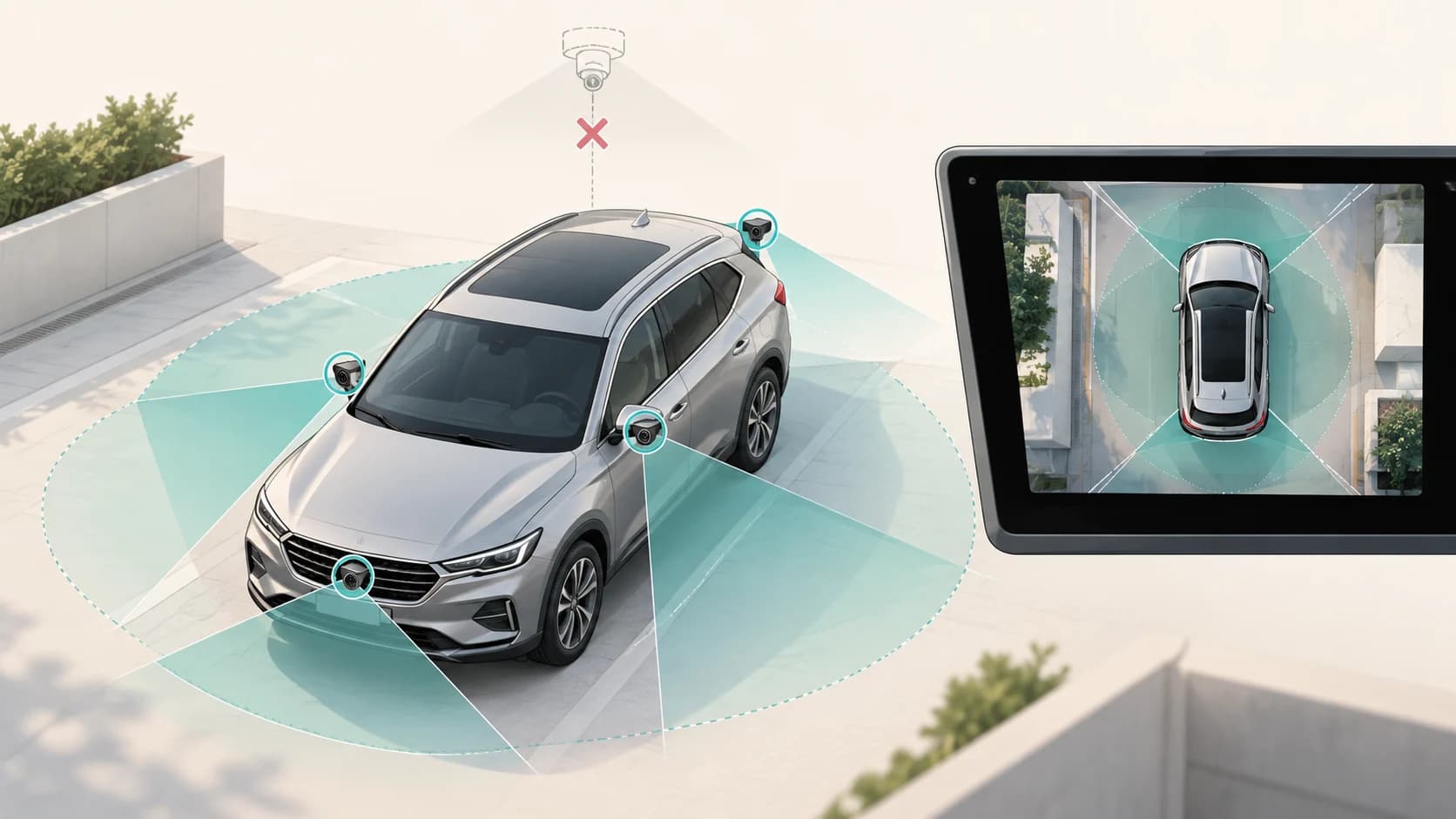
Shift a modern car into reverse and the dashboard may show something that appears impossible.
You can see the car from directly above.
Parking lines, kerbs, nearby vehicles and the edges of the road appear around it as though a camera were hovering several metres over the roof.
But there is no camera above the car.
And the ordinary reversing camera at the rear cannot see through the roof, around the bonnet and along both sides.
The image is constructed by software.
A typical surround-view system uses several wide-angle cameras positioned around the vehicle, commonly one at the front, one at the rear and one under each side mirror. Their images overlap. The car’s image processor corrects the unusual perspective of those cameras, transforms the road surface into a virtual top-down viewpoint and then blends the separate feeds together.
Nissan describes its current Around View Monitor as collecting live video from four wide-angle cameras around the vehicle and combining them into a real-time composite bird’s-eye view. Hyundai similarly explains that its top view converts input from four wide-angle cameras into a 360-degree image looking down around the vehicle.
So the first misconception to clear up is simple:
A reversing camera alone does not create the 360-degree top-down image.
The rear camera is one piece of a larger multi-camera system.
A Normal Reversing Camera Sees Only Behind the Car
The basic backup camera is relatively straightforward.
A camera mounted near the rear of the vehicle looks backward. When the car is shifted into reverse, its image appears on the dashboard display.
NHTSA describes a backup camera, or rearview video system, as providing the driver with an image of the area directly behind the vehicle while reversing.
That is useful because the driver's mirrors and rear window cannot show every point close to the bumper.
But the camera still has one physical viewpoint.
It cannot naturally see:
- the front bumper
- both front corners
- the sides of the car
- the kerb beside a front wheel
A surround-view system solves this by adding more viewpoints.
The Car Usually Has Four Wide-Angle Cameras
Although designs vary, the familiar 360-degree parking view is commonly built from four cameras:
- Front camera — often mounted in the grille or front fascia.
- Rear camera — commonly near the tailgate, boot handle or number-plate area.
- Left-side camera — often underneath the left exterior mirror.
- Right-side camera — usually underneath the right exterior mirror.
Hyundai's current Surround View Monitor documentation lists exactly this arrangement: one wide-front camera, two wide-side cameras beneath the exterior mirrors and one wide-rear camera.
Nissan also describes its system as using four exterior cameras at the front, rear and sides.
Some systems use more cameras, especially when they support additional views or more sophisticated perception. NXP's current surround-view platform notes that advanced parking systems may use four to five high-dynamic-range cameras.
The crucial point is not the exact number.
It is that the cameras' fields of view overlap, allowing software to build continuous coverage around the vehicle.
Why the Cameras Use Very Wide Lenses
A normal camera lens would leave large gaps between the views.
Parking cameras therefore tend to use very wide-angle lenses, often described as fisheye lenses.
One camera can then see a large portion of the road around its corner of the vehicle.
That creates coverage.
It also creates a new problem.
Wide-angle images are heavily distorted.
Straight parking lines may bend outward.
Objects near the edge of the frame can look stretched.
The horizon may curve.
If the system simply placed four raw fisheye images beside one another, the result would not look anything like a clean overhead view.
So the processor has to transform them.
Step 1: The System Knows How Each Camera Sees the World
Before the four images can be combined, the system needs a mathematical description of each camera.
This is part of camera calibration.
Calibration tells the software things such as:
- the camera's field of view
- lens-distortion characteristics
- where the camera is mounted
- the direction it points
- its position relative to the vehicle
Engineers often divide these into two broad categories.
Intrinsic calibration
This describes the camera itself.
It includes properties related to:
- focal geometry
- image centre
- lens distortion
In practical terms, it tells the processor why a straight line near the edge of a fisheye image appears curved.
Extrinsic calibration
This describes where the camera is in the real world relative to the car.
The system needs to know that:
- one camera sits at the front
- another sits at the rear
- two sit under the mirrors
- each points in a particular direction
Without accurate calibration, the views would not line up correctly.
This is one reason camera replacement or body repair can sometimes require recalibration. Nissan notes that cameras used by its Around View Monitor may require replacement and/or calibration following a collision so that the system continues to function correctly.
Step 2: The Fisheye Distortion Is Corrected
The first major image-processing task is geometric correction.
The processor takes the distorted camera image and mathematically remaps its pixels.
Imagine a parking line that appears curved because of the fisheye lens.
The software knows the lens distortion from calibration.
It can therefore estimate where that line should appear in a corrected view.
Texas Instruments describes geometric alignment as a core surround-view operation that corrects fisheye distortion and converts the input video frames toward a common bird's-eye perspective.
This does not magically create information that the camera never captured.
It rearranges the information that is already present so the different camera feeds can be compared and combined.
Step 3: The Road Is Reprojected Into a Bird's-Eye Perspective
This is the part that creates the illusion of an overhead camera.
Imagine placing a grid on the road around the vehicle.
The front camera sees that grid from a low forward-facing angle.
The rear camera sees it looking backward.
The side cameras see it from the mirrors.
All four cameras therefore record the same flat road from different perspectives.
The processor can mathematically ask:
If these road pixels were viewed from directly above instead, where would they appear?
It then warps, or reprojects, the images into that virtual viewpoint.
This is often called a perspective transformation, inverse perspective mapping, or part of geometric alignment.
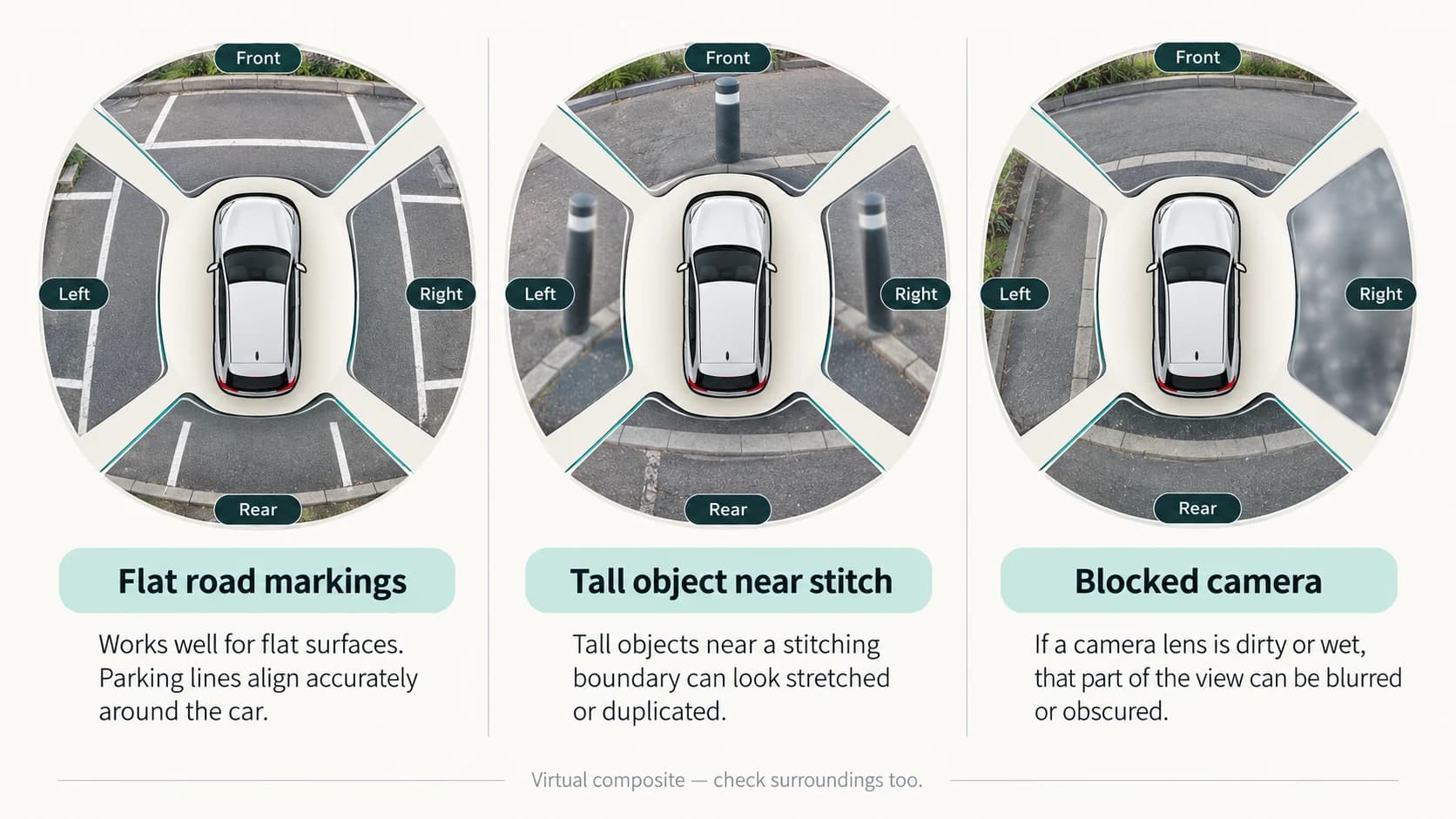
The transformation is particularly effective for the road surface because the algorithm can treat the ground around the car approximately as a plane.
Parking lines that originally stretched toward the horizon can now appear as parallel lines viewed from above.
A kerb beside the car can be placed beside the virtual vehicle.
Four very different camera views begin to resemble pieces of one overhead map.
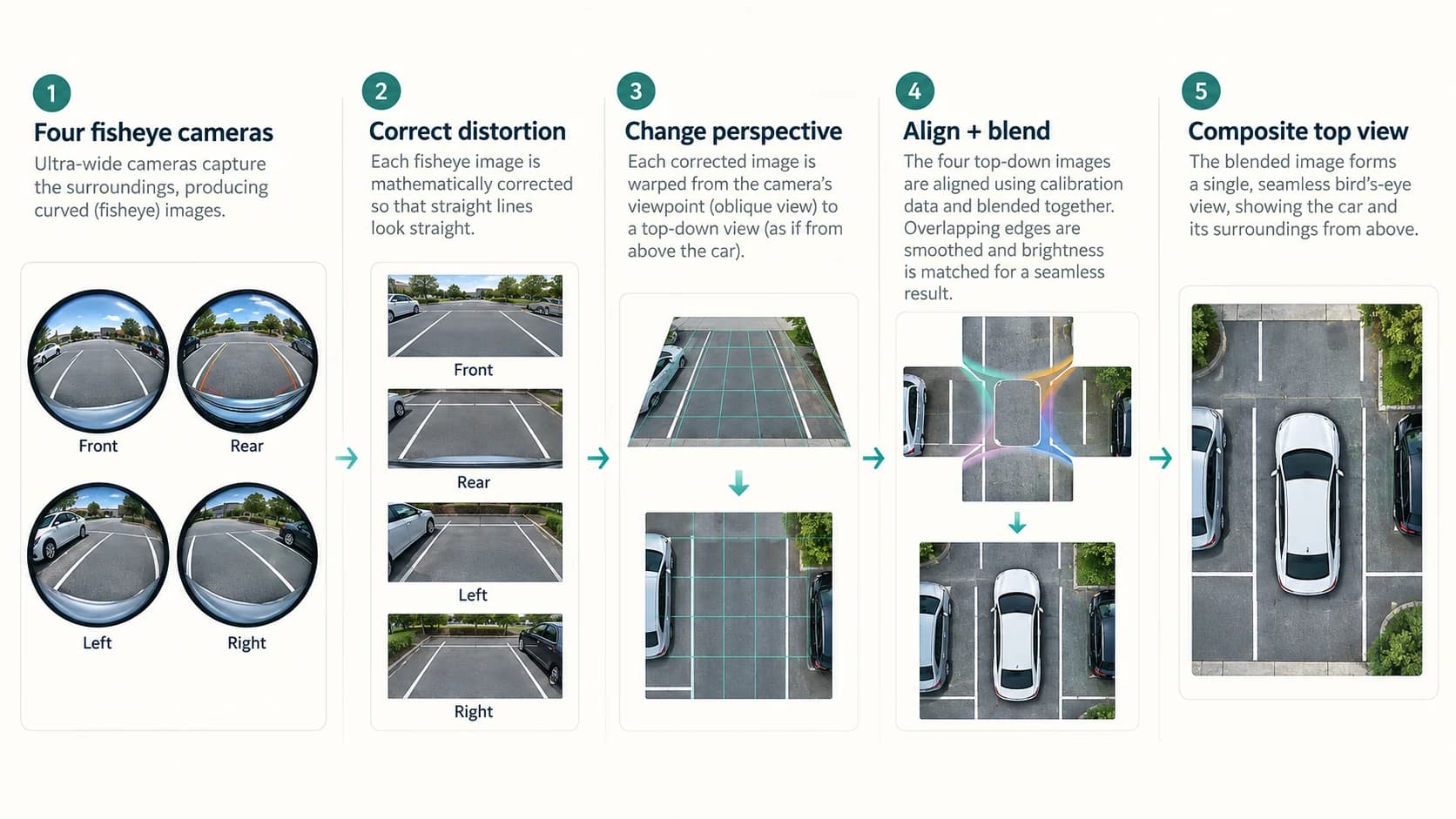
Step 4: The Four Views Are Stitched Together
Correcting each camera separately is not enough.
The processor still has four images.
They must be joined.
The camera fields overlap around the corners of the car, so some pieces of the world appear in two adjacent cameras at once.
Software determines where those images should meet and creates a combined surround view.
This is known as stitching or composite-view synthesis.
Texas Instruments describes surround-view generation as having two basic stages:
geometric alignment
followed by:
composite-view synthesis.
But simply cutting one image off and starting the next can create visible seams.
So more advanced systems perform additional blending.
Why the Boundaries Between Cameras Can Be Hard to See
Suppose the left-side camera sees a patch of road that looks slightly dark.
The front camera sees the same patch under a different angle and exposure, making it look brighter.
If the system combines them without adjustment, you may see an obvious boundary between the two feeds.
This is where photometric alignment becomes useful.
It can adjust properties such as:
- brightness
- colour
- exposure differences
to make neighbouring views look more consistent.
TI specifically describes photometric alignment as an important part of seamless surround-view stitching because adjacent cameras can produce brightness and colour mismatches.
The goal is to make four cameras feel like one.
Where Does the Image of the Car in the Middle Come From?
Look carefully at many 360-degree parking displays.
The car in the centre often looks unusually clean.
There is a reason.
The exterior cameras cannot see straight through the vehicle itself.
They can see the ground around it, but the roof and body block the region directly underneath and immediately beside some parts of the car.
So the centre of the display is usually represented using a vehicle graphic, rendered model or similar synthetic representation.
That graphic provides orientation:
- front
- rear
- left
- right
- position within the parking space
The live camera imagery surrounds it.
This creates the convincing impression that you are seeing the entire scene from above even though part of what you see is a graphical reconstruction.
Then Why Can Some Cars Rotate the View in 3D?
Newer systems may let you drag a finger across the display and move a virtual viewpoint around the car.
It can look even more impossible than the top-down view.
NXP describes modern multi-camera park-assist systems as displaying a virtual 3D view whose perspective can move depending on the vehicle's trajectory. Hyundai's current Surround View Monitor also offers selectable 3D views from different angles on supported vehicles.
The principle is similar.
The processor maps camera images onto a virtual representation of the space around the car.
A graphics engine can then render that mapped imagery from another virtual viewpoint.
This still does not mean the car has somehow captured every surface as a perfect 3D model.
It is a rendered visualization created from available camera information.
That distinction becomes important when objects are tall or close to the car.
Why Tall Objects Sometimes Look Bent, Stretched or Duplicated
The bird's-eye transformation works best when the world behaves like the flat ground plane assumed by the software.
A parking line painted on the road fits that assumption very well.
A person does not.
Neither does:
- a bollard
- another vehicle
- a wall
- a shopping trolley
- a tree
Imagine a tall pole standing beside the car.
The bottom of the pole touches the road.
The top of the pole is far above it.
If the system reprojects both as though they lie on the ground plane, the pole can appear stretched outward or distorted.
Now place the same pole in an area where two cameras overlap.
Each camera sees the pole from a different angle.
The software may struggle to blend those two versions perfectly.
TI notes that close objects in surround-view systems can become stretched and that objects near stitching boundaries can produce ghosting artifacts.
This is why the 360-degree view is excellent for understanding where the vehicle sits relative to:
- parking lines
- kerbs
- low obstacles
- neighbouring vehicles
but should not be treated as a geometrically perfect aerial photograph.
Why You Sometimes See a Visible Seam
If you know where to look, some surround-view displays reveal the joins between camera images.
You may notice:
- a line in the road that suddenly changes angle
- part of another car appearing stretched
- a person looking duplicated
- brightness changing across a boundary
- a wheel or kerb appearing slightly misaligned
Those are consequences of stitching multiple perspectives together in real time.
The system has to make decisions quickly while the car and surrounding objects may both be moving.
Better calibration, higher-quality cameras and more advanced blending can reduce these artifacts.
They cannot turn four cameras in different positions into one physically real overhead camera.
Why a Dirty Camera Can Ruin Part of the 360 View
The finished image may look unified, but each region still depends on a physical camera.
Put mud over the rear lens and the rear portion becomes unclear.
Cover one mirror-mounted camera with water droplets and one side of the composite can become distorted or obscured.
This is easy to forget because the final display looks like one image.
It is actually a mosaic built from several independent image sources.
The same applies to:
- snow
- dirt
- heavy rain
- lens condensation
- bright glare
- very low light
Some systems use high-dynamic-range imaging and image processing to cope with difficult lighting, but no algorithm can perfectly recover a scene hidden behind an opaque layer of mud.
Why Calibration Matters So Much
Imagine the left mirror camera is supposed to point 20 degrees downward but is physically shifted after a repair.
The software still assumes its original position.
Now the pixels it receives no longer correspond perfectly to the mathematical model.
The result can be:
- misaligned parking lines
- visible seams
- distorted object positions
- an inaccurate composite
This is why surround-view cameras should not be treated as ordinary cosmetic accessories after body repairs.
A camera mounted in:
- a grille
- bumper
- mirror
- tailgate
has a geometric relationship with the vehicle.
Change that geometry and calibration may need to be checked or repeated according to the manufacturer's service procedure.
Is the 360-Degree Camera Measuring Distance?
Not necessarily.
A camera image primarily shows visual information.
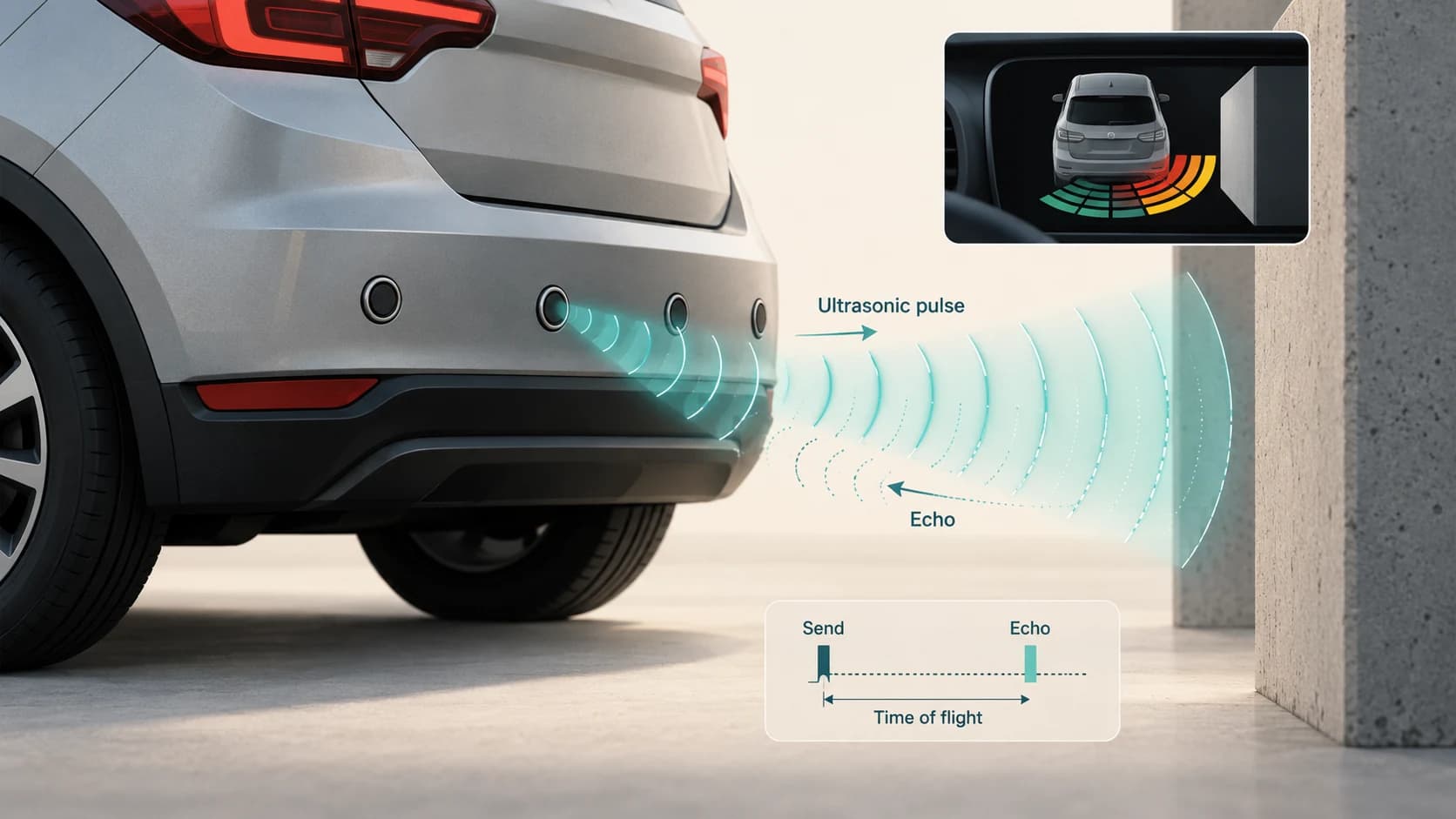
A car may also have ultrasonic parking sensors, radar or other sensing systems that measure or estimate nearby obstacles.
The vehicle can combine these systems on the same screen.
For example, you might see:
- 360-degree camera imagery
- coloured parking-sensor arcs
- warning tones
- projected guidelines
all at once.
That can make it look as though the camera itself produced every warning.
In reality, several systems may be contributing information.
NXP describes surround-view and park-assist systems as multi-camera systems that can be combined with additional processing and sensing capabilities.
The distinction matters because a camera's picture and a parking sensor's distance warning are not the same type of measurement.
How Does the System Know Where the Car Will Go?
Many parking displays draw curved guidance lines that change as you turn the steering wheel.
Those lines are not part of the camera image.
They are a graphical overlay.
The vehicle can estimate a path based on its geometry and steering state, then draw that predicted path over the live image.
The result is especially useful when reversing into a space because you can see both:
- the actual surroundings
- an indication of where the car is likely to travel
The lines remain guidance, not a guarantee.
Tyre slip, road shape, driver input and system design can all affect the exact path.
What Happens from Camera to Screen?
The full process happens quickly enough to feel live.
A simplified version looks like this:
Four wide-angle cameras capture the surroundings
↓
Camera images are synchronized and processed
↓
Fisheye distortion is corrected
↓
Each image is reprojected toward a common bird's-eye perspective
↓
Overlapping regions are geometrically aligned
↓
Brightness and colour differences may be blended
↓
The images are stitched into one composite
↓
Vehicle graphic and parking guidance are added
↓
The result appears on the dashboard
The process repeats continuously as the car and surroundings change.
Modern hardware can also support selectable front, rear, side and 3D perspectives from the same multi-camera system.
Why Does the Feature Usually Work Only at Low Speed?
A surround-view display is primarily designed for:
- parking
- manoeuvring through narrow spaces
- approaching kerbs
- checking close obstacles
At higher speeds, the driver needs to concentrate farther down the road rather than on a synthetic overhead image of the immediate surroundings.
Manufacturers therefore commonly restrict some surround-view modes to low speeds.
For example, Hyundai's current documentation describes top and 3D surround-view functions operating under low-speed conditions, with the exact behaviour depending on gear and mode.
The specific threshold varies between vehicles.
The underlying purpose is the same: close-range manoeuvring, not normal high-speed driving.
Does a 360-Degree Camera Remove Blind Spots Completely?
No.
The name “360-degree” means the system attempts to provide visual coverage around the vehicle.
It does not mean every physical point is perfectly visible at all times.
Limitations can result from:
- camera placement
- vehicle bodywork
- lens obstruction
- lighting
- stitching boundaries
- tall objects
- objects extremely close to the car
- limited resolution
- processing delay
NHTSA similarly warns drivers that even ordinary backup-camera systems are aids rather than replacements for mirrors and physically checking the surroundings.
The same principle applies even more strongly to a synthetic surround view.
Use the screen as another source of information.
Do not treat it as an infallible aerial camera.
Why the Illusion Works So Well
The clever part of a 360-degree camera system is not simply having four cameras.
Four raw video feeds would give you four distorted images and force your brain to work out how they fit together.
The software does that work for you.
It knows:
- where each camera is mounted
- how its lens distorts the image
- how the road appears from that camera
- where adjacent views overlap
It then transforms those views into the perspective your brain finds easiest for parking:
looking straight down.
That is why the result can feel almost like a drone is hovering above the roof.
But the reality is more interesting.
There is no invisible camera in the sky.
There are several cameras close to the ground, each seeing only part of the scene.
A computer takes those imperfect perspectives and reconstructs them into a single useful illusion.
And that illusion is good enough to make squeezing a large car between two parking lines feel much simpler than it would through mirrors alone.