Which Car Features Are Actually Worth Having for Everyday Driving?
From AEB and parking cameras to ventilated seats and ADAS, learn which car features genuinely improve everyday safety, comfort and convenience.
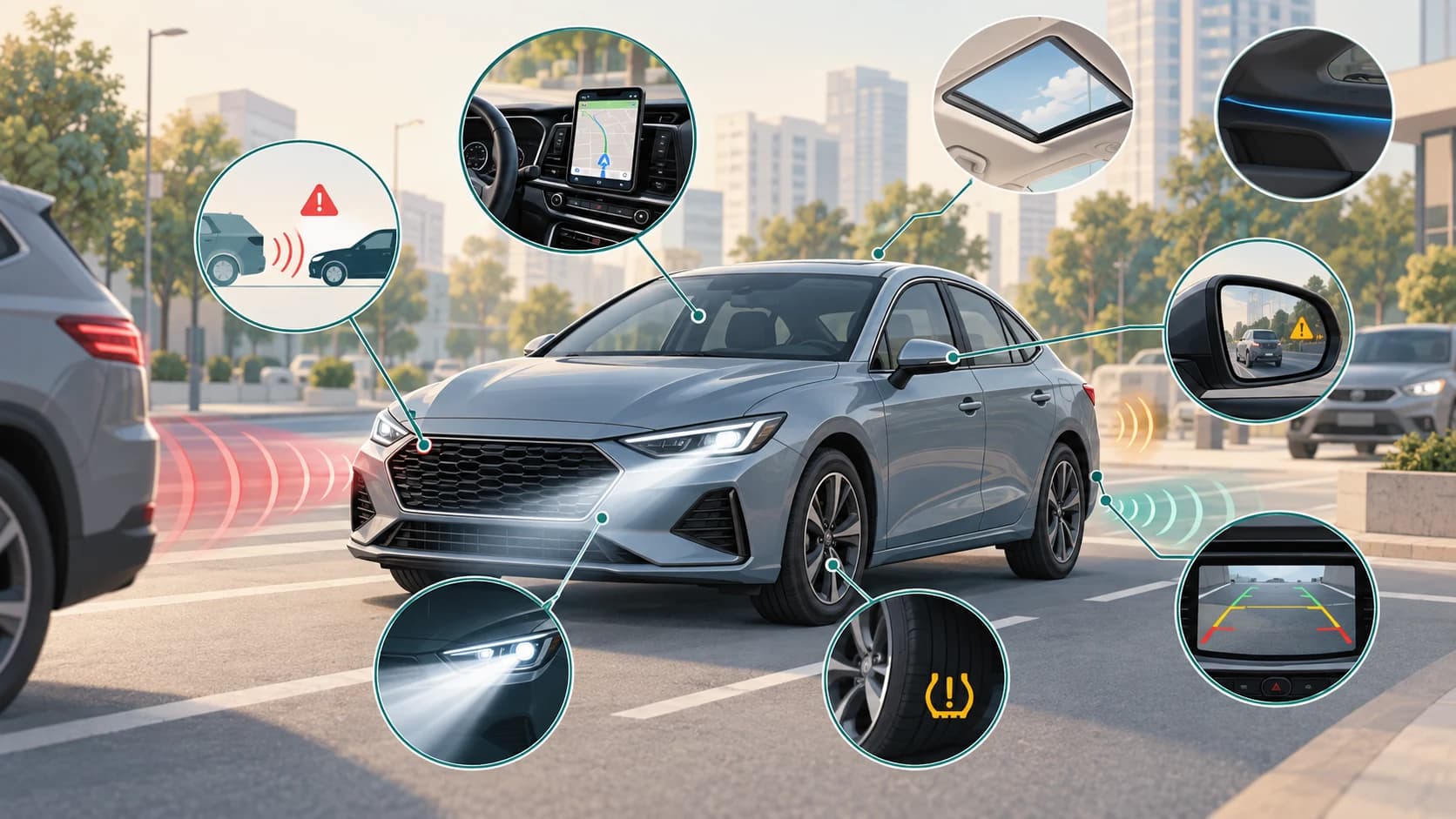
Open the brochure for a modern car and you may find several pages of equipment:
panoramic sunroof
360-degree camera
wireless charger
12-speaker audio
ADAS
ambient lighting
ventilated seats
connected-car features
powered driver seat
automatic headlights
digital instrument cluster
The obvious temptation is to compare cars by counting features.
A model with 40 features must be better than one with 30.
But that is not how everyday ownership works.
Some features can prevent a crash you never saw coming. Some save you frustration every time you reverse into a crowded parking space. Some quietly improve every journey through better visibility or cabin comfort.
Others may be enjoyable but used only occasionally.
And a few sound far more impressive in a brochure than they feel after six months of ownership.
A useful way to judge a feature is to ask three questions:
- How often will I actually use it?
- Does it meaningfully improve safety, comfort or convenience?
- Would I pay extra for it if it were not included in a higher variant?
Once you think this way, the features worth prioritizing become much clearer.
Start With the Features You Hope Never to Need
The most valuable car feature may be one that you never consciously use.
Automatic emergency braking
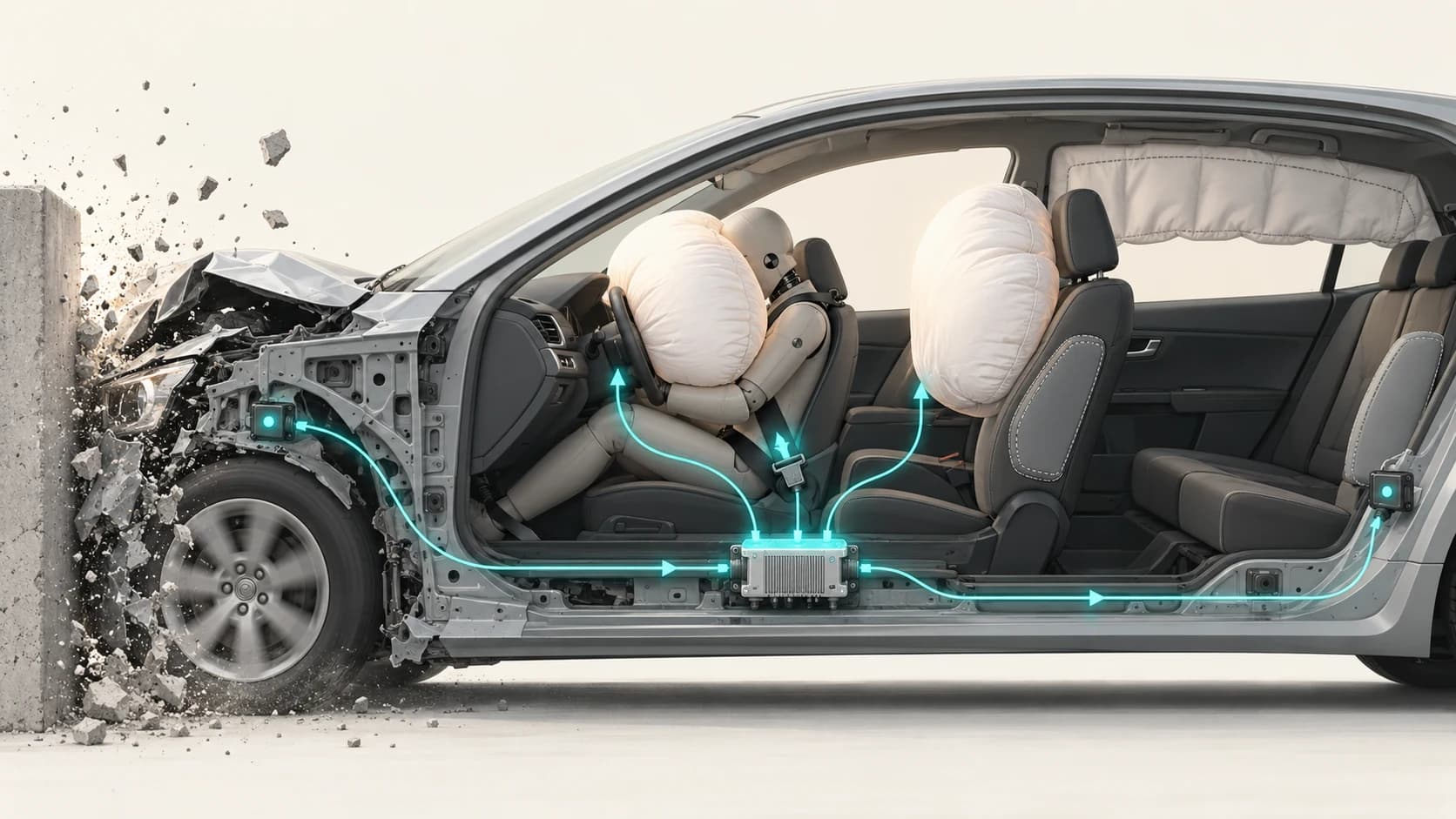
Automatic emergency braking, or AEB, monitors the road ahead and can apply the brakes if the system determines that a collision is imminent and the driver has not responded sufficiently.
Unlike a warning system that merely beeps, AEB can actually intervene.
NHTSA describes AEB as automatically applying the brakes to avoid or reduce the severity of an impending forward collision.
And this is not merely theoretical. IIHS research has found substantial reductions in rear-end crashes in vehicles equipped with forward-collision warning and AEB. A large real-world study found that FCW combined with AEB reduced rear-end striking crashes by about 50 percent in the vehicles studied.
You may drive for years without noticing AEB doing anything.
That is fine.
It is an emergency safety net, not an entertainment feature.
If two variants differ between something such as:
AEB
and
a larger touchscreen
the safety system usually deserves far more attention.
Electronic stability control
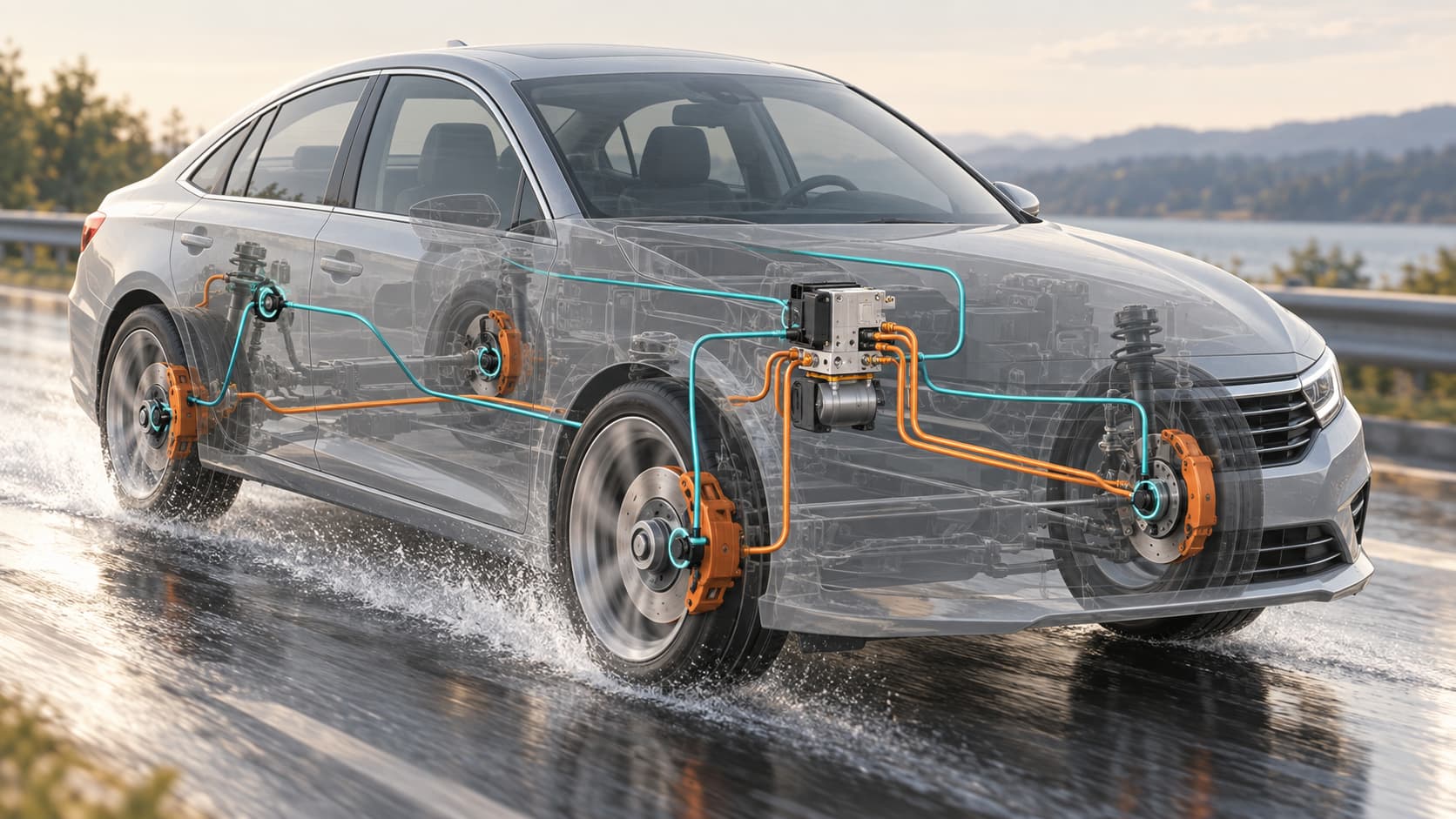
Electronic stability control, or ESC, is another feature that works mostly in the background.
Suppose the car begins to slide during a sudden avoidance manoeuvre.
ESC can compare the direction the driver intends to travel with the way the vehicle is actually moving, then selectively brake individual wheels to help restore stability.
NHTSA's research has found large reductions in single-vehicle crashes and rollovers associated with ESC.
It does not increase your car's horsepower.
It does not appear prominently on the dashboard.
But it addresses one of the most dangerous situations a driver can encounter: loss of control.
These are the kinds of features that should come before cosmetic upgrades.
Rear Camera and Parking Sensors: Simple Features You Use Constantly
Not every valuable feature has to be sophisticated.
A reversing camera is one of the easiest examples of a genuinely useful everyday feature.
It shows an area that may be difficult or impossible to see clearly through the rear window and mirrors.
NHTSA specifically describes backup cameras as helping drivers see behind the vehicle while reversing, while emphasizing that they do not replace checking mirrors and surroundings.
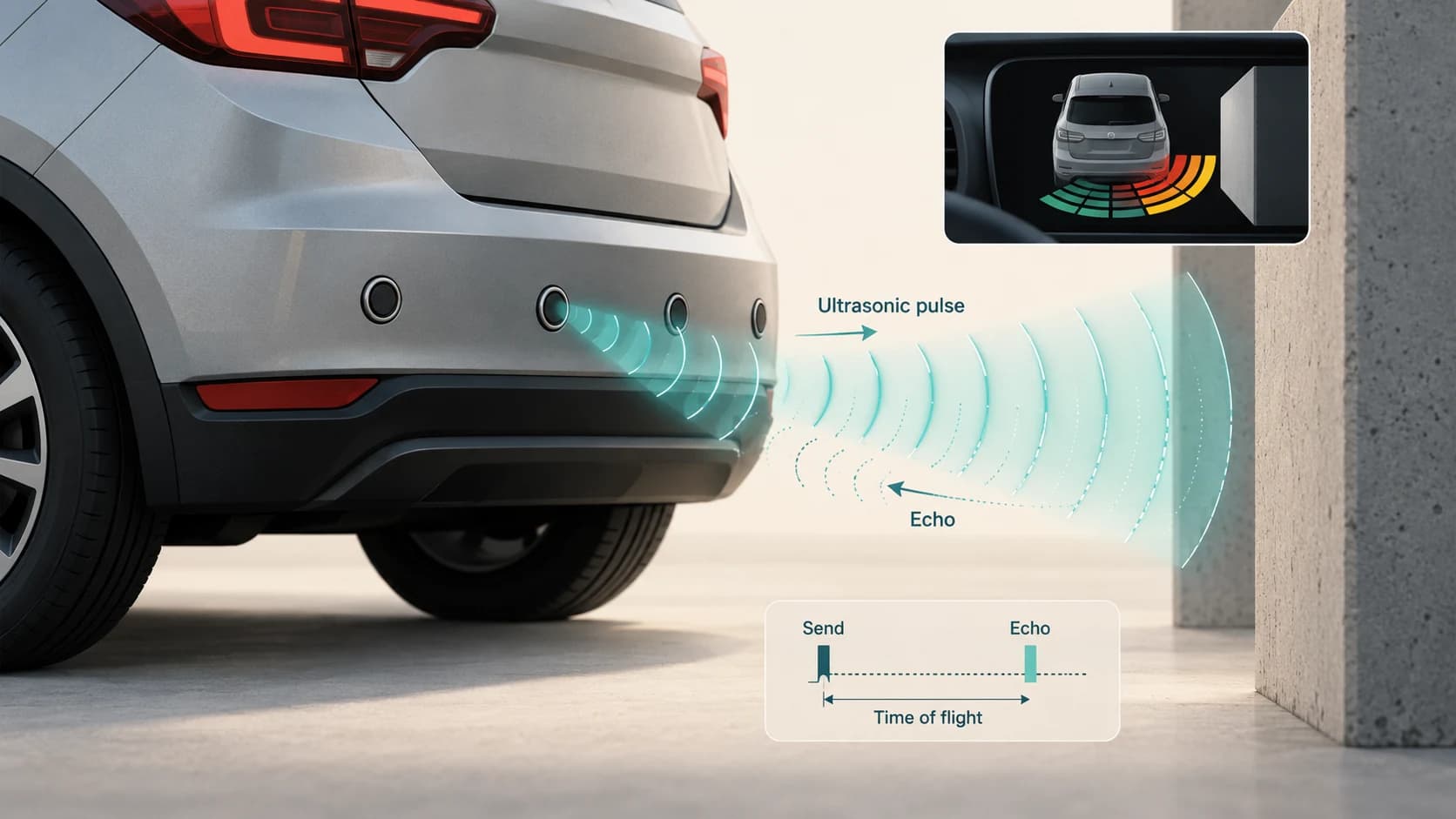
Parking sensors add something the camera does not provide:
distance awareness without requiring you to stare continuously at the screen.
The beeps become faster as you approach an object.
That combination can be especially useful in:
- tight parking spaces
- crowded markets
- apartment parking
- narrow streets
- larger SUVs
- areas with children or low obstacles
Real-world IIHS research found that rearview cameras and parking sensors can reduce backing crashes, while systems that add rear automatic braking provide an even larger benefit.
Is a 360-degree camera worth paying for?
This depends strongly on the vehicle.
On a small hatchback with excellent visibility, it may be mostly a convenience.
On a large SUV with:
- a high bonnet
- wide body
- large blind areas
- expensive alloy wheels
a good 360-degree system can be extremely useful.
It combines feeds from several cameras into a simulated overhead view, helping you judge:
- parking lines
- kerbs
- nearby vehicles
- narrow gates
- obstacles close to the front corners
It will not replace looking around the car, but for people who frequently park in tight urban spaces, it can move from “luxury feature” to something they use nearly every day.
Rear Cross-Traffic Alert Solves a Problem a Camera Cannot
Imagine reversing out of a parking space between two large SUVs.
Your rear camera shows what is directly behind you.
But you cannot see a motorcycle or car approaching from the side.
Rear cross-traffic alert is designed for exactly this situation.
NHTSA describes it as warning the driver about potential cross-traffic collisions while reversing, including hazards that may sit outside the camera's view.
IIHS research found lower rates of backing crashes among vehicles equipped with rear cross-traffic alert, including a 32 percent reduction in the specific perpendicular two-vehicle backing crashes the system is intended to address.
This is one of those features whose usefulness is immediately obvious once you experience the situation it was designed to solve.
Blind-Spot Monitoring Is More Useful Than Another Camera Lens on the Dashboard
Changing lanes appears simple.
Check the mirror.
Signal.
Look over your shoulder.
Move.
The problem is that every car has areas that are harder to see, and modern vehicle design can produce substantial blind zones.
Blind-spot monitoring uses radar, cameras or other sensors to detect a vehicle travelling beside you.
NHTSA describes blind-spot warning as providing an audio or visual warning when a vehicle is present in an adjacent lane that the driver may not see.
IIHS research found that blind-spot monitoring was associated with a 14 percent reduction in police-reported lane-change crashes in the vehicles studied.
That does not mean you should stop checking your mirrors.
The system is a second pair of electronic eyes.
Its value is highest if you regularly drive on:
- multi-lane highways
- busy urban roads
- roads with many motorcycles
- fast-moving traffic
For frequent highway drivers, it is one of the ADAS features most likely to be useful without changing the way you normally drive.
Good Headlights Are More Important Than Fancy Headlight Graphics
Headlights are a perfect example of why a specification sheet can be misleading.
A brochure may emphasize:
LED headlights
projector headlights
signature DRLs
animated welcome lights
But the question that matters at 11 p.m. on an unlit road is simpler:
Can you actually see far enough ahead?
LED technology does not automatically guarantee good illumination.
Beam pattern, intensity, aim and glare all matter.
IIHS research found that vehicles with better-rated headlights had lower nighttime crash rates. Vehicles with good headlight visibility ratings were associated with 19 percent fewer nighttime single-vehicle crashes than those with poor-rated headlights in the study.
So when choosing between:
flashy daytime lighting
and
excellent low-beam and high-beam performance
the second one matters far more once the sun goes down.
Automatic high beams can also be convenient, but the underlying headlight performance is more important than the automation switching them.
TPMS Is Easy to Ignore Until a Tyre Starts Losing Pressure
A tyre can gradually lose air without looking obviously flat.
That matters because incorrect tyre pressure affects:
- grip
- tyre wear
- fuel consumption
- heat generation
- handling
A Tyre Pressure Monitoring System, or TPMS, warns when tyre pressure falls too low.
NHTSA explains that TPMS can either measure pressure directly using tyre-mounted sensors or infer a problem indirectly through wheel-speed and other vehicle data.
Some systems merely illuminate a warning symbol.
Better implementations display the pressure of each tyre individually.
That is especially convenient because instead of seeing:
Low tyre pressure
you can immediately see something like:
Front left: unusually low
and investigate the correct wheel.
TPMS does not replace checking tyres for:
- damage
- tread wear
- correct cold pressure
but it is an excellent background-monitoring feature.
Android Auto and Apple CarPlay Solve a Real Infotainment Problem
Car manufacturers are expected to design:
- navigation
- music interfaces
- contact management
- voice control
- messaging
- app ecosystems
while smartphone companies already spend enormous resources doing exactly those things.
That is why Android Auto and Apple CarPlay are so useful.
Android Auto allows compatible phones to provide navigation, media, messaging and voice functions on the car's display.
Apple CarPlay similarly provides navigation, calling, messaging, music and compatible apps through the vehicle's screen and controls.
The advantage is not simply that you get Google Maps or Apple Maps.
You also get a familiar interface that follows you between cars.
Your:
- contacts
- destinations
- music
- podcasts
- navigation apps
already exist on your phone.
Is wireless CarPlay or Android Auto worth it?
It is convenient.
Get into the car and the system connects automatically.
But wired connectivity still has advantages:
- stable connection
- simultaneous charging
- less dependence on wireless pairing
So wireless support is nice to have rather than something that should determine the entire purchase.
A reliable wired implementation is better than an unreliable wireless one.
Physical Controls Are Still a Feature
This sounds strange until you drive a car where almost every function has moved onto a touchscreen.
You should not have to think deeply about changing:
- temperature
- fan speed
- demister
- audio volume
while moving.
A large display can be excellent for:
- maps
- reversing camera
- vehicle settings
- media information
But frequently used functions benefit from controls that can be found quickly.
A good interior does not necessarily have the largest screen.
It has controls placed where you expect them.
This is difficult to judge from specifications.
Sit inside the car before buying it.
Try adjusting the temperature without looking down for several seconds.
That small test can tell you more about everyday usability than knowing the touchscreen size to the nearest tenth of an inch.
Climate-Control Features Can Matter Every Single Day
Some comfort features look boring in a brochure because they cannot be demonstrated dramatically.
Then you live with the car.
Automatic climate control
Set a temperature and the system automatically adjusts factors such as:
- fan speed
- cooling
- heating
- air distribution
You still need to make adjustments occasionally, but it reduces repetitive fiddling.
Rear AC vents
If people regularly sit in the back, these can matter much more than a sophisticated ambient-lighting system.
A cabin can cool unevenly, particularly in hot weather.
Rear vents help deliver conditioned air directly to rear passengers.
Ventilated seats
These are more use-case dependent.
In a hot climate, especially with dark upholstery, ventilated front seats can be genuinely useful.
Unlike air conditioning, which cools the cabin air, the seat ventilation helps reduce the heat and moisture trapped between your body and the seat.
If you live somewhere cool, the same feature may be far less important.
This is the broader lesson:
comfort features should match the climate and people who actually use the car.
Seat and Steering Adjustment Matter More Than Power Seats
A powered driver's seat looks premium.
But the genuinely important feature is not the motor.
It is adjustability.
A manually adjustable seat with:
- sufficient height adjustment
- supportive cushioning
- good backrest range
can be more useful than a powered seat with poor ergonomics.
Likewise, a steering wheel adjustable for both:
- tilt
- reach
makes it easier for drivers of different heights to find a comfortable driving position.
Power adjustment is convenient when several people frequently share the car, particularly if the vehicle also stores memory positions.
Otherwise, it mostly changes how the seat moves, not whether you can achieve a good position.
Adaptive Cruise Control Is Excellent—If You Drive Where It Works Best
Adaptive cruise control can automatically adjust speed to maintain a selected following distance from the vehicle ahead.
On a long controlled-access highway, that can dramatically reduce the amount of:
accelerate → brake → accelerate
work the driver performs in varying traffic.
It can make long journeys less tiring.
But if most of your driving is:
- short city trips
- crowded mixed traffic
- narrow roads
- roads with frequent junctions
you may rarely use it.
This is why ACC belongs in a different category from AEB.
AEB is primarily a crash-avoidance feature.
ACC is mainly a driving-convenience system.
IIHS similarly notes that partial-driving-automation functions such as adaptive cruise and lane centering are largely convenience features, and research has not established consistent additional crash-reduction benefits beyond underlying crash-avoidance technologies.
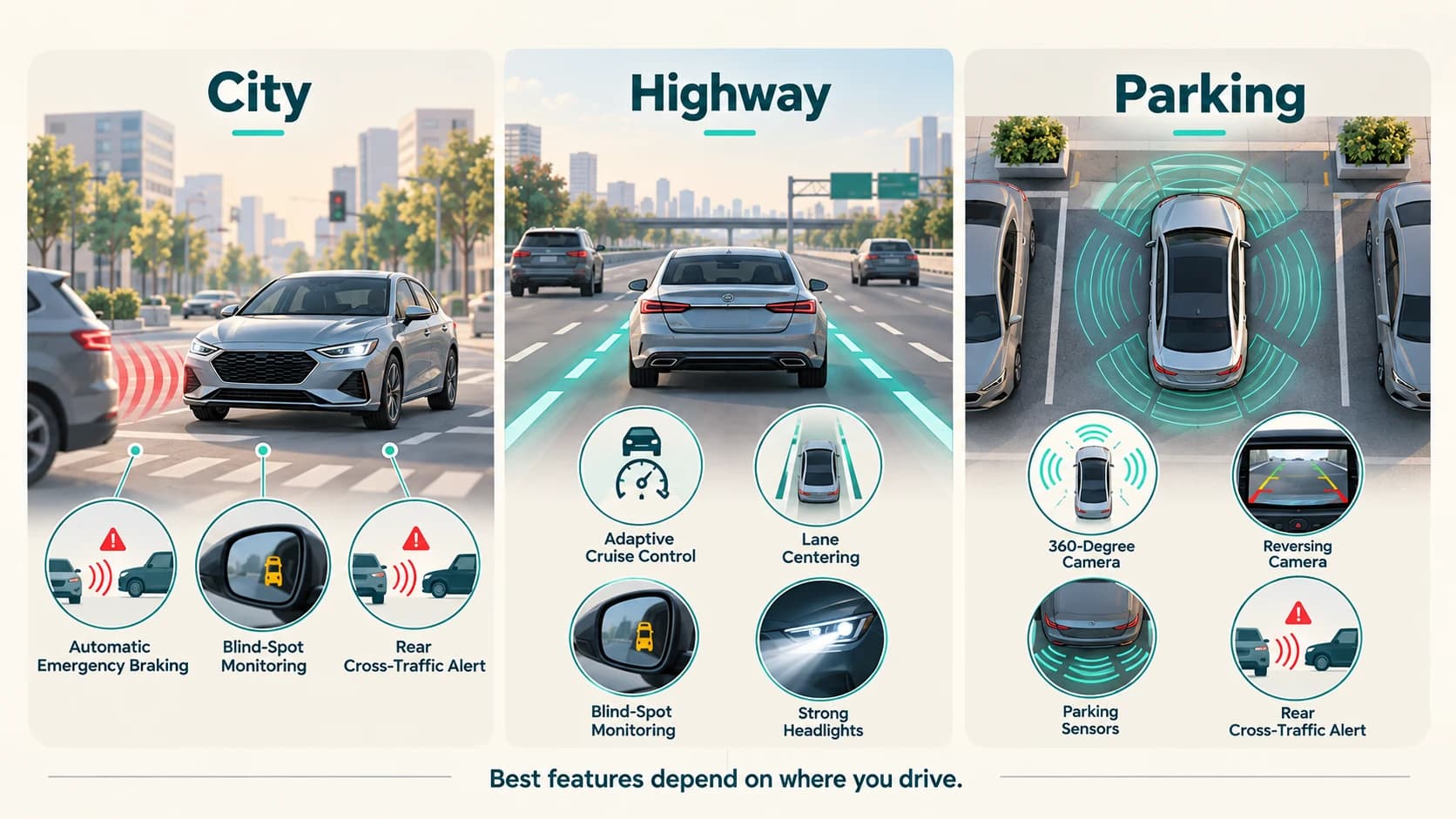
So ACC can be one of the best features in the car for a frequent highway traveller—and nearly irrelevant to someone who rarely leaves town.
Lane-Keeping Features Need the Same Context
Modern cars may offer several related functions.
Lane-departure warning
Warns when the vehicle unintentionally begins leaving its lane.
Lane-keeping assistance
Can gently intervene through steering or braking to help prevent departure.
Lane centering
Continuously assists with steering to keep the vehicle near the centre of the lane.
NHTSA distinguishes these functions and emphasizes that the driver remains responsible for monitoring and controlling the vehicle.
Their usefulness depends heavily on:
- road markings
- system calibration
- the kinds of roads you use
On a well-marked highway, lane centering can reduce workload.
On poorly marked or highly irregular roads, its opportunities may be much more limited.
It is therefore worth testing the exact vehicle rather than buying an “ADAS Level 2” badge and assuming every implementation works equally well.
Keyless Entry Is Pure Convenience—But Very Good Convenience
Keyless entry does not improve crashworthiness.
It does not make the engine more efficient.
But it solves an irritation you may experience several times every day.
With the key in your pocket:
approach → touch handle → open door
Then:
sit → press Start
It is particularly convenient when carrying:
- bags
- a child
- groceries
- luggage
Once you become accustomed to it, returning to a car where you need to search for the key can feel surprisingly old-fashioned.
But it should remain below major safety equipment when comparing variants.
Convenience is useful.
It is simply not the same as safety.
Features That Are Useful Only for Certain Owners
Not every good feature belongs on every buyer's must-have list.
Powered tailgate
Very useful if:
- you frequently load luggage
- the tailgate is large and heavy
- hands-free opening works reliably
Less important on a small hatchback.
Wireless phone charger
Convenient for short trips.
But the implementation matters.
A poorly positioned charger that:
- heats the phone
- charges slowly
- lets the device slide around
may be less useful than a good USB-C port.
Head-up display
Potentially very useful because speed and navigation information can remain close to the driver's forward line of sight.
But some systems display far more information than necessary.
The best HUD is clear, simple and easy to ignore when you do not need it.
Auto-dimming mirrors
A small feature that becomes valuable during night driving because it reduces the glare from headlights behind you.
Rain-sensing wipers
Convenient in changing rain.
Not essential.
And system sensitivity varies considerably between vehicles.
What About Sunroofs, Ambient Lighting and Huge Screens?
There is nothing wrong with enjoying them.
A panoramic sunroof can make the cabin feel brighter and more spacious.
Ambient lighting can make an interior more pleasant at night.
A large display can look excellent and provide a useful map view.
But these belong primarily to the category of:
experience and preference
rather than:
essential everyday function.
If your budget forces a choice between:
panoramic roof
and
AEB + blind-spot monitoring
the safety equipment provides a much stronger practical reason to upgrade.
Likewise, choosing a higher variant solely because it has a larger infotainment screen may make little sense if that variant does not improve the areas you actually care about.
The Feature You Shouldn't Ignore: Good Basic Design
Some of the most useful things in a car do not have impressive names.
They include:
- clear outward visibility
- comfortable seats
- a sensible driving position
- easy-to-read instruments
- effective headlights
- well-placed controls
- usable storage spaces
- adequate rear visibility
- a turning circle suited to your environment
- easy ingress and egress
No software update can completely fix poor fundamental ergonomics.
This is why a test drive matters.
Do not spend the entire test drive evaluating acceleration.
Try ordinary life.
Reverse into a parking space.
Make a U-turn.
Adjust the AC.
Connect your phone.
Sit in the back.
Use the boot.
Drive over a rough road.
Look over your shoulder before changing lanes.
Those tasks reveal the features you will actually live with.
A Practical Feature Priority List
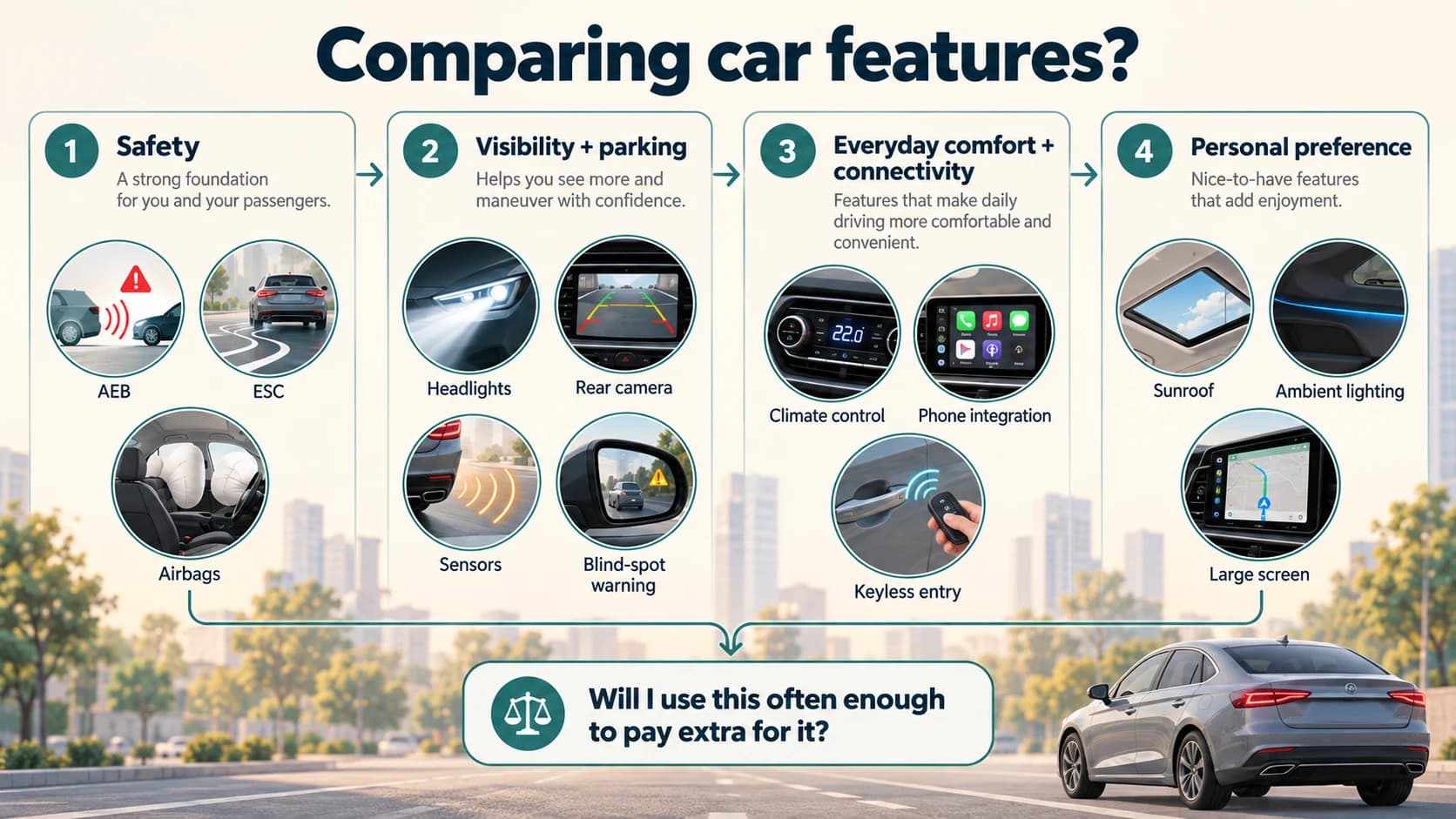
If you are comparing variants of the same car, a practical way to think about equipment is:
| Priority | Features worth looking for | Why |
|---|---|---|
| Safety first | ESC, AEB, good crash protection, adequate airbags | Can help avoid or reduce serious crashes |
| Visibility and parking | Good headlights, rear camera, sensors, blind-spot warning, rear cross-traffic alert | Useful in common real-world situations |
| Everyday monitoring | TPMS | Alerts you to a problem that may otherwise go unnoticed |
| High-use convenience | CarPlay/Android Auto, automatic climate control, keyless entry | Used frequently by many owners |
| Use-case dependent | 360° camera, ventilated seats, ACC, lane centering, powered tailgate | Excellent when they match how and where you drive |
| Preference features | Sunroof, ambient lighting, elaborate displays | Can improve enjoyment but are rarely fundamental |
This is not a universal ranking.
Someone who spends four hours a day on highways may value adaptive cruise control more than a 360-degree camera.
Someone navigating narrow urban parking every day may make the opposite choice.
That is exactly the point.
Count Useful Features, Not Total Features
Manufacturers understandably advertise equipment that is easy to show in a brochure.
A panoramic roof photographs beautifully.
A large screen looks impressive in a showroom.
A colourful ambient-lighting system is immediately visible.
Automatic emergency braking is almost invisible.
So is electronic stability control.
Good headlight performance is difficult to appreciate at noon under showroom lights.
Yet those quieter features can matter much more once the car becomes part of your daily life.
The best-equipped car is therefore not necessarily the one with the longest equipment list.
It is the one whose features solve the problems you actually encounter:
avoiding crashes
seeing properly at night
parking safely
keeping track of tyre pressure
staying comfortable
using navigation without constantly handling your phone
reducing fatigue on the kind of roads you regularly drive
So before paying extra for a higher variant, do not ask:
“How many more features do I get?”
Ask:
“Which of these features will make my driving safer, easier or more comfortable often enough that I will actually notice they are there?”
That question usually leads to a much better car purchase.