How Does Your Car Decide When to Deploy the Airbags?
Learn how crash sensors, accelerometers, pressure sensors and an airbag control unit decide within milliseconds whether—and which—airbags should deploy.
A collision begins.
Before you have time to understand what happened, your car may already have tightened the seat belts and inflated one or more airbags.
The decision can happen in milliseconds.
That raises an interesting question: how does the car know that this particular impact is serious enough to require an airbag?
There is no simple button at the front bumper that gets pressed during a crash. Nor does the car merely check the speedometer and follow a rule such as:
Above 30 km/h = deploy airbags.
A modern airbag system is much more sophisticated.
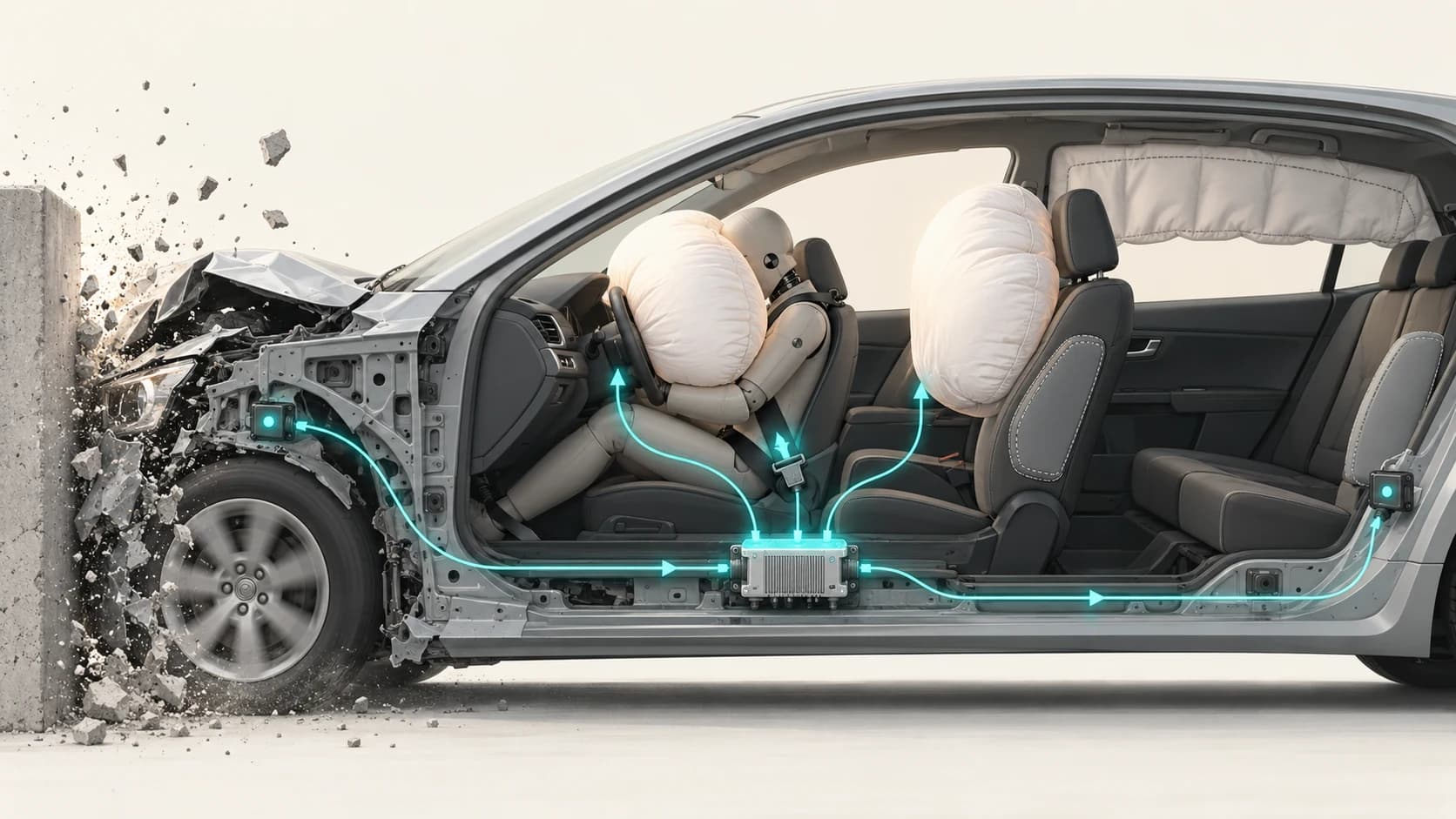
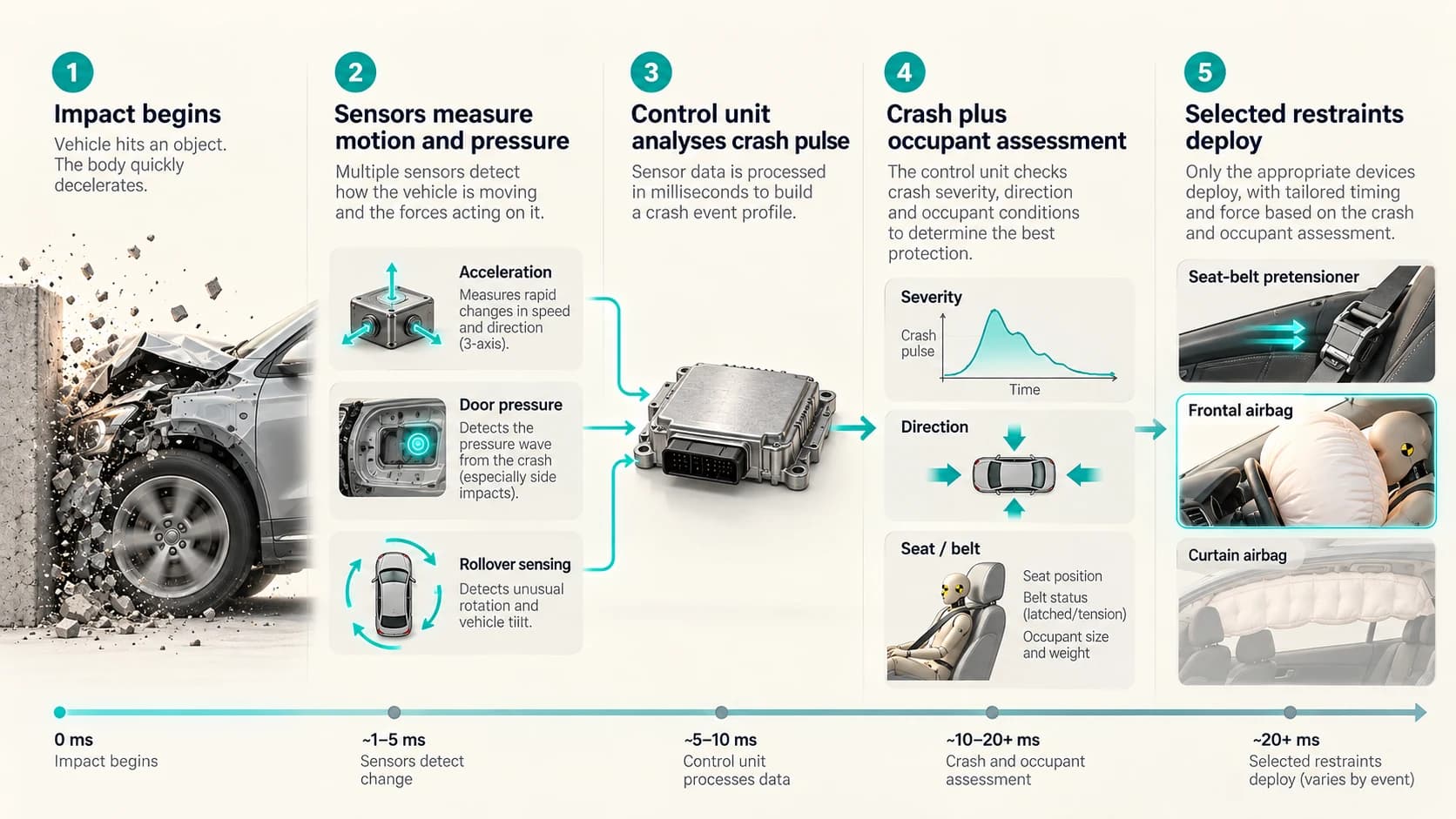
Sensors around the vehicle monitor things such as rapid acceleration and deceleration, pressure changes, sideways movement and rotation. An electronic airbag control unit continuously evaluates those signals. During a crash, it analyses the pattern of forces—the crash pulse—and decides what type of collision is occurring, how severe it appears to be and which restraints are appropriate.
Bosch describes modern control units as evaluating acceleration and pressure sensors to detect frontal, side and rear impacts, with rollover sensing available as well. NHTSA similarly explains that deployment depends on crash characteristics, impact direction, sensor locations and the vehicle's particular restraint-system strategy.
And the decision is not simply:
airbags on
or
airbags off.
The system may choose different combinations of:
- driver airbag
- passenger airbag
- side torso airbag
- curtain airbag
- knee airbag
- seat-belt pretensioner
depending on what is happening.
The Airbag Is Part of a Larger Restraint System
Airbags are often treated as the main safety system inside a car.
They are actually supplemental restraints.
That is why the formal term Supplemental Restraint System, or SRS, appears on many steering wheels and dashboards.
Seat belts remain essential.
NHTSA states that airbags are designed to work with seat belts, not replace them. Their job is to reduce the chance that the head, chest or upper body will strike hard parts of the vehicle interior during an appropriate crash.
A modern restraint system can coordinate several components.
For example, in a serious frontal crash it might:
- detect the collision,
- tighten the seat belt using a pretensioner,
- deploy the driver's frontal airbag,
- deploy the passenger airbag if appropriate,
- control deployment differently depending on occupant and crash conditions.
Bosch's airbag control units can activate both airbags and seat-belt tensioners through separate firing circuits.
So the airbag is better understood as one tool inside a coordinated occupant-protection system.
What Is the Car Actually Measuring?
The most important measurement is not simply the vehicle's speed before impact.
It is how the vehicle's motion changes during the crash.
Accelerometers detect violent changes in motion
An accelerometer measures acceleration.
That includes deceleration, which is acceleration in the opposite direction.
Imagine a car moving at a constant speed.
Its crash sensor does not interpret that as a collision simply because the number on the speedometer is high.
But if the vehicle suddenly loses a large amount of velocity over a very short period, the sensors detect a strong acceleration signal.
The control unit can study:
- how quickly the force begins
- how large the acceleration becomes
- how long it lasts
- which direction it acts in
- how the signal develops over time
That pattern is often called the crash pulse.
Crash Severity Is More Than Impact Speed
This is one of the most important things to understand about airbags.
Two cars travelling at the same speed can experience very different crashes.
Imagine one car hits:
- a rigid concrete barrier
while another strikes:
- an object that deforms substantially
The amount of speed lost, how quickly that speed is lost and how the vehicle structure absorbs the energy may differ significantly.
Likewise, a car can suffer dramatic-looking body damage without producing exactly the crash pulse required for a particular airbag to deploy.
A manufacturer's owner documentation filed with NHTSA makes this point explicitly: the visible amount of structural damage after a collision does not by itself determine whether frontal airbags should have deployed.
This is why photographs of a damaged car do not tell the full story of what the restraint controller detected.
Does the Car Have Crash Sensors in the Bumper?
Modern systems can use several sensors distributed around the vehicle.
The exact arrangement depends on the manufacturer and model.
Central acceleration sensors
The airbag control unit itself can contain high-range acceleration sensors.
These detect the vehicle's overall crash motion.
Peripheral acceleration sensors
Additional sensors positioned nearer parts of the body structure can detect impacts earlier and provide supporting information.
Door pressure sensors
Side impacts create a special problem.
There is much less distance between the side of the car and the occupant than there is between the front bumper and the passenger compartment.
The system therefore needs to recognise a dangerous side impact extremely quickly.
One approach is to place a pressure sensor inside the door cavity.
When another vehicle or object crushes the door, the internal pressure can change rapidly.
Bosch says its peripheral pressure sensor continuously monitors door-cavity pressure and can combine that information with acceleration sensors to make side-impact detection faster and more reliable.
Rollover sensors
Vehicles with rollover-sensitive curtain airbags can also use information about:
- rotational movement
- sideways acceleration
- vehicle tilt
IIHS explains that rollover-capable systems can use sensors measuring lateral motion and tilting to determine that a rollover is developing and deploy curtain airbags accordingly.
Different kinds of crashes therefore require different kinds of evidence.
The Airbag Control Unit Makes the Decision
All those sensor readings need somewhere to go.
That job belongs to the airbag control unit, sometimes called a restraint control module, sensing and diagnostic module or occupant restraint controller depending on the manufacturer.
Think of it as the decision-making centre of the restraint system.
It continuously receives sensor information.
Under normal driving it must correctly distinguish between events such as:
- braking hard
- hitting a pothole
- driving over a curb
- a minor bump
- a genuine severe collision
Bosch says a modern trigger algorithm can determine within roughly 10 milliseconds whether the vehicle has experienced ordinary harsh motion, a collision severe enough to require protection or a potential rollover.
That distinction is critical.
An airbag inflates with considerable force.
Deploying one unnecessarily is not harmless.
The system therefore has to be extremely sensitive to real crashes while remaining resistant to false triggering.
The Algorithm Looks for a Crash Pattern
An accelerometer does not simply report:
Serious crash: yes.
It produces a changing signal.
Imagine a simplified graph:
Acceleration
    |
    |       /\
    |      /  \__
    | ____/       \____
    |
    +---------------------- Time
The airbag controller analyses this evolving pattern.
The real algorithm is manufacturer-specific and considerably more complicated, but it can consider information related to:
- impact severity
- direction
- duration
- acceleration pattern
- signals from several sensors
- rollover motion
- occupant conditions
Modern control units can combine different sensor types precisely because one sensor reading alone may not tell the whole story.
Why Doesn't Hard Braking Deploy the Airbags?
Hard braking can produce strong deceleration.
So why doesn't slamming the brake pedal trigger an airbag?
Because the magnitude and timing of the signal are different from a crash.
Normal braking slows the car over a much longer period.
A collision can change the vehicle's motion far more abruptly.
The controller has been calibrated through engineering analysis and crash testing to distinguish these patterns.
The same principle helps prevent ordinary events such as road bumps from being mistaken for collisions.
It is therefore inaccurate to think of an airbag sensor as a simple switch that activates whenever it experiences a large jolt.
Why Front, Side and Curtain Airbags Don't All Deploy Together
A vehicle can contain many airbags, but deploying all of them in every crash would provide no benefit and could create unnecessary risk and repair costs.
Instead, the controller determines which restraints match the crash.
Frontal crash
A sufficiently severe frontal or near-frontal collision may activate:
- driver frontal airbag
- passenger frontal airbag when appropriate
- seat-belt pretensioners
- possibly knee airbags
Side impact
A serious side collision may activate:
- side torso airbag
- side curtain airbag
- relevant belt pretensioners
The frontal airbags may not be required unless the crash also creates substantial forward occupant movement.
Rollover
A rollover-capable system may deploy:
- curtain airbags
- seat-belt pretensioners
without necessarily deploying frontal airbags.
IIHS notes that rollover curtain airbags can remain inflated much longer than ordinary side airbags—sometimes for 10 seconds or more—to help cover the window area during multiple rolls and reduce occupant ejection risk.
The system is therefore responding to the geometry of the crash, not merely its existence.
Side Airbags Have Even Less Time to React
Front-end structures are designed with substantial crush space.
A side impact is different.
There may be only a door and relatively small distance between the striking object and the occupant.
That is why side airbags have to act particularly quickly.
IIHS says side airbags typically need to deploy within roughly the first 10–20 milliseconds of a side crash. Bosch says its door-pressure sensing system is designed to help the controller decide whether deployment is needed in less than 5 milliseconds in appropriate side-impact applications.
The system cannot wait until the passenger has already begun hitting the door.
The protection has to be in position first.
What Happens After the Computer Decides to Deploy?
Once the control unit concludes that a restraint is needed, the process moves extremely quickly.
The controller sends an electrical firing signal to the appropriate inflator.
An igniter starts the inflator process.
Gas rapidly fills the airbag.
The bag bursts through its designed cover in:
- the steering wheel
- dashboard
- seat
- roof rail
- another designated location
and moves into the occupant's path.
NHTSA says frontal airbags can inflate in less than one-twentieth of a second.
Bosch describes systems in which, following the control algorithm's decision, the airbag can be fully inflated within roughly 30 milliseconds. Exact timing varies with the restraint and vehicle design.
The airbag then begins venting.
It is not supposed to remain as a hard inflated balloon.
Its job is to cushion the occupant's motion and then release gas in a controlled way.
The Passenger Airbag Has Another Question to Answer
A modern car does not necessarily deploy the front passenger airbag simply because the driver's airbag is needed.
The system may first need to determine:
Is anyone sitting there?
And in some systems:
What kind of occupant appears to be there?
Advanced frontal airbags can use occupant-detection technology to suppress or modify deployment when the passenger seat is:
- empty
- occupied by a small child
- occupied by certain child restraints
- otherwise classified in a way where deployment would be inappropriate
NHTSA says many advanced frontal systems automatically disable the passenger airbag when the vehicle detects no occupant, a small-stature passenger or certain child-restraint conditions.
Some systems also use information such as:
- seat-belt status
- occupant weight
- seat position
to help decide how the restraint system should behave.
This is why many vehicles have a PASSENGER AIRBAG OFF indicator.
Can the Airbag Deploy With Different Levels of Force?
Yes, in advanced systems.
Older airbag systems were comparatively simple and could deploy in much the same way across different occupants and crash conditions.
Modern systems can be designed with multiple deployment stages or other adaptive strategies.
NHTSA describes advanced frontal airbags as using sophisticated sensing to determine whether, when and how much to deploy.
The exact method varies by manufacturer.
A system may consider factors such as:
- crash severity
- belt use
- occupant classification
- seat position
before selecting its restraint strategy.
So even when two crashes both cause an airbag to inflate, the system's internal decisions may not have been identical.
Why Can the Seat Belt Tighten Without an Airbag Deploying?
Because seat-belt pretensioners and airbags do not necessarily share exactly the same activation strategy.
A pretensioner rapidly removes slack from the belt during an appropriate crash.
This helps position the occupant so the rest of the restraint system can work effectively.
The control unit can have separate firing circuits for different restraint devices.
Depending on the crash, the system may conclude that:
belt restraint is useful
while:
frontal airbag deployment is unnecessary.
This is another reason “the airbags did not open” does not automatically mean the safety system did nothing.
Why Might Airbags Not Deploy in a Serious-Looking Crash?
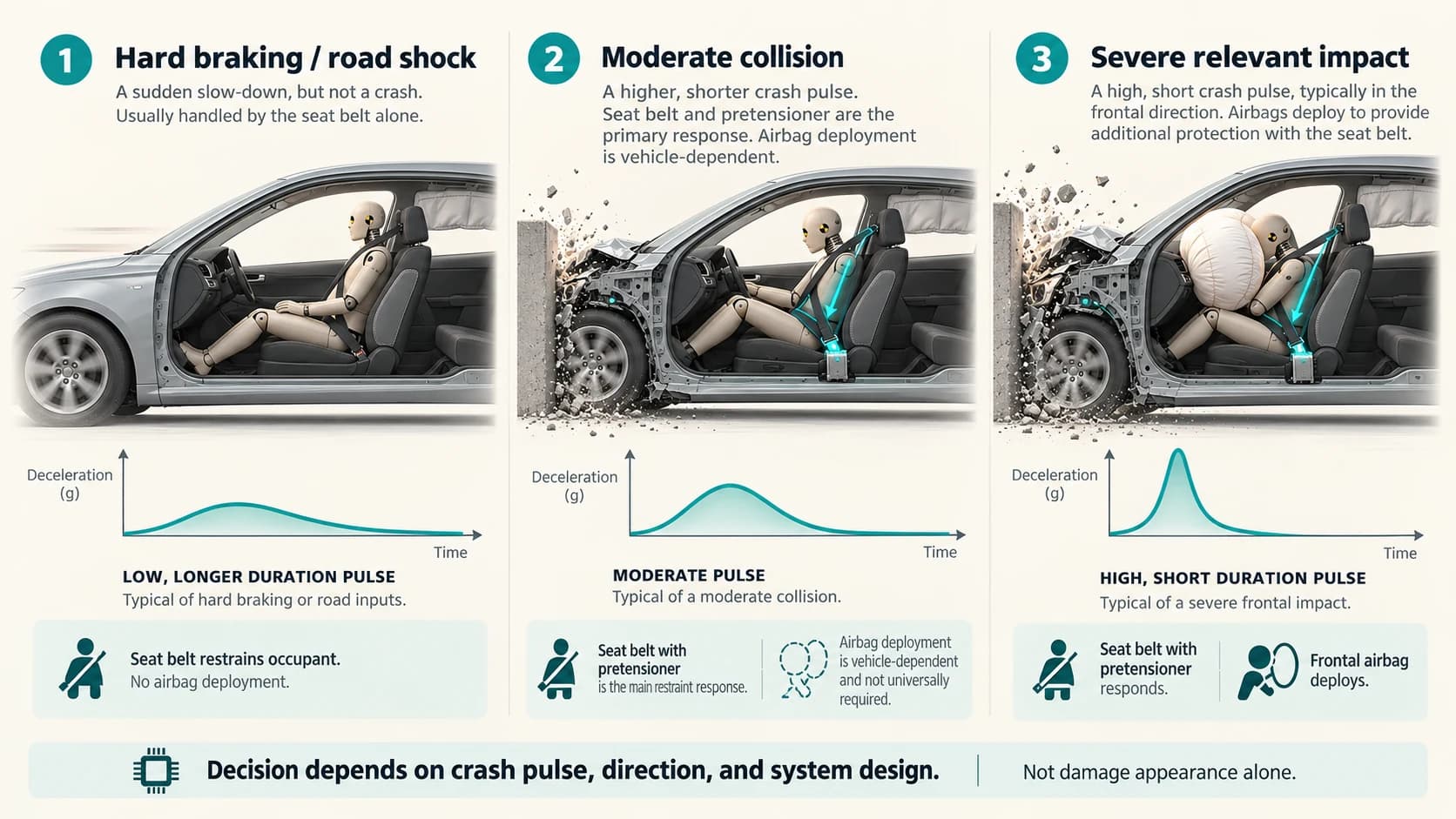
Airbags are not designed to deploy in every collision.
NHTSA lists several factors that affect the decision:
- crash severity
- impact direction
- vehicles or objects involved
- sensor location
- restraint-system design
- passenger classification
Some common situations can therefore produce little or no frontal-airbag deployment.
Rear-end collision
If your vehicle is struck from behind, the primary occupant motion is very different from a frontal collision.
Frontal airbags may provide little useful protection.
Some side impacts
Side airbags may deploy while frontal airbags remain unused.
Minor frontal impact
The seat belt may provide sufficient protection without the additional force of an airbag.
Impact that misses the main sensing pattern
Crash direction and structural deformation affect the signal reaching the sensors.
Passenger seat empty or appropriately suppressed
The passenger airbag may remain off even while the driver's deploys.
This is why the question:
“The front of the car is badly damaged—why didn't every airbag open?”
cannot be answered from external damage alone.
Crash sensing is based on the measured dynamics of the collision.
Is There a Fixed Speed at Which Airbags Deploy?
Not in the simple way people often imagine.
NHTSA provides approximate crash-severity equivalents for frontal airbags. For example, it says frontal airbags are generally designed for moderate-to-severe frontal or near-frontal crashes roughly equivalent to striking a rigid barrier at about 8–14 mph (13–23 km/h) or higher, depending on the system and conditions.
But that should not be interpreted as:
At 14 mph the airbag always opens, and at 13 mph it never does.
Real crashes differ in:
- object stiffness
- overlap
- impact angle
- vehicle structure
- belt status
- sensor strategy
The car is evaluating crash severity, not simply checking one speed value.
Can the Car Record What Happened?
Many vehicles contain an event data recorder, or EDR.
Depending on the vehicle, it can record a brief period of technical data associated with a crash, potentially including:
- vehicle dynamics
- system status
- driver inputs
- seat-belt status
- crash severity information
- restraint deployment
NHTSA describes EDRs as recording technical information for a short period—seconds, not minutes—before, during and after certain crash events.
The airbag control system and EDR can therefore be closely related.
That information can later help investigators understand what the vehicle detected and what restraint systems activated.
It is not a continuously recording video camera.
What If the Airbag Warning Light Stays On?
When the vehicle starts, the airbag warning lamp commonly illuminates briefly as the system performs a self-check.
If the light:
- remains illuminated
- comes on while driving
- behaves differently from what the owner's manual describes
it can indicate a fault in the restraint system.
Owner documentation filed with NHTSA describes airbag controllers monitoring sensors, pretensioners, airbag modules and associated wiring, with the warning lamp indicating when a malfunction may affect system readiness.
The correct response is to follow the vehicle manufacturer's service guidance rather than assuming the airbags will work normally.
Airbags Are Single-Use Devices
Once an airbag deploys, it cannot simply be folded back into the steering wheel.
NHTSA states that deployed airbags must be replaced before the system can provide its intended protection again.
Other components may also require inspection or replacement, including:
- pretensioners
- control modules
- sensors
- wiring
- trim
depending on the vehicle and crash.
A repaired car's airbag system therefore deserves the same attention as visible body repairs.
What the Car Is Really Asking During a Crash
The decision happening inside the restraint controller is far more sophisticated than:
Did the car hit something?
Conceptually, it is closer to:
Is this actually a crash?
↓
How severe is it becoming?
↓
Which direction is the force coming from?
↓
Is rollover occurring or likely?
↓
Which seats are occupied?
↓
Which restraints would help these occupants?
↓
Trigger the required devices immediately
The impressive part is not merely that an airbag can inflate quickly.
It is that the vehicle has to understand the crash quickly enough to deploy the correct protection before the occupant reaches the place where that protection needs to be.
A modern car therefore does not “know” a crash has happened in the human sense.
It measures motion, acceleration, pressure and occupant conditions.
Then, within milliseconds, an algorithm turns those measurements into one of the fastest safety decisions the car will ever make.