How Do Parking Sensors Know How Close an Object Is?
Learn how ultrasonic parking sensors send sound pulses, time their echoes and calculate how close a wall, car or other obstacle is.
You start reversing toward a wall.
At first, the car is silent.
Then:
beep ... beep ... beep
As the wall gets closer:
beep-beep-beep-beep
And when there is very little space left, the warning may become nearly continuous.
The car seems to know, with surprising precision, that an object is getting closer to the bumper.
But those small circular sensors do not contain tiny cameras. They usually do not “see” the wall at all.
They listen for echoes.
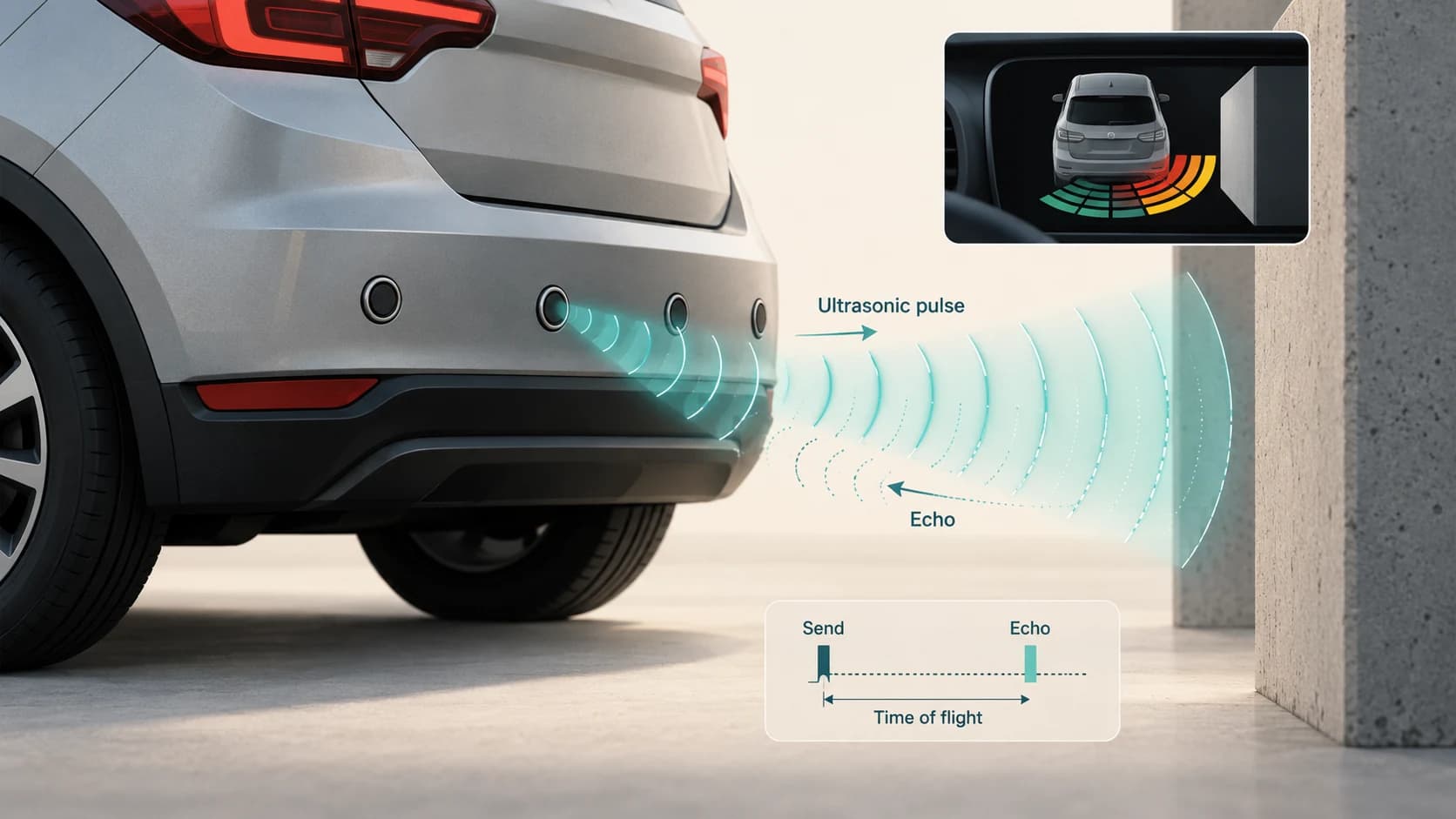
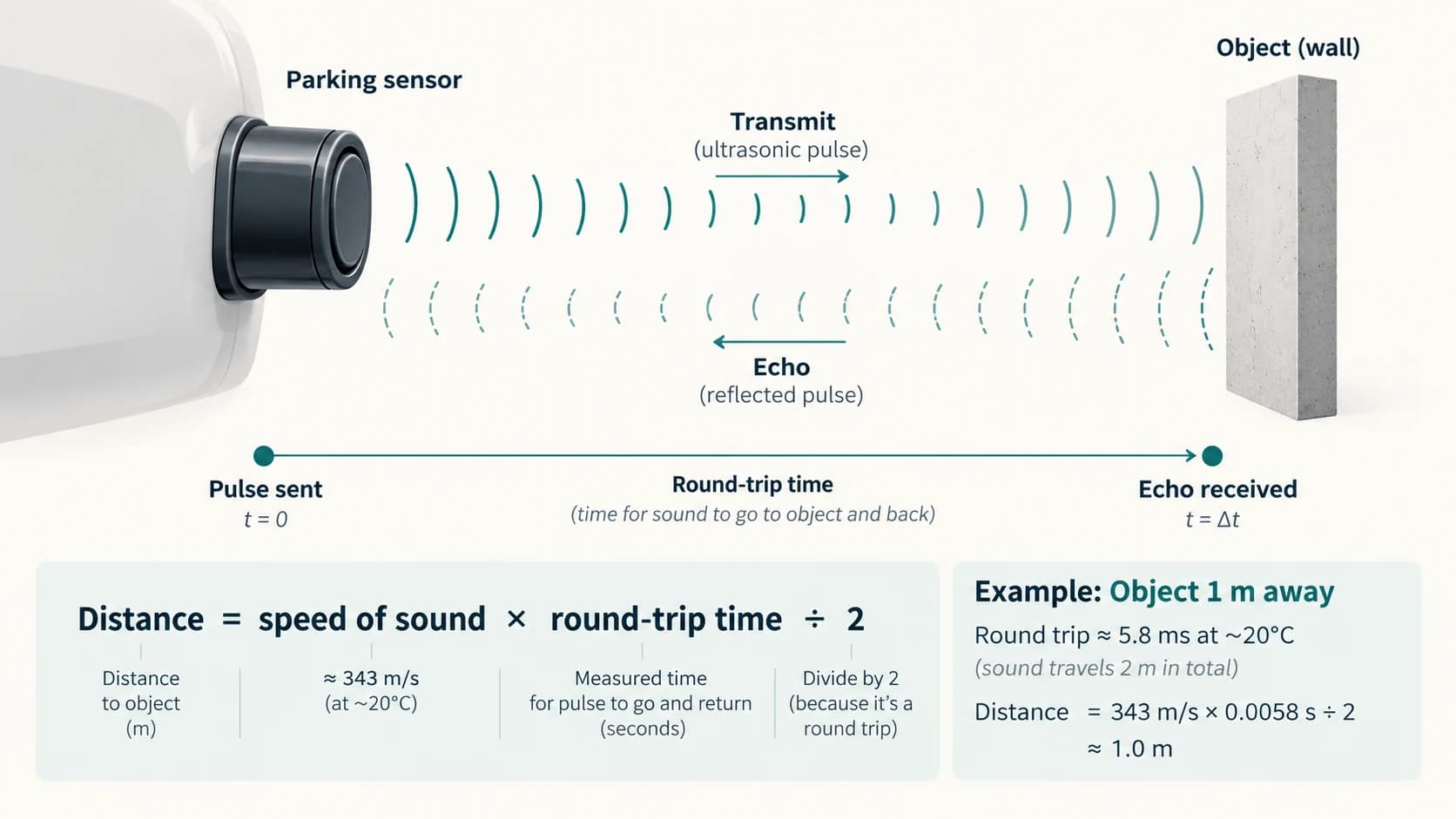
Most conventional parking sensors use ultrasound: sound waves at frequencies above normal human hearing. A sensor sends out a brief pulse, waits for that pulse to bounce off an object and return, then measures the round-trip time.
Because sound travels through air at a known approximate speed, the system can convert that time into distance.
Texas Instruments describes ultrasonic automotive parking systems in exactly these terms: they transmit high-frequency sound, receive the reflection and calculate distance from the time of flight between transmission and reception. Bosch likewise describes ultrasonic sensors as calculating distances to obstacles for parking and manoeuvring.
The principle is simple enough to explain in one equation.
Making it work reliably on a moving car surrounded by kerbs, poles, pedestrians, rain, exhaust noise and several other sensors is the clever part.
Those Round Circles in the Bumper Are Tiny Sonar Systems
Look closely at the front or rear bumper of a car with parking assistance.
You may see four, six or more small circular discs.
Behind each disc is an ultrasonic transducer.
A transducer is a device that converts one form of energy into another.
In this case it can convert an electrical signal into mechanical vibration, producing an ultrasonic sound pulse. The same transducer can then detect returning sound vibrations and convert them back into an electrical signal.
Automotive ultrasonic sensors operate at frequencies well above normal human speech and hearing. The precise frequency varies by design. For example, a Texas Instruments automotive park-assist reference design supports ultrasonic transducers in the 40–70 kHz range, while a Bosch ultrasonic sensor system has used modulated frequencies around 43–60 kHz.
You cannot hear those pulses.
The sensor can.
Step 1: The Sensor Sends Out a Short Sound Burst
Suppose you are reversing toward a wall.
The parking controller activates one of the rear sensors.
The transducer vibrates rapidly and sends a short burst of ultrasound into the air.
You can imagine the sound spreading outward in a cone-like region behind the bumper.
The pulse continues until it reaches something.
That might be:
- a wall
- another car
- a pillar
- a kerb
- a person
- a shopping trolley
Some of the acoustic energy reflects from the object's surface and travels back toward the vehicle.
The sensor then listens for the echo.
Step 2: The Car Measures How Long the Echo Took
The crucial measurement is not how loud the echo is.
It is when the echo arrives.
This is called time of flight.
Suppose the pulse leaves the sensor at time zero.
A few milliseconds later, the reflected signal returns.
The farther away the object is, the longer the round trip takes.
Texas Instruments gives the fundamental relationship as:
Distance = Speed of sound × Time of flight ÷ 2
Why divide by two?
Because the measured time covers two journeys:
sensor → object
and
object → sensor
If a wall is 1 metre behind the car, the sound travels approximately:
1 metre out + 1 metre back = 2 metres
At about 20°C, sound travels through air at roughly 343 metres per second. A two-metre round trip therefore takes about 5.8 milliseconds.
That tiny delay is enough for the electronics to estimate that the wall is roughly one metre away.
Why the Calculation Is Fast Enough to Feel Instant
A millisecond is one-thousandth of a second.
Even an object several metres away produces a returning echo quickly enough for the system to repeat the measurement many times while you manoeuvre.
The car does not make one measurement when you select reverse and then trust it.
The sensors repeatedly:
- transmit,
- listen,
- detect echoes,
- calculate distance,
- update the warning.
So as the vehicle moves, the measured range changes continuously.
The beeping pattern is simply a human-friendly representation of those changing measurements.
Why Do the Beeps Become Faster?
The sensor itself does not inherently produce a “slow beep” or “fast beep.”
It produces distance information.
The vehicle's software decides how to present that information to you.
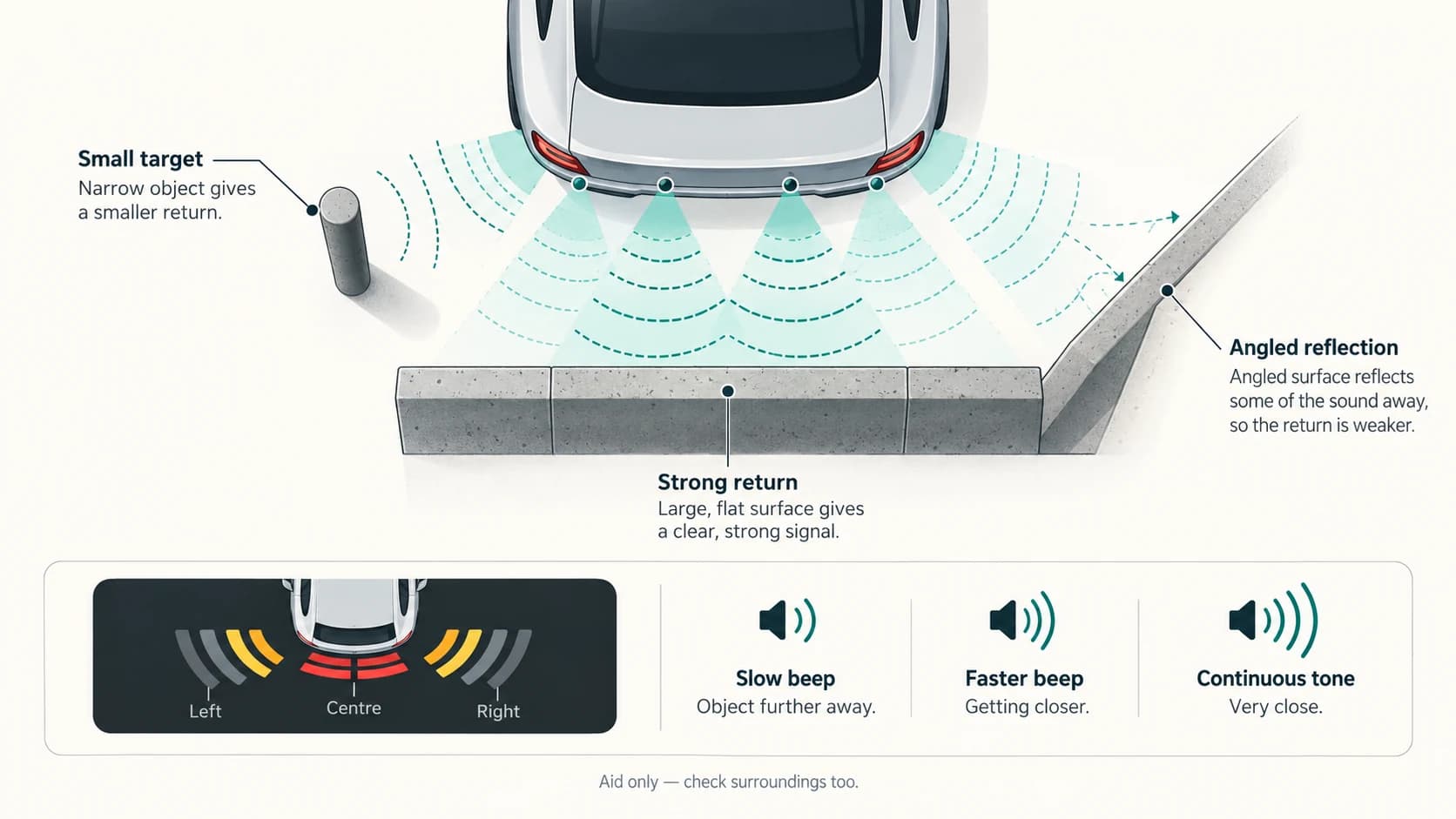
A manufacturer might divide the area around the bumper into several warning zones.
Conceptually:
farther away
→ slow intermittent beeps
closer
→ faster beeps
very close
→ rapid or continuous tone
The dashboard may also show coloured bars or a diagram indicating which side of the vehicle is closest to the object.
The exact distances assigned to each warning zone differ between cars.
So a continuous tone in one model should not be assumed to mean exactly the same number of centimetres as it does in another.
The important point is that the audio warning is generated from the measured distance; the beep rate is not the measurement itself.
Why Does the Car Need Several Sensors?
One sensor can tell you that something is within its detection area.
That is not enough to understand where the obstacle is relative to the whole bumper.
Suppose your car has four rear sensors.
An object near the left corner may produce the strongest or most relevant return at the left-side sensors.
A wall directly behind the centre may appear across several sensors.
The parking controller can combine these measurements to provide a more useful picture of the surrounding space.
That is why the dashboard can often indicate:
rear left
rather than merely:
something behind you.
Modern systems can process several echoes and several sensors together. Bosch says its ultrasonic technology is intended not only to calculate obstacle distances but also to monitor the surrounding space during parking and manoeuvring.
This multi-sensor coverage also reduces gaps that would exist if the car relied on one narrow sensing point.
Can One Sensor Hear Another Sensor's Echo?
Yes, and in some systems that can be useful.
An ultrasonic pulse transmitted by one sensor may reflect from an object and be received by another nearby sensor.
This is sometimes called a cross-echo or indirect measurement.
Multiple transmitter-receiver combinations can improve understanding of nearby objects and help fill gaps in coverage.
But they also create a timing problem.
If every sensor transmitted at the same moment, the system might struggle to determine which pulse created which echo.
The controller therefore coordinates sensor operation and signal processing so that the returns can be interpreted correctly.
As parking systems become more advanced, the raw echo information can also be used for more than a simple nearest-distance warning. Current suppliers such as Bosch and Valeo describe newer ultrasonic systems that can support object classification and automated parking functions.
Why Don't Parking Sensors Simply Use Echo Loudness?
It might seem easier to assume:
louder echo = closer object
But echo strength depends on much more than distance.
A large flat concrete wall may produce a strong reflection.
A narrow pole may reflect far less energy.
A soft object can absorb more sound.
A surface angled away from the sensor can reflect the sound in another direction instead of sending it back.
So echo amplitude can provide useful information, but it is not a reliable universal ruler.
Time of flight gives a much more direct relationship to distance.
The processor may still analyse properties such as:
- echo strength
- echo width
- timing
- repeated measurements
to decide which returns represent meaningful obstacles and which are noise.
Why Can Parking Sensors Miss Some Objects?
Ultrasound is useful, but it is not perfect.
The system needs enough sound to return to the sensor.
Angled surfaces
Imagine pointing a torch at a mirror tilted away from you.
The light reflects somewhere else.
Sound can behave similarly.
A smooth surface at an unfavourable angle may send much of the ultrasonic energy away from the sensor.
Microchip's ultrasonic measurement documentation identifies angled targets as a common limitation because the reflected sound may not return toward the transducer.
Small or thin objects
A narrow pole, wire, chain or thin object may present too little reflective area to produce a strong, reliable echo.
Soft materials
Some materials absorb sound rather than reflecting it strongly.
Microchip notes that acoustically soft or highly attenuating objects can produce weak returns.
Objects outside the sensor's field
A sensor mounted in the bumper has a particular horizontal and vertical detection region.
Something too low, too high or outside the beam may not be represented reliably.
This is why parking sensors should be treated as an aid, not as proof that the entire space is empty.
Why Is There a Minimum Detection Distance?
A surprisingly close object creates another technical problem.
Immediately after an ultrasonic transducer sends its pulse, it does not stop vibrating instantly.
It rings for a short period, a little like a bell continuing to vibrate after being struck.
During that ring-down period, an echo returning almost immediately can be difficult to distinguish from the sensor's own vibration.
Texas Instruments describes this as an ultrasonic blind spot: after transmission, the transducer needs time to stop oscillating before very close echoes can be recognised reliably.
That places a lower limit on accurate ranging.
Bosch's current automotive ultrasonic sensor, for example, specifies exact distance determination from about 15 cm, while it can detect the presence of an object in a closer 3–15 cm region. Those figures describe that particular Bosch sensor, not every car.
So when a parking system produces a continuous warning very close to an obstacle, you should not interpret it as a centimetre-perfect ruler all the way to physical contact.
The safest interpretation is:
stop getting closer.
Why Doesn't the Car Just Measure All the Way to the Wall at Zero Centimetres?
Because ultrasound is not a contact sensor.
Near the bumper, several things become difficult at once:
- the transducer may still be ringing
- the echo has an extremely short travel time
- the object's geometry may not reflect cleanly
- the sensor's physical mounting position may differ from the outermost point of the bumper
The warning system is therefore designed to give the driver useful safety margins rather than act as an electronic tape measure.
This is one reason manufacturers tell drivers to continue checking the vehicle's surroundings directly.
Temperature Actually Changes the Measurement
The formula depends on the speed of sound.
But the speed of sound in air is not perfectly constant.
Temperature changes it.
Texas Instruments gives a useful approximation:
Speed of sound ≈ 331 + 0.6 × temperature in °C
At around 20°C:
331 + 0.6 × 20 ≈ 343 m/s
In colder air, sound travels more slowly.
In hotter air, it travels faster.
TI notes that temperature is one of the most important environmental factors affecting ultrasonic ranging and that systems can compensate by adjusting the speed-of-sound value used in the distance calculation.
Humidity and air conditions can also affect ultrasonic propagation, although temperature is generally the dominant factor for this calculation.
This is a useful reminder that the car is not directly measuring centimetres.
It is measuring time, then converting time into distance using a model of how sound travels.
What About Rain, Mud or Snow?
The sensor needs a clear path to send and receive ultrasound.
If the transducer surface becomes obstructed by:
- mud
- snow
- ice
- heavy contamination
its performance can deteriorate.
Environmental conditions can also change how echoes behave.
Modern automotive sensors are engineered for outdoor use and include signal processing designed to reject noise and operate in difficult conditions. Valeo's current ultrasonic sensor technology, for example, emphasizes improved noise immunity, while Bosch describes modern sensors as being designed for robust object detection.
But “weather-resistant” does not mean “immune to physics.”
If a bumper sensor is visibly covered, cleaning it is sensible before trusting the parking assistance.
Why Do Parking Sensors Work in the Dark?
Because they are not relying on visible light.
A camera needs enough light, or some other illumination strategy, to form a useful picture.
Ultrasound only needs the sound pulse to travel out and return.
That means an ultrasonic parking sensor can measure distance:
- during the day
- at night
- inside a dark garage
without needing to illuminate the object.
Texas Instruments specifically lists operation in any lighting condition as an advantage of ultrasonic sensing.
This is one reason cameras and ultrasonic sensors complement each other so well.
A reversing camera tells you:
what the scene looks like.
Ultrasonic sensors tell you:
how close a reflecting object appears to be.
Is a Reversing Camera Better Than Parking Sensors?
They solve different problems.
Reversing camera
Good for seeing:
- people
- road markings
- the shape of obstacles
- the wider scene behind the vehicle
But judging exact distance from a two-dimensional image can be difficult, even with guidance lines.
Ultrasonic parking sensors
Good for:
- close-range obstacle detection
- direct distance estimation
- audible warnings without staring at a screen
- working in darkness
But they do not show what the object is.
A beep cannot tell you whether the obstacle is:
- a wall
- a bicycle
- a bollard
- another car
The most useful parking systems therefore combine several technologies.
NHTSA notes that rear automatic braking can use information from systems such as parking sensors and the backup camera to detect hazards behind the vehicle.
How Do 360-Degree Cameras Fit Into This?
A 360-degree camera system and ultrasonic parking sensors are often displayed on the same screen, which can make them feel like one technology.
They are not.
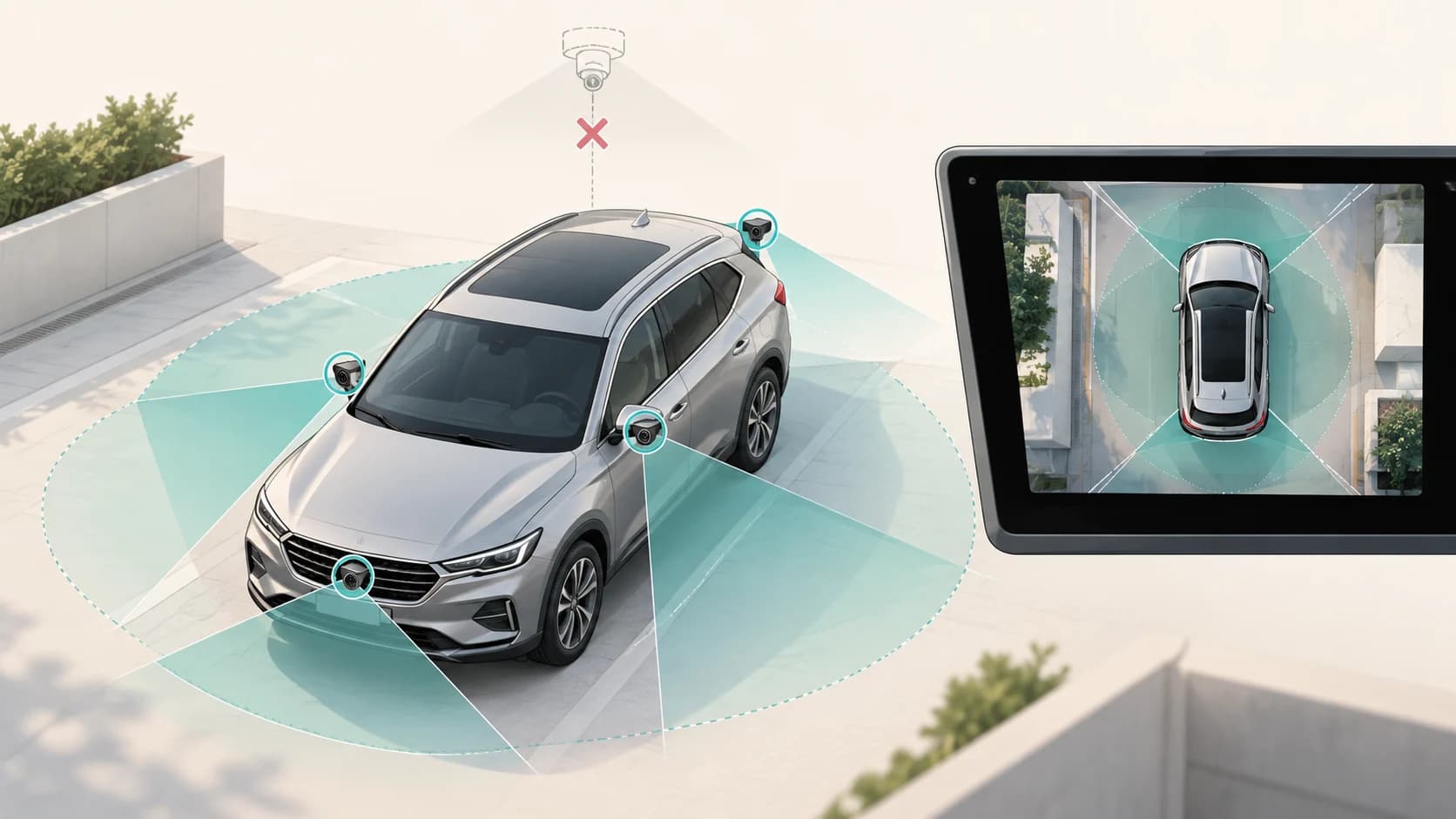
The 360-degree camera system stitches images from several cameras to show a virtual bird's-eye view.
The ultrasonic system uses echoes to estimate distance.
The vehicle can overlay the two.
For example, a top-down camera display might show coloured arcs near the left rear bumper.
Those arcs may represent distance zones supplied by the ultrasonic sensors.
So the screen can combine:
Where is the object visually?
with:
How close is it?
That is much more useful than either system alone.
Can Parking Sensors Automatically Stop the Car?
Some vehicles can go beyond warnings.
If the system determines that a collision is imminent at low speed, the car may be able to apply the brakes automatically.
NHTSA calls this rear automatic braking when it operates while reversing and describes it as using sensors, including parking sensors and cameras, to detect an imminent rear collision.
Bosch's current parking-aid systems similarly describe the possibility of automatic emergency braking at low speed when an obstacle is detected.
This should not be confused with ordinary parking beeps.
A basic parking sensor may only warn the driver.
Automatic braking requires additional software, integration with the braking system and a vehicle designed to support the function.
How Far Can Ultrasonic Parking Sensors Detect?
There is no single universal range.
It depends on:
- sensor hardware
- transmitted power
- transducer design
- object size
- object material
- angle
- environmental conditions
- vehicle calibration
As one current example, Bosch lists a maximum detection range of up to 5.5 metres for its latest ultrasonic sensor, with exact distance determination from about 15 cm.
A Texas Instruments automotive reference design intended for park assist demonstrated object detection from roughly 25 cm to 2.5 metres in that particular design.
Those numbers are not contradictory.
They describe different hardware, configurations and test conditions.
A production car should therefore be judged by its own manufacturer's specifications and behaviour rather than by a generic “parking sensors work up to X metres” rule.
What Is Happening During One Parking Beep?
Suppose you are slowly reversing toward a pillar.
The process looks roughly like this:
1. The sensor emits ultrasound
An electrical pulse makes the transducer vibrate.
2. The sound travels through air
The ultrasonic wave spreads behind the car.
3. It strikes the pillar
Some acoustic energy reflects.
4. The echo returns
The transducer detects the returning wave.
5. Electronics identify the echo
Signal-processing circuitry separates a meaningful return from noise and sensor ringing.
6. The controller measures time of flight
It determines how much time passed between transmission and echo reception.
7. Time becomes distance
The system applies the speed of sound and divides by two for the round trip.
8. Multiple sensors are combined
The car works out which part of the bumper is closest to the obstacle.
9. The driver receives a warning
The display changes and the beep becomes more urgent.
Then the entire sequence repeats as you continue moving.
All of that happens behind a warning sound so simple that most drivers never think about what created it.
Parking Sensors Are Basically Echo Timing Made Useful
The technology behind a parking sensor is related to a much broader idea: sonar.
Send out sound.
Wait for a reflection.
Measure how long it took.
Use the delay to estimate range.
What makes the automotive version impressive is not the basic physics.
It is how reliably the system has to perform while mounted in a bumper and exposed to:
- heat
- cold
- rain
- dirt
- traffic noise
- oddly shaped objects
- multiple simultaneous echoes
The small circles in the bumper therefore do not “know” that you are approaching a wall in the way a person does.
They know something more basic:
I transmitted a sound pulse.
An echo returned after this much time.
Given the speed of sound, the reflecting object is approximately this far away.
The car converts that invisible measurement into something immediately understandable:
beep ... beep ... beep-beep-beep.
And when the tone becomes continuous, the most useful piece of technology in the system may simply be knowing when to stop.