How ABS Works in Modern Cars
Learn how ABS prevents wheel lock during hard braking, how wheel-speed sensors and hydraulic valves work, and why ABS helps you steer while braking.
You are driving on a wet road when something suddenly appears in front of you. You press the brake pedal as hard as you can.
Without the right control, one or more wheels can stop rotating even though the car is still moving. The tyres then slide across the road instead of rolling over it. Once that happens, steering becomes much less effective.
Modern cars have a system designed specifically for this situation: ABS, or the Anti-lock Braking System.
ABS doesn't give the car unlimited grip, and it doesn't magically stop every vehicle in a shorter distance. Its most important job is simpler: prevent prolonged wheel lock so the tyres can continue generating useful braking and steering forces.
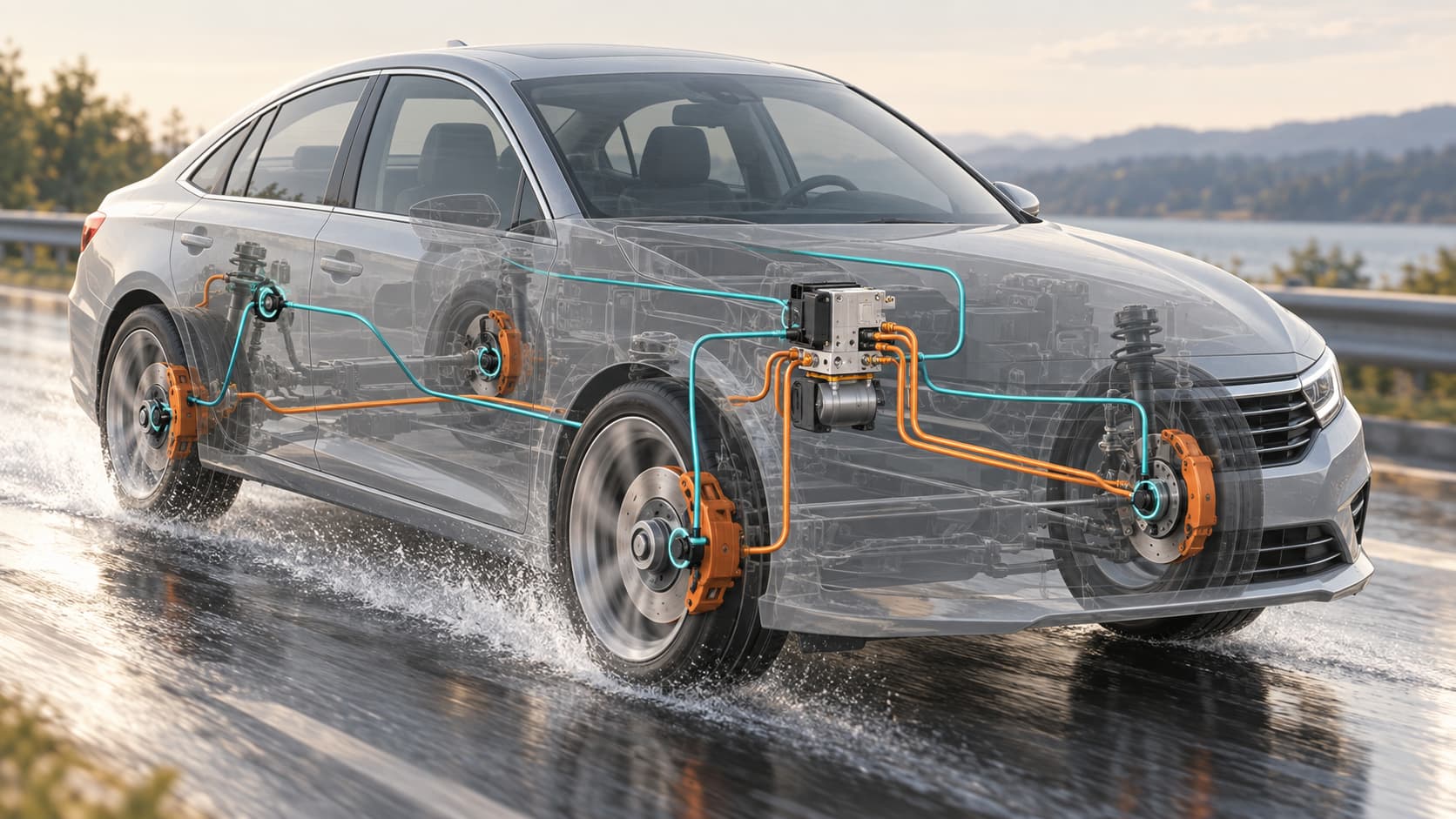
It does this by watching the speed of individual wheels and automatically reducing, holding and reapplying brake pressure when necessary, often many times during a single emergency stop. Bosch describes modern ABS as using wheel-speed sensors, an electronic controller and a hydraulic unit containing valves and a return pump to regulate braking pressure at individual wheels.
The entire process happens so quickly that the driver normally doesn't have to think about it.
To understand why that matters, we first need to understand what happens when a wheel locks.
What Does It Mean When a Wheel "Locks"?
Imagine a car travelling forward while its tyres are rotating normally.
Each tyre continuously rolls into contact with the road. When the driver brakes, the brakes resist wheel rotation, and the friction between the tyres and road slows the vehicle.
Now increase the braking force dramatically.
If the braking force becomes greater than the grip available between a tyre and the road, that wheel may stop rotating while the vehicle is still travelling forward.
The wheel has locked.
Instead of rolling, the tyre is now sliding across the surface.
That is a problem because a tyre has only a limited amount of grip available. When it is sliding heavily in the direction of travel, it becomes much harder for it to generate the sideways forces needed for steering.
NHTSA describes this in terms of wheel slip: when brake forces exceed the grip available between tyre and road, the wheel can move toward full lock, and a sliding tyre loses much of its ability to generate useful forces in other directions.
That is why an old car with locked front wheels can continue sliding roughly forward even when the driver turns the steering wheel.
The steering wheels may physically turn.
The car may not follow them effectively.
ABS Doesn't Prevent Hard Braking. It Controls Wheel Slip
A common misunderstanding is that ABS weakens the brakes whenever you brake hard.
That isn't really what it is trying to do.
ABS wants the brakes to provide as much useful braking force as the tyre-road combination can support without allowing uncontrolled wheel lock.
This means ABS is constantly balancing two things:
- strong braking
- enough wheel rotation for the tyre to continue interacting usefully with the road
The difference between the car's forward motion and the wheel's rotational behaviour is often described using wheel slip.
Some slip during braking is normal and useful. Complete or excessive slip leading toward lock is what ABS attempts to control.
The system therefore doesn't simply decide:
"Wheel turning = good. Wheel stopped = bad."
Its controller looks at how wheel speeds are changing and identifies when a wheel is decelerating in a way that suggests it is approaching lock-up.
Then it intervenes.
The Main Parts of an ABS System
A typical modern passenger-car ABS system contains several important pieces working together.
Wheel-speed sensors
Each wheel has a sensor that measures how quickly it is rotating.
Modern wheel-speed sensors commonly detect a rotating magnetic encoder or similar target without physical contact. Bosch, for example, describes active wheel-speed sensors that use magnetic sensing to generate wheel-speed information for braking and stability systems.
The important point for the driver is simple:
The car knows how each wheel is behaving individually.
If three wheels are rotating normally while one suddenly slows much faster than expected, the controller has evidence that the fourth wheel may be approaching lock.
Electronic control unit
The wheel-speed information is sent to the ABS controller.
This computer continuously evaluates the signals and determines whether intervention is required.
It doesn't simply wait until a wheel has remained completely stationary.
ABS is designed to identify the tendency toward excessive slip and regulate braking pressure accordingly.
Hydraulic modulator
The controller needs a physical way to change brake pressure.
That job is handled by the hydraulic control unit or modulator.
A conventional hydraulic ABS unit contains electronically controlled valves and a pump. These allow the system to manipulate hydraulic pressure going to the brakes at individual wheels.
The precise architecture varies by vehicle, particularly as electro-hydraulic and brake-by-wire systems become more common, but the control principle remains similar.
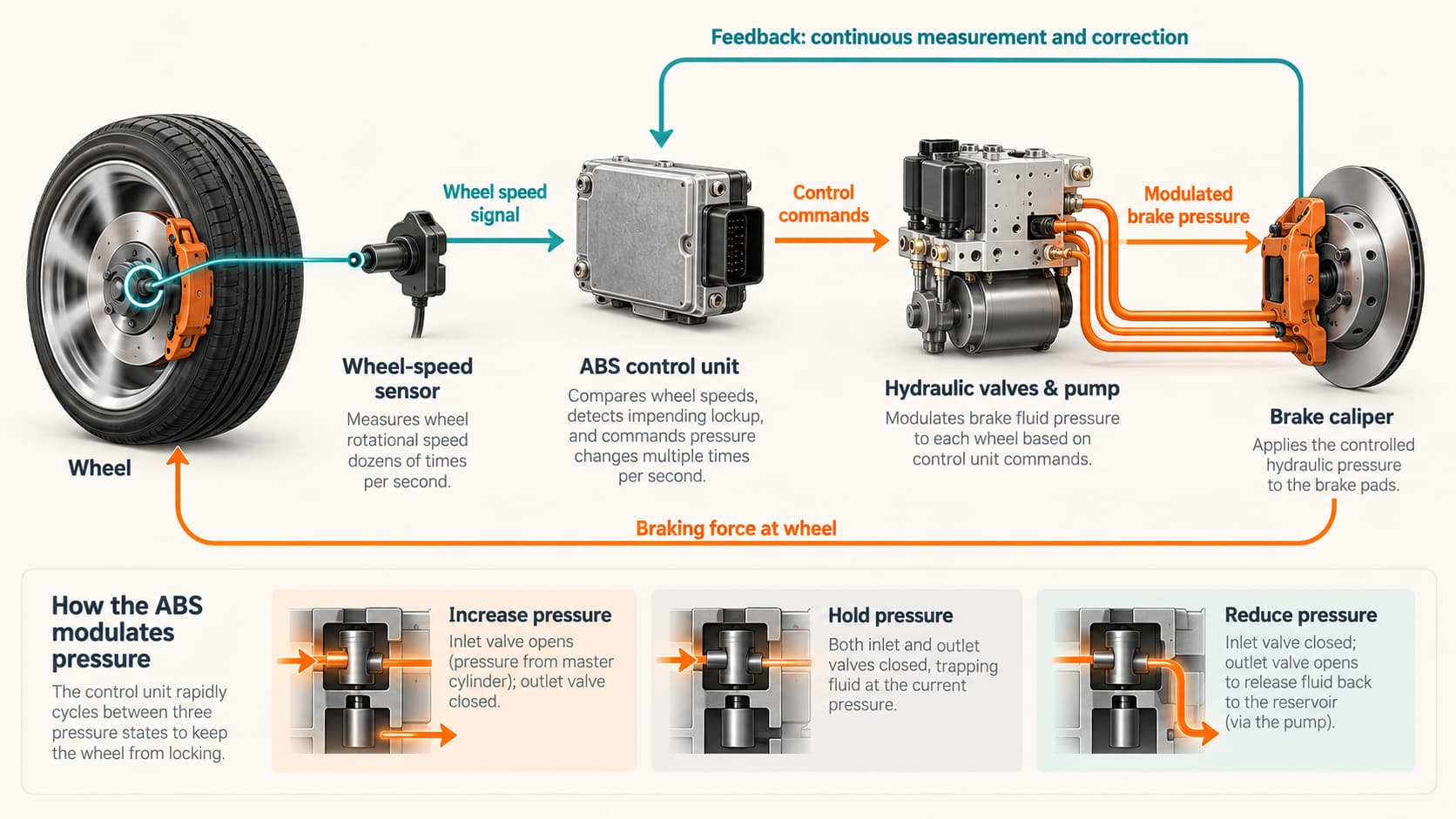
Together, these components form a closed-loop control system:
Measure the wheels → detect excessive slip → adjust pressure → measure again → adjust again
And the cycle continues while necessary.
What Happens During an Emergency Stop?
Suppose you are travelling on a wet road and suddenly press the brake pedal firmly.
1. The brakes begin slowing the wheels
Hydraulic brake pressure pushes the brake pads against the discs, creating braking torque.
The wheels begin slowing along with the vehicle.
2. The sensors report wheel speed
The ABS controller receives continuous information from the wheel-speed sensors.
Under normal braking, nothing special may happen.
ABS generally remains in the background.
3. One wheel begins approaching lock
Perhaps the front-left tyre crosses a wet painted road marking.
Its available grip suddenly becomes lower than that of the other tyres.
Under the same braking demand, that wheel may begin decelerating much more rapidly.
The ABS controller recognizes the developing lock-up condition.
4. ABS reduces brake pressure at that wheel
The hydraulic unit changes valve positions so that pressure at the affected brake can stop increasing or be reduced.
This allows the tyre to regain rotational speed.
5. Pressure is held or increased again
Once the wheel is rotating more appropriately, ABS can allow braking pressure to build again.
If the wheel once again begins approaching lock, pressure can be reduced again.
6. The process repeats
This sequence of increase, hold and decrease can repeat very quickly while the driver continues pressing the pedal.
Bosch says its current ABS systems may reduce and increase braking pressure up to around 40 times per second, although the exact control behaviour depends on the system and driving conditions.
The driver does not have to perform this modulation manually.
The car is effectively making rapid pressure corrections at the individual wheels based on the grip each tyre has available.
Why Does the Brake Pedal Vibrate When ABS Activates?
If you've ever experienced ABS during hard braking, you may have noticed something strange:
the brake pedal pulses or vibrates under your foot.
You may also hear mechanical noises.
That can be completely normal.
The hydraulic valves and pump are rapidly changing brake pressure while ABS operates. Some of this activity can be transmitted back through the braking system and felt at the pedal.
Bosch notes that, depending on the system, brake-pedal pulsation can occur during ABS operation. Vehicle manufacturers also commonly tell drivers that pulsation or operating noises during ABS activation are normal.
This sensation sometimes surprises drivers who have never experienced it before.
The instinctive reaction may be to release the brake pedal.
During a genuine emergency stop, that is usually exactly what you should not do.
Should You Pump the Brakes in a Car With ABS?
No.
The old advice to repeatedly pump the brake pedal came from an era when many vehicles did not have ABS.
With modern ABS, the system is already modulating brake pressure far more quickly and precisely than a person could.
During an emergency stop in an ABS-equipped car, the normal guidance is to press the brake firmly and maintain pressure while steering as necessary.
NHTSA-backed vehicle guidance explicitly warns drivers not to pump ABS brakes, while noting that the system can alter brake pressure more quickly than a driver could manually.
So if the pedal begins pulsing:
keep braking.
The vibration usually means the system is doing its job.
Why ABS Helps You Steer While Braking
This is the most important benefit of ABS.
Imagine trying to avoid an obstacle.
Without ABS, you brake extremely hard and the front wheels lock.
You turn the steering wheel.
But the front tyres are sliding rather than rolling, so their ability to generate sideways steering force is greatly reduced.
The car may continue travelling toward the obstacle.
ABS attempts to prevent that prolonged lock.
By keeping the wheels within a usable range of slip, the tyres retain more ability to generate lateral force.
The driver can therefore brake hard and still have some ability to change direction.
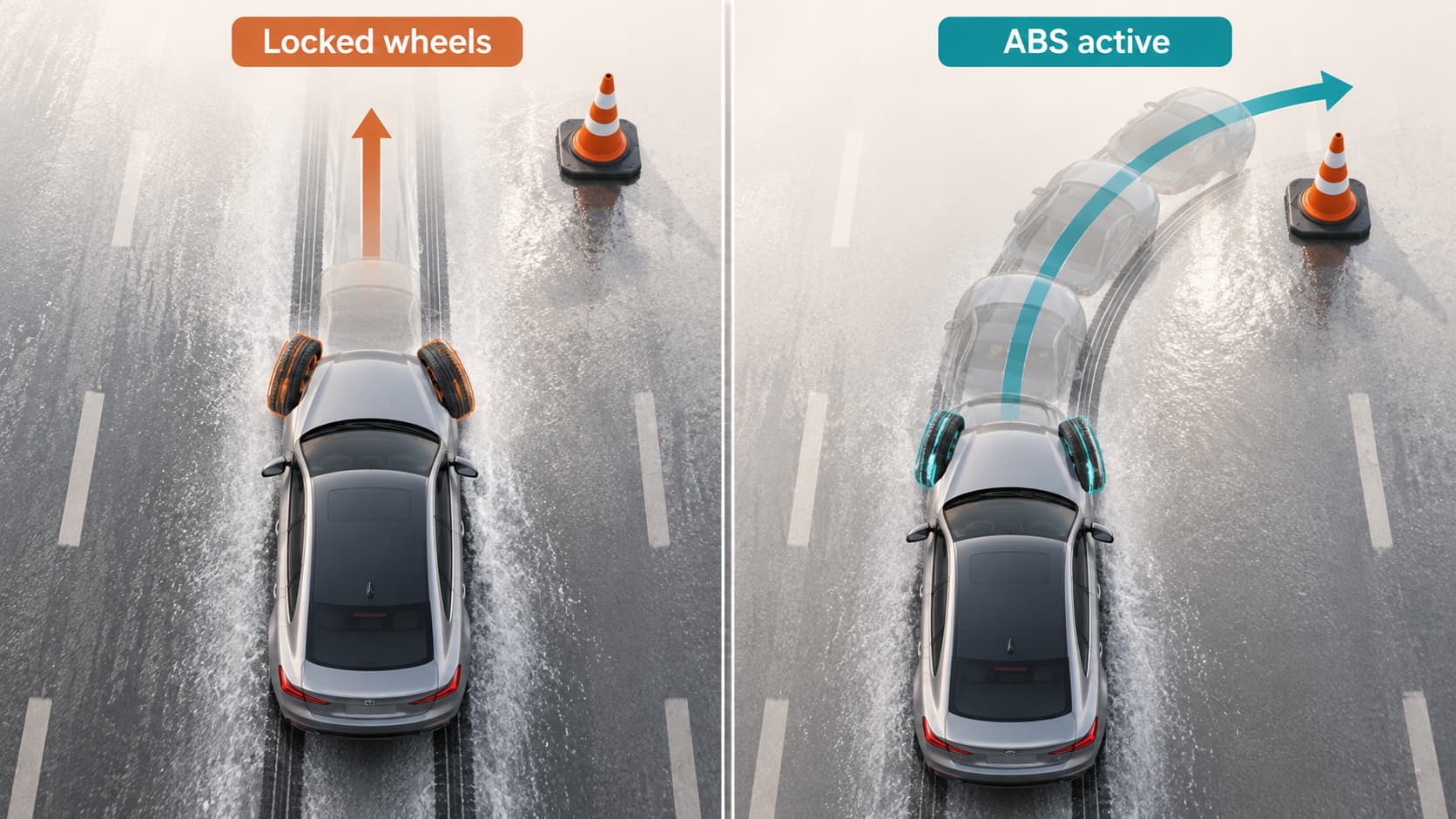
This does not mean you can perform any steering manoeuvre while braking.
The tyres still have limited grip.
If you demand more combined braking and cornering force than the tyres can provide, ABS cannot create additional friction.
NHTSA research describes maintaining directional control while braking hard as a major benefit of ABS, while also emphasizing that the system cannot overcome the physical limits of tyre-road adhesion.
Does ABS Always Make a Car Stop Faster?
No.
This is probably the most important misconception about ABS.
On many firm paved surfaces, ABS can produce very effective braking while keeping the car steerable.
But shortest possible stopping distance under every imaginable condition is not the sole purpose of ABS.
On loose gravel or some snow-covered surfaces, a locked tyre can sometimes push loose material in front of itself and build a wedge that contributes to stopping the vehicle.
ABS prevents sustained lock-up, so this particular effect may not occur to the same extent.
NHTSA material specifically notes that ABS can produce longer stopping distances on certain gravel and snow-covered surfaces.
This is why saying:
"ABS always stops a car sooner"
is inaccurate.
A better statement is:
ABS is designed to control wheel lock, preserve stability and retain useful steering capability while applying strong braking within the available tyre grip.
Stopping distance depends on the road surface, tyres, vehicle, speed and many other factors.
ABS Cannot Create Grip
ABS is impressive, but it cannot change the basic laws of physics.
Suppose your tyres have very little grip because you are travelling on ice.
ABS can prevent them from simply locking and sliding continuously.
It cannot transform ice into dry asphalt.
Likewise, ABS cannot compensate completely for:
- worn tyres
- excessive speed
- hydroplaning
- badly maintained brakes
- unsafe following distance
- extreme steering inputs
- road surfaces with almost no grip
A driver still needs enough distance to stop.
NHTSA guidance makes this point directly: ABS doesn't remove the driver's reaction time and doesn't always reduce stopping distance, so a safe following distance remains necessary.
ABS helps the tyres make better use of the grip that exists.
It cannot manufacture grip that isn't there.
What Happens if One Side of the Road Is Slippery?
This is a particularly useful example of why individual wheel control matters.
Imagine the left wheels of the car are on a wet or icy patch while the right wheels remain on dry asphalt.
The tyres on each side now have very different amounts of grip.
If the same high braking pressure were applied without control, the low-grip wheels could lock long before the others.
Modern ABS can monitor the wheels separately and regulate pressure according to their behaviour.
That helps maintain vehicle stability and allows the higher-grip tyres to continue contributing useful braking force without simply forcing the low-grip wheels into sustained lock.
The exact control strategy varies by vehicle and axle, but modern systems are specifically designed to cope with rapidly changing road friction.
How ABS Connects to Traction Control and Stability Control
ABS began as a braking technology, but the sensors and hydraulic hardware it introduced became useful for much more.
Think about what ABS already has:
- wheel-speed sensors
- an electronic controller
- the ability to change brake pressure at individual wheels
Those are valuable tools for controlling other forms of tyre slip.
Traction control
ABS deals primarily with excessive wheel slip while braking.
Traction control deals with excessive wheel spin while accelerating.
If a driven wheel begins spinning much faster than the others, the system can reduce engine or motor torque and, depending on the vehicle, apply braking to that wheel.
Electronic stability control
Electronic stability control goes further.
In addition to wheel-speed information, it can use sensors that measure:
- steering angle
- vehicle yaw
- lateral acceleration
The system compares where the driver is trying to go with how the vehicle is actually moving.
If the car begins understeering or oversteering significantly, stability control can reduce power and selectively brake individual wheels to create a corrective turning effect.
Bosch describes its Electronic Stability Program as incorporating the functions of ABS and traction control while adding steering-angle and vehicle-motion sensing.
So ABS is no longer an isolated technology.
It forms part of the foundation of the modern vehicle's electronic chassis-control system.
ABS in Electric and Hybrid Cars
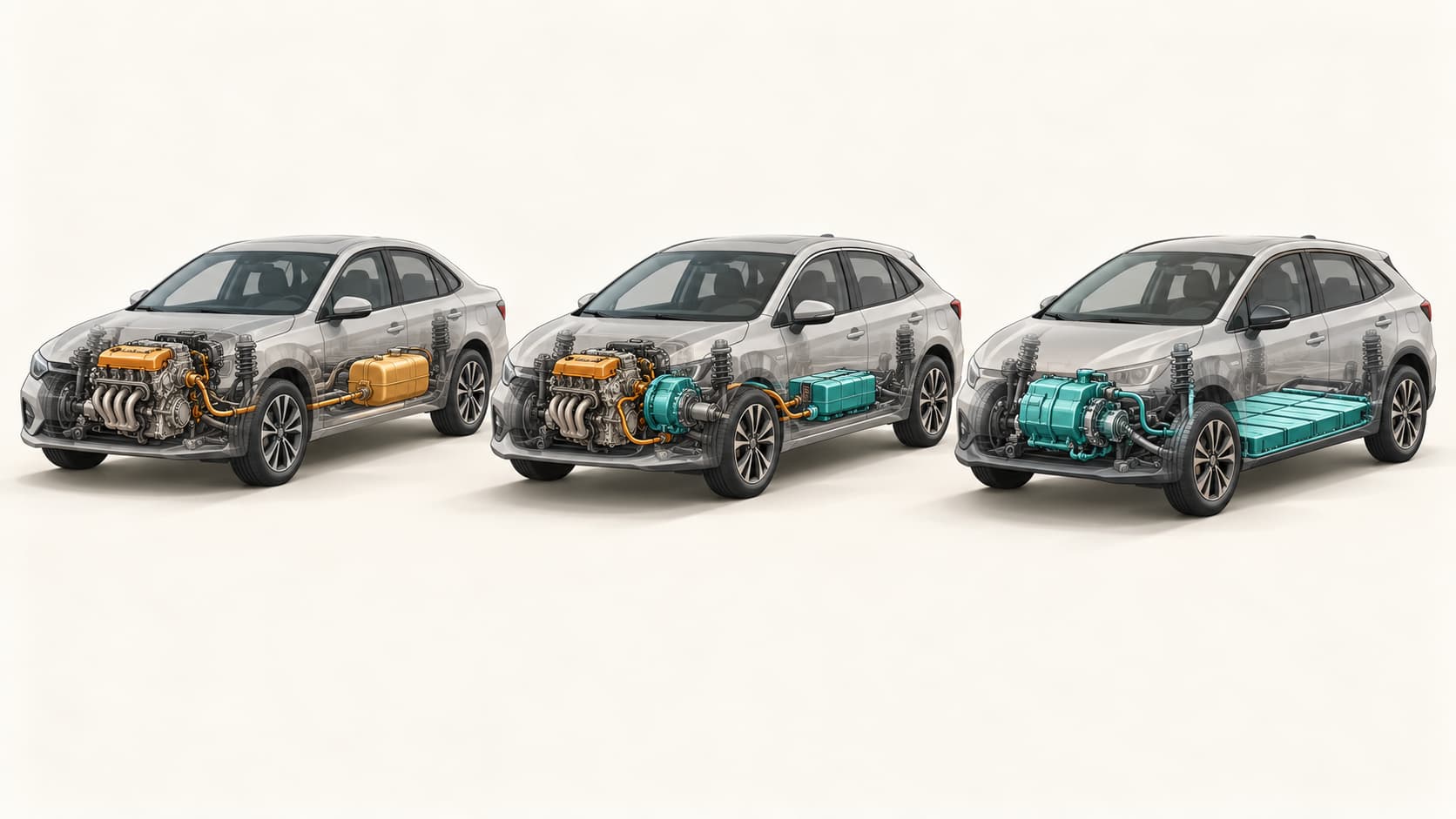
Electric and hybrid vehicles add another complication: regenerative braking.
During regeneration, the electric motor slows the vehicle while returning energy to the battery.
But what happens if a tyre begins approaching lock while regeneration is producing braking force?
Vehicle control systems have to coordinate regenerative and friction braking.
When tyre stability becomes critical, preventing excessive slip takes priority over recovering energy.
Modern brake-control systems therefore integrate conventional hydraulic braking, regenerative braking, ABS and stability-control functions.
Bosch's current brake-control systems specifically support regenerative braking as part of their broader ESP and brake-control architecture.
From the driver's perspective, much of this can happen automatically.
Behind the pedal, however, braking has become a sophisticated coordination problem involving mechanical, hydraulic and electronic systems.
What Does the ABS Warning Light Mean?
When the car starts, you will normally see the ABS warning symbol briefly illuminate along with other dashboard warning lights.
The system performs diagnostic checks and the light should then go out if everything is functioning normally.
If the ABS warning light remains illuminated or appears while driving, there may be a fault in the anti-lock system.
That does not necessarily mean the car has lost all braking ability.
On many vehicles, the conventional hydraulic brakes can continue operating even if ABS has been disabled by a fault.
However, the anti-lock function and possibly related stability or traction-control functions may no longer be available.
The exact behaviour differs by vehicle, so an illuminated warning light should be checked according to the manufacturer's instructions rather than ignored.
ABS Is Really a Feedback System
The easiest way to understand modern ABS is not to think of it as a special kind of brake.
It is a control system managing the brakes you already have.
It continually asks:
How quickly is each wheel rotating?
Is one wheel beginning to slip too much?
Should brake pressure be increased, held or reduced?
Then it acts on the answer and immediately measures the result again.
That feedback loop can continue repeatedly through an emergency stop.
The result is a system that can react to a wet patch beneath one wheel, changing road grip or a sudden emergency much faster than a driver could manually adjust braking force at four separate tyres.
And that is why the familiar pulsing brake pedal during a panic stop isn't the brakes failing.
It can be the opposite.
It is often the sensation of the car rapidly doing something a driver simply could not do alone: controlling the braking force at the wheels while trying to keep the tyres rolling, gripping and steering at the same time.