
Petrol, Diesel, CNG, Hybrid or Electric: Which Car Suits Your Annual Driving?
Compare petrol, diesel, CNG, strong hybrid and electric cars in India using annual kilometres, fuel costs, driving conditions and ownership break-even calculations.
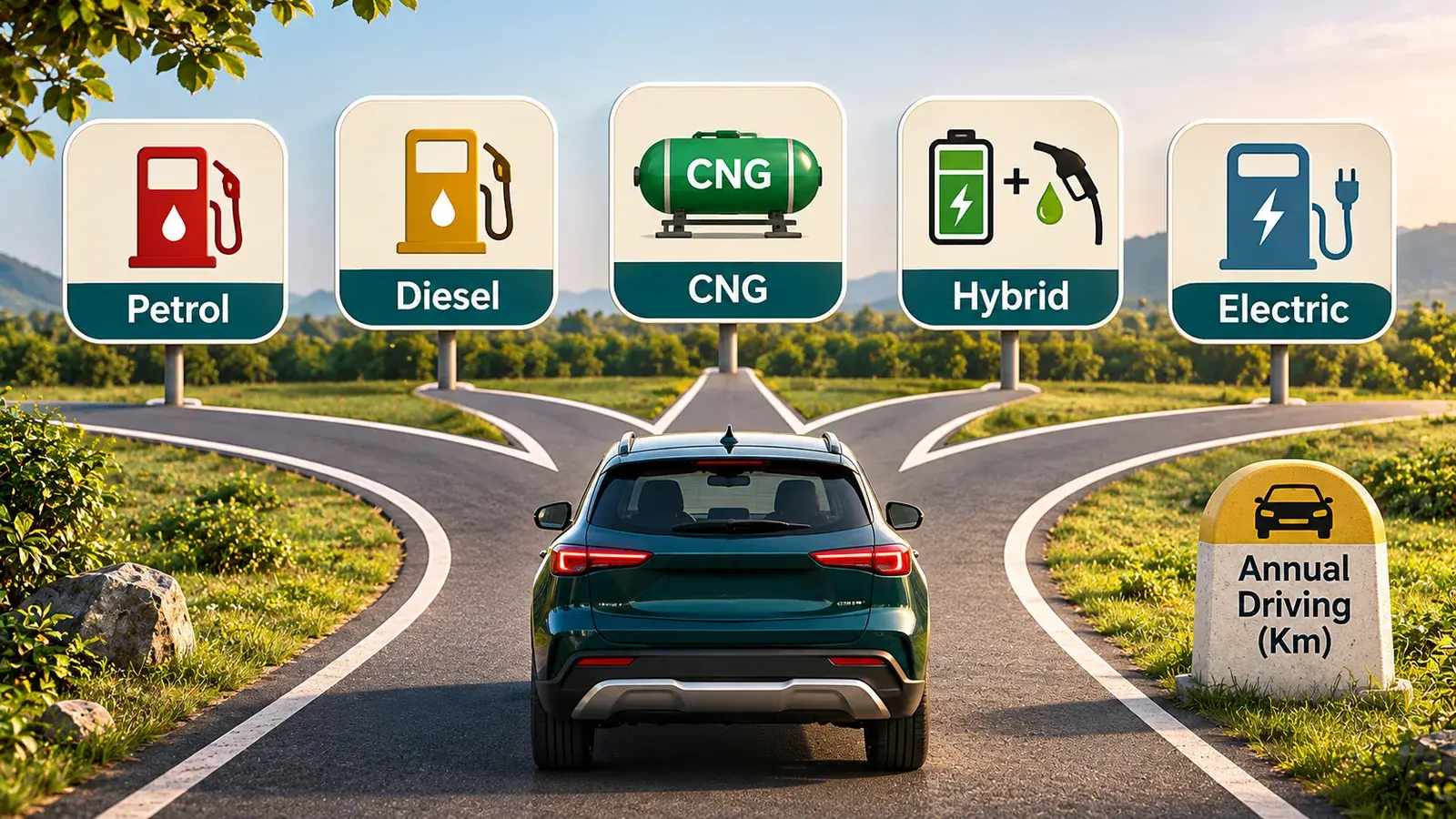
Quick Answer
Choose your car's fuel type based on how far you drive, where you drive, how long you will keep the car and how easily you can refuel or recharge. The cheapest option per kilometre is not necessarily the cheapest car to own.
| Annual driving | Options to shortlist | Best conditions |
|---|---|---|
| Under 5,000 km | Petrol | Occasional trips, low purchase cost |
| 5,000–10,000 km | Petrol, CNG or EV | CNG/EV if the price premium is small and infrastructure is convenient |
| 10,000–20,000 km | CNG, strong hybrid, diesel or EV | Choose according to route and running costs |
| Over 20,000 km | EV, diesel, CNG or strong hybrid | EV with dependable charging; diesel for frequent highways; CNG or hybrid for suitable routes |
These are starting points, not universal mileage thresholds. A low-mileage buyer can still benefit from an affordable EV, while a high-mileage buyer may prefer petrol if alternatives are too expensive or impractical.
Which fuel type fits your driving?
| Type | Choose it when | Main compromise |
|---|---|---|
| Petrol | Driving is occasional or unpredictable | Higher fuel cost in many comparisons |
| Diesel | Frequent long highway journeys, especially in larger cars | Purchase premium, emissions-system maintenance |
| Factory-fitted CNG | Regular driving with convenient CNG stations | Refuelling queues, possible boot-space and power reduction |
| Strong hybrid | Stop-start city driving without plugging in | Higher purchase price; savings vary by route |
| Battery electric (EV) | Predictable commuting and reliable charging | Charging access, journey planning and price premium |
Petrol: Often the simplest financial choice for a lightly used family car. Do not pay a large premium just to save fuel on a few trips each month.
Diesel: Consider for sustained highway driving. Repeated short, slow trips can interfere with diesel particulate filter (DPF) regeneration. Follow the specific car's owner manual rather than assuming every diesel is suitable for short city commutes.
CNG: Check actual CNG station availability along your routes and usable luggage space. Factory-fitted bi-fuel models can also run on petrol; account for that petrol use in your budget.
Strong hybrid: Uses a petrol engine and electric motor, recovering some braking energy. Conventional non-plug-in strong hybrids need no external charging. Mild hybrids generally do not offer the same electric-driving capability or savings.
EV: Especially attractive with dependable home or workplace charging. For highway use, verify realistic range, charging stations, connector compatibility and alternative stops. Public charging may reduce the savings substantially.
Compare running costs per kilometre
The following is an illustrative calculation, not current fuel quotations, certified mileage figures or tested results. Replace these assumptions with your local prices and realistic efficiency for comparable cars.
| Type | Assumed price | Assumed efficiency | Cost/km |
|---|---|---|---|
| Petrol | ₹100/L | 15 km/L | ₹6.67 |
| Diesel | ₹90/L | 20 km/L | ₹4.50 |
| CNG | ₹80/kg | 25 km/kg | ₹3.20 |
| Strong hybrid | ₹100/L | 22 km/L | ₹4.55 |
| EV (home) | ₹8/kWh | 6 km/kWh | ₹1.33 |
| EV (public) | ₹18/kWh | 6 km/kWh | ₹3.00 |
For the EV, efficiency is measured per billed kWh, including assumed charging losses. For CNG, the table excludes any petrol consumed separately.
At 10,000 km per year, these assumptions give annual energy costs of approximately ₹66,700 for petrol, ₹45,000 for diesel, ₹32,000 for CNG, ₹45,500 for strong hybrid, ₹13,300 for home-charged EV and ₹30,000 for public-charged EV. These figures exclude servicing, insurance and other ownership expenses.
Check PPAC, your local CNG supplier, electricity bill and charging operator for applicable rates.
Calculate when the higher price pays off
Cost per km = energy price ÷ real-world efficiency
Fuel-only break-even distance = extra on-road purchase cost ÷ savings per km
Example: A CNG variant costs ₹1 lakh more than an equivalent petrol variant. Using the table, it saves approximately ₹3.47 per km in CNG mode.
- Break-even distance: approximately 28,850 km.
- At 5,000 km/year: about 5.8 years.
- At 10,000 km/year: about 2.9 years.
- At 20,000 km/year: about 1.4 years.
Actual payback may take longer with petrol usage, financing or additional servicing. If savings per kilometre are zero or negative, there is no fuel-only break-even.
Before you book a car
- Compare actual on-road prices for similarly equipped variants, not just advertised starting prices.
- Estimate annual kilometres and your city/highway split. Use realistic mileage rather than brochure figures alone.
- Include loan interest, insurance renewals, scheduled maintenance, tyres, charging installation and expected resale value. Check applicable battery warranties and any subscription or battery rental charges.
- For EVs, confirm parking permission, electrical capacity and charging prices. For CNG, inspect boot space and station convenience.
- Check local registration, taxation and usage restrictions, especially if driving in Delhi-NCR. Rules and enforcement can change; consult your transport authority and CAQM.
Final recommendation: Start with petrol for occasional use, shortlist CNG or strong hybrid for regular city driving, diesel for frequent long-distance journeys, and EV for predictable driving with reliable charging. Then let your own ownership-cost calculation decide between suitable options.
For more background, read EV vs Hybrid vs Petrol Cars: Understanding the Difference. For model suggestions, see Best Hybrid Cars in India.
Sources and useful links
- CEEW — Cost of ownership for India's road transport sector
- NITI Aayog e-AMRIT — Journey cost calculator
- NITI Aayog e-AMRIT — Home charging calculator
- Hyundai — Diesel particulate filter guidance
- Maruti Suzuki — Strong hybrid technology
- Maruti Suzuki — Factory-fitted CNG technology
If you are considering an EV, price the installation as well as the electricity. See the home charging checklist.
At a glance
Petrol
Best for: Occasional or low-mileage driving
Use a petrol variant as the starting point when a fuel-saving upgrade would take years to pay back.
Diesel
Best for: Regular highway use
Check local age and usage rules, the purchase premium and the owner manual’s guidance on regeneration.
Factory-fitted CNG
Best for: Regular routes with convenient CNG stops
Try loading the boot and check station access before using the fuel-only savings in your budget.
Strong hybrid
Best for: Stop-start driving without a plug
Compare the premium on similar trim levels, then use your city and highway mix to estimate payback.
Battery electric
Best for: Repeatable journeys with dependable charging
Include the cost of charging installation and compare home and public rates before estimating savings.