
Electric Car Home Charging Guide: Chargers, Safety and Running Costs
Prepare your home for EV charging in India, choose a compatible charger, check electrical capacity and safety, and estimate charging time and electricity costs.
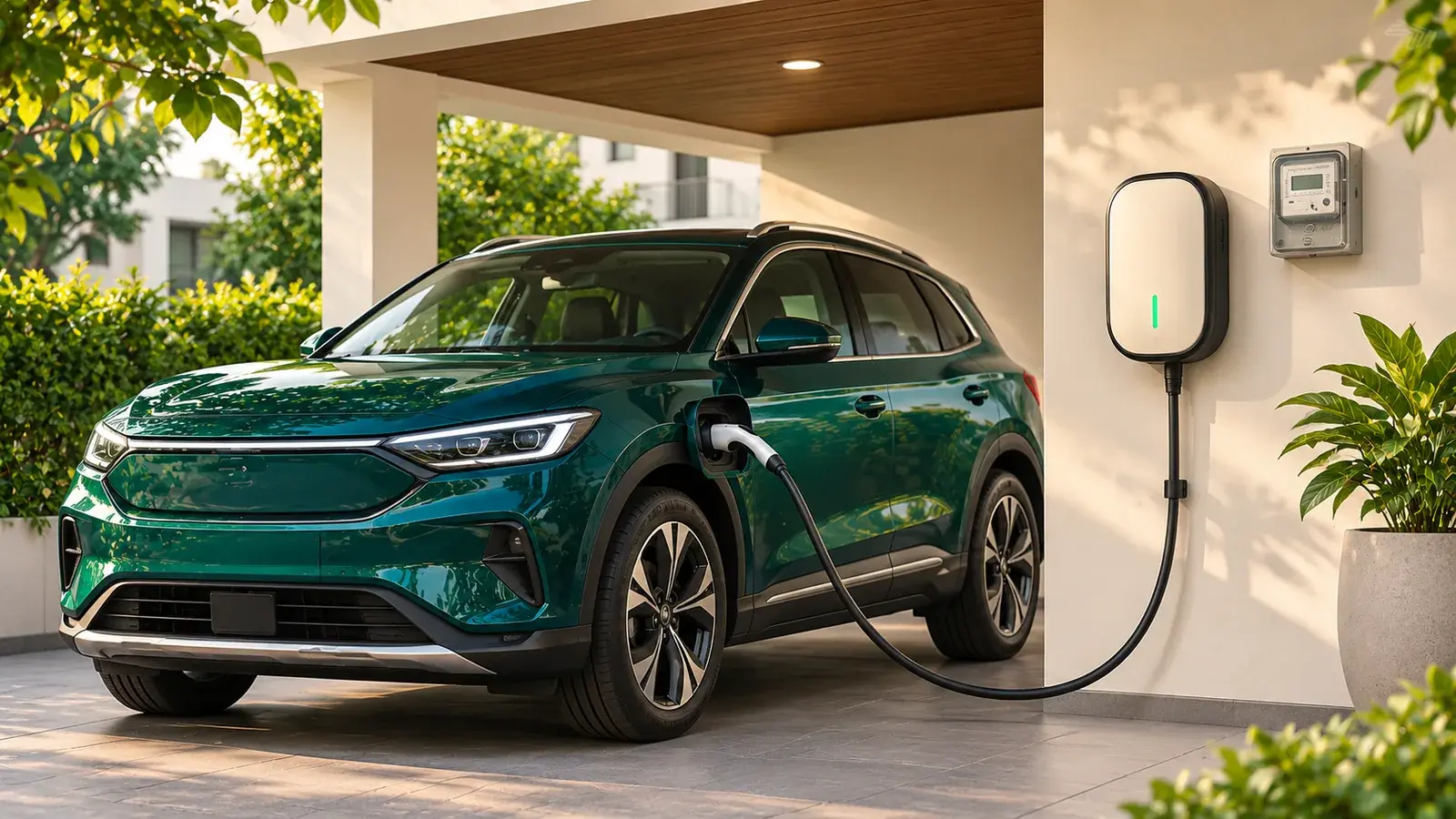
Quick Answer
For modest daily driving in India, a professionally installed 3–3.3 kW AC charging setup can be enough, while a 7.2–7.4 kW wallbox is worth considering for faster overnight top-ups. An 11 kW charger makes sense only if your car, electricity supply and driving needs support it.
Before buying a charger, confirm your car's AC charging limit, parking access, sanctioned electrical load and earthing. Arrange an installation survey before taking delivery of the car.
1. Choose the right home charger
| Charging option | Best suited to | What to check |
|---|---|---|
| Portable AC EVSE (around 2–3 kW) | Modest daily driving | Approved fixed socket, dedicated circuit and manufacturer compatibility |
| 3–3.3 kW AC wallbox | Regular overnight charging | Adequate electrical capacity |
| 7.2–7.4 kW AC wallbox | Larger batteries or frequent driving | Higher available load and vehicle AC limit |
| 11 kW AC wallbox | Faster home charging for compatible cars | Suitable three-phase supply and vehicle support |
| DC fast charger | Primarily public or commercial charging | Generally unnecessary for a normal home |
EVSE means electric vehicle supply equipment. With AC charging, the car's onboard charger converts electricity to DC for the battery. A higher-rated wallbox will not exceed the car's own AC charging limit. Check the connector too: Type 2 is common on modern Indian electric cars, but confirm your exact model.
2. Prepare your parking and electricity supply
Ask the car manufacturer's installation partner or a qualified electrical contractor to check:
- Parking: A designated space within safe cable reach, with protection from flooding, physical damage and unsuitable weather exposure.
- Sanctioned load: The permitted electrical capacity on your electricity bill, accounting for air conditioners, geysers and other simultaneous household loads.
- Supply: Whether your connection and distribution board can support the proposed charging power and phase requirement.
- Installation quote: Charger, wiring distance, protective equipment, earthing, civil work, taxes and any additional load-upgrade costs.
India's Ministry of Power 2024 charging guidelines, sections 15–16, allow residential charging using an existing connection. Apply to your electricity distributor (DISCOM) if the sanctioned load needs increasing. Domestic tariffs apply to ordinary home charging; a separate metered EV connection can also be requested.
For apartments, coordinate cable routing, parking rights, metering, building approvals and common-area safety with your housing society and DISCOM. Consider shared charging if private installation is impractical.
3. Electrical safety checklist
Have the installer provide and test the following under applicable CEA safety regulations and manufacturer requirements:
- A dedicated final circuit with correctly rated wiring and overcurrent protection.
- Effective protective earthing and appropriate residual-current protection, including DC leakage protection as required by the EVSE.
- Suitable surge protection, isolation and weather-rated equipment where required.
- A manufacturer-approved fixed outlet if using a portable EVSE; an ordinary socket is not automatically suitable for sustained EV charging.
Never use extension boards, travel adapters, improvised wiring or loose sockets. Do not install a wallbox yourself unless professionally qualified. Keep the cable clear of vehicle wheels and walkways. Stop charging if you notice overheating, burning smells, damaged cables or repeated breaker trips; have the installation inspected before restarting. Do not repeatedly reset a tripping breaker.
4. How long does home charging take?
Estimated hours = energy added to the battery (kWh) ÷ charging efficiency ÷ actual AC input power (kW).
Example: a car with 40 kWh usable battery capacity charging from 20% to 80% needs 24 kWh stored energy. Assuming 90% charging efficiency:
| Actual AC input power | Approximate time |
|---|---|
| 3.3 kW | 8.1 hours |
| 7.2 kW | 3.7 hours |
| 11 kW | 2.4 hours |
These are illustrative estimates, not manufacturer promises. Charging limits, temperature, battery management and supply conditions can change the result. You usually need to replace only the energy used that day, not recharge the entire battery.
5. Calculate home-charging running costs
One electricity unit equals one kWh. Use the additional per-unit rate applicable to your electricity consumption, including relevant variable charges and slab changes.
Example assumptions: ₹8 per unit, 6 km per kWh of battery energy, 90% charging efficiency and 1,000 km monthly driving.
| Calculation | Estimated result |
|---|---|
| Battery energy used | 166.7 kWh/month |
| Electricity drawn from the meter | 185.2 units/month |
| Additional energy cost | ₹1,481/month |
| Electricity cost per kilometre | ₹1.48/km |
These are assumed values, not current nationwide tariffs. Fixed charges, installation costs and public charging are excluded. A charger energy meter can help you track actual consumption. Try NITI Aayog's home charging calculator for another estimate.
6. Before taking delivery of your EV
- Confirm whether the charger and standard installation are included in the car price.
- Obtain a site survey and written quote for any extra work.
- Complete required approvals and load upgrades.
- Ask the installer to demonstrate safe charging, status indicators and fault handling.
- Set charging schedules if your tariff makes them useful; follow the vehicle manufacturer's battery charge-limit guidance.
- Identify a nearby public charger as a backup.
Bottom line: Choose the lowest charging power that comfortably replaces your daily energy use. A safe, dependable installation matters more than the fastest charger.
Related reading: EV vs Hybrid vs Petrol Cars: Understanding the Difference.
References
- Ministry of Power — Guidelines for Installation and Operation of Electric Vehicle Charging Infrastructure, 17 September 2024, sections 6, 15 and 16.
- Central Electricity Authority — Chief Electrical Inspectorate, notified safety regulations and amendments.
- Mahindra — BE 6 owner manual, charging section.
- Mahindra — Home and public charging information.
- NITI Aayog — e-AMRIT home charging calculator.
Use the real-world EV range explainer to estimate the kilometres your daily charge needs to cover.