
How to Remove Hypothecation From Your Car's RC After Loan Repayment
Learn how to remove a bank or finance company's hypothecation entry from your car's RC in India, including Form 35, lender NOC, VAHAN steps and applicable fees.
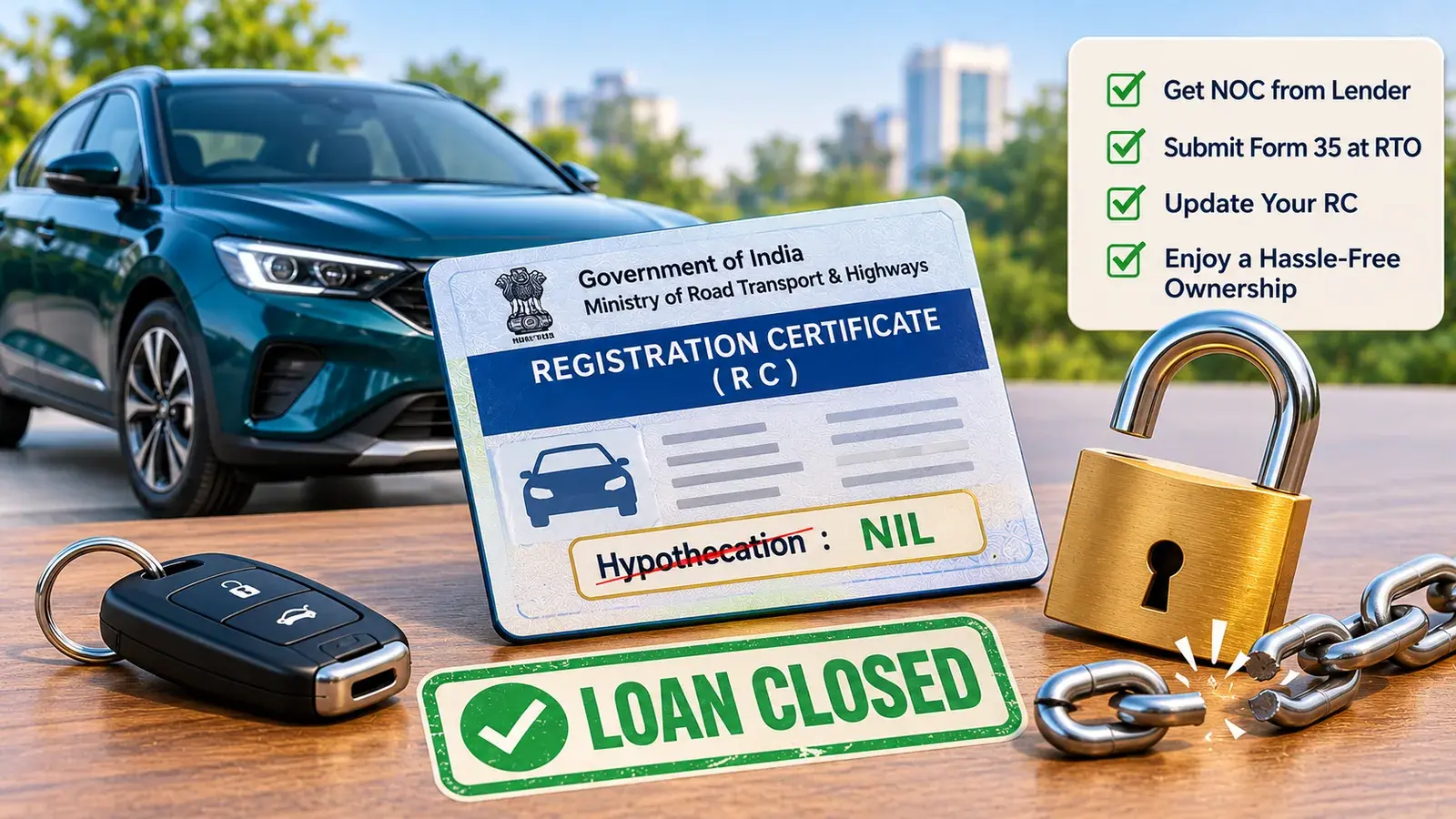
Quick Answer
Paying your final car loan EMI does not necessarily remove the lender's name from your Registration Certificate (RC). You must ensure that the hypothecation entry is cancelled in the vehicle registration records.
| Step | What to do |
|---|---|
| 1 | Confirm that the loan is fully repaid and closed. |
| 2 | Obtain the lender's NOC or due-clearance certificate and signed Form 35, or the accepted electronic equivalent. |
| 3 | Apply for Hypothecation Termination on VAHAN or through your registering authority. |
| 4 | Complete document verification and pay any applicable charges. |
| 5 | Verify the updated RC and inform your insurer. |
Fee note: The central fee schedule waives a separate hypothecation cancellation fee. Other applicable state or service charges may vary.
1. Collect the documents from your lender
Hypothecation records the lender's security interest in your car while you retain possession. After full repayment, ask your bank or finance company for the documents needed to release that interest.
| Document | Purpose |
|---|---|
| Form 35 | Joint notice of termination signed by the registered owner and financier. |
| Lender NOC / due-clearance certificate | Confirms clearance of loan dues and supports removal of the charge. |
| Loan closure statement | Useful evidence of the final balance and closure date. |
| Existing RC | Identifies the vehicle and recorded financier. |
| Valid insurance | Required supporting vehicle document. |
Keep your address proof, PAN or applicable alternative, PUC certificate and vehicle allotment letter ready if requested. Some RTOs also require chassis or engine impressions and signature verification. Check the local document list.
Use the Form 35 PDF hosted by Delhi Transport as a reference and confirm your RTO's accepted submission process. For paper applications, the form calls for two copies, or three where the original registering authority differs. Check that the registration number and lender details are correct. Ask about any acceptance period for the lender's NOC rather than assuming a universal expiry date.
2. Apply online through VAHAN
- Visit the official VAHAN vehicle services portal.
- Select your state or vehicle service jurisdiction as prompted and enter your registration details.
- Complete the required chassis-number and mobile OTP or other authentication checks.
- Choose Hypothecation Termination (HP Termination).
- Confirm the financier details, enter insurance information and upload the required documents where supported.
- Review the application and itemised fee details. Pay applicable charges, if any, and save the acknowledgement.
- Book an appointment or submit originals to the RTO if instructed.
The exact screens and verification methods vary by state. Some transactions may be faceless; others require an office visit. If your lender has initiated a digital release, check its status before submitting a duplicate application.
If online services are unavailable or your vehicle details are incorrect, contact the registering authority for the manual process.
3. How much does hypothecation removal cost?
Under Rule 81 of the Central Motor Vehicles Rules, as amended by G.S.R. 1183(E) of 29 December 2016:
| Fee component | Central fee position |
|---|---|
| Cancellation of hypothecation | No separate fee |
| Fresh RC issued following cancellation | No separate fee |
| Usual ₹200 smart-card surcharge | Exempt for this replacement RC |
Do not confuse the ₹1,500 central fee for adding hypothecation to a light motor vehicle with the fee for removing it.
The amount payable may differ if separately authorised state service, delivery or other applicable charges appear. Additional transactions, such as an ownership transfer, may have their own fees. Ask the RTO for a breakdown if a charge appears inconsistent with the schedule.
4. What if the lender delays the NOC?
For covered personal loans, RBI's responsible lending directions require regulated lenders to return original property documents and complete charge-release obligations within 30 days of repayment or settlement. Where the qualifying delay is attributable to the lender, compensation is ₹5,000 per day beyond the prescribed period, subject to the applicable conditions. Special provisions apply if original documents are lost or damaged.
This is not a guaranteed 30-day RTO processing deadline. Complete any owner-side formalities promptly.
Complain in writing to the lender, keeping your loan closure proof and complaint reference. If the response is unsatisfactory or the applicable response period has elapsed, eligible complaints can be escalated through RBI CMS.
5. Verify that the process is complete
- Track your application using the acknowledgement number on VAHAN.
- Check the updated official RC record or digital RC: the previous financier should no longer be listed as an active hypothecation.
- Request correction from the RTO if the application is approved but the record still shows the charge.
- Ask your motor insurer to remove the financier endorsement from your policy and retain the revised document.
- Keep your loan closure proof, NOC, Form 35 and updated RC. Check your credit report separately for correct loan closure reporting.
Complete these steps before selling or exchanging the car wherever possible. A lender's NOC alone is not proof that the RC has been updated.
For background, see how hypothecation works in secured lending.
Official sources and useful links
- mParivahan — Hypothecation termination
- Delhi Transport — Rule 61 Form 35 (PDF)
- VAHAN — Vehicle services
- VAHAN — Official hypothecation termination user manual
- Gazette amendment G.S.R. 1183(E) — Rule 81 fee schedule
- Telangana Transport — Rule 81 fee schedule
- RBI — Commercial Banks Responsible Business Conduct Directions, 2025, paragraphs 354–360
- RBI — NBFC Responsible Business Conduct Directions, 2025, paragraphs 35–41
- RBI — Ombudsman complaint FAQs
For the loan statement, repayment mandate and credit report, use the loan closure checklist.