
Security for Loans: Collateral, Pledge, Hypothecation, Mortgage and Lien
Security for Loans: Collateral, Pledge, Hypothecation, Mortgage and Lien. A detailed chapter in Lending, Credit & Interest Rates, with explanations and examples for Indian banking examinations.
By Akhilesh Saini · Reviewed 7 Oct 2026
1. What is security?
Security is an asset, right or legal arrangement that supports repayment of a loan.
If the borrower defaults, the lender may be able to enforce the security subject to law.
Security reduces expected loss, but does not eliminate credit risk.
2. Secured vs unsecured loan
Secured loan
Backed by security.
Examples:
- home loan secured by mortgage;
- car loan secured by hypothecation;
- gold loan secured by pledge;
- loan against FD secured by lien.
Unsecured loan
No specific asset is charged as collateral/security.
Examples can include:
- personal loan;
- some credit-card exposure;
- clean business loan.
Unsecured does not mean:
borrower has no legal repayment obligation.
The borrower still owes the debt.
3. Primary security vs collateral security
Primary security
The asset created/purchased from the loan or the asset directly associated with the financed activity.
Example:
machinery financed by a machinery loan.
Collateral security
Additional security offered over and above the primary security.
Example:
a residential property mortgaged as extra security for a business loan.
In everyday language, people often use "collateral" to mean all security.
In banking appraisal, primary and collateral security can be distinguished.
4. Charge
A charge is a legal interest/encumbrance created over an asset to secure debt.
Security interests can arise through:
- pledge;
- hypothecation;
- mortgage;
- assignment;
- lien;
- statutory charge.
5. Pledge
Under the Indian Contract Act, a pledge is the bailment of goods as security for payment of debt or performance of a promise.
The most exam-relevant feature is:
possession of the pledged movable goods is delivered to the lender/pawnee or controlled on its behalf.
Examples:
- gold ornaments pledged for gold loan;
- certain securities pledged;
- goods under pledge finance.
6. Pledge example
Borrower pledges gold to bank.
- Ownership remains with borrower.
- Possession/control of gold is with bank.
- Bank grants loan.
- If borrower repays, gold is returned.
- If borrower defaults, bank can enforce according to law/procedure.
7. Hypothecation
The SARFAESI Act defines hypothecation broadly as a charge over movable property created in favour of a secured creditor without delivery of possession.
This is the key distinction.
Examples:
- vehicle loan;
- stock;
- machinery;
- book debts/receivables;
- movable business assets.
The borrower usually keeps possession and continues using the asset.
8. Hypothecation example
Borrower buys a car with bank finance.
- Car remains with borrower.
- Bank's charge is recorded.
- Borrower uses vehicle.
- On default, bank can enforce security under applicable law.
9. Pledge vs hypothecation
| Pledge | Hypothecation |
|---|---|
| Movable goods/security | Movable property |
| Possession with lender / under lender control | Possession remains with borrower |
| Stronger physical control | Lender relies more on legal charge and monitoring |
| Example: gold loan | Example: vehicle loan |
Memory rule
Pledge = possession passes. Hypothecation = possession stays.
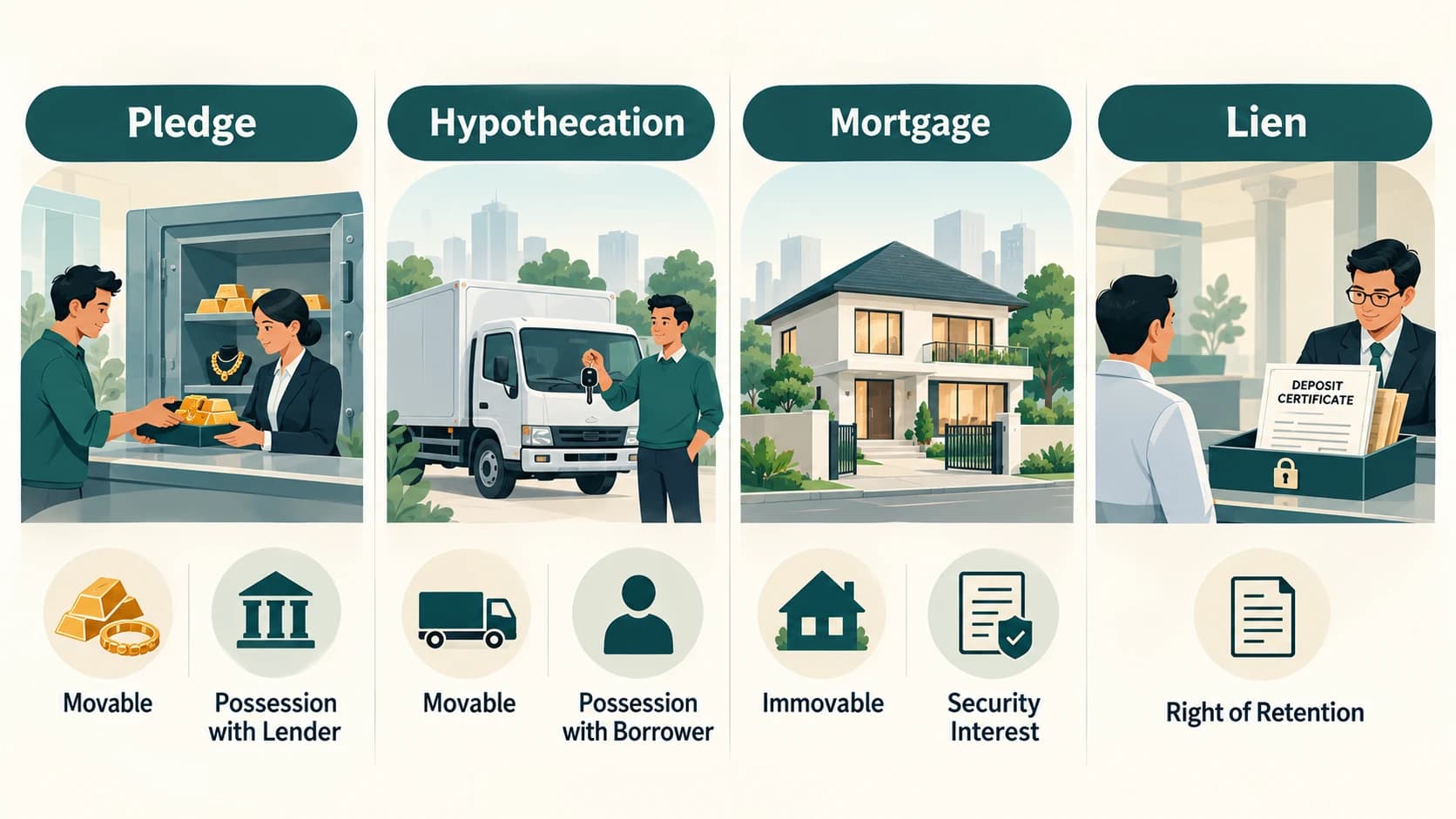
10. Mortgage
Section 58 of the Transfer of Property Act defines a mortgage as transfer of an interest in specific immovable property for securing payment of money/debt.
The borrower/mortgagor does not normally transfer full ownership.
Instead, a security interest is created in the property.
Typical example:
home loan.
11. Mortgage example
Property value = ₹80 lakh.
Home loan = ₹60 lakh.
Bank creates mortgage over property.
Borrower remains owner/occupier subject to mortgage.
If default becomes enforceable, lender can exercise rights according to mortgage and recovery law.
12. Mortgage is not a sale
A mortgage transfers a security interest, not necessarily absolute ownership.
That distinction is fundamental.
The borrower remains the owner subject to the mortgage.
13. Types of mortgage
The Transfer of Property Act recognises several forms.
For Banking Awareness, commonly discussed forms include:
- simple mortgage;
- mortgage by conditional sale;
- usufructuary mortgage;
- English mortgage;
- mortgage by deposit of title deeds;
- anomalous mortgage.
Banks frequently use mortgage by deposit of title deeds / equitable-mortgage style arrangements where legally applicable.
Detailed property law is beyond this module.
14. Lien
A lien is a right to retain property/security until a debt/obligation is discharged.
Section 171 of the Indian Contract Act recognises the general lien of bankers, subject to contract and law.
A banker's lien is particularly important for assets/securities held by the bank.
15. Lien vs pledge
A pledge is a specific security arrangement created for debt/performance.
A lien is a right of retention.
Both may involve possession, but they are not identical legal concepts.
16. Loan against fixed deposit
When a bank lends against its own FD, it normally marks a lien on the deposit.
The bank has control over repayment from the deposit if the borrower defaults.
This is why such loans are often low-risk and priced below unsecured personal loans.
17. Assignment
Assignment transfers a right or receivable to the lender as security.
Examples can include:
- life-insurance policy rights;
- receivables;
- contract proceeds;
- book debts.
The borrower transfers/assigns the relevant claim/right according to documentation.
18. Guarantee as secondary support
A guarantee is a promise by a third party to pay/perform if the borrower fails.
A guarantor creates an additional legal source of repayment.
Guarantee is different from collateral:
- collateral = asset/security;
- guarantee = personal/legal promise by another party.
19. Personal guarantee vs corporate guarantee
Personal guarantee
Individual promises repayment.
Corporate guarantee
Company guarantees obligation of another borrower/entity.
Both create contingent exposure for the guarantor.
20. Margin and security value
Suppose asset value = ₹100.
Bank lends = ₹70.
Margin = ₹30.
The lender does not assume asset value will remain unchanged.
Therefore lenders use:
- margin;
- valuation;
- haircut;
- insurance;
- periodic inspection.
21. Haircut
A haircut is a reduction applied to market value when determining eligible security value.
Example:
Market value of security = ₹100.
Haircut = 20%.
Recognised value = ₹80.
This protects against price volatility and liquidation costs.
22. Valuation risk
Collateral can lose value.
Examples:
- property market falls;
- stock prices decline;
- machinery becomes obsolete;
- inventory deteriorates.
This is why a bank cannot rely only on collateral.
23. Security perfection
Creating a security agreement is not always enough.
The lender may need to perfect the security by:
- registration;
- filing;
- possession;
- notation;
- charge registration;
- title verification.
Perfected security improves enforceability and priority.
24. CERSAI
CERSAI is the Central Registry of Securitisation Asset Reconstruction and Security Interest of India.
Security interests are registered in CERSAI under applicable law/rules.
This helps:
- reduce multiple financing/fraud;
- provide notice of existing security;
- support enforcement.
Detailed SARFAESI/CERSAI treatment belongs in Module 07.
25. Security is not insurance
Collateral reduces credit loss if default occurs.
Insurance protects against specified insured events.
Example:
home loan:
- mortgage protects bank's debt claim against property;
- property insurance protects against specified physical loss.
They serve different purposes.
26. Guarantor is not a nominee
A guarantor promises repayment on default.
A nominee is associated with succession/claim settlement.
They are completely different roles.
27. Common security map
| Security concept | Asset type | Possession |
|---|---|---|
| Pledge | Movable goods/securities | With lender/control |
| Hypothecation | Movable assets | With borrower |
| Mortgage | Immovable property | Usually borrower retains possession depending on type |
| Lien | Asset/security retained by lender | Lender has possession/control |
| Assignment | Right/receivable/policy | Right transferred/assigned |
Quick check - BA-06-02
- What is the key difference between pledge and hypothecation?
- Which security concept is mainly associated with immovable property?
- What does banker's lien mean?
- Is a guarantor the same as collateral?
- Why does a bank apply margin/haircut to security?
- What does CERSAI record?
Quick answers
- Pledge involves delivery/control of possession; hypothecation leaves possession with borrower.
- Mortgage.
- Bank's right to retain certain property/security until dues are discharged, subject to law/contract.
- No.
- To protect against value fluctuations and liquidation risk.
- Security interests/charges under the applicable legal framework.