
Lending Basics and the Credit Process
Lending Basics and the Credit Process. A detailed chapter in Lending, Credit & Interest Rates, with explanations and examples for Indian banking examinations.
By Akhilesh Saini · Reviewed 7 Oct 2026
1. Why do banks lend?
Banks perform financial intermediation.
They receive funding through sources such as:
- deposits;
- borrowings;
- capital; and
- other liabilities.
They then deploy funds into assets such as:
- loans and advances;
- Government securities;
- other permitted investments;
- cash and reserves.
For most commercial banks, lending is one of the principal sources of:
- interest income;
- customer relationships; and
- economic intermediation.
But lending also creates credit risk.
That is why a bank cannot lend purely because a customer asks for money.
2. What is credit?
Credit is the provision of funds or financial accommodation today against an obligation to pay or perform in the future.
A credit facility may involve:
- direct disbursement of money;
- permission to overdraw;
- purchase/discounting of receivables;
- a bank guarantee;
- a letter of credit; or
- another contingent commitment.
So:
all credit is not necessarily a cash loan.
3. Loan vs advance vs credit facility
These terms overlap in banking practice, but a useful distinction is:
Loan
A definite amount is sanctioned/disbursed, usually with a repayment schedule.
Example:
home loan of ₹40 lakh for 20 years.
Advance
A broader banking term that includes many forms of credit extended by banks.
"Loans and advances" is a common balance-sheet/regulatory phrase.
Credit facility
The widest term.
It includes both:
- fund-based facilities; and
- non-fund-based facilities.
4. Why does a bank appraise a loan?
The bank wants to answer one central question:
Can and will this borrower repay according to the agreed terms?
To answer that, the bank evaluates:
- purpose;
- income/cash flow;
- existing obligations;
- repayment capacity;
- credit history;
- business risk;
- management quality;
- security;
- legal enforceability;
- loan structure;
- economic conditions.
Security matters, but repayment capacity is normally more important.
A bank does not ideally make a loan because:
"There is enough property to sell if everything goes wrong."
The first source of repayment should be the borrower's operating cash flow or income.
5. The classic credit principles
Traditional lending language often uses the "Cs of credit".
Different books list different numbers, but a practical framework includes:
Character
Does the borrower have a history of responsible repayment and honest conduct?
Capacity
Can income/cash flow support repayment?
Capital
How much of the borrower's own money is invested?
Collateral
What security supports the exposure?
Conditions
What economic, industry and loan-specific conditions affect risk?
These are not statutory formulas, but they are useful underwriting concepts.
6. Primary source of repayment
For an individual:
- salary;
- business income;
- professional income;
- rental income where accepted; and
- other sustainable cash flows
can support repayment.
For a business:
- operating cash flow;
- receivables;
- profits;
- project cash generation
are central.
Collateral is normally the secondary source of repayment.
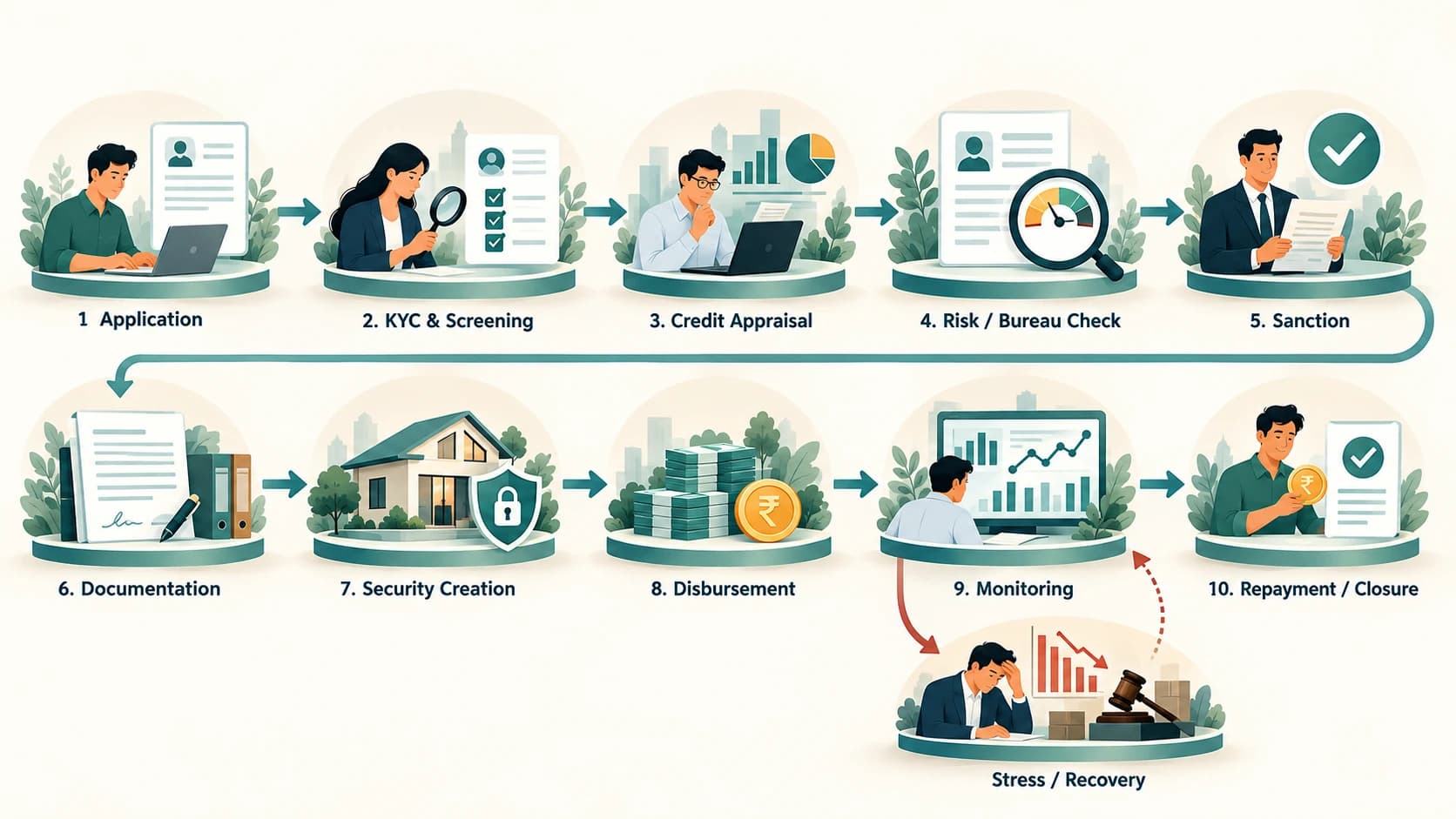
7. The credit process
A simplified bank credit process is:
Application
↓
KYC and initial screening
↓
Credit appraisal
↓
Risk assessment / credit score / bureau check
↓
Sanction decision
↓
Documentation
↓
Security creation / perfection
↓
Disbursement
↓
Monitoring
↓
Repayment / renewal / review
↓
Closure or recovery
Each stage has a different purpose.
8. Loan application
The borrower provides information such as:
- identity;
- address;
- income;
- business details;
- loan purpose;
- required amount;
- existing borrowings;
- collateral/security;
- bank statements;
- financial statements;
- tax records;
- quotations/invoices where relevant.
The exact documents depend on the loan type.
9. KYC is not the same as credit appraisal
KYC asks:
Who is the customer and what is the nature of the relationship?
Credit appraisal asks:
Is this borrower creditworthy and is the proposed loan viable?
A borrower can pass KYC and still be denied credit.
Likewise, a good credit score does not replace KYC.
10. Credit appraisal
The bank evaluates the borrower and proposal.
For individuals, common factors include:
- income;
- employment/business stability;
- age;
- debt obligations;
- loan-to-value;
- credit history;
- repayment behaviour.
For businesses:
- turnover;
- profitability;
- cash flow;
- leverage;
- working-capital cycle;
- management;
- industry risk;
- project viability;
- collateral;
- banking conduct.
11. Credit underwriting
Underwriting is the decision process through which the lender assesses risk and decides:
- whether to lend;
- how much to lend;
- at what price;
- for what tenor;
- on what security;
- with what covenants.
Underwriting is broader than simply checking a score.
12. Sanction
If approved, the lender issues a sanction.
A sanction can specify:
- amount;
- purpose;
- rate;
- benchmark/spread;
- tenure;
- repayment;
- margin;
- security;
- guarantor;
- insurance requirements;
- covenants;
- conditions before disbursement.
Sanction is not always the same as disbursement.
13. Sanction vs disbursement
A loan can be sanctioned but not yet disbursed.
Before disbursement, the borrower may need to complete:
- loan agreement;
- mortgage/charge creation;
- insurance;
- contribution/margin;
- documentation;
- verification.
Only after conditions are satisfied does money move.
14. Documentation
Loan documentation creates legal evidence of:
- debt;
- repayment obligation;
- interest;
- security;
- rights;
- default consequences;
- covenants.
Typical documents may include:
- loan agreement;
- demand promissory note where applicable;
- hypothecation agreement;
- mortgage documents;
- guarantee;
- assignment;
- undertaking;
- declarations;
- security filings.
15. Margin
Margin is the part of asset/project cost funded by the borrower rather than the lender.
Example:
Car price = ₹10 lakh.
Bank finances = ₹8 lakh.
Borrower contributes = ₹2 lakh.
Margin = 20%.
Margin reduces the lender's exposure and ensures borrower stake.
16. Loan-to-Value - LTV
LTV compares loan amount to value of collateral/asset.
Formula:
LTV = Loan Amount ÷ Value of Asset × 100
Example:
Loan = ₹60 lakh.
Property value = ₹80 lakh.
LTV = 75%.
A lower LTV generally gives the lender a larger collateral cushion.
17. EMI
EMI stands for Equated Monthly Instalment.
It contains:
- principal; and
- interest.
In an amortising loan, early EMIs often contain a larger interest component because outstanding principal is higher.
Over time:
- principal outstanding falls;
- interest component generally falls;
- principal component rises.
18. Reducing-balance interest
Most bank loans calculate interest on the outstanding principal.
If principal falls after repayment:
interest is calculated on a lower balance.
This differs from a simplistic "flat rate" presentation where interest is calculated on original principal across the whole tenure.
Borrowers should compare APR/effective cost, not marketing rate alone.
19. Term loan
A term loan is sanctioned for a fixed amount and generally repaid over a defined period.
Examples:
- home loan;
- vehicle loan;
- machinery loan;
- education loan;
- project term loan.
20. Cash credit
Cash credit is commonly used for working capital.
A bank sanctions a limit.
The borrower can draw within:
- sanctioned limit; and
- drawing power,
subject to terms.
Interest is generally charged on the amount actually utilised, not simply the full sanctioned limit.
21. Drawing power
Drawing power is the amount a borrower is permitted to draw based on eligible current assets/security after applying margin and other rules.
Example:
Eligible stock/receivables = ₹100 lakh.
Required margin = 25%.
Drawing power ≈ ₹75 lakh.
If sanctioned limit is ₹80 lakh:
actual drawing ability may be limited to ₹75 lakh.
22. Overdraft
An overdraft allows a customer to draw more than the balance in an account up to a sanctioned limit.
It may be:
- secured; or
- unsecured.
Examples:
- OD against FD;
- business OD;
- salary overdraft.
23. Working capital vs term finance
Working capital
Finances day-to-day operations.
Examples:
- stock;
- receivables;
- operating cycle.
Term finance
Finances longer-term assets/projects.
Examples:
- machinery;
- property;
- vehicle;
- plant expansion.
24. Loan review and monitoring
Credit risk does not end after disbursement.
Banks monitor:
- repayments;
- account turnover;
- financial statements;
- stock statements;
- insurance;
- collateral value;
- covenant compliance;
- credit bureau data;
- conduct with other lenders;
- early-warning signals.
A loan can be good on day one and deteriorate later.
25. Renewal vs review
Certain running facilities such as cash credit are periodically:
- reviewed;
- renewed;
- reassessed.
The bank may revise:
- limit;
- pricing;
- margin;
- security;
- covenants.
Term loans may not require annual "renewal" in the same way, though they remain subject to monitoring.
26. Loan closure
A loan closes when:
- principal;
- interest;
- charges; and
- other dues
are fully paid/settled and the lender completes closure formalities.
For secured personal loans, RBI's responsible-lending framework requires timely:
- return of original property documents; and
- removal/satisfaction of registered charges.
Quick check - BA-06-01
- What is the bank's primary expected source of loan repayment?
- What is the difference between sanction and disbursement?
- What does LTV measure?
- What is drawing power?
- How is cash credit different from a term loan?
- Is collateral normally a substitute for repayment capacity?
Quick answers
- Borrower's sustainable income/cash flow.
- Sanction approves the facility; disbursement actually releases funds after conditions are met.
- Loan amount relative to asset/collateral value.
- Amount that may be drawn based on eligible security/current assets after margin and rules.
- Cash credit is a running working-capital limit; term loan is fixed-tenor finance.
- No.