
Deposit Insurance and DICGC
Deposit Insurance and DICGC. A detailed chapter in Deposits & Bank Accounts, with explanations and examples for Indian banking examinations.
By Akhilesh Saini · Reviewed 7 Oct 2026
1. Why deposit insurance exists
Banks operate with fractional reserves and transform short-term deposits into longer-term loans and investments.
Even a fundamentally sound banking system can suffer panic if depositors believe they may lose everything when a bank fails.
Deposit insurance helps:
- protect small depositors;
- reduce panic;
- strengthen trust; and
- support financial stability.
2. What is DICGC?
DICGC stands for:
Deposit Insurance and Credit Guarantee Corporation
It is a wholly owned subsidiary of the Reserve Bank of India.
Its most exam-relevant role is:
insuring eligible bank deposits up to the statutory ceiling.
3. What deposits are insured?
DICGC insures eligible bank deposits such as:
- savings deposits;
- current deposits;
- fixed deposits;
- recurring deposits;
- other eligible deposit balances.
The cover applies to principal plus interest, subject to the insurance ceiling.
4. Which banks are insured?
DICGC covers:
- commercial banks;
- branches of foreign banks operating in India;
- Local Area Banks;
- Regional Rural Banks; and
- covered co-operative banks.
DICGC states that all eligible co-operative banks are currently covered.
Primary co-operative societies themselves are not insured as banks under DICGC merely because they accept member funds.
5. What deposits are excluded?
DICGC does not insure categories such as:
- deposits of foreign Governments;
- deposits of Central/State Governments;
- inter-bank deposits;
- deposits received outside India; and
- amounts specifically exempted with RBI approval.
This is why "every deposit everywhere is insured" is incorrect.
6. Insurance ceiling
The current DICGC ceiling is:
₹5 lakh
per depositor per bank in the same right and same capacity.
The ₹5 lakh includes:
- principal; plus
- interest
up to the relevant cut-off date under the insurance event.
7. ₹5 lakh is per depositor per bank, not per account
Suppose A has in the same bank:
- Savings account: ₹2 lakh
- FD: ₹3 lakh
- RD: ₹1 lakh
Total:
₹6 lakh.
If all are held in the same right and same capacity:
maximum insured amount = ₹5 lakh, not ₹5 lakh per account.
8. Different branches of the same bank
Deposits in different branches of the same bank are aggregated.
Example:
Branch X FD = ₹3 lakh
Branch Y savings = ₹3 lakh
Same depositor, same capacity.
Total = ₹6 lakh.
Insurance = ₹5 lakh.
Changing branches does not create a new insurance limit.
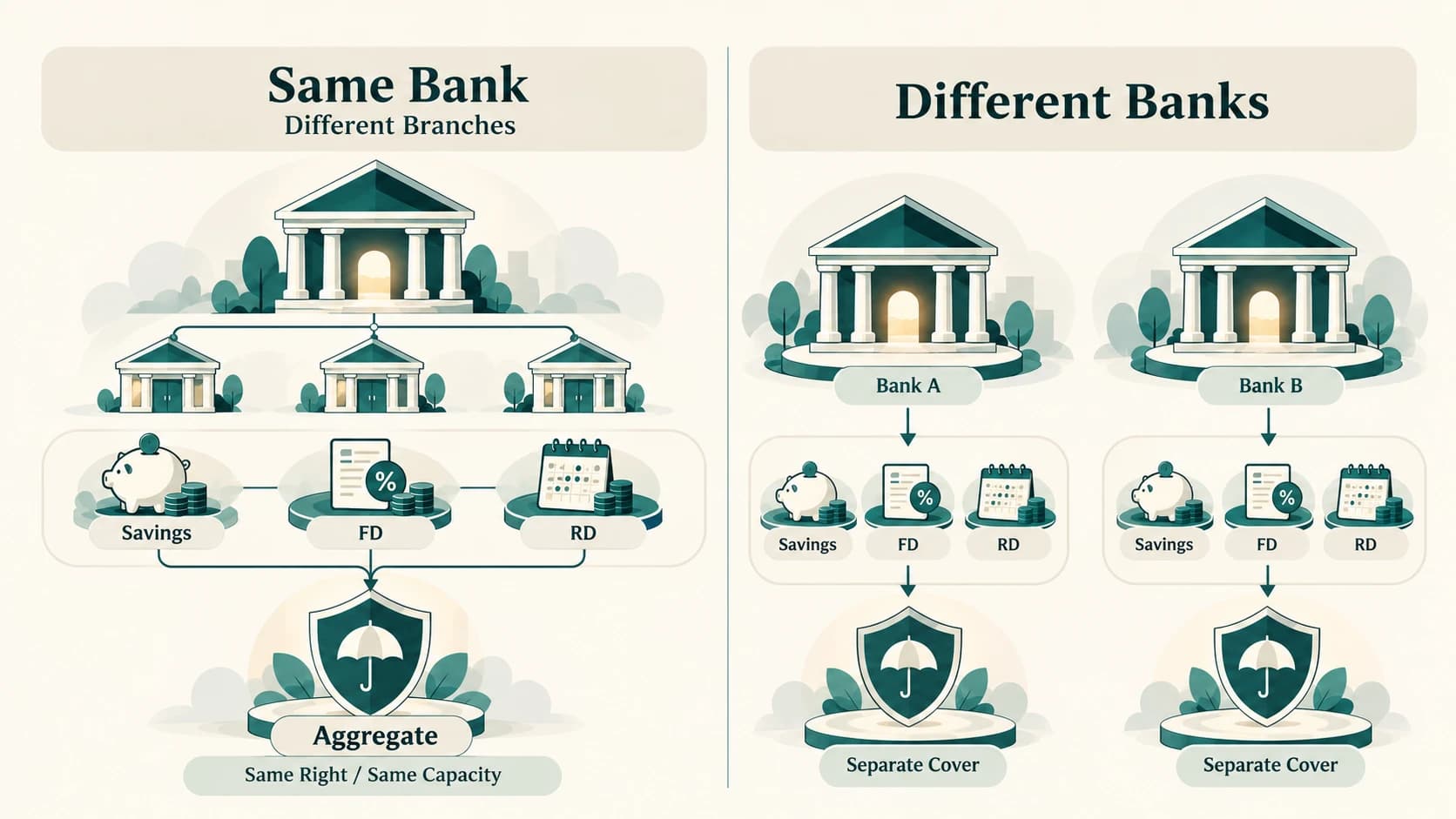
9. Different banks
The insurance limit applies separately for different banks.
Example:
Bank A = ₹5 lakh
Bank B = ₹5 lakh
Both held individually.
Each bank's deposits are separately insured up to the applicable limit.
Total potential cover = ₹10 lakh.
10. "Same right and same capacity"
This is the most important DICGC phrase.
If one person holds multiple deposits in the same legal capacity, they are aggregated.
Examples in the same capacity:
- savings in own name;
- current account in own name;
- FD in own name;
- RD in own name.
Different legal capacities can receive separate insurance treatment.
Examples may include:
- individual capacity;
- guardian of a minor;
- partner;
- trustee;
- certain joint-account combinations.
11. Individual vs sole proprietor
DICGC specifically clarifies that:
- deposits held by an individual in personal capacity; and
- deposits of that person's sole proprietorship
are aggregated for insurance.
This is because a sole proprietorship is not legally separate from the proprietor.
12. Joint accounts
Joint-account insurance depends on:
- names of account holders; and
- order of names.
Accounts with the same holders in the same order are aggregated for the insurance limit.
Accounts with different combinations/orders can constitute different right/capacity treatment under DICGC rules.
This is technical but frequently tested.
13. Example - individual and joint account
A has:
Individual FD = ₹5 lakh.
A and B jointly have:
Joint FD = ₹5 lakh.
The joint account can be treated in a different capacity/right from A's individual deposit.
Therefore the insurance treatment can be separate.
14. Nominee does not multiply insurance cover
A common misunderstanding:
"If I put four nominees, I get four times DICGC insurance."
Wrong.
Insurance is based on:
- depositor;
- bank;
- right/capacity.
Nomination is for claim settlement, not insurance multiplication.
15. Principal plus interest
Suppose principal = ₹4.8 lakh.
Accrued interest = ₹40,000.
Total claimable deposit = ₹5.2 lakh.
Maximum insurance:
₹5 lakh.
The ceiling applies to the combined principal and interest.
16. Netting bank dues
DICGC notes that banks have the right to set off dues payable by a depositor from deposit balances as of the relevant cut-off date.
Insurance is then available on the net eligible deposit amount.
This is another reason the final insurance calculation can differ from the visible gross deposit balance.
17. Who pays the insurance premium?
The insured bank pays the DICGC premium.
The depositor does not separately pay the premium.
This is a classic exam fact.
18. Is DICGC insurance optional for banks?
No.
The deposit insurance scheme is compulsory for insured banks within the framework.
A bank cannot simply opt out because it wants to save premium.
19. When does DICGC pay?
Different legal situations include:
- bank liquidation;
- reconstruction;
- amalgamation/merger; and
- banks placed under All-Inclusive Directions where withdrawal restrictions trigger the applicable provisions.
The payment process depends on the type of event.
20. All-Inclusive Directions - AID
If RBI places an insured bank under directions that prevent depositors from accessing deposits, DICGC's special statutory framework can become applicable.
Under Section 18A:
- bank must submit depositor data within the statutory timeline;
- DICGC verifies claims;
- payment is intended within the statutory maximum period, subject to conditions.
The current headline timeline is:
up to 90 days from imposition of AID under the statutory framework, provided required information is submitted.
21. Does DICGC mean no depositor can ever lose money?
No.
DICGC guarantees eligible deposits only up to the insurance ceiling.
If eligible deposit = ₹20 lakh in one bank, same capacity:
insured = ₹5 lakh.
The remaining balance depends on:
- liquidation;
- resolution;
- merger;
- recovery; and
- legal process.
22. DICGC does not insure investment losses
DICGC does not protect:
- mutual funds;
- shares;
- bonds held as investments;
- insurance products;
- crypto-assets;
- gold prices.
Even if those products were purchased through a bank channel, they are not automatically bank deposits.
23. Why deposit insurance has a limit
Unlimited insurance can create moral hazard.
If every depositor is fully protected regardless of amount, large depositors may stop caring about bank risk.
A limited guarantee aims to protect ordinary depositors while preserving some market discipline.
24. Deposit insurance and financial stability
DICGC is one layer of protection.
Other layers include:
- bank regulation;
- supervision;
- capital requirements;
- liquidity requirements;
- resolution;
- lender-of-last-resort support.
Deposit insurance does not replace sound regulation.
Quick check - BA-05-05
- What does DICGC stand for?
- What is the current insurance ceiling?
- Is the limit per account or per depositor per bank?
- Are different branches of the same bank insured separately?
- Who pays the DICGC premium?
- Does nomination increase the insurance limit?
Quick answers
- Deposit Insurance and Credit Guarantee Corporation.
- ₹5 lakh.
- Per depositor per bank in the same right and same capacity.
- No.
- The insured bank.
- No.