
NRI Bank Accounts: NRE, NRO and FCNR(B)
NRI Bank Accounts: NRE, NRO and FCNR(B). A detailed chapter in Deposits & Bank Accounts, with explanations and examples for Indian banking examinations.
By Akhilesh Saini · Reviewed 7 Oct 2026
1. Why separate NRI accounts exist
Once a person becomes non-resident under FEMA rules, ordinary resident accounts cannot simply be used indefinitely as if residential status had not changed.
India maintains specific account categories to distinguish:
- foreign earnings;
- Indian income;
- repatriable funds;
- non-repatriable/conditionally repatriable funds; and
- foreign-currency deposits.
The three core exam categories are:
- NRE;
- NRO;
- FCNR(B).
2. Residential status for FEMA is not the same as tax residency
An important advanced point:
"resident" and "non-resident" status under FEMA follows foreign-exchange law.
Income-tax residence is determined under tax law.
The two concepts can differ.
For Banking Awareness, NRE/NRO/FCNR(B) should be understood primarily through FEMA/RBI rules.
3. NRE account
NRE means:
Non-Resident External Rupee Account
It is a rupee-denominated account designed mainly for eligible foreign/repatriable funds of NRIs/eligible persons.
NRE accounts can generally be maintained as:
- savings;
- current;
- recurring/term deposits,
subject to the applicable framework.
4. Currency of NRE account
NRE is denominated in Indian rupees.
If foreign currency is remitted into the account, it is converted into rupees.
Therefore the account holder bears exchange-rate exposure when converting back into foreign currency.
5. Repatriability of NRE
NRE balances are generally repatriable.
This means permitted principal and interest can be remitted outside India under the regulatory framework.
This is one of the biggest differences from an NRO account.
6. Typical credits to NRE
Broadly, permitted credits can include:
- inward remittances from outside India;
- transfers from other NRE/FCNR(B) accounts;
- certain eligible investment proceeds;
- other permitted repatriable receipts.
The exact FEMA list should be checked for current operational details.
7. Typical debits from NRE
Permitted debits can include:
- local payments;
- remittances outside India;
- transfer to other NRE/FCNR(B) accounts; and
- permitted investments.
8. NRE interest and taxation
Under the prevailing Indian tax framework, qualifying NRE interest enjoys tax treatment different from NRO interest.
However, tax law can change.
For Banking Awareness, remember the structural distinction but use current tax law for exact tax questions.
9. NRO account
NRO means:
Non-Resident Ordinary Rupee Account
It is a rupee-denominated account used mainly for income and transactions arising in India.
Examples:
- rent;
- pension;
- dividends;
- local receipts;
- sale proceeds subject to rules.
A resident account is normally redesignated appropriately when the account holder becomes non-resident.
10. Currency of NRO account
NRO is denominated in Indian rupees.
Like NRE, it is exposed to rupee/foreign-currency exchange-rate movement from the depositor's perspective.
11. Repatriability of NRO
NRO funds are not freely repatriable in the same manner as NRE.
However:
- current income can be remitted subject to rules; and
- eligible NRI/PIO balances/assets can be remitted up to the prescribed limit per financial year, subject to conditions and documentation.
This is a major exam distinction.
12. NRE vs NRO - intuition
Ask:
Where did the money mainly come from, and how freely can it go back abroad?
NRE
Foreign/repatriable money → rupee account → generally repatriable under rules.
NRO
Indian/local income and mixed eligible receipts → rupee account → repatriation more restricted/conditional.
13. FCNR(B)
FCNR(B) means:
Foreign Currency Non-Resident (Bank) Account
Unlike NRE/NRO, this is a foreign-currency term deposit.
It allows eligible non-residents to hold deposit funds in a permitted freely convertible foreign currency.
14. Why FCNR(B) reduces currency risk
Suppose an NRI earns US dollars.
If dollars are converted into an NRE rupee FD:
- deposit is in rupees;
- future dollar value depends on INR/USD exchange rate.
If the customer places an FCNR(B) deposit denominated in US dollars:
- principal/interest remain denominated in dollars;
- rupee depreciation does not reduce the deposit's dollar denomination.
This is the central practical attraction.
15. FCNR(B) is a term deposit only
FCNR(B) is not a normal transaction savings/current account.
It is a term-deposit scheme.
RBI's current framework allows specified maturities from one year up to five years.
Recurring deposits are not accepted under FCNR(B).
16. Permitted currencies
FCNR(B) deposits can be accepted in freely convertible foreign currencies under the FEMA framework.
Banks decide which permitted currencies they operationally offer.
Do not memorise an old fixed list as if no other freely convertible currency can ever be used.
17. Interest on FCNR(B)
RBI prescribes the overall ceiling framework for FCNR(B) interest with reference to currency-specific market benchmarks.
This is more complex than domestic FD pricing.
For exam purposes, learn:
- foreign-currency denomination;
- 1-5 year tenor;
- benchmark-linked interest ceiling framework;
- no recurring deposit;
- repatriability.
Do not memorise temporary benchmark rates.
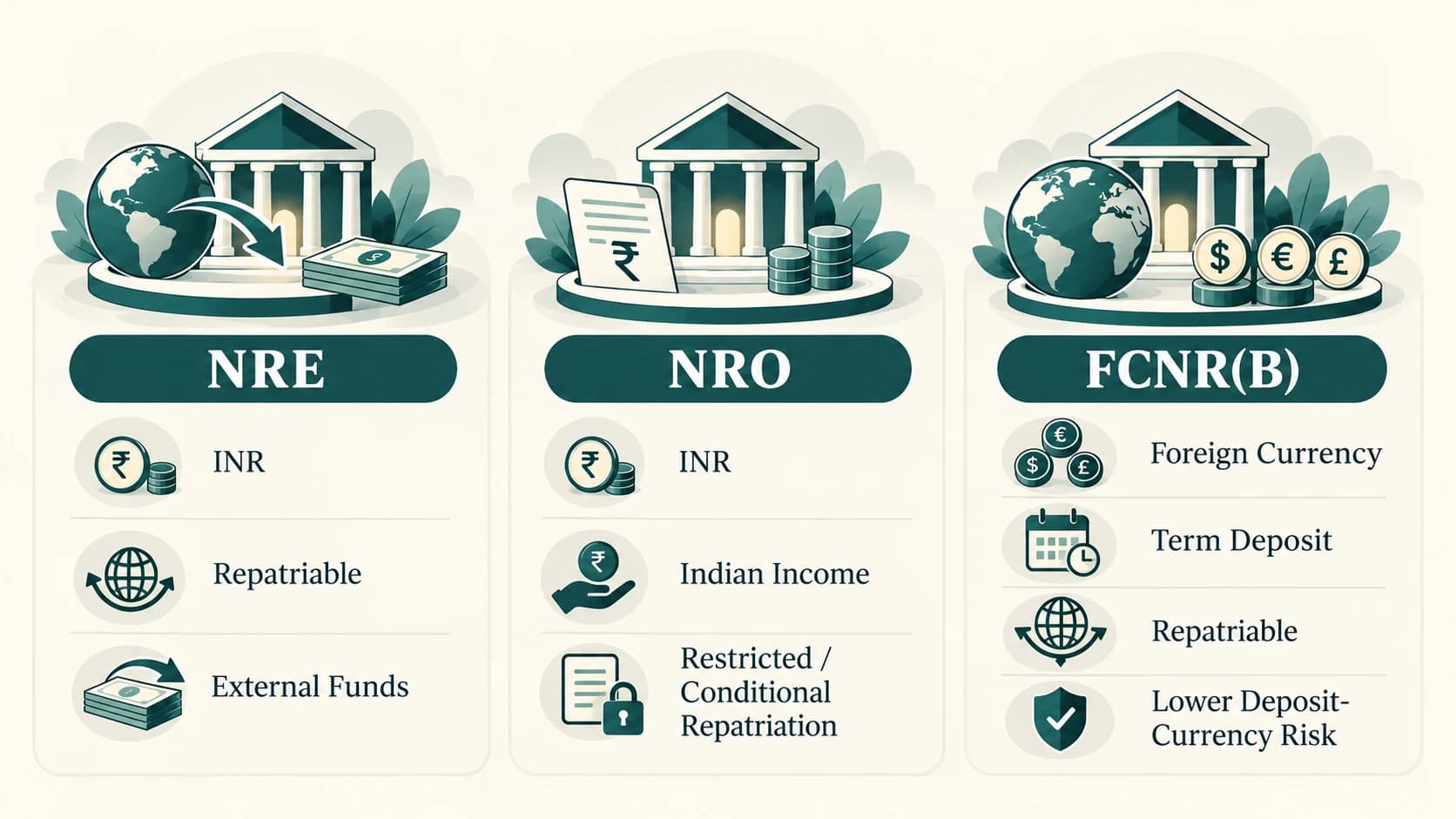
18. NRE vs NRO vs FCNR(B)
| Feature | NRE | NRO | FCNR(B) |
|---|---|---|---|
| Currency | INR | INR | Foreign currency |
| Main purpose | Repatriable foreign earnings/funds | Indian income/local receipts | Foreign-currency term deposit |
| Account form | Savings/current/term as permitted | Savings/current/term as permitted | Term deposit |
| Repatriability | Generally repatriable | Restricted/conditional beyond current income | Repatriable |
| Currency risk vs foreign currency | Yes | Yes | Lower for deposit currency |
| Minimum term for term deposit | Current RBI rule | Current RBI rule | 1 year |
| Maximum FCNR term | Not applicable | Not applicable | 5 years |
19. NRE term-deposit minimum tenor
NRE term deposits have a longer regulatory minimum tenor than ordinary domestic/NRO term deposits.
This difference is often asked in exams.
20. NRO term-deposit minimum tenor
NRO term deposits follow the shorter minimum tenor applicable under the RBI deposit-interest framework.
21. Premature withdrawal of NRE deposit
Banks can impose penalties according to their disclosed policy.
However, special rules apply in cases such as conversion when a non-resident returns to India.
These details are better understood as regulatory exceptions rather than memorised random penalties.
22. Premature withdrawal of FCNR(B)
FCNR(B) can generally be prematurely withdrawn on request under RBI rules.
If withdrawn before the minimum stipulated period:
no interest is paid.
The bank may also apply permitted penalty/swap-cost treatment.
23. Returning to India
When an NRI returns for permanent settlement, account treatment changes.
Examples include:
- NRE redesignation/conversion;
- FCNR(B) continuation to maturity under specified conditions;
- possible conversion to Resident Foreign Currency - RFC account where eligible.
This reflects the change from non-resident to resident status under FEMA.
24. Joint holding
NRE/NRO/FCNR(B) accounts can have joint-holder arrangements subject to FEMA rules.
The exact eligible resident/non-resident joint-holder conditions should be checked from current RBI regulations for operational questions.
For general exam preparation, focus first on:
- currency;
- purpose;
- repatriability;
- account type.
25. NRE vs FCNR(B)
Both are repatriable, but:
NRE
INR-denominated.
FCNR(B)
foreign-currency denominated.
Therefore the main distinction is not simply repatriability; it is currency denomination and resulting exchange-rate exposure.
26. NRO vs resident savings account
An NRO account is specifically for a non-resident under FEMA.
It is not just "a normal savings account with another name".
Its:
- credits;
- debits;
- remittance;
- tax; and
- joint-holder rules
follow the non-resident framework.
Quick check - BA-05-04
- Which of NRE, NRO and FCNR(B) is foreign-currency denominated?
- Which account is generally used for Indian-source income of an NRI?
- Which rupee account is generally repatriable?
- Can FCNR(B) be a recurring deposit?
- What is the major currency-risk difference between NRE and FCNR(B)?
- Is NRO principal freely repatriable without conditions?
Quick answers
- FCNR(B).
- NRO.
- NRE.
- No.
- NRE is in INR; FCNR(B) remains in foreign currency.
- No.